Häggeby Church: A Medieval Parish Church in Sweden
Site at a Glance
- Country
- Sweden
- Primary era
- Medieval
- Eras represented
- Medieval, Early Modern, Modern
- Civilizations
- Swedish
- Site type
- Religious
- Remains
- Church
On this page15 sections
History
Häggeby Church is the parish church of Häggeby in Sweden. Its original building was erected around 1200, and it remains the parish church within the Church of Sweden’s Diocese of Uppsala.
Medieval church
Around 1325, the church was extended eastward and given a chancel as wide as its nave. Archbishop Olov Björnsson reconsecrated it on 2 October 1328, dedicating it to the Virgin Mary and Saint Erik, a Swedish royal figure venerated as a Christian saint.
During the 15th century, brick vaults were added inside the church, and a porch was built and vaulted. These works altered the earlier building while retaining its medieval core.
Repairs and alterations
Major work in 1693 and 1694 included rebuilding the east wall with a large chancel window and opening windows in three other parts of the church. Lightning damaged the tower in autumn 1697, and it underwent substantial repairs the following year. The interior was also renewed in 1698, probably when the wall paintings were added.
New pews were installed in 1707, and brick paving was laid in the aisles in 1724. Work in 1745 and 1746 rebuilt the upper part of the tower and renewed its spire. A gallery followed in 1756, and the pews were modified in 1767 and 1768.
In 1790 the windows were enlarged, the interior and exterior walls were plastered, and a new entrance was opened in the tower. The spire was replaced by a tower hood in 1805, when the bells were transferred from a separate belfry into the tower. Another hood was installed in 1829.
Modern restoration
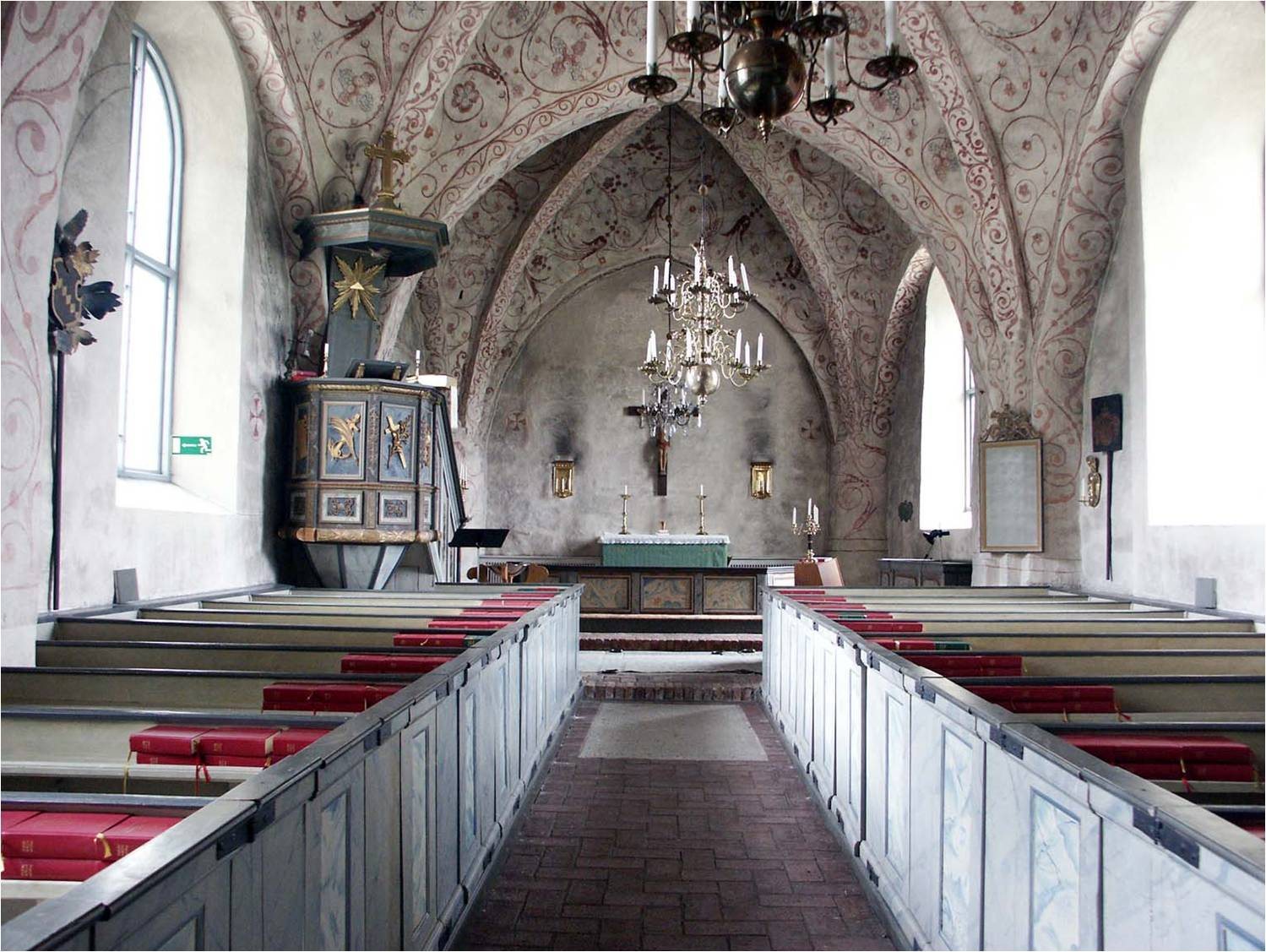
An extensive restoration in 1952 and 1953 followed plans by architect Erik Fant. The wall paintings, whitewashed since 1790, were uncovered; a new altar and altar rail were installed, the floor was relaid, electric heating was added, and the pews were made more comfortable. The east chancel window was bricked up on its interior side.
The original Häggebystenen, an image stone bearing carved pictures, was sold to the Swedish History Museum in 1873. A copy was placed in the churchyard in 1953.
Remains
Church and churchyard
Church building
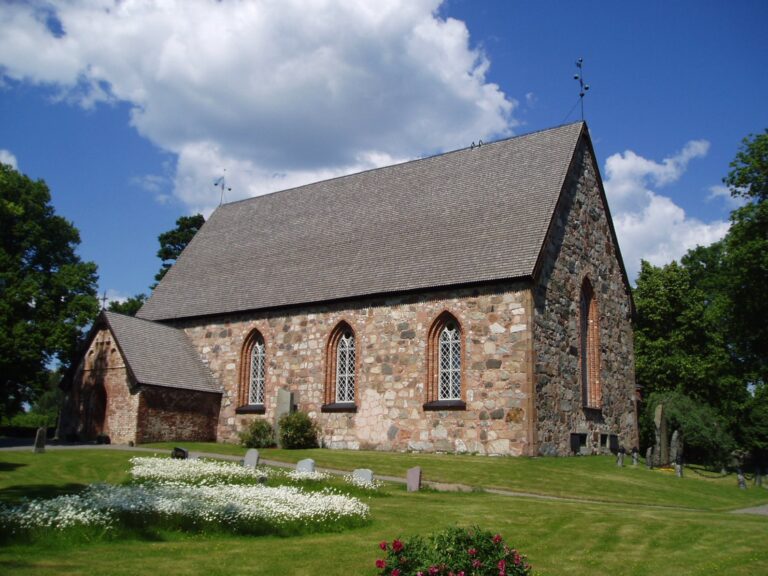
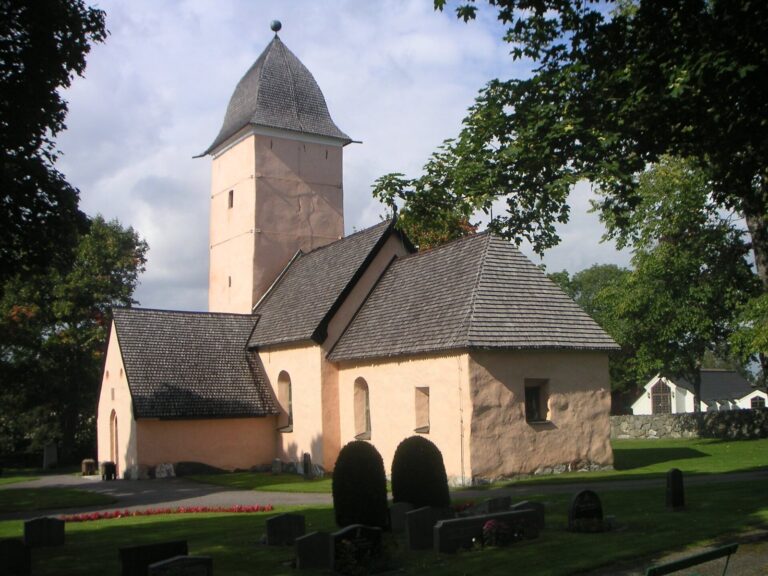
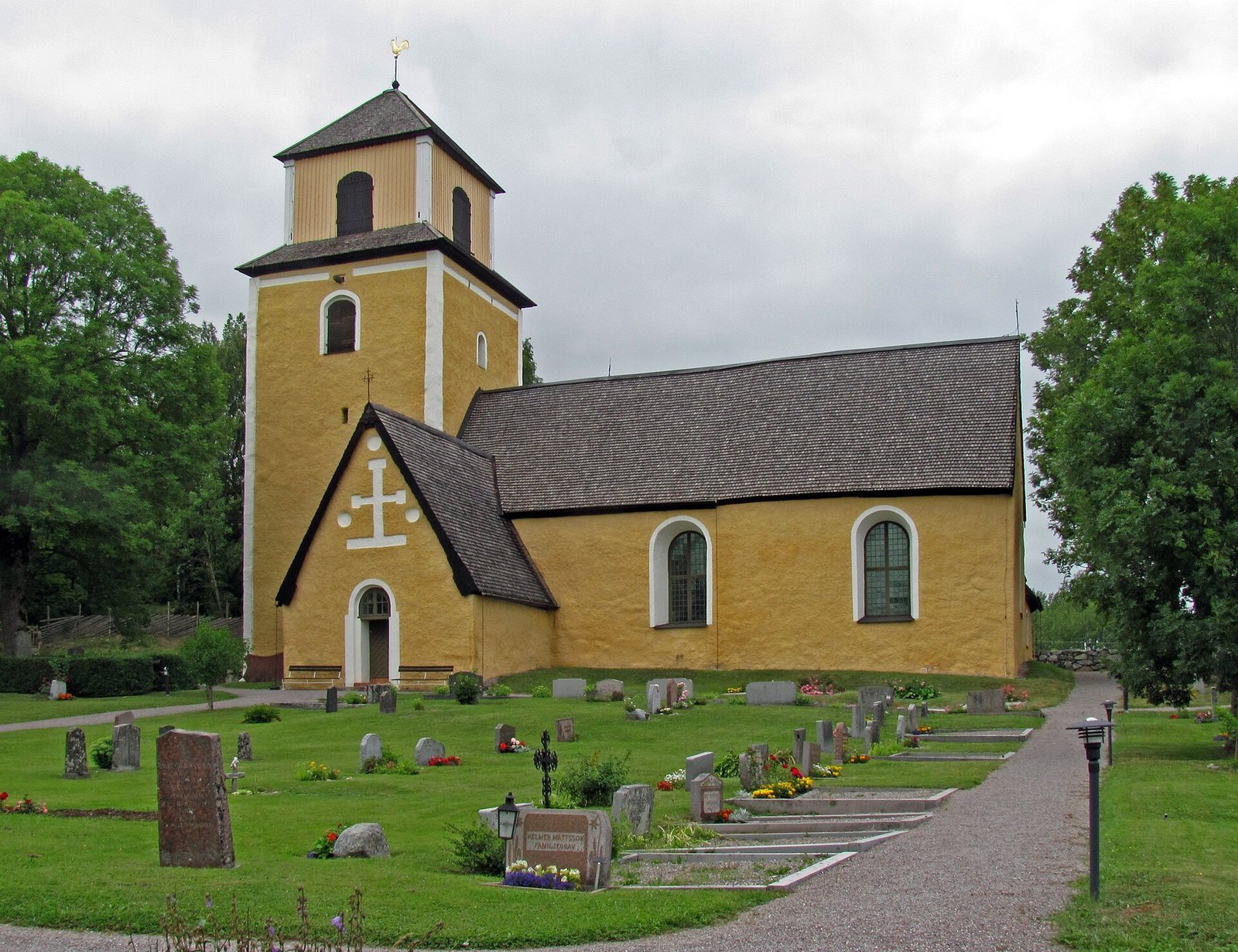
The church’s present layout has a rectangular nave, the main body of the building, and a straight-ended chancel to the east. A tower stands at the west end, with a porch to the southwest and a sacristy, a room for clergy and church furnishings, to the northeast. The walls are covered in yellow-painted plaster, and the main gabled roof is clad in shingles. The tower has a tent-shaped shingled roof topped by a wooden lantern with a smaller tent-shaped roof.
The tower and nave preserve parts of the building erected around 1200. A construction joint east of the large window in the nave’s south wall marks the later eastward extension; its walls are narrower than those of the earlier church. The extension’s original east wall had three windows, while its south wall had two tall, narrow windows. The east chancel window is now blocked on the inside, where the masonry forms a backdrop for the altar cross. The enlarged window openings and the tower entrance opened in 1790 remain part of the church’s present form.
Interior
Brick cross vaults, formed by intersecting vaulted sections, cover the church interior. The porch has a brick star vault, whose ribs form a star-like pattern. The wall paintings are decorated with plant forms, without figures or symbols.
Churchyard
A boundary wall encloses the churchyard, with entrances on its south and west sides. The wall was formerly clad in boards and had three covered gates on the south, west, and north. A copy of the Häggebystenen stands near the porch and tower.
Furnishings and objects
Pulpit
The pulpit originated in the 17th century. It was remodelled in the late 18th century in the Gustavian style, a Swedish form of neoclassical design, and acquired its present form in 1865.
Organ gallery
The gallery, built in 1756, holds an organ made in 1843 by Per Zacharias Strand.
Baptismal font
The foot of a medieval baptismal font is preserved in the church. The font was made in the 13th or 14th century.
Crucifixes
A wooden crucifix at the eastern altar area was carved in 1953 by Carl-Oscar Avén. A separate crucifix made of gilded copper, formerly belonging to the church, is now held by the Swedish History Museum.
Bells
Two bells hang in the tower. The smaller bell dates to 1604. The larger was made in 1635 and recast in 1873.