Gustavsburg: A Baroque Palace Complex in Germany


Site at a Glance
- Rating
- 4.6
- Popularity
- Low
- Country
- Germany
- Primary era
- Early Modern
- External website
- Open
- Eras represented
- Medieval, Early Modern
- Civilizations
- Holy Roman Empire
- Site type
- Domestic
- Remains
- Palace
On this page8 sections
History
Gustavsburg is a historic castle and palace complex in Germany, located in Jägersburg near Homburg. The site developed from a Salian border castle into a Staufer stronghold and later a Baroque palace, whose present form largely dates from a renovation commissioned in 1720.
From Salian stronghold to Hattweiler Castle
The earliest phase was a border castle associated with the Salians, a medieval ruling dynasty whose imperial power preceded that of the Staufer, or Hohenstaufen, dynasty. Around 1168, Emperor Frederick Barbarossa destroyed the castle. Barbarossa was a twelfth-century Holy Roman Emperor and a member of the Staufer dynasty. The site was subsequently rebuilt as a Staufer castle.
After the decline of the Staufer emperors, the castle became known as Hattweiler Castle and passed to the Counts of Zweibrücken. Their vassal, Bartholomeus of Hattweiler, was first recorded in 1272. Later holders included Waitier of Hattweiler in 1282 and Thielemann of Hattweiler in 1318. In 1402, the castle was pledged to Philip of Nassau-Saarbrücken.
The name Hattweiler also entered literary history. Elisabeth of Nassau-Saarbrücken used it in place of Hautefeuille in a French minnesong that she adapted in Sibille, her Moselle Franconian chivalric romance. Other later holders included Hermann Boos of Waldeck, Anselm of Bitsch, Symont Mauchenheimer, Hans Ryten Esel of Ruschenburg, Alheim Eckbrecht of Dürkheim, Albrecht of Morsheim, and Philipp Breder of Hohenstein.
War, palace conversion, and destruction
During the 1522 war between Franz von Sickingen, a German knight and military leader, and Richard von Greiffenklau, the prince-archbishop of Trier, the castle passed to Trier. A prince-archbishop held both ecclesiastical and territorial authority in the Archbishopric of Trier. The castle’s holder from Hohenstein was imprisoned in Wittlich, but his sons recovered the property in 1543 and transferred it to Friedrich von Steinkallenfels.
Friedrich von Steinkallenfels sold the castle to Johann von Warsberg, who later sold it to Duke Johann I of Palatinate-Zweibrücken. In 1590, Johann I converted the castle into a palace, then called Hansweiler Palace. A watchtower was added in 1622, but the palace burned during the Thirty Years’ War, the European conflict fought from 1618 to 1648 amid religious and dynastic struggles across the Holy Roman Empire.
Rebuilding as Gustavsburg
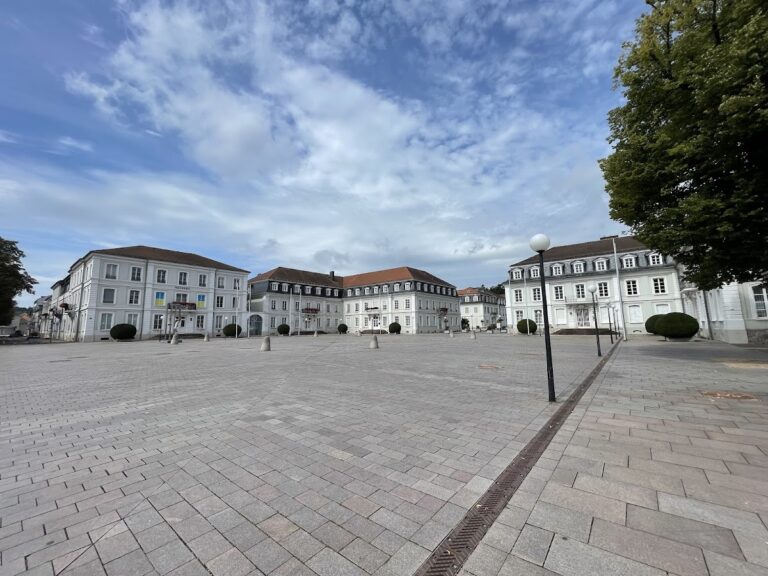
In 1666, Duke Friedrich Ludwig commissioned a residential building with a barn and stable on the site of the burned palace. In 1720, Duke Gustav Samuel Leopold engaged the Swedish architect Jonas Erikson Sundahl to renew the residential building in the Baroque style, an early-modern architectural tradition known for elaborate forms and decoration. The same project added a chapel, and the complex was renamed Gustavsburg after the duke.
After the French Revolution, Gustavsburg passed to the forester Christian Lindemann. The Bavarian Forestry Administration acquired it in 1842, and the municipality of Jägersburg took it over in 1973. The City of Homburg restored the complex between 1978 and 1981 with subsidies from Saarland. Gustavsburg is now owned by the City of Homburg and houses the Jägersburg Castle and Palace Museum.
Remains
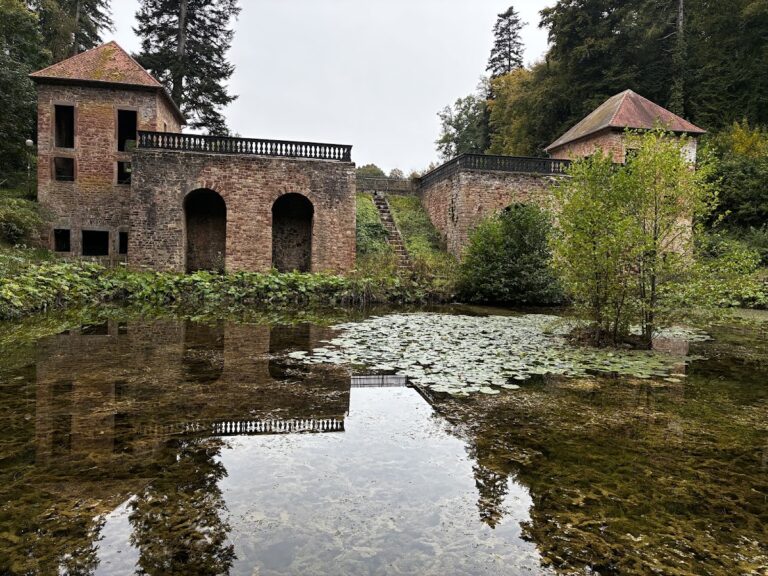
Gustavsburg is a Baroque complex at the center of Jägersburg beside the 1.7-hectare Schlossweiher. Its physical development preserves the sequence from border castle and Staufer castle to palace. The complex includes an inner courtyard, the renewed residential building, a chapel, and a festival hall, together with the barn and stable associated with the rebuilding of 1666.
Residential and ceremonial buildings
Residential building
The residential building forms the principal surviving structure. It was commissioned in 1666 after the palace fire and renewed in 1720 by Jonas Erikson Sundahl in the Baroque style. The building is part of the palace complex that now accommodates the museum, and its upper-floor hall is used for exhibitions, concerts, and celebrations.
Chapel and festival hall
The chapel was added during Sundahl’s 1720 renovation. Along with the festival hall, it remains part of the complex’s ceremonial spaces and is used for wedding ceremonies. The surviving arrangement also includes the inner courtyard, while the barn and stable belong to the residential rebuilding that followed the destruction of the earlier palace.
Nearby sites