Holborn Viaduct: A Road Bridge and Street in London
Site at a Glance
- Popularity
- High
- Country
- United Kingdom
- Primary era
- Modern
- Eras represented
- Modern
- Civilizations
- British
- Site type
- Infrastructure
- Remains
- Bridge
On this page12 sections
History
Holborn Viaduct is a road bridge and street in London, United Kingdom, carrying the A40 across Holborn Valley. Built between 1863 and 1869, it was the central element of a public-works scheme intended to improve access to the City of London and traffic flow around Holborn Circus.
The Holborn Valley Improvements
Before the viaduct was built, carriages crossed the Fleet valley by descending and climbing steep roads, including Holborn Hill and Snow Hill, called Skinner Street from 1829. The raised road created a continuous route from Newgate Street through Holborn and High Holborn towards Oxford Street, improving the connection between the City and Westminster. At the junction of Victoria Street and Farringdon Street, Oldbourne Bridge had crossed the River Fleet before it was enclosed underground in 1734 to make way for Farringdon Street and its market.
The Holborn Valley Improvement Act of 1864, which received royal assent on 23 June, authorized the City of London Corporation to construct the viaduct and carry out associated street works. Acts receiving royal assent on 31 May 1867 and 24 June 1869 authorized further improvements and funds to complete the project. The overall scheme cost more than £2.5 million. It involved demolishing older buildings, widening and laying out streets, extending Farringdon Street as Farringdon Road, creating Queen Victoria Street and the City section of the Embankment, rebuilding Blackfriars Bridge, and developing railway routes and stations.
City Surveyor William Haywood led the project and served as its architect. Engineer Rowland Mason Ordish designed the bridges. Queen Victoria formally opened the viaduct on 6 November 1869 during a carriage procession. She first opened Blackfriars Bridge, then continued to the Farringdon Street bridge and the viaduct.
Railway and power uses
Holborn Viaduct railway station opened at the eastern end on 2 March 1874. It provided a low-level route towards Farringdon. In 1990 it was replaced by St Paul’s Thameslink station, later renamed City Thameslink.
In 1882 the Edison Electric Light Station began operating at Holborn Viaduct. It was the world’s first coal-fired power station and remained in operation until 1886.
Wartime damage and rebuilding
During the Blitz, Germany’s sustained aerial bombing campaign against Britain in the Second World War, attacks in 1941 destroyed or damaged much of the surrounding area. The bombing destroyed the power station building and the two northern bridge pavilions. The north-western pavilion was reconstructed in 2000 and the north-eastern one in 2014 as part of nearby property developments, and lifts were added.
Remains
The raised road
The brick viaduct carries a roadway about 1,400 feet (430 metres) long and 80 feet (24 metres) wide across Holborn Hill and the steep-sided Fleet valley. It passes above Farringdon Street, Shoe Lane and the Fleet, which runs underground. The brickwork extends along much of the street and has round-arched openings arranged on as many as three levels. Some openings connect with the underpasses beneath the bridges, while others serve as basements for adjoining buildings. Buildings now obscure parts of the structure between them.
Infrastructure beneath and beside the road
Near the eastern end, masonry encloses the Snow Hill railway tunnel, used by Thameslink. Walk-in service ducts along both sides of the viaduct carried gas and telegraph lines. Downpipes directed water from street gullies to sewers at the foot of the structure, which also served some nearby buildings. Ventilation pipes ending in the bases of street posts provided forced air circulation.
Bridges and pavilions
Farringdon Street bridge
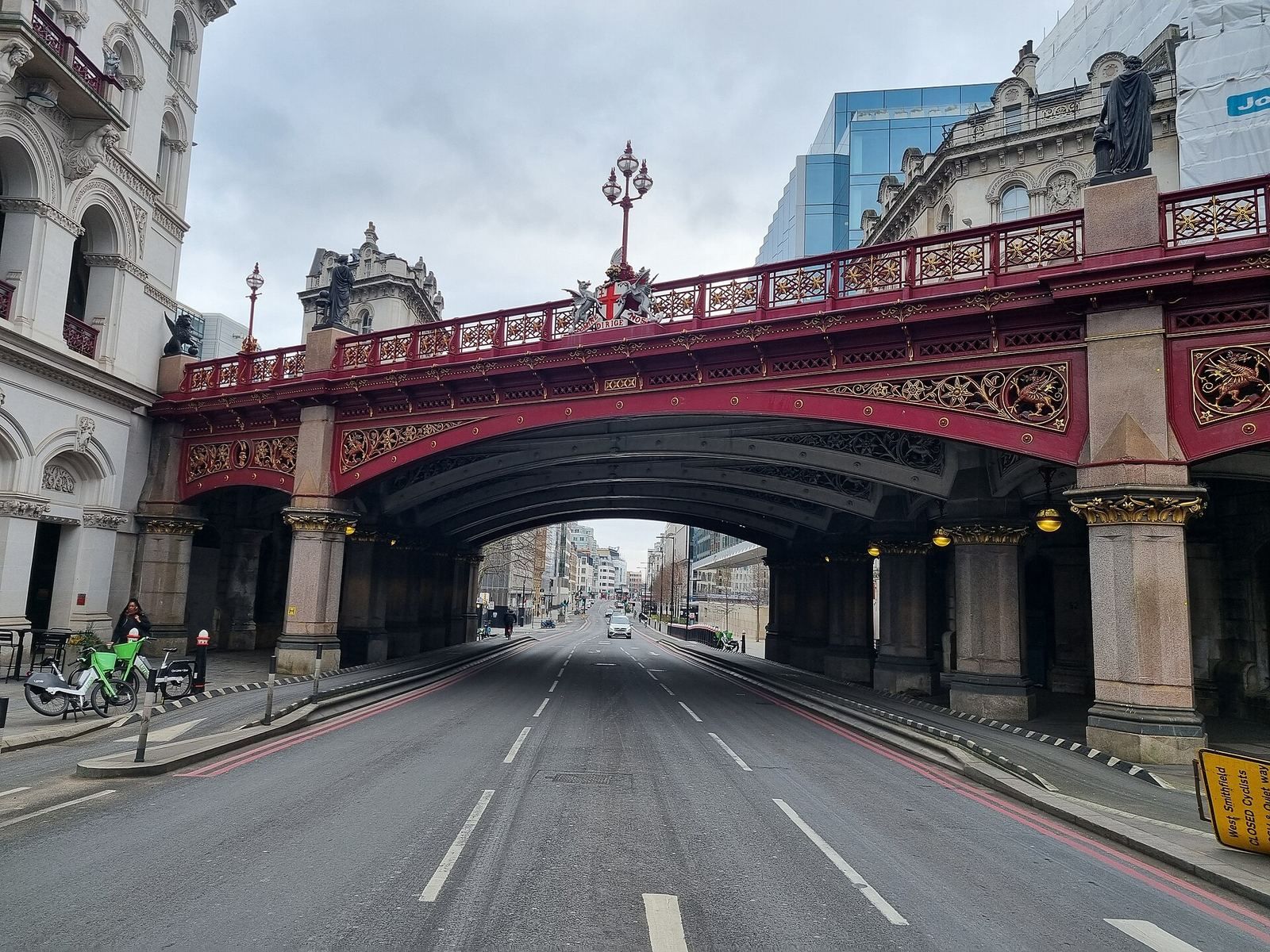
The bridge over Farringdon Street is a cast-iron arch, with a large opening over the roadway and smaller ones over the pavements. Six curved iron supports form each arch, resting on granite piers. They are set at an angle because Farringdon Street and the road above do not cross at a right angle. Each roadway support consists of two cast pieces bolted together at the top of the arch; the other supports are single castings. Steel beams placed between the supports and a concrete road deck strengthened the bridge in the twentieth century.
The bridge’s cast-iron railings bear the City of London’s arms at their centre. Circular forms in the spaces between the arches and roadway contain griffins from the City’s arms. Cast-iron lamp standards stand on the railings, with two griffins at the base of each. At either end, a bronze winged lion holds a globe.
Bridge pavilions and sculpture
Four five-storey pavilions flank the Farringdon Street bridge, two on each side. Their staircases connect the upper and lower street levels, and lifts were added to the rebuilt northern pair. Statues on the roof parapets, the low walls along their edges, represent William Walworth, a fourteenth-century Lord Mayor of London, at the north-west; Hugh Myddelton, an engineer and entrepreneur associated with the New River water-supply project, at the north-east; Henry fitz Ailwin, generally identified as London’s first mayor, at the south-west; and Thomas Gresham, a sixteenth-century merchant and financier, at the south-east. Sculptures by Farmer & Brindley on the north side represent science and the arts. On the south side, Henry Bursill’s sculptures represent commerce and agriculture.
Shoe Lane bridge
The smaller bridge over Shoe Lane is made of 14 wrought-iron girders joined by rivets. Its cast-iron railings are comparatively plain.
Former electricity station site
The Edison Electric Light Station stood at 57 Holborn Viaduct on the north-eastern side. A large building at 60 Holborn Viaduct now occupies its former site.