Greater Gornal Hillfort: Remains of a Severian Tribal Center
Site at a Glance
- Popularity
- Medium
- Country
- Russia
- Primary era
- Medieval
- Eras represented
- Iron Age, Classical, Medieval
- Civilizations
- Unclassified
- Site type
- Settlement
- Remains
- Town
On this page7 sections
History
Greater Gornal Hillfort is an archaeological settlement site on the right bank of the Psel River in Russia and the core of the Gornal archaeological complex. It preserves one of the tribal centers of the Severians, an East Slavic people, and is also known as Belogorsk Hillfort and Greater Belogorsk Hillfort.
Early activity and Severian settlement
The earliest evidence of human activity belongs to the Scythian archaeological period, dated here to the fourth through first centuries BC. The term refers to an era associated with Scythian cultures, but does not by itself show that people at the site were Scythians. Slavs of the Severian tribe settled at the hillfort late in the first millennium AD. The substantial deposits associated with their settlement date from the late eighth to the second half of the ninth century.
A defensive wall enclosed the Severian settlement and was rebuilt at least four times. It may have been intended to protect the community from the Rus’, an early medieval polity in eastern Europe, or from the Magyars, ancestors of modern Hungarians.
Flourishing and destruction
The settlement reached its height in the second and third quarters of the tenth century. Upper deposits, accumulating from the late ninth century through the 970s, contain more finds than the lower layers. Wheel-made pottery appears in this phase, while slate spindle whorls, weights used for spinning thread, began to reach Gornal in the middle to later part of the tenth century.
Fire destroyed dwellings and other buildings in the upper layer. The settlement is thought to have been destroyed between the 960s and 980s, in connection with military campaigns by either Sviatoslav Igorevich, a tenth-century prince of Rus’, or Vladimir Sviatoslavich, a later Rus’ ruler also known as Vladimir the Great.
Fragments of eleventh- and twelfth-century Old Russian wheel-made pottery occur at the site, although the hillfort was then uninhabited. Residents of a nearby fortified settlement may have used it as a refuge. The site entered written literature in the early nineteenth century. In 1829, A. I. Dmitryukov collected handmade Romny pottery, associated with the Romny archaeological tradition, and D. Ya. Samokvasov carried out test excavations in 1875. I. I. Lyapushkin surveyed the hillfort in 1948, S. S. Shirinsky in 1968, and Yu. A. Lipking inspected it repeatedly. A. V. Kuza led excavations from 1971 to 1973 with A. V. Kashkin, A. A. Uzyanov, and others; Kashkin surveyed it again in 1979, and V. V. Enukov studied it in 2013. The hillfort is a federal cultural heritage site in Russia.
Remains
Setting and defenses
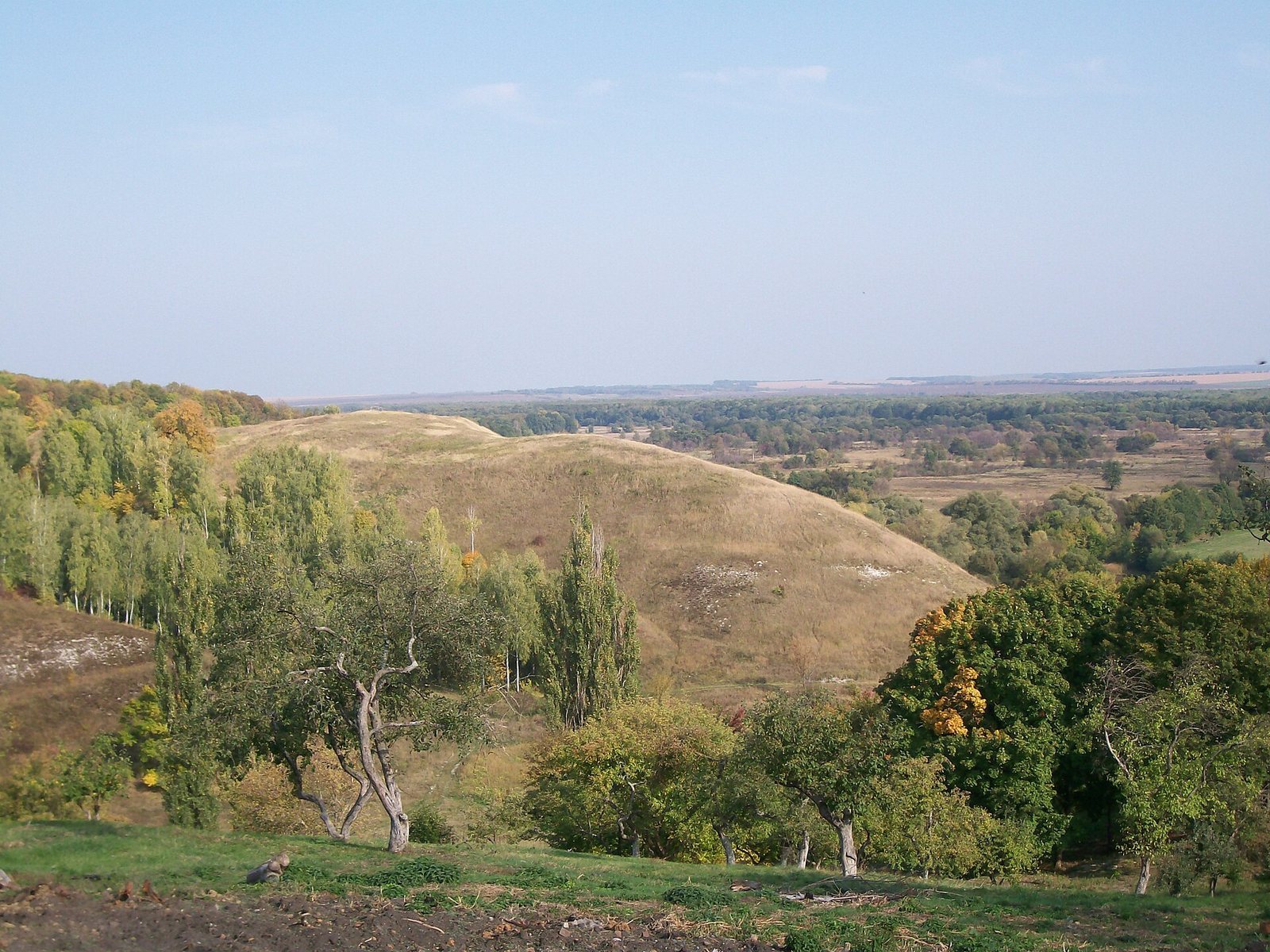
The hillfort occupies a triangular promontory on the right bank of the Psel River, 35 to 40 metres above the water, and covers 1.7 hectares. A rampart and ditch mark its landward northern edge, and a rampart can also be traced along the eastern side of the platform. The slopes were steepened. The Severian defensive wall was made of timber log structures packed with earth.
Dwellings and other structures
The archaeological soil layer, accumulated through human activity, ranges from 0.25 metres thick at the center of the platform to 2.2 metres near its eastern edge. The settlement had an open central area surrounded by dwellings. Excavated remains include houses, other buildings, storage pits, and cellars. The earliest dwellings were dug 0.2 to 1.5 metres into the ground; later houses were only slightly sunken. A two-chamber building in the center has been interpreted either as a princely dwelling or as a work building for grinding and storing grain. Scythian-period deposits are about 0.2 metres thick and include several pits.
Finds and surface condition
Finds from the hillfort include hunting and fishing equipment, farming tools, weapons, and ornaments made of silver, bronze, and glass. Pottery is abundant, with both fragments and complete vessels. Numerous traces of treasure hunting are visible across the site.