Goryeong Jisan-dong Tumuli: Daegaya Burial Mounds in South Korea
Site at a Glance
- Rating
- 4.5
- Popularity
- Very Low
- Country
- South Korea
- Primary era
- Classical
- External website
- Open
- Eras represented
- Classical, Medieval
- Civilizations
- Unclassified
- Site type
- Burial
- Remains
- Necropolis
On this page9 sections
History
Goryeong Jisan-dong Tumuli are fourth- to sixth-century burial mounds of Daegaya in Jisan-ri, Daegaya-eup, Goryeong-gun, South Korea. Daegaya was one of the polities belonging to the Gaya confederacy, a grouping that existed alongside the kingdoms commonly known as Korea’s Three Kingdoms. The cemetery is associated with the Daegaya ruling class and has produced pottery, gilt-bronze crowns, armor, helmets, swords, and ornaments.
The Daegaya cemetery
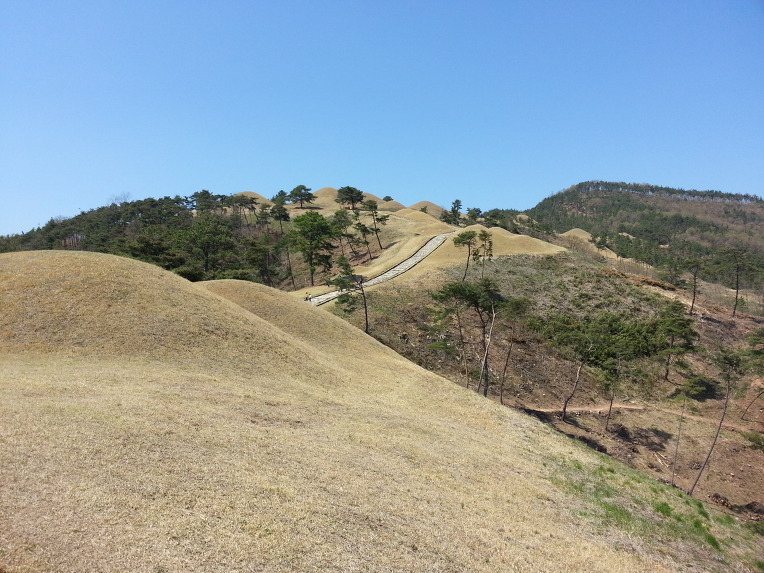
More than 200 large and small tombs are associated with the cemetery, while the wider Goryeong area contains several hundred burial mounds. The visible mounds have been numbered to Tomb 72. Their distribution and contents provide evidence for the organization of Daegaya society and the burial customs of its elite.
Ruling-class burials and attendant burial
The cemetery is important for the study of attendant burial, the interment of people with a principal deceased person, presumably to serve or accompany that person in the afterlife. Several people were buried within individual mounds, and these multiple burials are interpreted as attendant burials rather than family graves. Tomb 32 was identified as a ruling-class burial containing evidence of this practice.
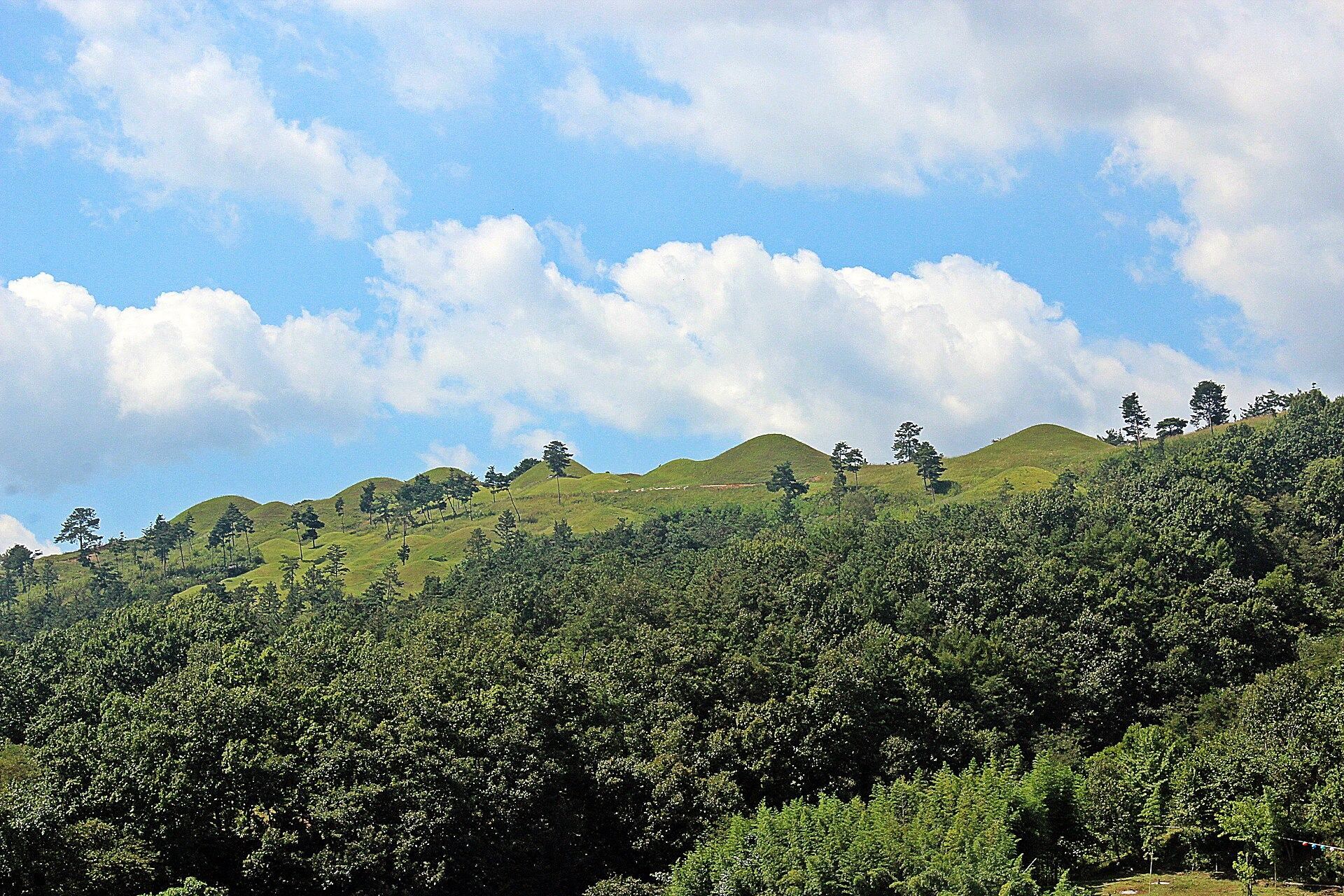
The largest mound on the southern side of Jusan Mountain is traditionally regarded as the tomb of King Geumrim. Other large mounds below it are likewise traditionally regarded as royal tombs. Tomb 47, excavated in 1939, is traditionally transmitted as King Geumrim’s tomb and is also considered likely to be the burial of Inoe, described as the fifteenth king of Daegaya. Its burial arrangement is characteristic of attendant burial. Tomb 30 is regarded as a mid-fifth-century burial of the Daegaya ruling class and was excavated in 1994 and 1995 by the Yeongnam Institute of Cultural Properties Research.
Protection and recognition
The tumuli were designated Historic Site No. 79 of South Korea on January 21, 1963. In 2023, the cemetery was inscribed as part of the Gaya Tumuli serial cultural property on the UNESCO World Heritage List.
Remains
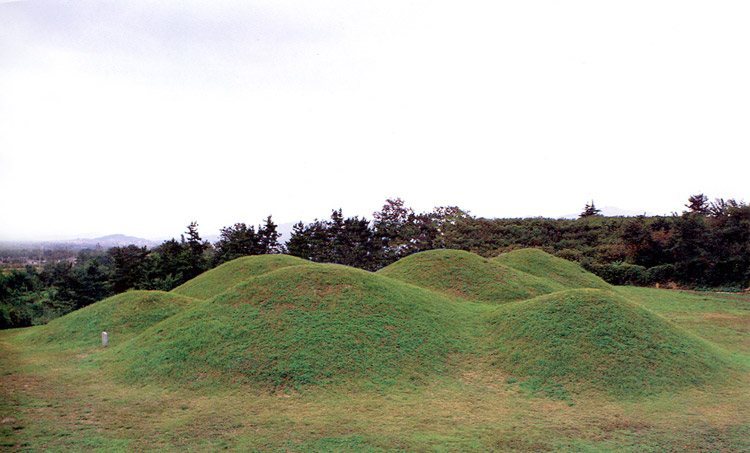
The cemetery covers approximately 830,181 square meters and consists of circular earthen burial mounds arranged according to size and the ridges of Jusan Mountain. Large mounds, generally more than 10 meters in diameter, occupy the upper ridges. Medium-sized mounds, around 10 meters across, cluster on the middle ridges, while smaller mounds occur around or below the larger ones. The numbered mounds retain clearly defined forms and substantial earthen coverings.
Burial structures
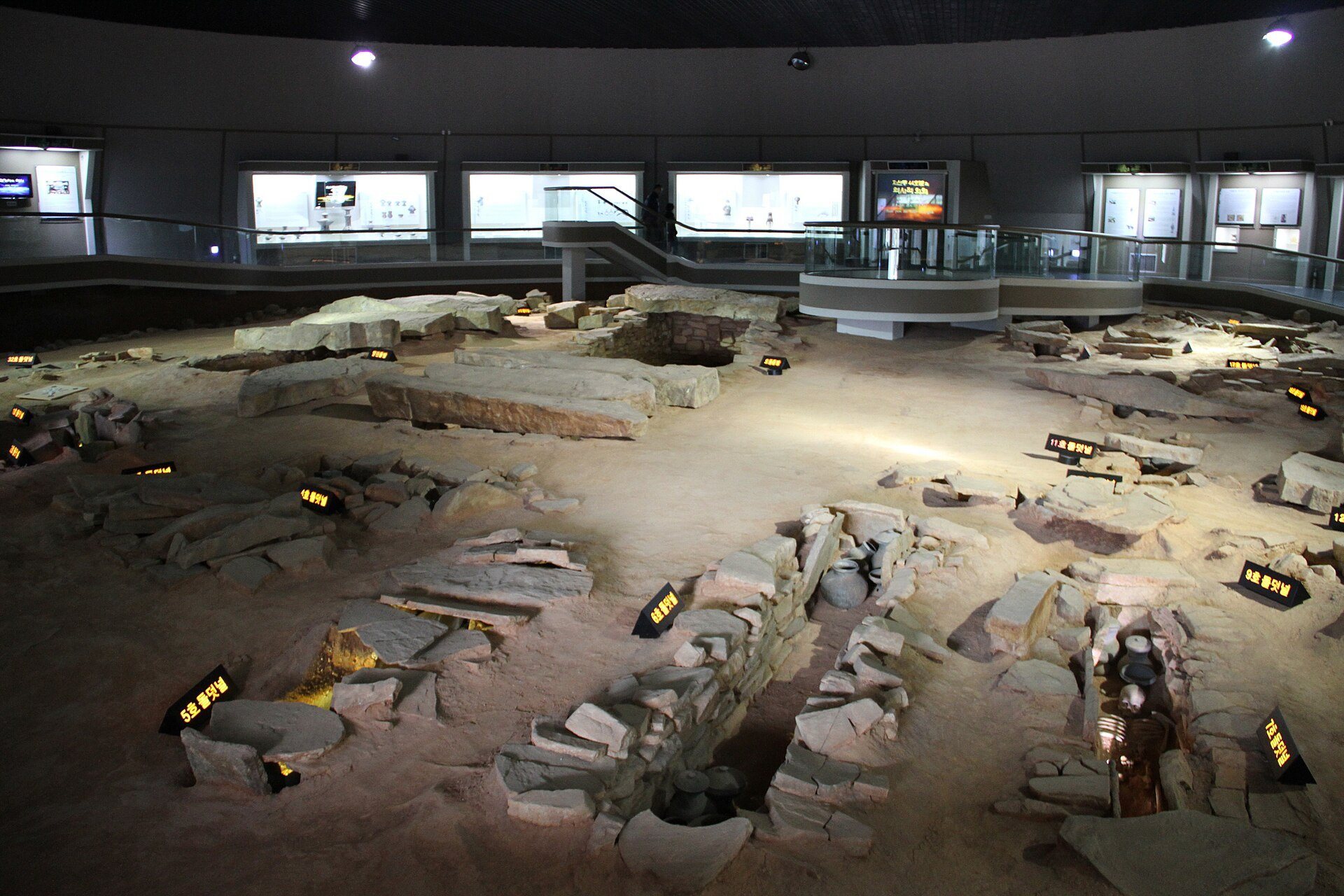
The cemetery contains stone-cist graves, stone-lined graves, and stone-chamber tombs. Stone-cist graves use stone slabs to form the burial container, stone-lined graves have stone-built linings around the burial space, and stone-chamber tombs contain a larger enclosed stone burial space. The stone-cist tradition continues a form of burial known from the Bronze Age.
Excavated ridge tombs
Tomb 30
Tomb 30 stands alone at the end of a southeastern foothill ridge of Jusan Mountain. Its mound measures 18 meters from east to west and 15 meters from north to south, and the surviving earth covering was 1.5 meters high. The tomb contains a T-shaped main stone chamber and a subsidiary chamber, together with three attendant-burial chambers arranged in a U-shaped layout on the east, south, and north sides. Beneath the floor of the main chamber, excavators found a lower subsidiary chamber, a feature not previously known from Gaya tombs.
A ditch followed the contour lines around the southeastern slope, and pottery recovered from it was likely used in rituals. Finds from the tomb include bowl-shaped vessel stands, long-necked jars, handled jars, pedestal dishes, iron ingots, horse equipment, weapons, and a gilt-bronze object. A rock image carved on the capstone of the lower subsidiary chamber suggests that rock imagery no longer served its earlier function as an object of worship by the time of the burial.
Tomb 47
Tomb 47 is the largest tumulus in the cemetery. Its mound measures 49 meters in diameter, and its stone chamber is approximately 9.38 meters long and 1.8 meters wide. Excavated objects include a gilt-bronze quiver, fish bones, a gold-decorated ring-pommel sword, an unusual gilt-bronze object, and 30 iron arrowheads.