Golden Chapel: A Royal Mausoleum in Poznań Cathedral
Site at a Glance
- Rating
- 4.7
- Popularity
- Very Low
- Country
- Poland
- Primary era
- Modern
- Eras represented
- Modern
- Civilizations
- Kingdom of Prussia
- Site type
- Religious
- Remains
- Tomb
On this page11 sections
History
The Golden Chapel, also called the Chapel of the Polish Kings, is a Roman Catholic chapel within Poznań Cathedral in Poznań, Poland. Built in 1836–1837 in a Byzantine style, an artistic tradition developed in the Eastern Roman Empire and its cultural sphere, it was intended as a mausoleum for Poland’s first Piast rulers, Mieszko I and Bolesław the Brave. Its furnishings were completed by 1841.
Medieval tombs and an earlier chapel
Mieszko I and Bolesław may have been buried in an early Romanesque cathedral, an early medieval European style associated with rounded arches and massive forms. That cathedral was destroyed during the invasion by Bretislav, duke of Bohemia, in 1038 or 1039. In the thirteenth century, Bishop Bogufal II probably established a shared mausoleum for the rulers in the cathedral’s main nave. Bolesław I’s epitaph, preserved in literary records, is associated with that tomb.
Around 1360, Casimir III the Great paid for a new sandstone sarcophagus. A chapel dedicated to the Blessed Virgin Mary was built on the same site in 1405. The sarcophagus survived until a fire in 1772, after which the rulers’ remains were kept in an urn in the cathedral chapter house, a meeting room for the clergy. Fires and floods later destroyed the medieval chapel. The partitions of Poland, which divided Polish territory among Russia, Prussia, and Austria, and the Napoleonic Wars delayed plans for a new royal tomb.
The nineteenth-century project
In 1815, the priest Teofil Wolicki proposed a new mausoleum and initiated a committee led by Count Edward Raczyński. Contributions came from all three partitioned territories. The project took shape after the Congress of Vienna established the Grand Duchy of Poznań within Prussia, during a period when Prussian policy increasingly promoted German language and culture. When Wolicki died in 1829, Raczyński continued the negotiations with Prussian authorities, church representatives, and architects.
The chapel’s Byzantine style reflected contemporary ideas that Poland was nearing its thousandth anniversary and that early Poland had longstanding ties with the Byzantine Empire. When available funds ran short, Raczyński personally paid for the monument to Mieszko I and Bolesław. Its pedestal initially carried an inscription saying he had offered the monument to the chapel. Public outrage and false accusations that he was claiming credit for constructing the whole chapel followed. Raczyński ordered the inscription removed, but the criticism contributed to his suicide.
Remains
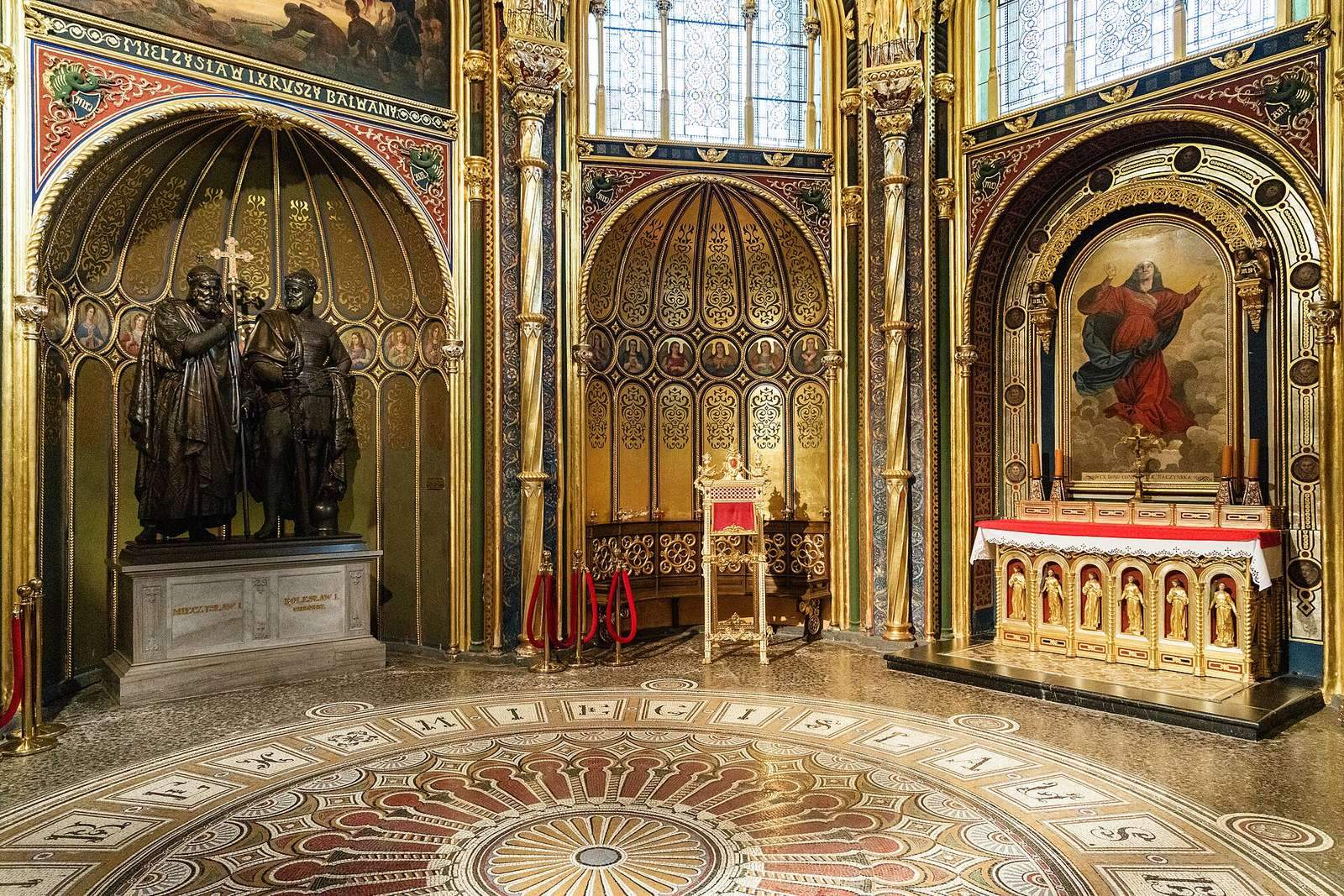
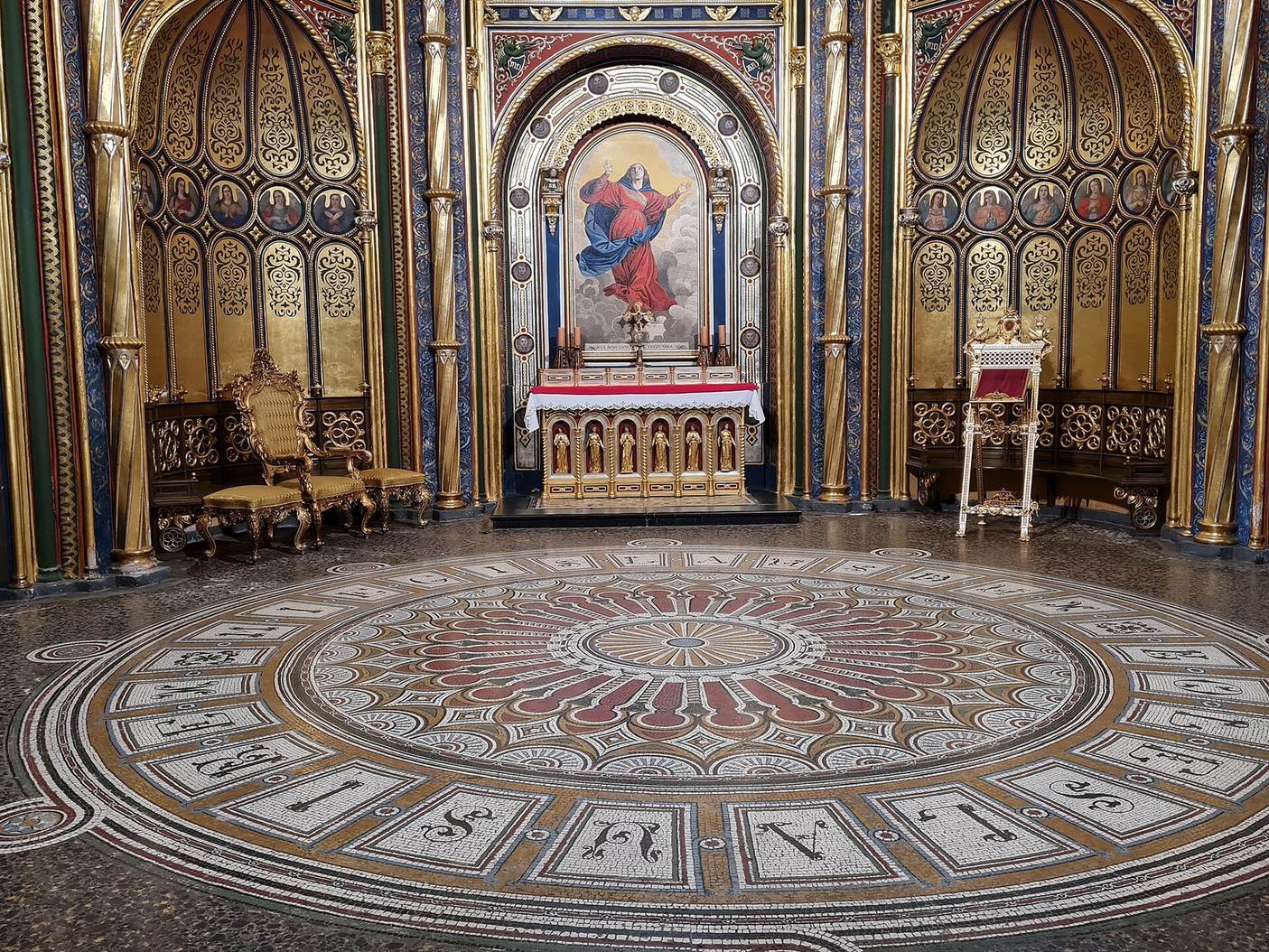
The octagonal chapel stands on the main axis of Poznań Cathedral. A semicircular ambulatory, or passage around the altar, provides access from the area around the cathedral’s main altar. The Byzantine interior brings together royal memorials, paintings, mosaics, sculpture, and heraldic decoration.
Interior monuments and decoration
The sarcophagus
Near the entrance is a Neo-Gothic sarcophagus, designed by Franciszek Maria Lanci and made by Gustav Hesse. Neo-Gothic refers to the nineteenth-century revival of medieval Gothic forms. Pointed-arch niches contain figures of Christ and four apostles. The figures of Christ and St Peter at the far right came from the earlier sarcophagus; Tomasz Oskar Sosnowski made the other figures. Above the tomb, Edward Brzozowski’s painting shows Bolesław the Brave and Otto III at the tomb of St Adalbert, a bishop and missionary venerated as a martyr.
The monument to Mieszko I and Bolesław
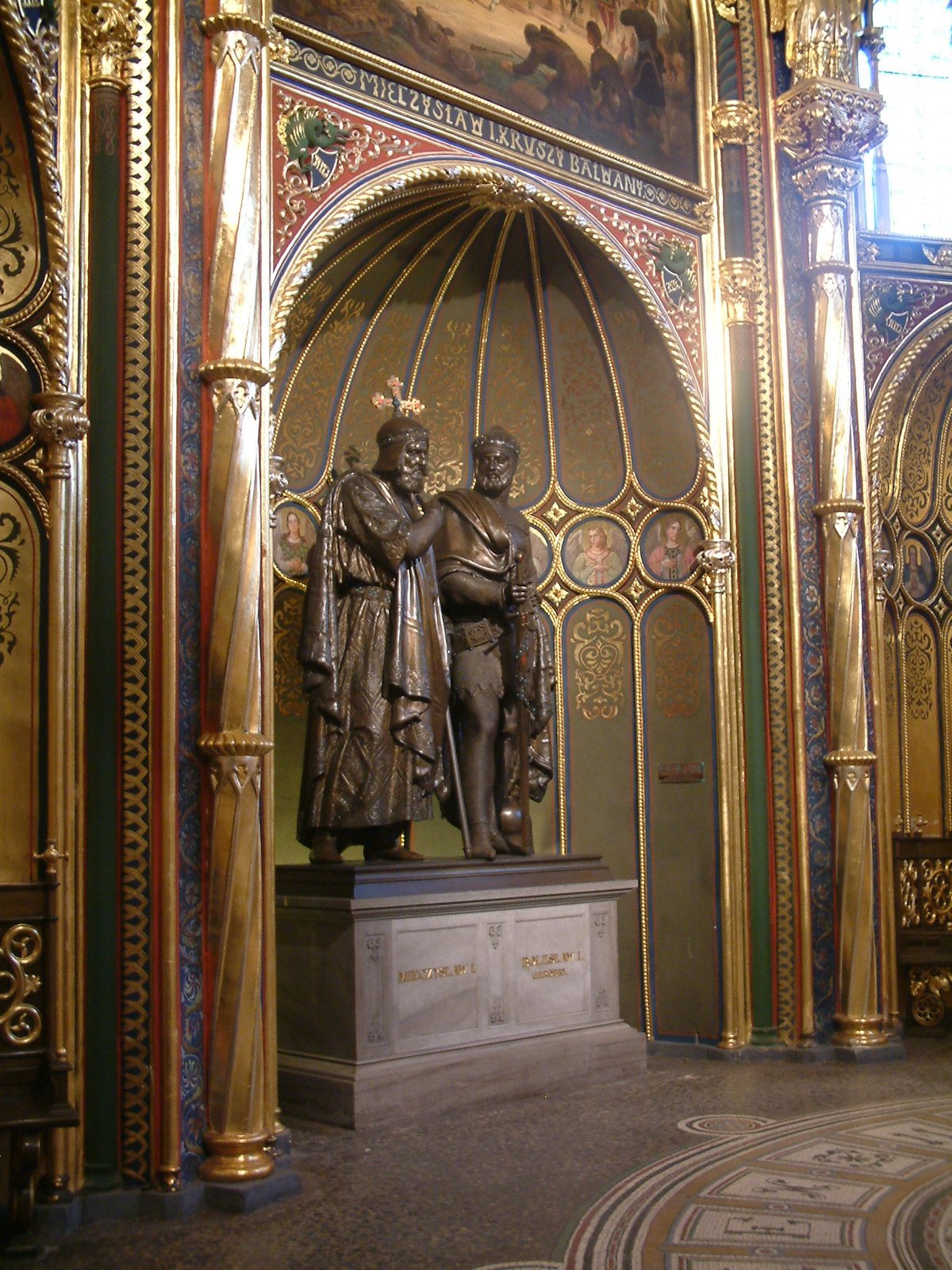
Opposite the sarcophagus stands the monument to Mieszko I and Bolesław, funded by Raczyński and designed by Christian Rauch. Bolesław’s facial features resemble those of Prince Józef Poniatowski. Above the monument hangs January Suchodolski’s 1837 painting of Mieszko I smashing idols.
The altar and mosaics
Opposite the entrance, an altar carries a mosaic of the Assumption of the Virgin Mary, the Christian belief that Mary was taken bodily into heaven. Liborio Salandri made it, based on part of Titian’s Madonna Assunta, at the request of Konstancja Raczyńska, born Potocka. Six zinc statuettes of saints and female martyrs decorate the altar front; they were cast at Moritz Geiss’s workshop in Berlin. Salandri also made the floor mosaic, whose inscription reads Miecislaus Dux Boleslaus Rex, meaning “Mieszko, Duke; Bolesław, King.”
The dome and columns
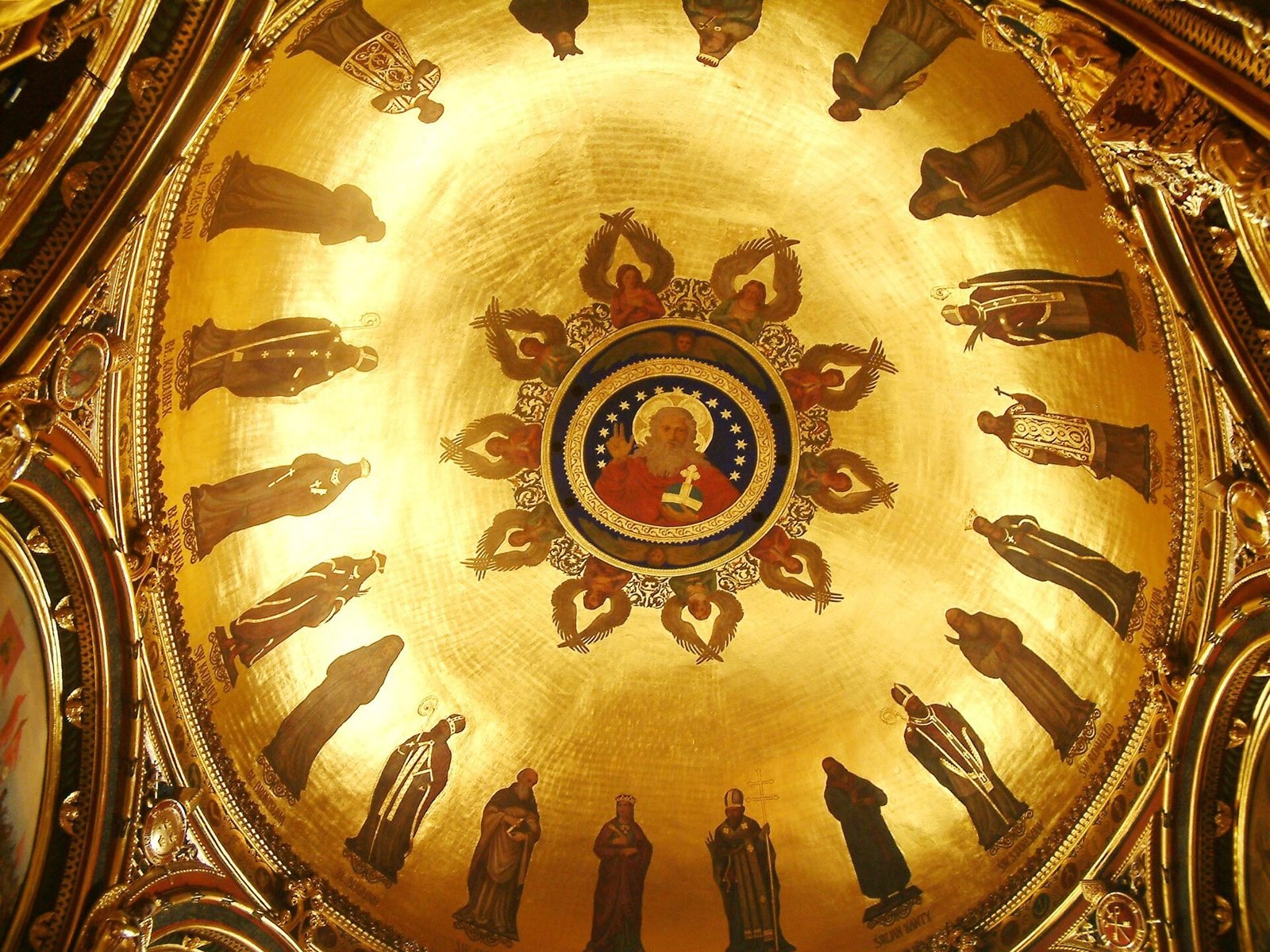
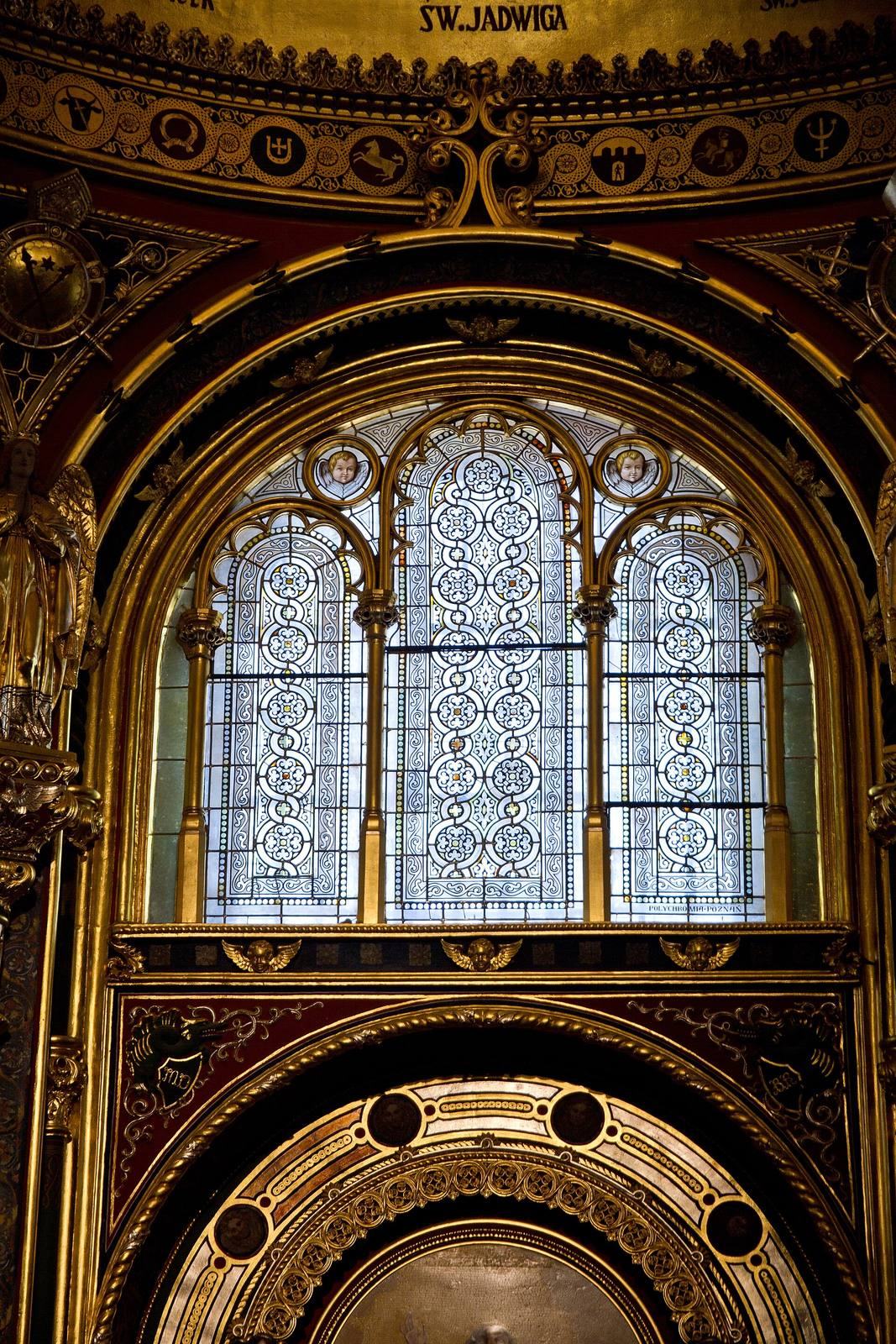
The gilded dome depicts God the Father surrounded by cherubim. Beneath him are figures of eighteen Polish saints and people who were beatified but not canonized, along with St Veronica, traditionally associated with wiping Jesus’s face on his way to the crucifixion, and St Romuald, an Italian monk who founded the Camaldolese order. Lower down, medallions show 34 of the oldest Polish noble coats of arms. Eight shields beneath them represent the chapters of the oldest dioceses: Poznań, with crossed keys and St Paul’s sword; Gniezno, three lilies; Kraków, three crowns; Wrocław, the head of John the Baptist; Płock, the Virgin Mary; Kujawy, St Joseph; Kamień, a cross; and Lubusz, two spears.
Lanci designed the dome from Raczyński’s concept, and Müller of Berlin carried it out. Beneath the diocesan arms, eight half-columns support angel figures. Albert Wolff, a pupil of Rauch, created the model; Hesse made six figures in artificial stone and carved two in sandstone. This work was completed in 1839. Eagles top the column capitals, with a frieze of cherub heads below.
The entrance grille
A grille closes the entrance. It was probably designed by Lanci and was made in 1838 by the locksmith Steinbring of Mosina.
Exterior sculptures
Stone sculptures by Czesław Woźniak adorn the chapel’s exterior corners. Made between 1974 and 1976, they represent Jordan, generally identified as Poznań’s first bishop; Mieszko I; Dobrawa, a Bohemian princess and Mieszko’s wife; and Bolesław the Brave.