Church of Mary Help of Christians in Poznań: A Gothic Roman Catholic Church
Site at a Glance
- Rating
- 4.2
- Popularity
- Low
- Country
- Poland
- Primary era
- Unclassified
- Eras represented
- Unclassified
- Civilizations
- Unclassified
- Site type
- Religious
- Remains
- Church
On this page8 sections
History
Dominican beginnings and medieval rebuilding
The Church of Mary Help of Christians in Poznań is a Gothic Roman Catholic church in Poland, with origins in a Dominican convent founded in 1282. The Dominicans are a Catholic religious order. The convent began at a church dedicated to St Paul and St John the Evangelist, founded by the brothers Wincenty, Mirosław, and Mikołaj Przedpełkowic of the Łodziów, a Polish noble clan, with the participation of Duke Przemysł II, who later became king of Poland.
In the first half of the fourteenth century, Dominican nuns established a monastery near the city walls. St Catherine of Alexandria, a Christian martyr venerated in Catholic tradition, became the church’s patron in 1365. The nuns consequently became known as the Catherine nuns. The church was rebuilt in 1404, when a new vault was added above the chancel. A north aisle followed around the turn of the fifteenth and sixteenth centuries.
Fire, warfare, and secular use
A fire destroyed the church in 1536. It suffered further damage from Swedish troops during the Swedish Deluge, the mid-seventeenth-century invasion and occupation of the Polish-Lithuanian Commonwealth, and from Augustus II the Strong during the Great Northern War (1700–1721), a major conflict in northern and eastern Europe. During the Napoleonic era, French troops and later Russian troops were stationed inside the church.
Part of the monastery was demolished in 1816 because of its poor structural condition. In 1822, Prussian authorities dissolved the convent and converted the complex into military warehouses. This took place under Prussian rule over Poznań following the partitions of Poland. In 1899, part of the monastery buildings was demolished to make way for Masztalarska Street.
Salesian church and twentieth-century events
On 8 January 1926, Edmund Dalbor, Primate of Poland and a cardinal archbishop, invited the Salesians to Poznań. The Salesians are a Catholic congregation founded by the nineteenth-century priest St John Bosco, known for his work with young people. The church and monastery on Wroniecka Street were transferred to them. After repairs, Dalbor blessed the church under its present dedication, Mary Help of Christians, a title of the Virgin Mary, on 6 June 1927.
The Salesians established an oratory, or religious youth center, for boys. During Father Augustyn Piechura’s directorship from 1931 to 1937, about 180 boys attended. Their activities included religious, missionary, social, and dramatic groups, among them the Society of the Most Holy Sacrament, Marian Society, Missionary Circle, Society of Cheerfulness, Drama Circle, and Society of St John Bosco.
In September 1940, the Gestapo, Nazi Germany’s secret state police, arrested five young men associated with the oratory: Edward Klinik, Franciszek Kęsy, Jarogniew Wojciechowski, Czesław Jóźwiak, and Edward Kaźmierski. They were accused of belonging to the secret Military Organization of the Western Territories; an informer within the organization had revealed their names. They were first imprisoned at Fort VII, used as a prison during the German occupation of Poznań, and were martyred in Dresden on 24 August 1942. Pope John Paul II beatified them in 1999. Beatification recognizes a person as blessed and permits veneration under specified conditions.
The church suffered minor damage in 1945. It belongs to the Roman Catholic parish of Our Lady of Perpetual Help, St Mary Magdalene, and St Stanislaus the Bishop. Its liturgical feast is observed on 24 May, and since 2017 it has served as a Lenten stational church, designated for communal religious observance during Lent.
Remains
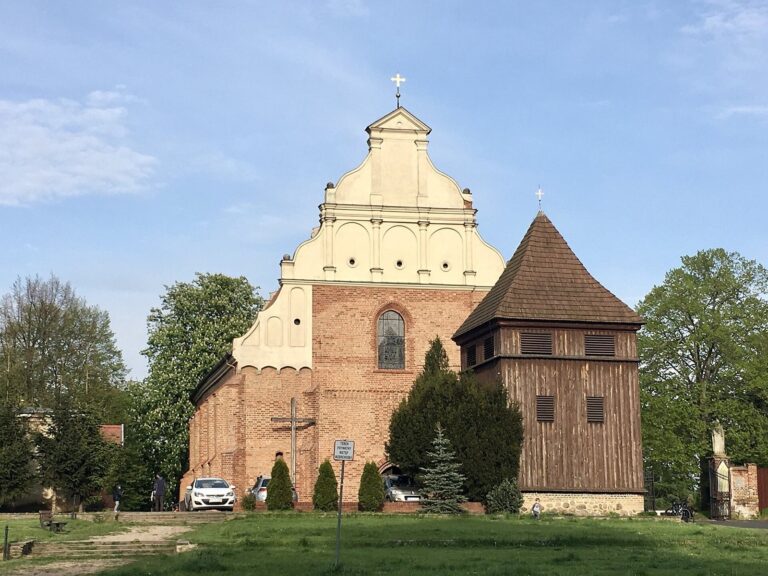
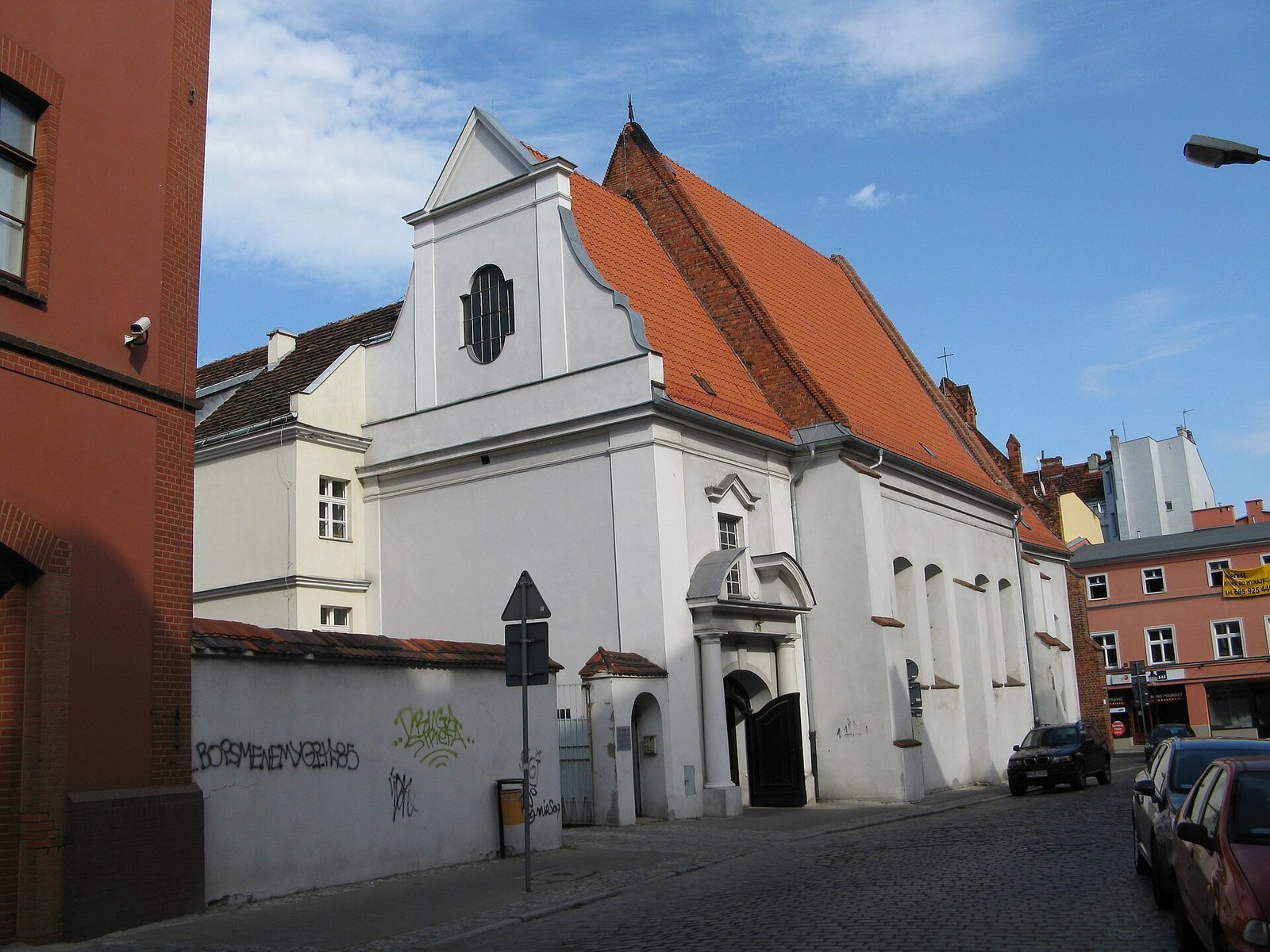
The Gothic church stands at the corner of Masztalarska and Wroniecka Streets. Its surviving features include a gabled roof, a patterned eastern gable, vaulted ceilings, two altars, and an organ.
Gothic fabric
Exterior
The church’s Gothic body is topped by a gabled roof. On its eastern side, slender vertical shafts divide the gable into recessed panels. Brick latticework fills the central recess.
Vaults and furnishings
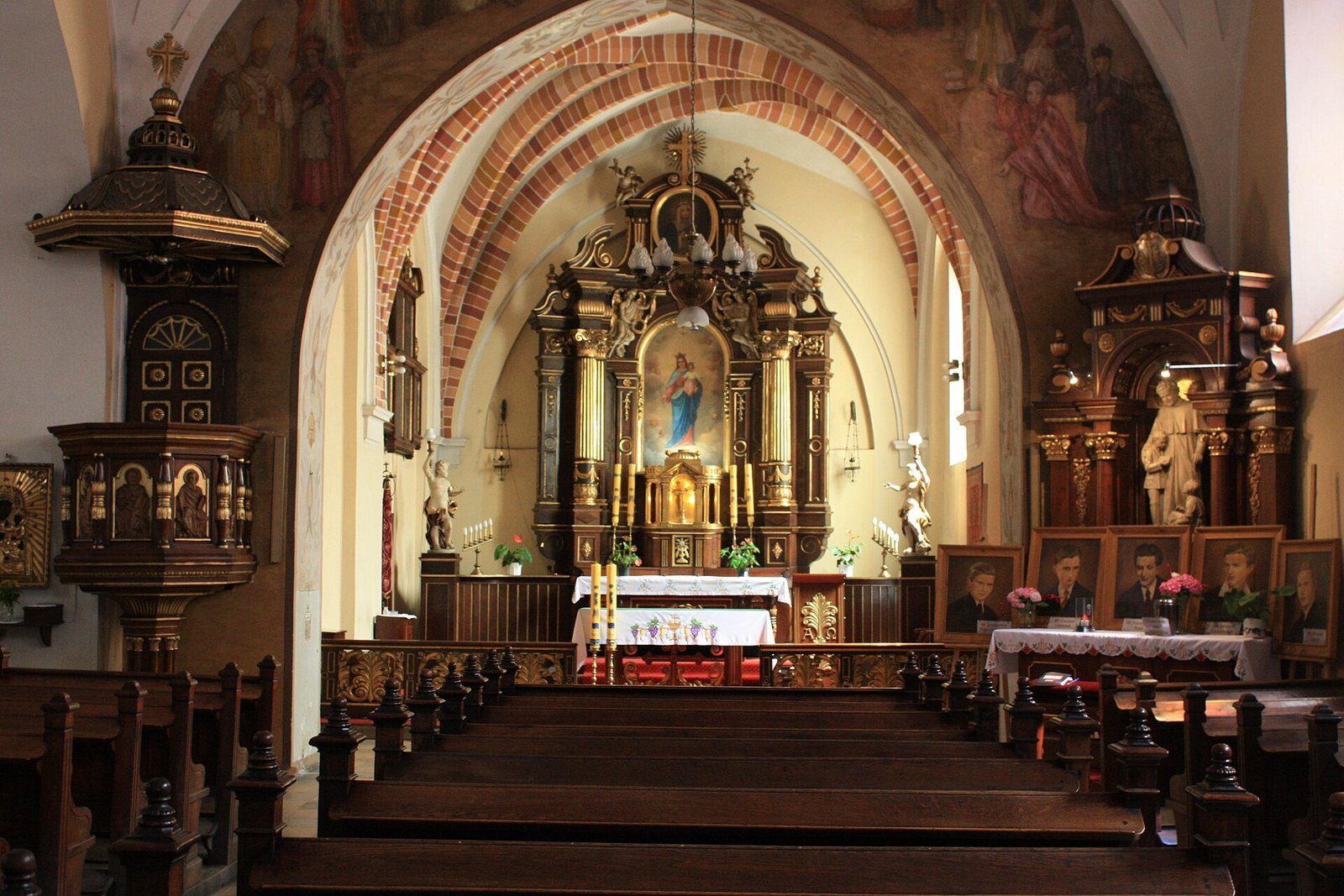
A distinctive rib vault, a ceiling supported by intersecting ribs, covers the chancel and is known as the Piast vault, referring to Poland’s medieval ruling dynasty. The north aisle has a star vault, whose ribs form a star pattern. Inside are two altars and an organ with 17 stops, which select different pipe sounds, two keyboards, and a foot-operated pedalboard.