Ryōzen-ji Temple: The First Temple of the Shikoku Pilgrimage


Site at a Glance
- Rating
- 4.3
- Popularity
- Medium
- Country
- Japan
- Primary era
- Medieval
- External website
- Open
- Eras represented
- Medieval
- Civilizations
- Ashikaga shogunate
- Site type
- Religious
- Remains
- Temple
On this page19 sections
History
Ryōzen-ji Temple is a Buddhist temple in Naruto, Japan, belonging to the Kōyasan Shingon tradition, a branch of Shingon Buddhism associated with Mount Kōya. Temple tradition places its foundation during the Tenpyō era, around 729–749, and attributes it to the priest Gyōki at the request of Emperor Shōmu. Its formal name is Jikuwasan Ichijōin Ryōzen-ji, while its traditional titles include “Temple Number One” and “the temple of the beginning of the vow.” The principal object of worship is Shaka Nyorai, the Japanese Buddhist name for Shakyamuni, the historical Buddha.
Traditional foundation and Kūkai
The foundation story connects Ryōzen-ji with Gyōki, an eighth-century Buddhist priest traditionally associated with temple foundations and religious work supported by Emperor Shōmu. A later tradition says that Kūkai, the ninth-century monk who established the Shingon tradition in Japan, visited the temple in 815 and practiced there for an extended period.
The surrounding landscape was understood as resembling Vulture Peak in India, the mountain where Shakyamuni was believed to have taught. Ryōzen-ji therefore became associated with bringing that sacred mountain into Japan. Kūkai is traditionally credited with enshrining an image of Shaka Nyorai and praying for the creation of a pilgrimage site. These associations helped shape the temple’s later religious identity, although the tradition that Kūkai personally established all 88 temples and fixed their numbers is not historically supported.
Medieval patronage and destruction
Ryōzen-ji was formerly a subsidiary temple of Ōasahiko Shrine, a Shinto shrine in Tokushima Prefecture. During the Muromachi period, it received the protection of the Miyoshi family, a prominent warrior house of medieval Japan, and flourished as one of the Three Great Monasteries of Awa.
In 1582, during the conflicts that affected sixteenth-century Shikoku, forces commanded by Chōsokabe Motochika destroyed the temple. Motochika was a daimyō who expanded his power across much of the island. Ryōzen-ji was later rebuilt under the Hachisuka family, the daimyō rulers of the Tokushima domain, and became their prayer temple.
The first temple of the pilgrimage
Ryōzen-ji is traditionally the first temple of the Shikoku pilgrimage, a circuit of 88 Buddhist temples associated with Kūkai. It is also identified as the first temple of the Shikoku Thirteen Buddhas circuit, a Japanese Buddhist system linking thirteen buddhas and bodhisattvas with memorial rites.
The 1687 guidebook Shikoku Henro Michishirube, written by Yūben Shinnen, is regarded as the oldest surviving book to assign numbers to the pilgrimage temples, and it names Ryōzen-ji as number one. Its position near the Naruto crossing used by pilgrims arriving from the Kansai region is considered the likely reason for this designation. Earlier evidence indicates that beginning the pilgrimage at Ryōzen-ji was already customary, although the precise origin of the numbering remains uncertain.
The temple continues to serve as the pilgrimage’s traditional starting point. Returning to Ryōzen-ji for an orei mairi, or thanksgiving visit, after completing the circuit is customary, although this practice may be relatively recent. A fire in 1891 destroyed much of the complex. Lost buildings were gradually replaced, and later rebuilding and restoration recovered the temple’s historic appearance. The main hall was reconstructed in 1908 and restored in 1964.
Ryōzen-ji forms part of “Shikoku Henro: The 88-Temple Pilgrimage Route and Its Pilgrimage Culture,” among the first group of Japan Heritage designations selected in 2015. The designation encompasses the 88 temples and pilgrimage routes through Awa, Tosa, Iyo, and Sanuki.
Remains
The temple complex is organized around an approach from the eastern side, a principal gate, a central courtyard, the main hall, ponds, and halls associated with Kūkai and the Thirteen Buddhas. The buildings now standing are later replacements or restorations following the destruction of 1582 and the fire of 1891. The Tahōtō, a Japanese Buddhist pagoda with a square lower section and rounded upper structure, preserves an older phase of the complex.
Entrance and central buildings
Sanmon and Gate of Aspiration
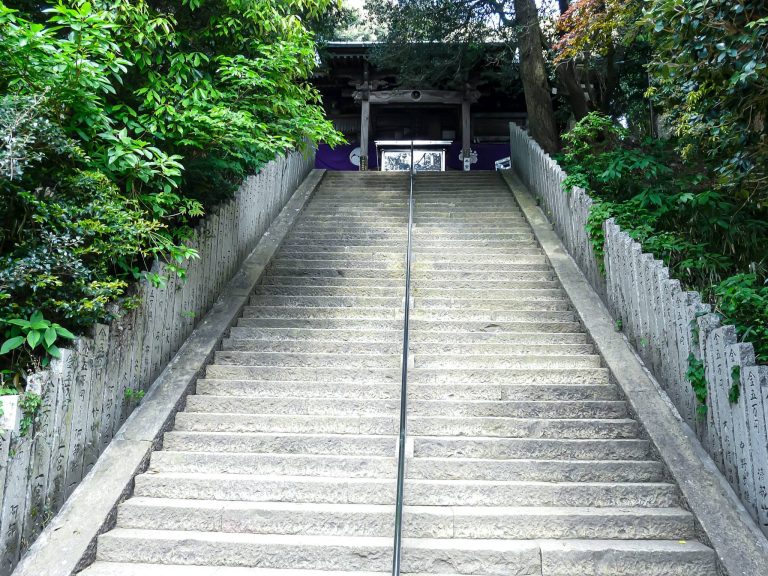
From the eastern parking area, the approach passes through the Gate of Aspiration before reaching the Sanmon, also called the Niōmon. This two-story gate has an irimoya roof, a hipped-and-gabled roof form used in Japanese religious architecture. It leads into the main grounds and establishes the route toward the central buildings.
Tahōtō
The Tahōtō stands to the left after the Sanmon. Built during the Ōei era, around 1394–1428, it rises approximately 22 metres and is described as the only surviving old building in the complex. The pagoda houses images of the Five Wisdom Buddhas, a group of esoteric Buddhist figures representing different aspects of awakened wisdom.
Hondō
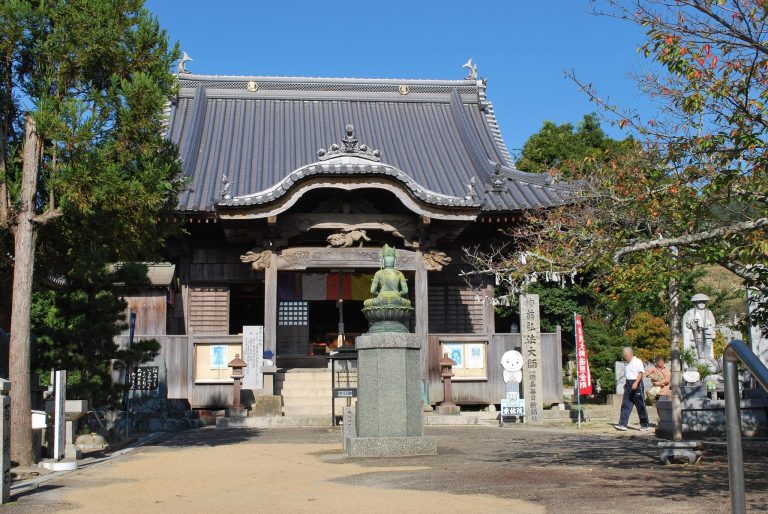
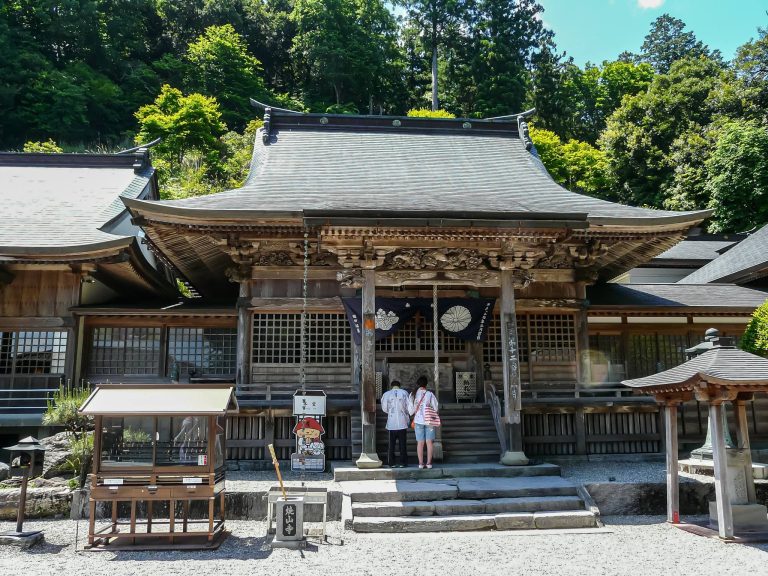
The Hondō, or main hall, stands at the front of the complex. Its form combines a worship hall with an inner sanctuary extended behind it. A dragon is painted on the central ceiling of the worship hall, whose interior is hung with numerous lanterns. In front of the shrine for the principal image is a small reliquary containing Buddhist ashes.
The worship hall also contains a triad of Jizō Bosatsu images in its upper right corner and a Shaka image in the left corner. Above them is a red seated image of Pindola Bharadvaja. Beside this group is an image of Kūkai represented as an ascetic master.
Halls and sacred images
Daishidō
Beyond the large pond stands the Daishidō, the hall dedicated to Kūkai. A bridge crosses the pond to reach it. Inside is a completely black image of Kūkai that can be viewed directly.
Jūsambutsudō
The Jūsambutsudō is arranged as a Fudō Myōō hall followed by a hall containing the other twelve figures of the Thirteen Buddhas grouping. Fudō Myōō, also called Acala, is a Buddhist Wisdom King regarded as a wrathful protector. In the temple grounds, a seated image of Fudō appears first, followed by twelve standing images.
Images of Shaka Nyorai
The principal image is a secret image of seated Shaka Nyorai, traditionally attributed to Kūkai. It holds a jewel in the left hand and was displayed publicly for four months in 2014. A separate bronze image of Shaka at the time of his birth survives from the Hakuhō period, which immediately preceded the Nara period. The figure is approximately 14 centimetres high.
Ponds and gardens
Large hōjō pond
The large pond occupies part of the route between the Sanmon and the Daishidō. It is a hōjō pond, a Buddhist release pond where captured animals, especially fish, are set free, and it symbolizes Buddhist paradise. Carp occupy the water, while six child figures are shown praying to Jizō Bosatsu, a bodhisattva associated with the protection of travelers, children, and the dead.
Smaller pond and Meiji gardens
The smaller pond lies to the left when facing the Daishidō. It contains a small waterfall and a small seated image of Amida Nyorai, the Buddha of the Pure Land tradition. These features form part of the Meiji-period garden elements. The Meiji Garden is a small garden in front of and to the right of the Hondō, while a larger garden occupies the northeastern part of the grounds and contains ten outdoor sculptures of Son Goku, the Monkey King from the Chinese novel Journey to the West. The sculptures were made by Masato Ijou.
Other features of the grounds
Enmusubi Kannon
Behind the ablution pavilion on the left after entering the Sanmon stands the Enmusubi Kannon, a standing stone image. It is used as a water-pouring Kannon, a bodhisattva associated with compassion, and is connected with blessings for various forms of personal connection.
Belfry, monuments, and hospitality station
The grounds also include a belfry, a structure containing a temple bell, and the Kishu hospitality station near the right side of the Sanmon. The Kishu Arida hospitality association has provided hospitality since 1828, with periods of decline, and now operates for four days in spring. A sales and pilgrimage-inscription office stands beside the eastern parking area.
A haiku monument by Kimura Kanryū stands in front of the Niōmon, and a song monument by the same poet stands in front of the Tahōtō. A memorial installation known as the Atomic Bomb Fire was kept in the grounds from 1990 before later being moved to Tōrin-in Temple.