Gojō Nekozuka Kofun: A Fifth-Century Burial Mound in Japan
Site at a Glance
- Rating
- 3.6
- Popularity
- Very Low
- Country
- Japan
- Primary era
- Classical
- Eras represented
- Classical
- Civilizations
- Yamato
- Site type
- Burial
- Remains
- Burial Mound
On this page9 sections
History
Gojō Nekozuka Kofun is an ancient Japanese burial mound in Gojo, Nara Prefecture, Japan, built in the first half of the fifth century. It belongs to the Kofun period, an era of early Japanese history named for burial mounds of this kind. The tomb’s grave goods have been interpreted as evidence of connections with continental Asia and possible links to craftspeople who migrated from the mainland.
Excavation and later research
Around 1955, cultivation damaged about half of the mound and brought many artifacts to light. Archaeologists Shuichi Goto and Aboshi Yoshinori were visiting the area when Goto saw the finds and wrote to Masao Suenaga, then director of the Nara Prefectural Kashihara Archaeological Institute. Suenaga considered further investigation necessary and appointed Aboshi to lead an excavation.
In 2005, the Nara National Museum organized a team to reassess the excavated objects and published its findings. The tomb’s position in relation to Yamato, the historical region centred on present-day Nara, and the Kinokawa River has also prompted the suggestion that exchange may have passed through neighbouring Kii, on the Kii Peninsula.
Nara Prefecture designated the tomb a historic site on March 29, 2013. In March 2026, its excavated objects were recommended for designation as Important Cultural Properties, a formal Japanese category for culturally significant works and objects. Formal designation was pending notification in the official gazette.
Remains
The site comprises a square mound with a central stone burial chamber and grave goods. Its setting in a narrow valley and its construction provide a sense of the tomb’s place within a group of nearby burial mounds.
Mound and burial chamber
Mound
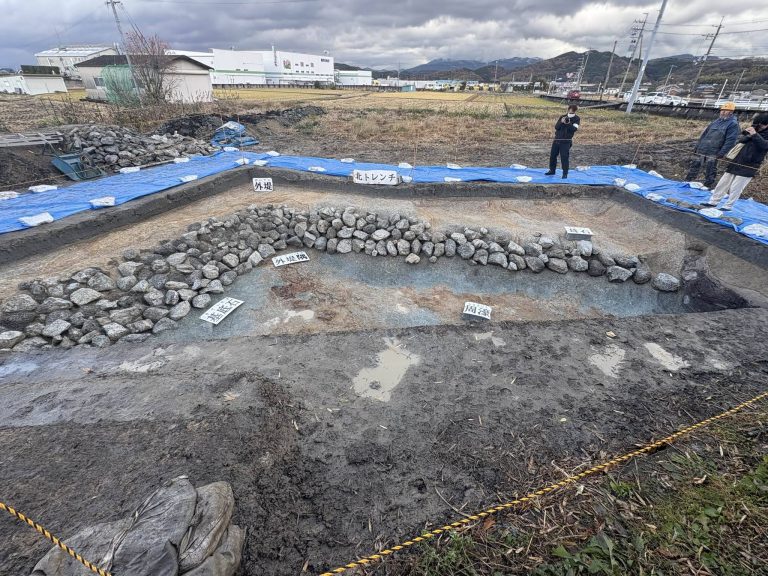
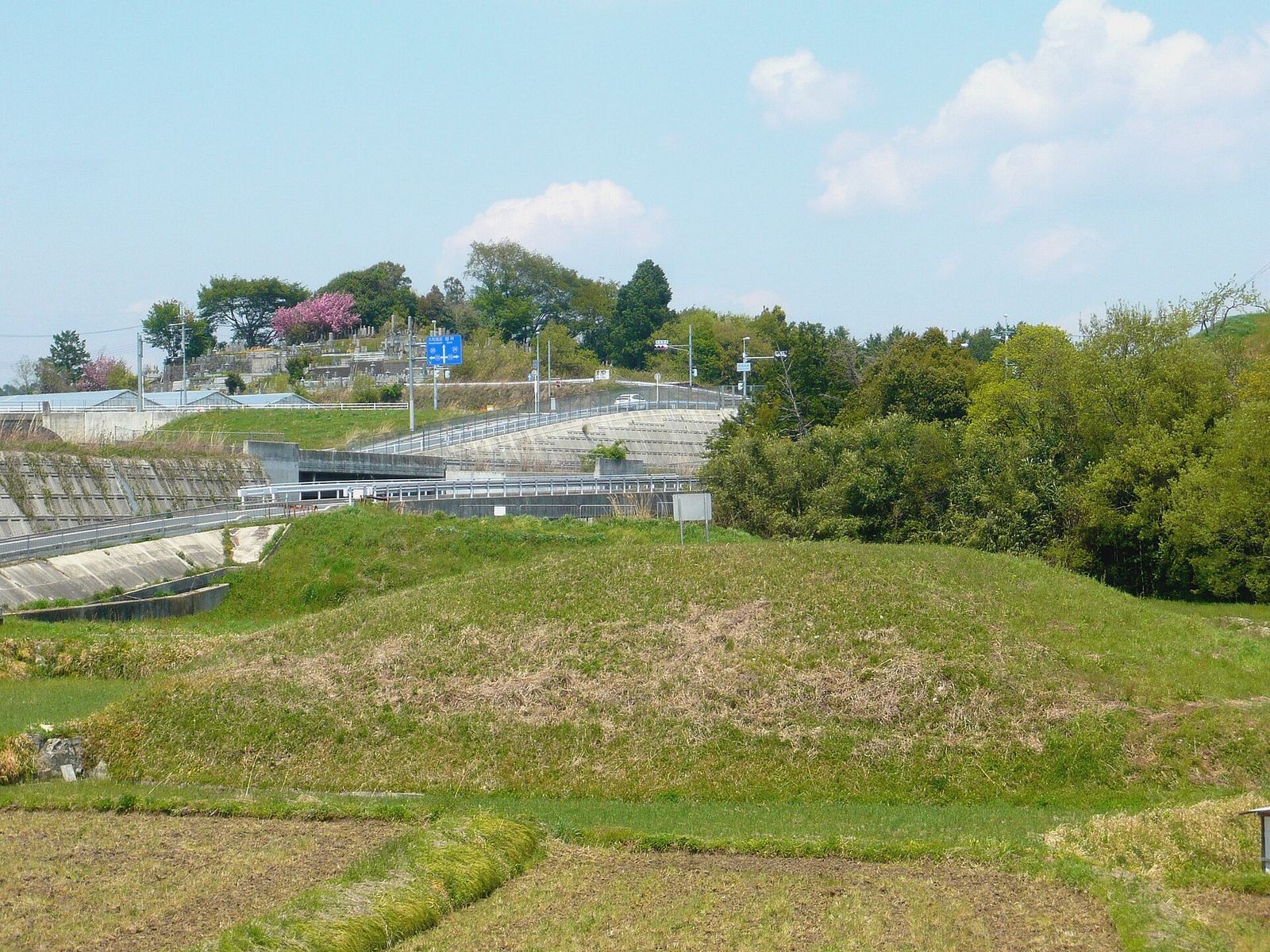
The mound lies about 500 metres south of a settlement in Gojo, within a group of burial mounds that includes many similar square examples. It measures 27 metres on each side and stands about 5 metres high. Clay figures called haniwa, placed around burial mounds, encircled it, while fist-sized stones covered its slopes.
Burial chamber
A stone burial chamber, 5.17 metres long and set in a pit at the mound’s centre, held the burial. A clay pillow lay near the chamber’s midpoint. The deceased appears to have been placed with the head pointing northwest.
Grave goods
Armor and weapons
The burial included armor, belt fittings, swords, spears, and other weapons. Three visored helmets were recovered. One is a gilt-bronze example of a bowl-shaped type whose form resembles helmets associated with Mongolia, though this resemblance does not establish a connection. It is now held by the Nara National Museum. The other two combine iron and gilt bronze, with gilt bronze applied at the front, back, and sides.
Belt fitting and blacksmithing tools
A pierced gilt-bronze belt fitting carries dragon and three-leaf motifs. Comparable examples are uncommon, and its design has been interpreted as indicating strong continental connections. The grave goods also included blacksmithing tools: tongs, a hammer, chisels, an anvil, and a whetstone. Finds of this kind of tool are rare in Japan.