Godesburg: A Medieval Electoral Castle in Bonn, Germany


Site at a Glance
- Rating
- 4.3
- Popularity
- Very Low
- Country
- Germany
- Primary era
- Medieval
- Eras represented
- Medieval, Early Modern, Modern
- Civilizations
- German, Holy Roman Empire
- Site type
- Military
- Remains
- Castle
On this page11 sections
History
Godesburg is a partially restored hilltop castle in Germany, located in present-day Bad Godesberg, a district of Bonn. The site was probably first built by the Franks as a refuge fortress, although the date of this early phase is uncertain. Its principal medieval fortress was begun in 1210 in the architectural style of the Middle Ages, and the castle later became an important stronghold of the Archbishops of Cologne.
Early traditions and religious associations
The hill was called Woudensberg or Wotansberg in a record from 722, while later documents used forms such as Gotensberg and Gotensperg. The suggestion that the name refers to Wotan, a Germanic deity associated with war, death, and the hunt, belongs to nineteenth-century Heimat scholarship, a movement concerned with regional identity and local traditions. Its interpretation of the summit as a pre-Christian cult site remains speculative. Roman activity is represented by an altar stone incorporated into the castle fabric, and tenth-century documents have been interpreted as evidence for a religious community on the hill.
Foundation and archiepiscopal power
On 15 October 1210, Archbishop Dietrich I of Hengebach of Cologne ordered a new fortress to be built at Godesburg. A vicar laid the foundation stone on his behalf, and Dietrich’s successors completed the castle after his death in 1224. From the thirteenth through the fifteenth centuries, Godesburg served as a material expression of the power of the Archbishops of Cologne. These senior Christian bishops also held the political office of elector, which gave the castle both religious and territorial importance during their conflicts with the patricians of the imperial city of Cologne.
Under Archbishop Siegfried of Westerburg in the late thirteenth century, the fortress resisted a five-week siege by Count William of Cleves. Successive archbishops strengthened and enlarged the defenses. By the late fourteenth century, the castle held the Elector’s valuables and archives, and by the middle of the sixteenth century it was popularly regarded as the Electors’ favored residence.
Destruction during the Cologne War
Godesburg was attacked in 1583 during the Truchsessian War, also called the Cologne War, a conflict in which Protestant and Catholic forces struggled over control of the Electorate of Cologne. Troops commanded by the newly elected Elector Ernst of Bavaria partly destroyed the walls in an explosion. On 17 December 1583, a Catholic mercenary entered through a latrine, followed by other attackers. With the garrison threatened by forces inside and outside the damaged defenses, the fortress eventually surrendered.
Ruin, rebuilding, and later use
In 1891, Emperor Wilhelm II donated the ruin to the municipality of Godesberg. A civil-defense bunker constructed beneath the castle during the Second World War remains as a wartime feature. In 1959, the ruin was rebuilt according to plans by Gottfried Böhm and adapted for a hotel and restaurant. The restaurant remains in operation, while the former hotel tract has been divided into apartments. Later conservation included work by the city of Bonn on the gastronomic facilities, restoration of the principal tower in 2006 and again between September 2012 and February or March 2014, and the creation of a small historical information center in the tower.
Remains
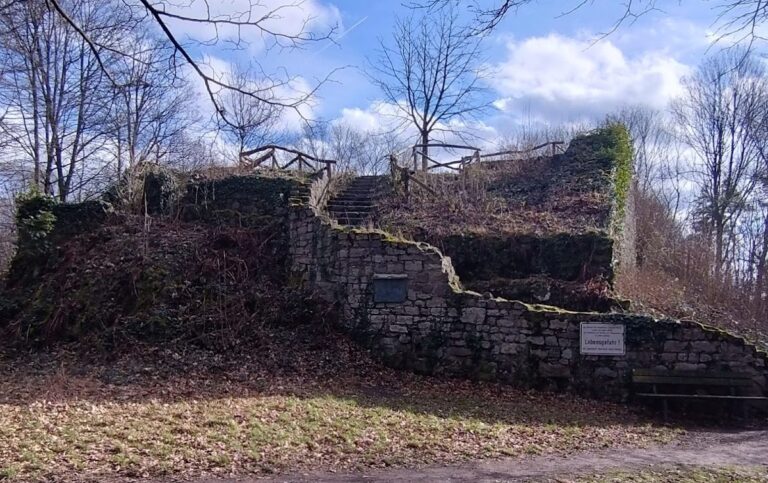
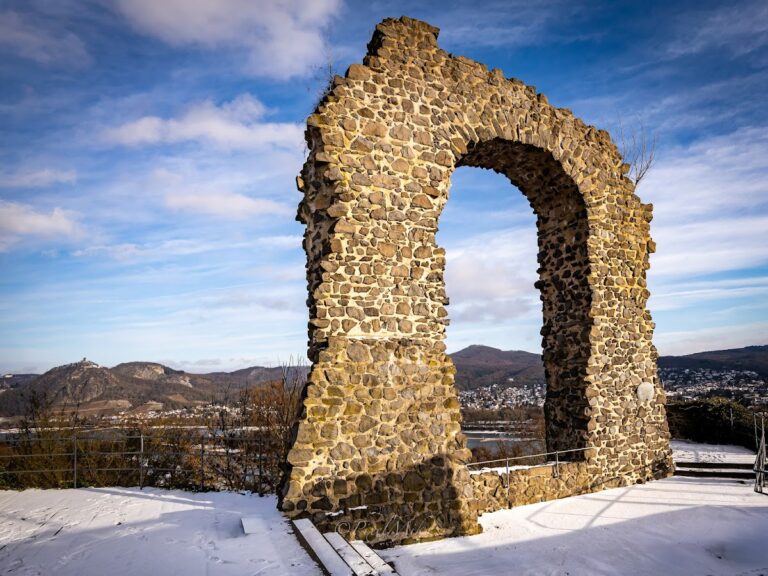
Godesburg occupies the summit of the Godesberg, now called Burgberg, an extinct prehistoric volcano and the prominent elevation in the Godesberg Rhine valley basin. The principal fortified tower stands at approximately 122 metres above sea level, and the castle platform overlooks the Rhine valley. The surviving complex is a partially restored medieval hilltop ruin whose steep setting formed part of its defensive character.
Fortifications and castle layout
The medieval fortress developed into an elaborate stone stronghold by the 1580s. Its defenses included strengthened walls, expanded moats, improved roads, a curtain wall, and massive gates influenced in part by Italian military methods. Thick rounded defensive sections and iron-studded gates formed the inner works, while the steep hill and elevated position made artillery fire difficult. The castle also contained a small residence, dungeons, and a chapel, incorporating residential, defensive, and religious functions within the fortified enclosure.
Principal tower
The central Bergfried, the principal fortified tower of a medieval German castle, is cylindrical rather than square. Archbishop Konrad of Hochstaden added its first five storeys in 1244, and Archbishop Walram of Jülich later raised it to 32 metres and built the outer bailey. The tower has been restored, including work completed in 2006 and a further campaign carried out between September 2012 and February or March 2014. A small historical information center occupies the tower.
Roman altar and courtyard replica
A Roman altar stone is built into the castle. The original, found at Godesburg in 1583, was dedicated to the healing deities Aesculapius and Hygia. Since 1981, a replica of a Roman votive stone dating to around AD 200 has stood in the courtyard, preserving the evidence of the hill’s Roman religious associations within the later fortress setting.
Castle cemetery
Beside St. Michael’s Chapel, the associated Bad Godesberg castle cemetery contains numerous ornate nineteenth-century graves and richly designed funerary monuments belonging to members of the bourgeoisie. Herbert Wehner, the actor Paul Kemp, and the innkeeper Aennchen Schumacher are buried there.
Modern adaptations
The 1959 rebuilding adapted parts of the ruin for commercial use while retaining the castle complex as a historic structure. The restaurant continues in the complex, and the former hotel areas have been subdivided into smaller apartments. These adaptations and later conservation works form part of the surviving physical character of Godesburg.
Nearby sites