Castillo de Gómez Arias: A Hispano-Muslim Fortress in Benamejí


Site at a Glance
- Rating
- 4.5
- Popularity
- Very Low
- Country
- Spain
- Primary era
- Medieval
- External website
- Open
- Eras represented
- Medieval
- Civilizations
- Umayyad
- Site type
- Military
- Remains
- Fort
On this page7 sections
History
Castillo de Gómez Arias, also known as Castillo de Benamejí, is a Hispano-Muslim fortress in Spain, built between 888 and 912 during the rule of Abdallah I, the Umayyad emir of Córdoba. Its original name was Banu Bashir, and its early purpose was to besiege Belda, an abandoned settlement now within the municipality of Cuevas de San Marcos. The name Gómez Arias comes from the fourteenth-century governor of Benamejí. Pottery found in the area indicates that the site had been inhabited since antiquity.
Emirate, caliphate, and taifa rule
The fortress may have received further fortification under Abd al-Rahman III during the tenth-century Caliphate of Córdoba, the centralized Umayyad state that dominated much of Islamic Iberia. After the caliphate collapsed, Benamejí belonged to the Taifa of Granada, one of the independent Muslim kingdoms that emerged from that breakdown. Its position between Córdoba and Málaga placed it along a route used by Almoravid, Almohad, and Marinid armies advancing from Algeciras toward Córdoba. These successive North African dynasties intervened militarily in Iberia.
Castilian and Nasrid frontier
Ferdinand III of Castile took the fortress by agreement in 1240. On 23 March 1254, Alfonso X granted it to the Order of Santiago, a military-religious order involved in defending Christian territories and fighting in the Iberian frontier wars. The bishopric of Córdoba received the tithe from customs revenues connected with the fortress. For centuries, Benamejí stood on the frontier between the Crown of Castile and the Nasrid Kingdom of Granada, the last major Muslim polity in medieval Iberia, and repeatedly changed hands.
In 1277, the Marinid Sultanate captured the area while moving toward Córdoba. The defenders were killed, their property was plundered, and the fortress was demolished. A peace agreement concluded at Priego later returned Benamejí to Castile and fixed the boundaries between Benamejí, Belda, and Lucena. Nasrid attacks continued. In 1333, Sultan Muhammad IV recovered Benamejí while Gómez Arias and his Castilian army were fighting the Marinids at Gibraltar. Alfonso XI subsequently counterattacked, retook the fortress, and granted it to Alonso Meléndez de Guzmán, the new master of Santiago.
The stronghold changed sides several more times before Peter I of Castile definitively conquered it in 1361. He took advantage of the civil war between Muhammad V and Muhammad VI. Further Nasrid incursions followed, although military pressure declined substantially after Ferdinand of Trastámara conquered Antequera in 1410. In 1495, Luis Fernández Portocarrero, lord of Palma del Río, held the fortress’s tenure. Three years later, Gonzalo Fernández de Córdoba, known as the Great Captain, held it.
Abandonment and modern protection
Settlement at Benamejí remained inconsistent for centuries. Pedro de Guevara, a knight of the Order of Santiago, commander of Valencia del Ventoso, and owner of the fortress, tried to establish a more permanent population but died in 1544 before completing the effort. In 1547, Emperor Charles I offered the fortress for sale. Diego de Bernuy purchased it in 1548 for nearly 20 million maravedís, a historical Iberian monetary unit, and Juan de Cisneros became its governor.
Bernuy considered building over the old fortress, but experts from Antequera advised against the plan because of the site’s poor condition. He instead founded a new town at the location of present-day Benamejí, constructed a new bridge over the Genil, became lord of Benamejí, and left the old fortress abandoned. In 1772, the inhabitants began proceedings before the Chancery of Granada to join the Crown. The case was suspended by the Spanish War of Independence. Although the decision favoured the Bernuy family in 1814, the abolition of lordships in Spain in 1837 ended the family’s authority over Benamejí.
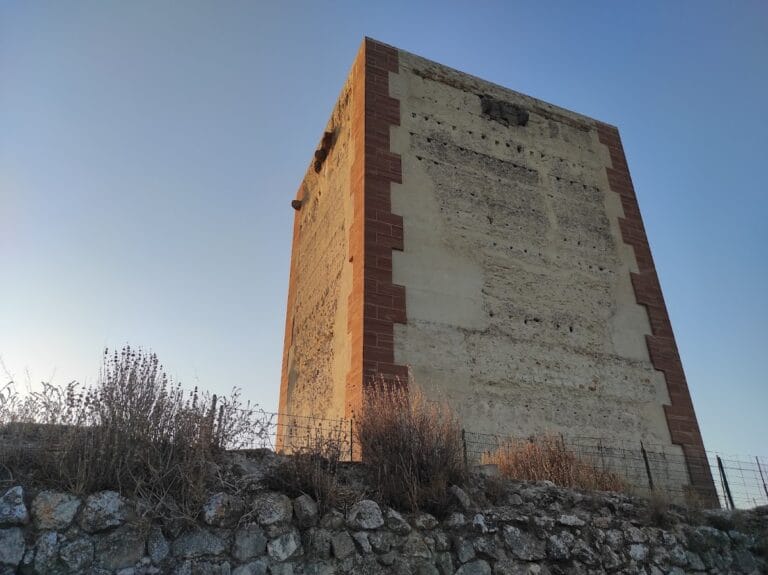
Castillo de Gómez Arias is protected as an Asset of Cultural Interest in the category of Monument and is owned by the Benamejí municipal council. In January 2021, the municipality requested nearly one million euros from the Ministry of Transport, Mobility and Urban Agenda for restoration and valorization, describing the fortress as severely neglected and ruined. The proposal also sought to improve access to the site. The fortress has continued to influence Spanish literature and theatre: Calderón de la Barca set his 1672 play La niña de Gómez Arias there, and the site inspired Pío Baroja’s 1917 novel La feria de los discretos.
Remains
Setting and surviving fortress
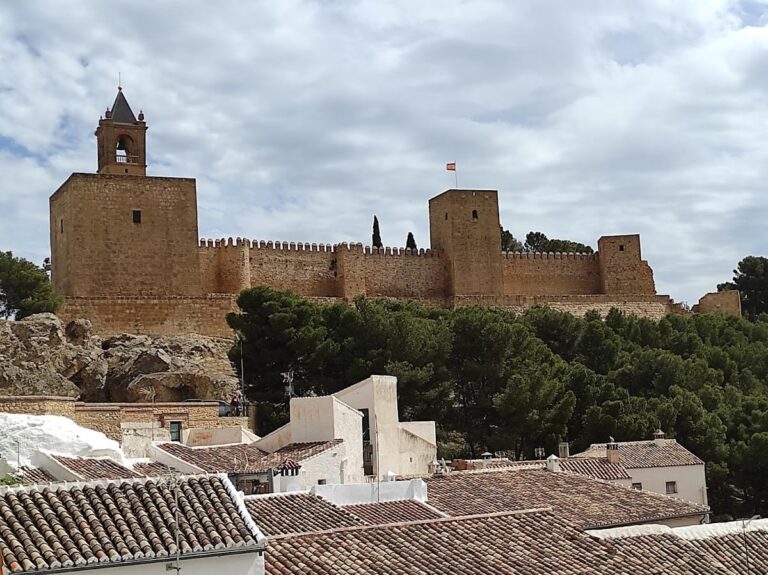
The fortress stands south of Benamejí at an elevation of about 390 metres, on the right bank of the Genil River and beside the former road between Córdoba and Málaga, now near the A-45 motorway. It is identified as a Hispano-Muslim fortress, although no complete plan or detailed inventory of its defensive elements is available. The structure was already in poor condition in 1547, and by 2021 it had deteriorated into a severely neglected ruin.
Associated settlement and infrastructure
In 1547, access to the fortress was provided by a wooden bridge that the Genil repeatedly destroyed during floods. The settlement associated with the stronghold consisted of huts made from wood and thatch. The foundations of its water-powered mill were the only surviving part of that installation, while its church was a plain room without ornaments or decoration. These remains belong to the settlement that preceded Bernuy’s creation of the present town of Benamejí.