Gammel Køgegård: A Danish Manor House and Estate
Site at a Glance
- Popularity
- Medium
- Country
- Denmark
- Primary era
- Early Modern
- Eras represented
- Early Modern, Modern
- Civilizations
- Danish
- Site type
- Domestic
- Remains
- Manor House
On this page9 sections
History
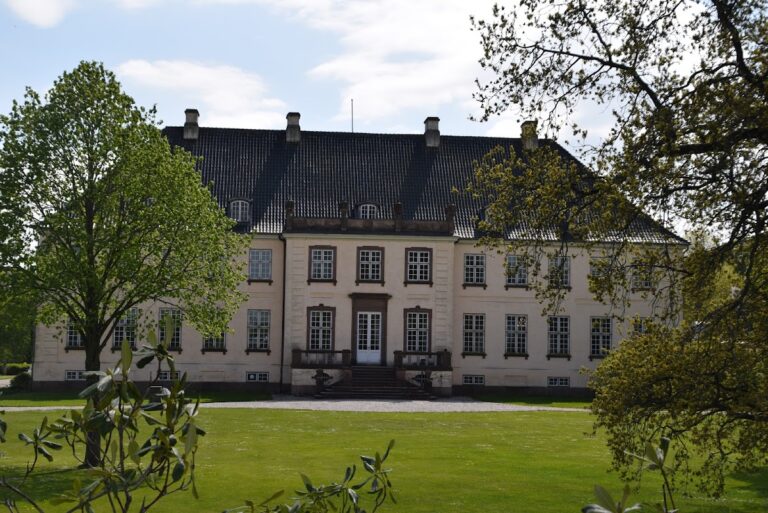
Gammel Køgegård is a manor house just west of Køge, Denmark. Its main building dates to 1791 and is Neoclassical, a style drawing on classical Greek and Roman forms. The estate is closely connected to the town’s beginnings: Køge’s original settlement stood on these grounds before moving toward the bay.
Old Køge and the first manor
As sediment accumulated along the coast, the beach and marshlands became suitable for building, and the settlement shifted toward the bay. Old Køge dwindled to a few scattered houses. The Bille family acquired the estate in the 16th century. In 1603, Elisabeth Bille, who had inherited the family’s property at Old Køge from her father, began building a house there that remained for almost two centuries. Later in the 17th century, the estate passed to the Skeel family and expanded considerably.
The Carlsen-Lange family
Local farmer and merchant Rasmus Carlsen bought the property in 1776. His son, Christen Rasmussen-Carlsen, was ennobled in 1817 and adopted the name Lange. Hans Carlsen, Christen’s son, took over the estate from his widowed mother in 1833. He received the Danish court title Hofjægermester, associated with royal hunting service, in 1841, and soon married Clara Sophie Krag-Juel-Vind-Frijs of Frijsenborg. They had three daughters and a son.
Hans served as a king-appointed member of the Landstinget, one of Denmark’s parliamentary chambers, and briefly as Minister of the Interior in the cabinet of Ditlev Gothard Monrad, a clergyman and politician who headed the government. Clara died in 1852. At her funeral on 26 December, the pastor, theologian, writer, and religious reformer N. F. S. Grundtvig inaugurated the family burial ground. Grundtvig had married Hans’s sister the previous year; she and Grundtvig were among those later interred in the graveyard’s crypt. Hans and Clara’s son Jens Christen died aged 19 in 1865. Their daughter Emmy was the last family member buried in the graveyard, after her death in 1912.
The trust and the estate today
After Hans died in 1887, Emmy took over Gammel Køgegård. She founded the Carlsen-Lange Family Trust, which assumed ownership after her death in 1912. The estate is now owned by the Carlsen-Lange Foundation. It covers 625 hectares of forest and 350 hectares of farmland. The park was redesigned in 1967 with assistance from Danish landscape architect C. Th. Sørensen.
Remains
The manor house and grounds
Main building
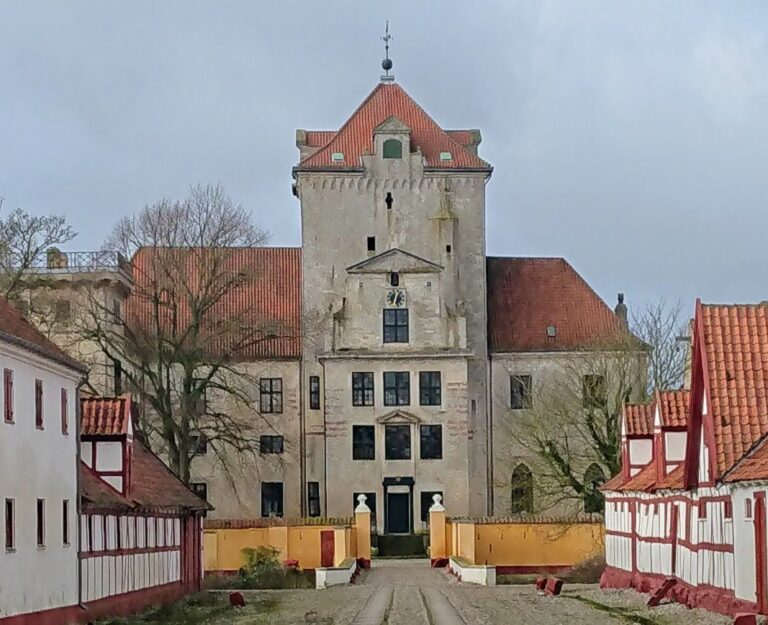
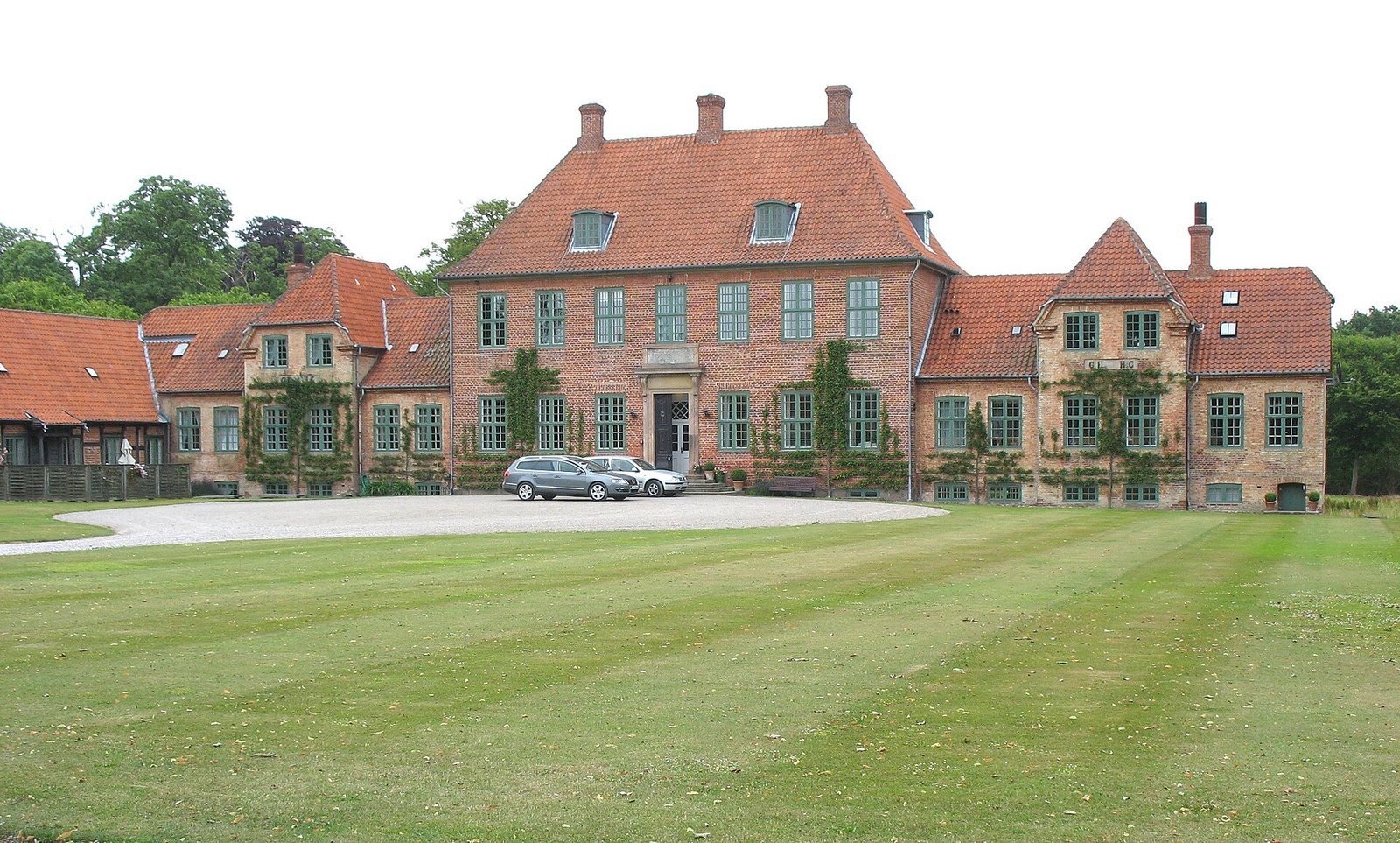
The red-brick main building has a two-storey central wing beneath a red-tile roof, flanked by two lower side wings. The side wings were altered in 1856. An interconnected timber-framed wing survives as the only preserved part of the earlier complex. The house also contains portraits of the estate’s owners dating from the 16th through the 20th centuries.
Park and orchard
Køge Å crosses the park, which holds a large collection of rhododendrons, including many rare varieties. Remains of a church have been found in the estate orchard.
Clara’s Graveyard
The family burial ground lies east of Køge Å, about half a kilometre from the main building. Its crypt was constructed in 1855.