Girolamini: An Oratorian Church and Monastic Complex in Naples
Site at a Glance
- Rating
- 4.5
- Popularity
- Low
- Country
- Italy
- Primary era
- Early Modern
- External website
- Open
- Eras represented
- Early Modern
- Civilizations
- Kingdom of Naples, Kingdom of the Two Sicilies, Spanish
- Site type
- Religious
- Remains
- Monastery
On this page24 sections
History
Girolamini is an Oratorian church and monastic complex in Naples, Italy, established by followers of Saint Philip Neri in 1586 during the late Renaissance and early Baroque period. The Oratorians, also known as Filippini or Girolamini, were a Catholic congregation devoted to preaching, teaching, spiritual guidance, and communal religious exercises. The name Girolamini derives from San Girolamo della Carità in Rome, where the first Oratory had been founded.
Foundation and construction
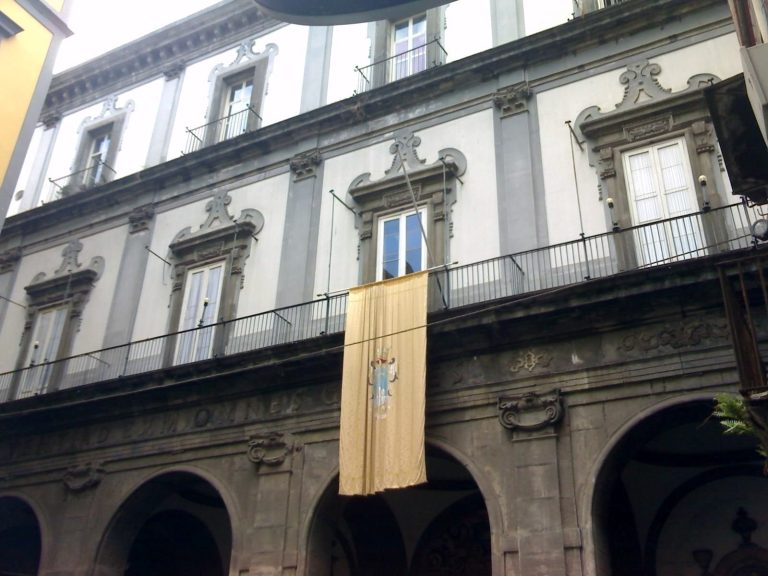
The Oratorians acquired the Palazzo Seripando opposite Naples Cathedral for approximately 5,800 ducats. Donations from the archbishopric and the Neapolitan nobility helped finance the purchase, and the palace was adapted as a convent. A smaller church initially accompanied the new foundation.
In 1592, Domenico Fontana supervised the demolition of several small churches, chapels, and properties belonging to the Seripando and Filomarino families. This work created the Largo dei Girolamini and cleared the area for the present church and an expanded convent. Giovanni Antonio Dosio, a Florentine architect influenced by Brunelleschi, designed the church, using Rome’s San Giovanni dei Fiorentini as a model. Construction began in the 1590s. After Dosio’s death, Dionisio Nencioni di Bartolomeo continued the work, which was completed in 1619. The church was consecrated in 1658 after the side aisles had been finished.
The convent grew from the late sixteenth century through approximately the first half of the seventeenth century. This expansion added the larger Chiostro degli Aranci, further rooms, and additional building sections. The Quadreria, a picture gallery formed from donations and works belonging to the Oratorian fathers, opened to the public in the 1620s. Domenico Lercaro began a major donation in 1622, and the Milano family collection entered the complex in 1631. The gallery is described as Naples’ first public picture gallery.
Baroque enrichment and later alterations
During the seventeenth and eighteenth centuries, the church was filled with paintings, sculptures, frescoes, altars, and other decoration. Artists from Naples, Tuscany, Emilia-Romagna, Rome, and Bologna contributed to the complex, including Pomarancio, Federico Zuccari, Marco dal Pino, Fabrizio Santafede, Giovanni Bernardo Azzolino, Belisario Corenzio, Guido Reni, Pietro da Cortona, Luca Giordano, Francesco Gessi, Giacomo del Po, Nicola Malinconico, Francesco Solimena, Pietro Bernini, Jacopo Lazzari, and Giuseppe Sanmartino.
Dionisio Lazzari’s original seventeenth-century facade was replaced and completed in 1780 according to designs by Ferdinando Fuga. Giuseppe Sanmartino produced much of its sculptural decoration. The church’s tribune and dome were rebuilt during the first half of the nineteenth century. The dome, originally erected in the mid-seventeenth century by Dionisio Lazzari, was demolished and reconstructed during this work.
War damage, protection, and recovery
The complex was declared a national monument in 1866 under legislation concerning ecclesiastical property. Bombing during the Second World War damaged the church, including its coffered ceiling, which suffered severe destruction in 1943. Postwar restoration was followed by further maintenance and recovery work during the second half of the twentieth century.
The church remained closed for more than thirty years before reopening in September 2009. Restored paintings were presented in 2011, including works by Luca Giordano and Guido Reni. In November of that year, the convent and the historic library room known as the Sala del Camino opened to the public. In 2013, two torch-bearing angels by Giuseppe Sanmartino returned to the church after thirty-four years in the Capodimonte Museum. A painting by Luca Giordano showing angels holding a mitre also returned from the diocesan museum of Naples.
From 2013, the church and convent formed part of the Girolamini museum circuit, while the Oratorio dell’Assunta continued to serve religious purposes. Extensive restoration under the UNESCO project for Naples’ historic centre was completed in 2024. The church reopened in March that year, while the cloisters and library remained inaccessible.
The library and the theft of 2012
The Girolamini Library contains approximately 200,000 manuscripts, including about 6,500 manuscripts concerning musical compositions and works from the sixteenth to the nineteenth centuries. One room is dedicated to Giambattista Vico, the Neapolitan philosopher and historian, who donated first editions of all his works to the convent.
In 2012, systematic theft affected the library. Books were removed and sold by a criminal group associated with its administration. The former director Marino Massimo de Caro and accomplices were convicted in 2013. By late 2013, approximately 80 percent of the missing volumes had been recovered, although some valuable material remained unaccounted for.
Remains
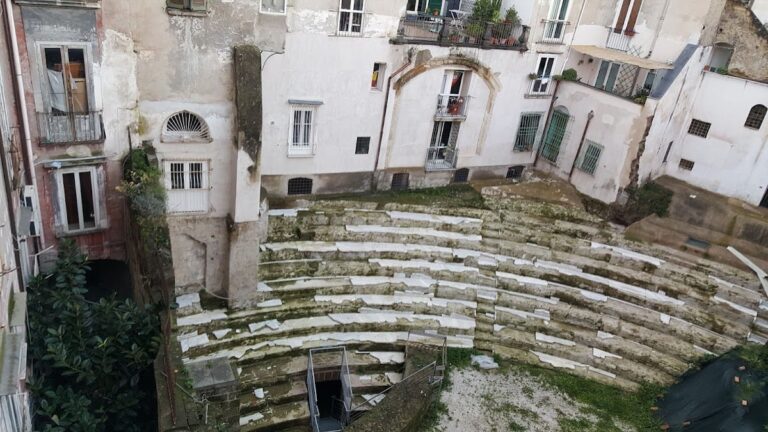
The Girolamini complex occupies approximately 12,000 square metres over seven levels. Its surviving elements include the church, convent, two monumental cloisters, the Oratorio dell’Assunta, additional oratories, the Quadreria, and the Girolamini Library. The church faces the Largo dei Girolamini and Via dei Tribunali, while the convent extends behind it around its cloisters and associated rooms.
The church exterior and main interior
Facade and bell towers
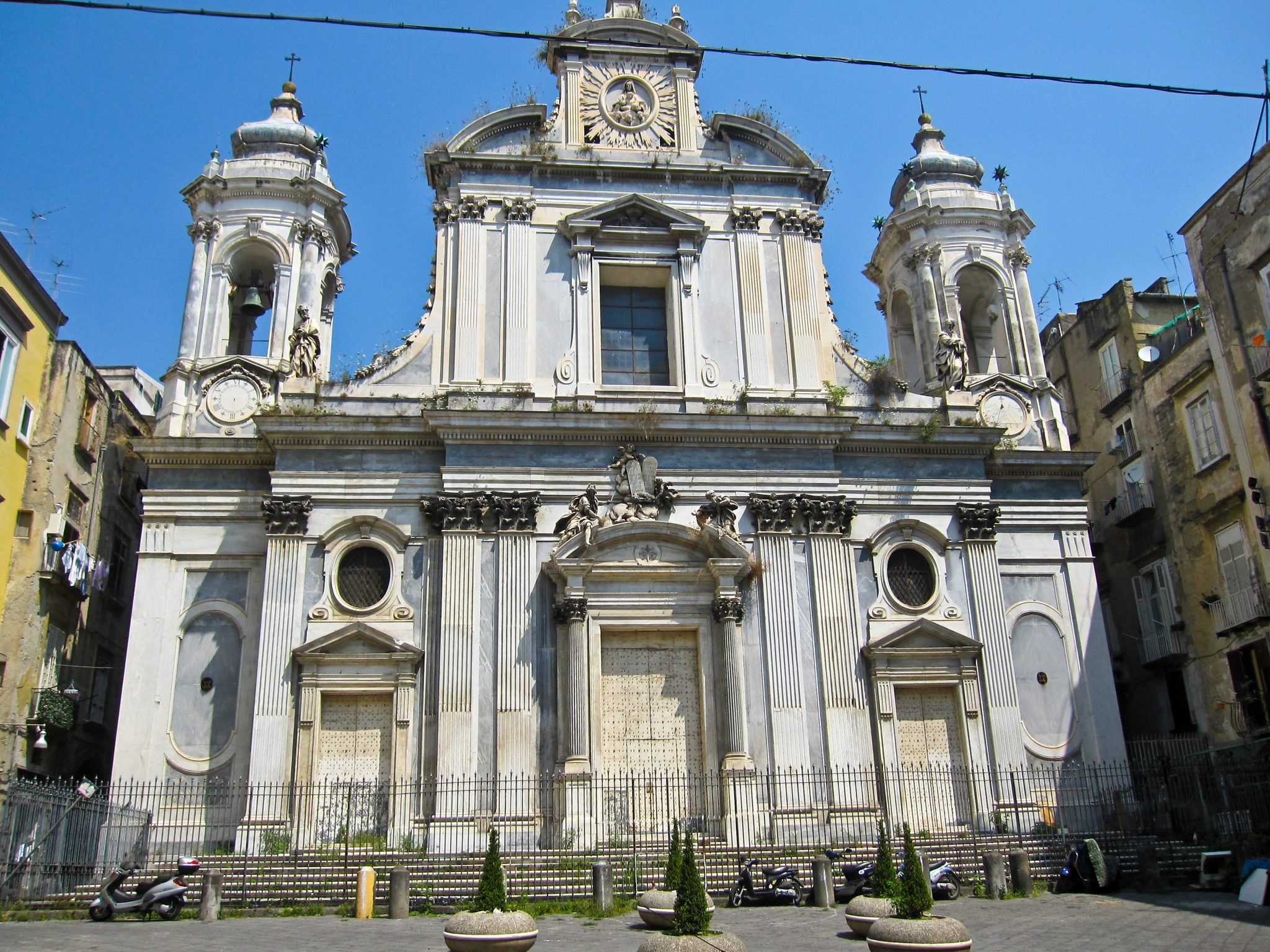
The church is a Baroque basilica on a Latin-cross plan, meaning that a central nave is flanked by lower side aisles and crossed by a transept. It is approximately 68 metres long and 28 metres wide. Twelve granite columns, six on each side, separate the three naves; the columns were brought from the island of Giglio.
The facade is built of white marble and grey bardiglio, a veined marble used for architectural facing. It is arranged in two orders with fluted pilasters and three portals, of which the central portal is the largest. Above it, Giuseppe Sanmartino’s sculptural group presents Moses and Aaron with the Tablets of the Commandments supported by angels. The upper level contains a rectangular window beneath a triangular pediment and a curved broken pediment with a relief of the Madonna and Child known as the Madonna della Vallicella.
Twin bell towers flank the facade. They contain different types of clocks, including a solar clock and a six-hour clock, and carry statues of Saints Peter and Paul begun by Cosimo Fanzago and completed by Giuseppe Sanmartino.
Nave, crossing, and ceiling
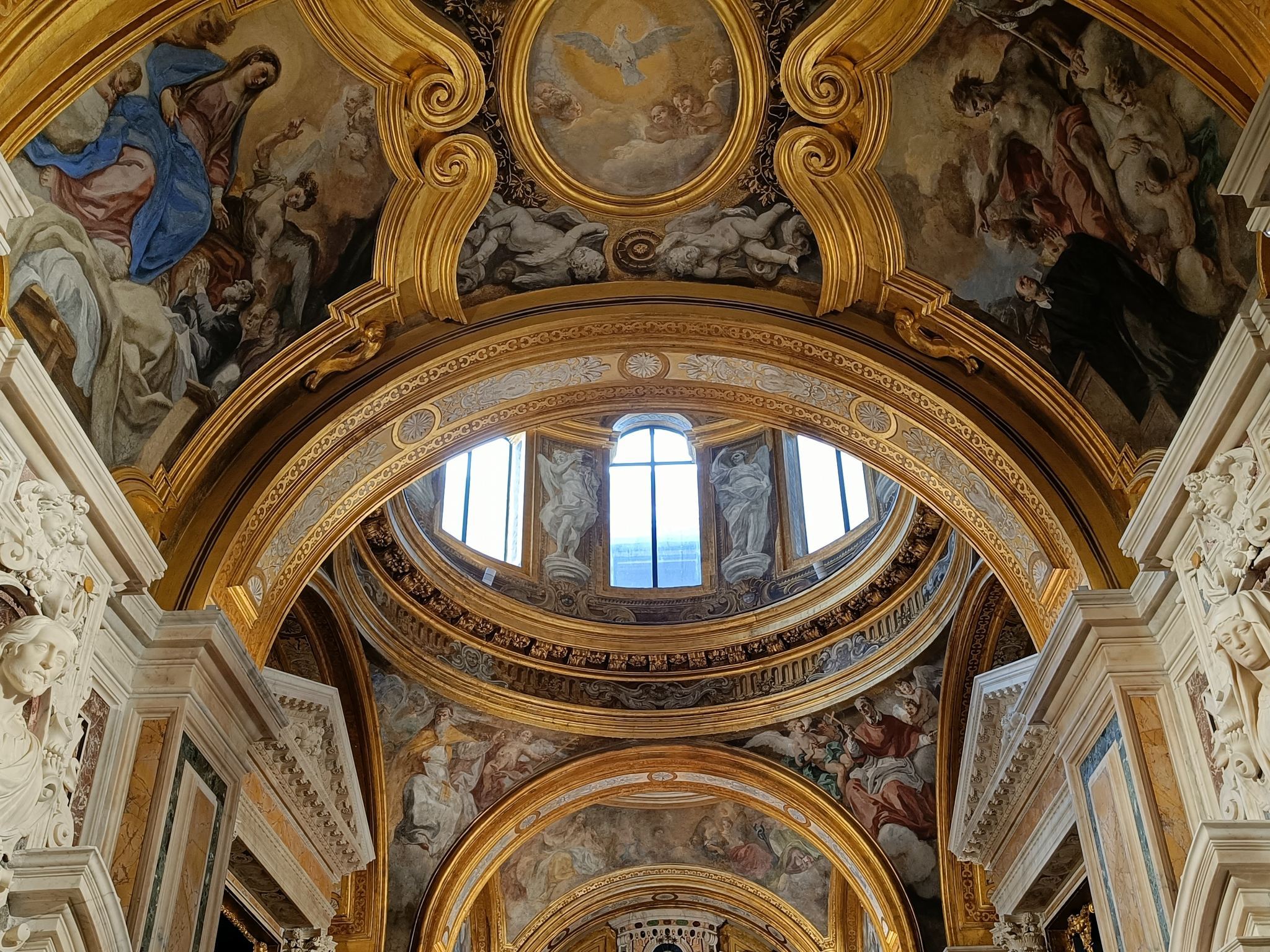
Gilding, marble, and mother-of-pearl gave the interior the nickname Domus Aurea, a reference to the richly decorated palace built by the Roman emperor Nero. The crossing piers have polychrome marble decoration and gilded Corinthian capitals, together with symbols associated with the Oratorians, including white lilies and the Sacred Heart.
Luca Giordano painted the counterfacade fresco of Christ Driving the Money Changers from the Temple in 1684. The entrances to the bell towers carry Ludovico Mazzanti’s 1736 frescoes of The Expulsion of Heliodorus and The Punishment of Uzzah. The coffered ceiling was decorated in 1627 by Marcantonio Ferrara, Nicola Montella, and Giovanni Iacopo De Simone with the Glory of Saint Philip, the Madonna della Vallicella, and figures of angels and archangels. Bombing in 1943 severely damaged this ceiling.
Giovanni Battista Beinaschi painted the saints along the nave arcades in 1681. The dome retains fragments of Camillo Guerra’s Paradise cycle from the 1845 reconstruction, while Ludovico Mazzanti’s Evangelists, painted in the pendentives between 1735 and 1740, survive. Francesco Solimena painted Abraham, Melchizedek, Moses, and David in the transept arcades around 1727 to 1730.
Apse, high altar, and tribune
The rectangular apse is enclosed by a marble balustrade, a railing formed from a series of small supporting posts. Its principal altarpiece, Madonna della Vallicella and All the Saints, is attributed either to Giovanni Bernardino Azzolino or to Luigi Rodriguez. The flanking paintings, The Capture of Christ and The Crucifixion, were painted by Belisario Corenzio around 1615.
Wooden statues of Saints Peter, Andrew, John, and James by Giuseppe Picano, dating to approximately 1780, stand around the high altar. Two white Carrara marble angels by Giuseppe Sanmartino, made in 1787, carry torches beside the balustrade. The present high altar dates from the nineteenth century. Dionisio Lazzari’s original seventeenth-century altar was transferred to the church of Sant’Agata at Sant’Agata sui Due Golfi near Sorrento.
The tribune, the choir and sanctuary area beyond the crossing, contains an artwork attributed to Luca Cambiaso showing angels with the Instruments of the Passion, Giovanni Bernardo Azzolino’s 1603 Lamentation over the Dead Christ, a fragment of Luca Giordano’s painting of angels carrying the Instruments of the Passion from approximately 1680, and an anonymous Flagellation dated to approximately 1605–1610.
Side chapels and transept chapels
Chapels of the nave
The church has eleven side chapels, six on the left and five on the right. Their broadly uniform design reflects the Oratorians’ effort to maintain a consistent plan and decoration. The Chapel of Saints George and Pantaleon contains paintings of Saints Cosmas and Damian by Giovanni Battista Beinaschi, a Guardian Angel attributed to Cesare Fracanzano, Saints George and Pantaleon by Gaetano Gandolfi, and Saint Dominic Soriano with the Virgin, Saints, Mary Magdalene, and Martha, also attributed to Fracanzano. Wooden reliquary busts of Saints Flavian and Just are by Aniello Stellato.
The Chapel of Saint Mary of the Snows and Saint Anne contains Angels and Saint Anne Awakened by the Angel by Francesco Di Maria, Saint Sebastian by Mathias Stomer, a fresco of Saint Mary of the Snows from the school of Polidoro da Caravaggio, and God the Father with Saints Anne and Joachim by Giuseppe Marullo. Wooden reliquary busts of Saints Vitus and Julius are by Aniello Stellato.
The Chapel of Saint Charles Borromeo contains Luca Giordano’s cycle of 1704, including Saint Charles Borromeo Kissing the Hands of Saint Philip Neri, Saint Charles Borromeo and Saint Philip Neri in Prayer, King Saint Canute, Saint Philip Neri Meeting Saint Charles Borromeo at the Building Site of Santa Maria della Vallicella in Rome, and a Madonna and Child. Giovanni Antonio Colicci made its wooden and papier-mache Glory of Saint Philip Neri.
The Chapel of Saint Agnes contains Saint Agnes by Cristoforo Roncalli, known as Pomarancio, and Luca Giordano’s Saint Nicholas of Bari Saving Three Children from a Vat, Saint Januarius in the Amphitheatre, Angels Carrying Vials, and Angels Carrying a Mitre. Guido Reni’s 1622 Saint Francis in Ecstasy is in the Chapel of Saint Francis of Assisi, together with works by Giovanni Maria Morandi depicting Saint Peter of Alcantara, Saint Anthony of Padua, and angels.
The Chapel of Saint Francis de Sales contains works attributed to the school of Fabrizio Santafede showing Saint Jane Frances de Chantal and Saint Francis de Sales. Francesco De Mura painted meetings between Francis de Sales and Jane de Chantal and between Philip Neri and Francis de Sales. Other works include a Madonna with Apostles Peter and Paul by Paolo De Matteis and a wooden reliquary bust of Saint Vitus by an unidentified Neapolitan artist of the mid-seventeenth century.
The Chapel of Saint Alexis contains The Arrest of Saints Peter and Paul from the school of Marco dal Pino, The Dying Saint Alexis by Pietro da Cortona, a Madonna with Saints Joseph and Anthony of Padua by an unidentified early-seventeenth-century Neapolitan artist, and the Archangel Raphael by Pietro del Pò. The Chapel of Saint Joseph contains works by Giacomo del Pò, Fabrizio Santafede, and Andrea Malinconico, including Saint Casimir, King of Poland, the Holy Family with God the Father, the Archangel Gabriel, and Saint Edward, King.
The Chapel of Saint Jerome contains the Virgin with Saint Catherine and Saint Jerome, copied from Correggio, Saint Jerome and the Angel by Francesco Gessi, Saint Francis of Paola by Fabrizio Santafede, the Apparition of the Virgin and Child to Saint Cajetan from the school of Andrea Vaccaro, and Saint Peter by an unidentified Lombard artist of the sixteenth century.
Nativity and Saint Philip Neri chapels
The Chapel of the Nativity in the left transept was built between 1601 and 1605 by Dionisio Nencioni di Bartolomeo from a design by Giovanni Antonio Dosio, for Caterina Ruffo. Pietro Bernini made its marble sculptures of Saints Catherine of Alexandria, Simon, Matthias, Catherine of Siena, Bartholomew, and James around 1606. Jacopo Lazzari made the altar and balustrade, while Fabrizio Santafede painted the Annunciation to the Shepherds and Cristoforo Roncalli painted the Nativity altarpiece, both in 1606.
Jacopo Lazzari designed the Chapel of Saint Philip Neri. It contains seventeenth-century marble sculptures of the Virgin and Christ by Ottaviano Lazzari and a 1647 altar by Dionisio Lazzari. The altarpiece, The Virgin Appearing to Saint Philip, is a 1647 copy of Guido Reni by Giovan Battista Salvi, known as Sassoferrato. Francesco Solimena’s frescoes from 1724 to 1730 depict Paradise, several saints, the Virgin appearing to the dying Saint Philip, the Dove of the Holy Spirit, and Christ appearing to Saint Philip Neri.
Epiphany, Magdalene, and martyr chapels
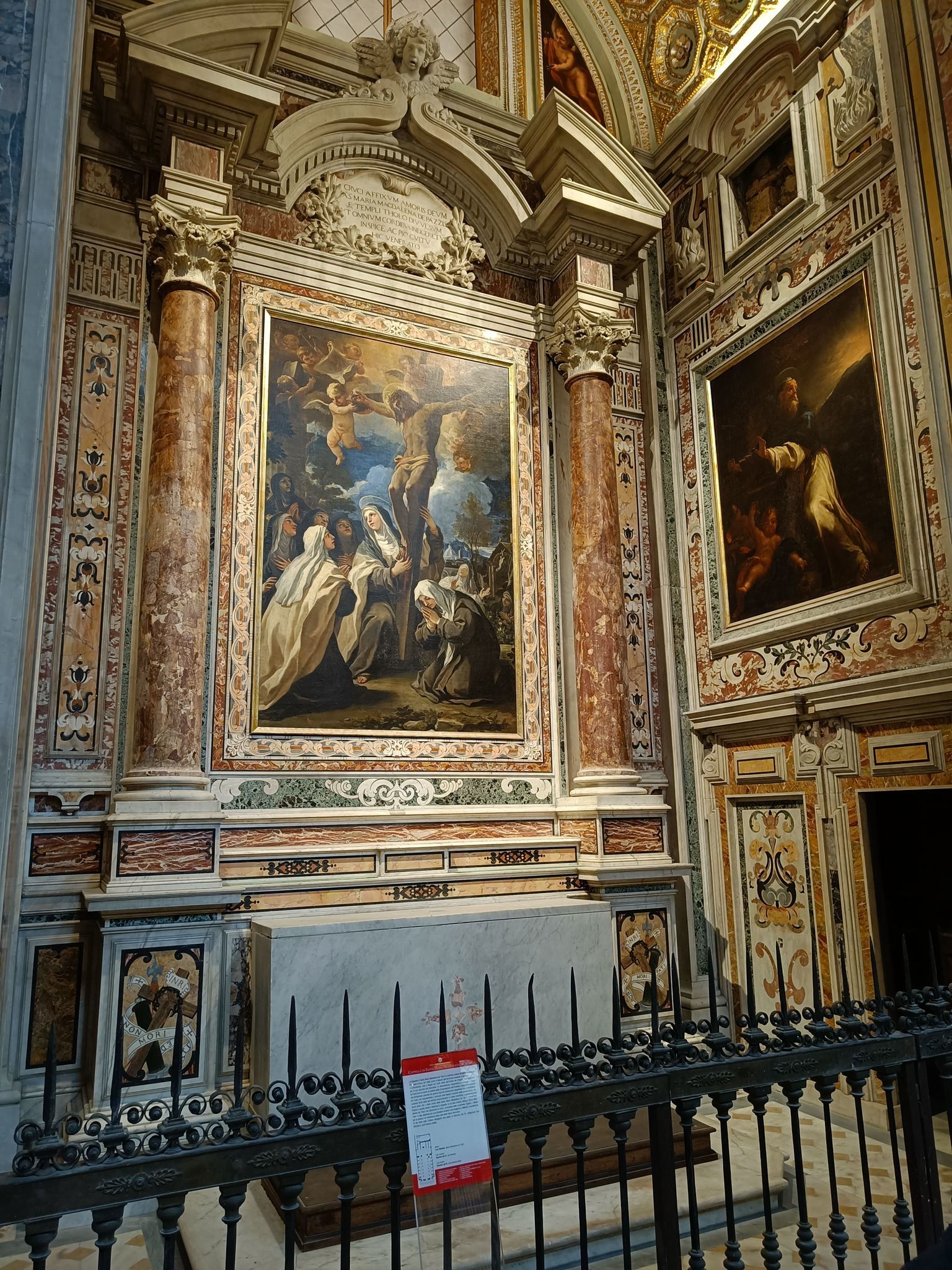
The Chapel of the Epiphany, designed by Jacopo Lazzari, contains Belisario Corenzio’s Epiphany, Giovan Antonio D’Amato’s Martyrdoms of Saint Cordula and Saint Ursula, and Saint Paul by an unidentified Lombard artist of the sixteenth century. The Chapel of Saint Mary Magdalene de’ Pazzi was under the patronage of Father Francesco Gizzio, a long-serving prefect of the Girolamini Congregation who wrote a drama about the saint. Its principal work is Luca Giordano’s Saint Mary Magdalene de’ Pazzi and the Sisters Adoring the Crucifix; it also contains Saint Michael the Archangel and Saint Anthony Abbot by Giacomo del Pò.
The Chapel of the Holy Martyrs in the right transept was built around 1647 entirely in wood, imitating the Nativity chapel. Giuseppe Piscopo painted its altarpiece, All the Holy Martyrs. Its side panels formerly contained wooden reliquaries by Aniello Stellato, of which nine survive. Federico Zuccari’s tympanum painting of the Madonna della Vallicella dates to approximately 1605. The Chapel of the Immaculate Conception contains marble sculptures of Saint John the Baptist and the Christ Child by Michelangelo Naccherino, Cesare Fracanzano’s Immaculate Conception of about 1645, and Giuseppe Simonelli’s fresco cycle of the Triumph of Judith, Prophets, and Saints from 1700 to 1705.
Sacristy and crypt
Sacristy
The sacristy lies behind the apse and is reached through two doors from the transept chapels. Its vaulted ceiling contains a 740-by-400-centimetre fresco of the Glory of Saint Philip Neri, attributed by recent studies to Giovanni Battista Beinaschi and attributed in a 1692 guide to Luca Giordano. The room has a polychrome marble floor, walnut cupboards bearing the arms of Cardinal Vincenzo Maria Orsini of Gravina, later Pope Benedict XIII, eighteenth-century gilded doors, and an altar with a copy of Guido Reni’s Christ Meeting Saint John the Baptist. Leonardo Antonio Olivieri painted the small dome and vault in 1750.
Guido Reni’s original painting of Christ Meeting Saint John the Baptist is now in the Quadreria. Correggio’s Saint Anthony Abbot, dated to approximately 1517–1518, was displayed in the sacristy until 1907 and then transferred to the Capodimonte Museum.
Crypt
The crypt lies beneath the sacristy behind the high altar. One chamber served as a burial place for Oratorian fathers and another as an ossuary, a chamber for storing human bones. The crypt contains a fresco of Saint Philip and a small marble altar. The skulls were traditionally objects of popular devotion, and the crypt has been closed to the public since 1979 except for exceptional access.
Oratories and cloisters
Oratorio dell’Assunta
The Oratorio dell’Assunta, also called the Oratorio degli Artisti, is one of five oratories in the convent. It is reached from the church’s right side aisle and was used by artists and their assistants. It retains a religious function and has late-sixteenth- and eighteenth-century decoration, including an altarpiece of the Assumption attributed to Fabrizio Santafede and eighteenth-century frescoes by Giuseppe Funaro and Crescenzo Gamba. Gamba also painted its trompe-l’oeil ceiling decoration.
Convent entrances and small cloister
The convent facade has two entrances. The left entrance leads through a broad staircase and the Oratorio dell’Assunta to the church’s right nave. The right entrance leads to the two cloisters and the other convent spaces.
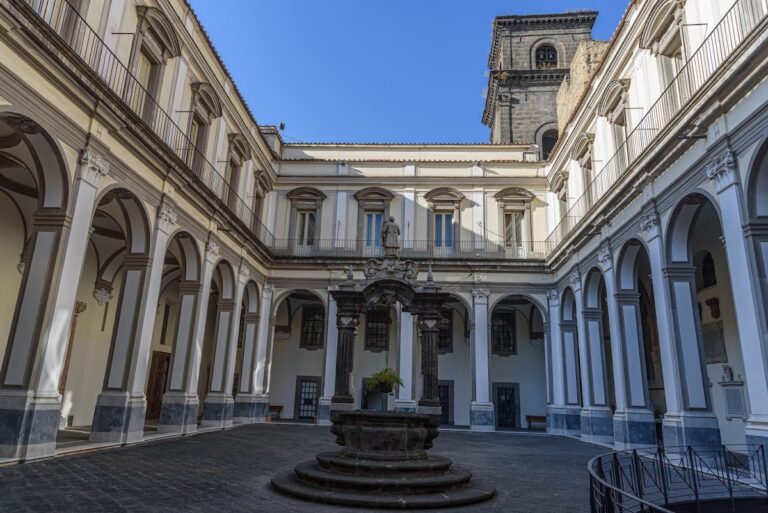
The small square cloister, known as the Maiolicato or Chiostro della Porteria, was designed by Giovanni Antonio Dosio on the site of the Palazzo Seripando. Its arcades rest on four columns on each side, with piperno corner pilasters and two half-columns. The central well dates from the late sixteenth century. The present maiolica and terracotta paving, made from decorated glazed earthenware, dates from the late nineteenth century. Barrel-vaulted walks surround the cloister, which is associated with a clock tower bearing a relief of the Madonna della Vallicella held by angels.
Chiostro degli Aranci
The larger Chiostro degli Aranci was built in the 1630s to designs by Dionisio Nencioni di Bartolomeo and Dionisio Lazzari. Its name refers to the citrus trees cultivated in the lower garden. Monumental arcades surround the cloister, with eight arches on each shorter side and nine on each longer side. Strong pilasters, garlanded capitals, mascarons, and the contrast between dark piperno and white walls give the architecture a Tuscan influence. Two iron-railed stairways connect the lower garden with the ambulatory.
The larger cloister provides access to the Oratories of the Doctors, Purification, Saint Joseph, and Merchants, as well as to the historic library and the Quadreria on the upper floor.
Library and Quadreria
Girolamini Library
The Girolamini Library contains approximately 200,000 manuscripts, including around 6,500 manuscripts concerning musical compositions and works dating from the sixteenth to the nineteenth centuries. A room dedicated to Giambattista Vico preserves first editions of all his works, donated by the Neapolitan philosopher and historian.
Quadreria
The Quadreria occupies rooms on the first floor of the convent. Its collection includes works by Battistello Caracciolo, Massimo Stanzione, Francesco Solimena, Jusepe de Ribera, Luca Giordano, Guido Reni, Federico Zuccari, Francesco Vanni, Francesco Curradi, Francesco Gessi, Andrea Vaccaro, Paolo De Matteis, Ludovico Mazzanti, and Giuseppe Sanmartino. It also brings together Neapolitan, Roman, Bolognese, Tuscan, Flemish, and Cretan traditions.
Among its paintings are Andrea Sabatini’s 1513 Adoration of the Magi, works by Cavalier d’Arpino, Federico Zuccari, Lucas van Leyden, and Bartholomeus Spranger, and a Cretan Madonna and Child. The collection also contains works by Santafede, Azzolino, and Pomarancio, Caravaggist paintings by Battistello Caracciolo and Jusepe de Ribera, Massimo Stanzione’s Supper at Emmaus, Guido Reni’s Flight into Egypt and Christ Meeting Saint John the Baptist, and paintings by Andrea Vaccaro, Paolo De Matteis, Luca Giordano, and Ludovico Mazzanti. Wooden sculptures include a Crucified Christ and a Pietà by Giuseppe Sanmartino.