Freudenfels Castle: A Former Fortified Residence and Administrative Seat in Switzerland


Site at a Glance
- Rating
- 4.7
- Popularity
- Low
- Country
- Switzerland
- Primary era
- Early Modern
- External website
- Open
- Eras represented
- Medieval, Early Modern
- Civilizations
- Holy Roman Empire
- Site type
- Domestic
- Remains
- Castle
On this page5 sections
History
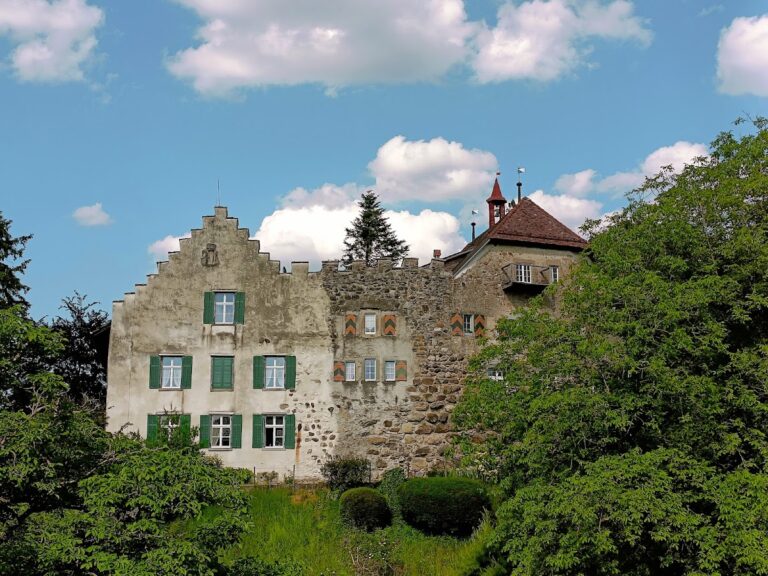
Freudenfels Castle is a historic castle in Eschenz, Switzerland, probably built by the Lords of Eschenz in the twelfth or thirteenth century as a fortified residential tower. Located about 1 kilometre southeast of Eschenz on a rocky spur above the southern shore of the Untersee, it helped secure the transport hub at Stein am Rhein together with Hohenklingen and Oberstaad castles. It also became the administrative seat of the Freudenfels judicial lordship.
From medieval stronghold to Austrian possession
The castle was first recorded in 1359, when it passed from the Lords of Hohenklingen to the dukes of Austria. Its medieval tower was remodelled in 1617, and a residential wing was added. After several further changes of ownership, the castle and the lordship came into the possession of Einsiedeln Abbey in 1623.
The Einsiedeln period
Einsiedeln Abbey, a Benedictine monastery in Switzerland, united the castle and lordship with its Eschenz office to create the Freudenfels–Eschenz judicial lordship. A judicial lordship was a territory in which a lord or institution exercised defined judicial and administrative rights. The acquisition was promoted by Augustin Hofmann, the ruling abbot of Einsiedeln, and by the Swiss Benedictine Congregation as part of an effort to advance the re-Catholicization of the area.
The lordship covered approximately the territory of the present municipality of Eschenz, along with properties in Kaltenbach, Wagenhausen, and Nussbaumen. Freudenfels served as the seat of Einsiedeln’s governor from 1623 to 1985. Between 1730 and 1922, it was also the residence of Eschenz’s Catholic parish priest, who was a monk of Einsiedeln.
Baroque transformation and later use
Renovation of the complex began in 1692 under Caspar Moosbrugger, an architect and lay brother associated with Einsiedeln. In 1747, Abbot Nicolaus Imfeld commissioned the master builder Frank Singer to carry out a Baroque transformation. This work gave the castle its present architectural character, and the complex later served as a summer residence for monks of Einsiedeln Abbey.
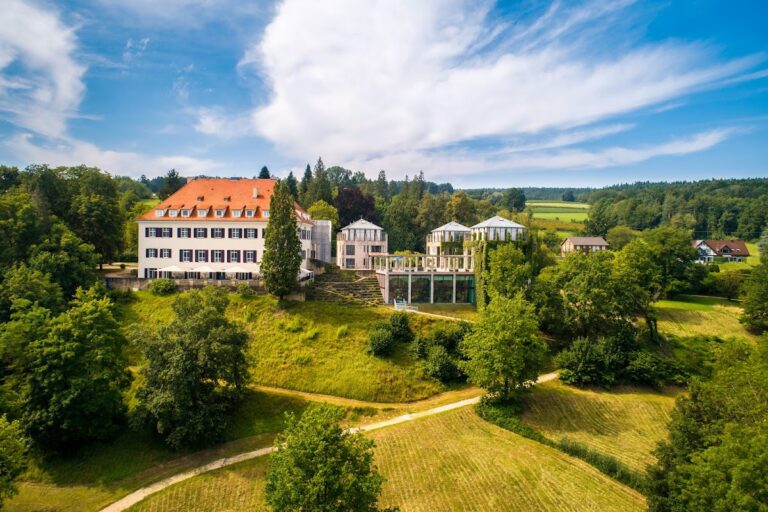
During the Helvetic period, the centralized phase of government in Switzerland from 1798 to 1803, the Freudenfels–Eschenz lordship lost its judicial privileges. The property gradually became the castle complex and agricultural operation that it is today, while remaining in the possession of Einsiedeln Abbey. In 1988, the castle and its ancillary buildings were leased to Marti Holding AG, and between 1989 and 1992 the complex was adapted as a training and continuing-education centre.
Since 1996, the tenant has been Schloss Freudenfels AG, held through the Liechtenstein Academy Foundation by the Princely House of Liechtenstein. Freudenfels is used as a venue for celebrations and seminars. The castle is recognized as a Swiss heritage site of national significance.
Remains
Freudenfels Castle occupies a rocky spur on the southern shore of the Untersee, approximately 1 kilometre southeast of Eschenz. The original principal structure was a fortified residential tower, reflecting the castle’s medieval defensive and residential purpose. The tower was remodelled in 1617, when a residential wing was added, and the wider complex later developed to include ancillary buildings and an agricultural operation.
The Baroque transformation commissioned in 1747 produced the architectural appearance of the castle today. The complex was subsequently adapted between 1989 and 1992 for use as a training and continuing-education centre, while its buildings and associated agricultural operation continued to form the physical ensemble of Freudenfels.