Fortress of Komárno: A Habsburg Frontier Fortress in Slovakia


Site at a Glance
- Rating
- 4.5
- Popularity
- Medium
- Country
- Slovakia
- Primary era
- Early Modern
- External website
- Open
- Eras represented
- Early Modern, Modern
- Civilizations
- Habsburg
- Site type
- Military
- Remains
- Citadel
On this page11 sections
History
The Fortress of Komárno is a sixteenth-century Habsburg military complex in Komárno, Slovakia, at the meeting point of the Danube and Váh rivers. Its Old Fortress was begun in 1546 as a Renaissance-era frontier defense, and the complex later protected Habsburg-ruled Hungary against the expanding Ottoman Empire.
Creation of the Old Fortress
The fortress gained strategic importance after the Ottoman invasion of Hungary in 1526 and the capture of Buda in 1541. These events brought Komárno into the frontier zone between the Habsburg and Ottoman empires. The Old Fortress was built on the foundations of a medieval castle, following plans associated with the Italian master builder Pietro Ferrabosco and the Alsatian military architect Daniel Specklin.
The completed defenses played a central role in the region’s military security. In 1594, an Ottoman army of 100,000 men attempted to capture Komárno, but the fortress resisted the attack. Its defenses were strengthened between 1673 and 1683 as pressure on the frontier continued.
The New Fortress and the Ottoman frontier
The Ottoman conquest of nearby Nové Zámky in 1663 led to the decision to construct a second major fortification at Komárno. Master builder Franz Wymes was commissioned to build the New Fortress, which was completed in 1673. The Old and New Fortresses later became known collectively as the Citadel.
Flooding severely damaged the fortress in 1682, prompting Emperor Leopold I to order repairs and restoration. The following year, the army of Emmerich Thököly besieged the stronghold but failed to take it. The Ottoman defeat near Vienna in 1683 changed the military balance in the region, and Komárno subsequently lost its role as a frontier bastion. The fortress was never captured by the Ottomans.
Abandonment and renewed military use
An earthquake in 1783 caused extensive damage. Military authorities judged the cost of repair uneconomical, and the fortress was abandoned as a military installation. Emperor Joseph II donated the site to the city, while its buildings were sold at auction in 1784.
The complex regained military importance during the Napoleonic Wars. It was prepared for renewed military use in 1808, and new barracks were built in one of its courtyards in 1810.
The revolutions of 1848–1849
During the Revolution and the Hungarian War of Independence of 1848–1849, Hungarian revolutionary troops held the fortress under General Klapka. Austrian forces besieged it several times. After the Third Battle of Komárno, Klapka’s army was encircled, and the final siege began on 13 July 1849.
After several months, the Hungarian garrison surrendered. The fortress was handed over to the victorious Austrian forces on 2 October 1849, ending its role in that conflict.
Imperial fortification and twentieth-century transitions
By the end of the nineteenth century, Komárno had developed into the largest fortification system in the Austro-Hungarian Empire. The system was strengthened through field fortifications in 1914 and 1915 under a peacetime general equipment plan. It was officially decommissioned in early January 1918, and the fortress had lost its strategic importance by the end of the First World War.
After the dissolution of the Austro-Hungarian Empire, the fortress on the left bank of the Danube passed to the Czechoslovak Republic under the Treaty of Trianon, the 1920 peace settlement that assigned territories of the former Kingdom of Hungary to the new state. The buildings were then used as barracks by the Czechoslovak Army.
Following the 1968 occupation of Czechoslovakia by Warsaw Pact forces, Red Army soldiers were quartered in the fortress. After the Velvet Revolution, the largely peaceful political transformation of Czechoslovakia in 1989 that ended Communist rule, Soviet troops withdrew. The Army of the Slovak Republic used the complex from 1993 to 2003.
In 2003, the city of Komárno purchased the Old and New Fortresses. The acquisition was intended to support reconstruction, preserve the complex’s historic character, and make it accessible to the public.
Remains
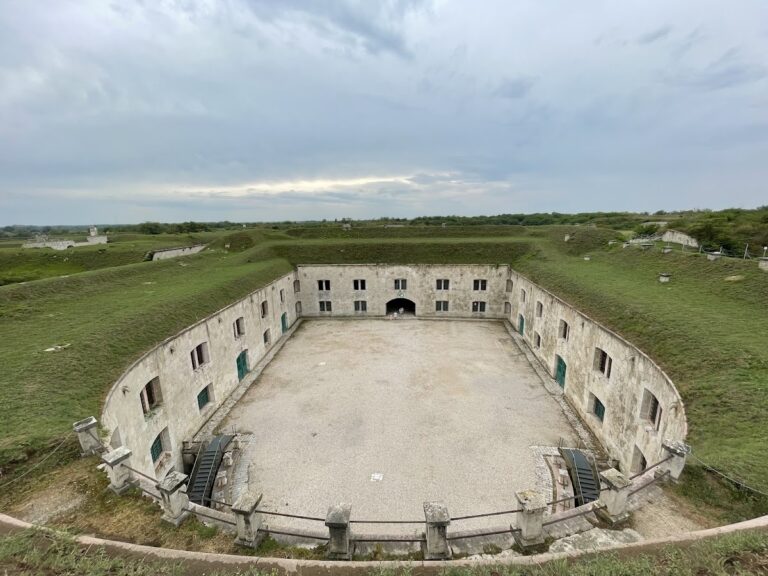
The surviving fortress occupies the strategic meeting point of the Danube and Váh. Its defensive layout consists of the Old Fortress and the later New Fortress, linked into a larger complex of bastions, courtyards, protected internal spaces, gates, and surrounding moats.
Old and New Fortresses
Old Fortress
The Old Fortress follows the foundations of the medieval castle and forms the earlier core of the complex. It had five bastions, or projecting fortified platforms that allowed defenders to cover the walls and approaches with fire. Two inner courtyards organized the interior, while casemates, protected vaulted spaces used for troops and other military purposes, accommodated guards around the courtyards.
A moat enclosed the Old Fortress, and access was concentrated through the Ferdinand Gate. The fortification’s surviving arrangement reflects its transformation from a medieval stronghold into a planned sixteenth-century defensive work.
New Fortress
The New Fortress was completed in 1673 and extended the defensive system beyond the Old Fortress. It also had five bastions and was connected to the older fortification through its two eastern bastions. A wide moat surrounded the New Fortress, reinforcing the separation between the defended complex and its approaches.
The principal entrance was the well-guarded Leopold Gate. The western bastion bears the inscription “NEC ARTE, NEC MARTE,” meaning “Neither by cunning nor by force.” The inscription expresses the defensive character associated with the fortress and remains part of the surviving fabric.
Barracks
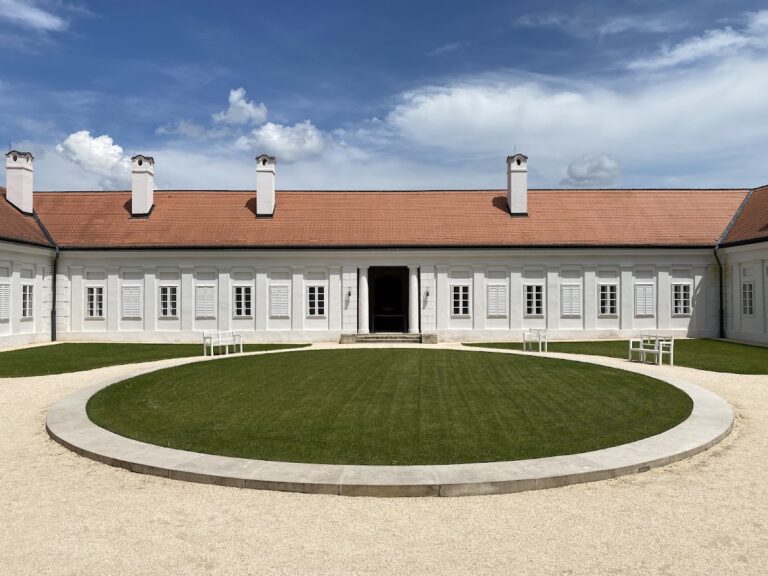
New barracks were built in one of the fortress courtyards in 1810, when the complex was prepared for renewed military use during the Napoleonic Wars. These buildings form part of the later military adaptation of the older defensive layout.