Fortress of Arad: Habsburg Border Fortress and Military Prison
Site at a Glance
- Popularity
- Medium
- Country
- Romania
- Primary era
- Early Modern
- Eras represented
- Early Modern
- Civilizations
- Habsburg, Habsburg Austria
- Site type
- Military
- Remains
- Fort
On this page11 sections
History
From Ottoman frontier to Habsburg fortress
The Fortress of Arad is an eighteenth-century Habsburg fortification in Arad, Romania. Built from 1763 to 1783, it followed the Vauban-Tenaille style, an Austrian-developed system of bastioned defenses with inward-bent lines. It was intended to protect the Habsburg Empire’s outer regions and later served as a major military prison.
After Habsburg forces advanced east from 1685, Arad passed from Ottoman control in 1687 following their victory at the second Battle of Mohács. In 1689, Prince Eugene of Savoy proposed rebuilding and strengthening an earlier rectangular Ottoman fortress on the opposite bank of the Mureș River. After consulting Maria Theresa, the decision was instead made to build a new complex on a peninsula south of the city.
The 1699 Treaty of Karlowitz established the Habsburg-Ottoman border along the Mureș, and Arad became a center of the Habsburg Military Frontier, a border-defense zone organized along the Ottoman frontier. The first border troops, recruited from among Serbs, arrived in August 1699. Arad retained its frontier-administration role until 1751.
Maria Theresa ordered the new fortress, designed by Austrian general and architect Ferdinand Philipp von Harsch. Construction took place from 1763 to 1783 under Johann Georg Haruckern, with thousands of prisoners employed. Because the site lay across the river from Arad, in Banat’s then-Temes County, the Temeswar regional administration oversaw and financed the work and its military buildings. Once complete, the fortress formed part of the empire’s inner defenses. Its regular garrison was the 33rd Infantry Regiment of the Imperial Habsburg Army.
Garrison and prison
The fortress lost strategic importance after the last Ottoman war, but it acquired a new role as a place of confinement. In 1794 it held 1,200 French soldiers involved in the Napoleonic Wars. It later became one of the largest military prisons in the empire.
Revolution and executions
During the Hungarian Revolution of 1848-49, a revolt against Habsburg rule that sought Hungarian self-government, the Hungarian Republican Army besieged the fortress from October 1848 until June 1849. Hungarian forces occupied it that summer, but Habsburg troops retook it after 46 days. More than 500 officers were imprisoned there, and most were sentenced to death.
On 6 October 1849, 13 Hungarian Republican officers were executed outside the fortress’s eastern outer fort. Ernő Kiss, József Sweidel, Arisztid Dessewffy, and Colonel Vilmos Lázár were shot. Ernő Poeltenberg, János Damjanich, Lajos Aulich, György Láhner, József Nagysándor, Károly Leiningen-Westerburg, Károly Knezich, Ignác Török, and Károly Vécsey were hanged. They became known as the Martyrs of Arad.
Emperor Franz Joseph I visited in 1852 and ordered some pardons. Eftimie Murgu, a Romanian revolutionary, was among the prisoners. Franciscan friars, members of a Catholic religious order, lived in the fortress’s monastic complex beside the church. The last four monks left in 1861; the associated buildings became a hospital, and the church was converted into a military hospital.
Wartime detention and changing armies
During the First World War, the outer forts housed an improvised detention camp for thousands of Serbian soldiers and civilians from Bosnia-Herzegovina. From 1914 to 1918, 4,317 detainees died from typhus and mistreatment, and were buried in mass graves at Pomenirea Cemetery. Among the prisoners associated with the fortress was Gavrilo Princip, who assassinated Austro-Hungarian heir Archduke Franz Ferdinand and his wife Sophie in Sarajevo on 28 June 1914, an event that led to the outbreak of the war. In 1917, Romanian National Party deputy Ștefan Cicio Pop warned the Hungarian parliament about the inhumane conditions facing prisoners.
French and Serbian troops occupied the fortress in November 1918, and the Romanian Army took it over in July 1919. Between the world wars, it served as the garrison of the 93rd Infantry Regiment of Romania’s 1st Infantry Division. The regiment fought on the Eastern Front during the Second World War. Many soldiers from the Arad garrison died in fighting in the Kalmyk Steppe, south of Stalingrad, on 20 November 1942.
Postwar military use
After the Romanian-Soviet armistice of 12 September 1944, the Red Army occupied Arad and stationed a Soviet tank division at the fortress. That unit withdrew in 1958, and a Romanian tank regiment then took its place. Following the Romanian Army’s 1995 reorganization, the newly formed 191st Infantry Battalion “Colonel Radu Golescu” was based there. Since 1999, its 400 soldiers have served as part of a mixed Romanian-Hungarian peacekeeping battalion, and the fortress is the battalion’s headquarters. The complex was designated a Romanian historic monument in 2004.
Remains
Central fortification
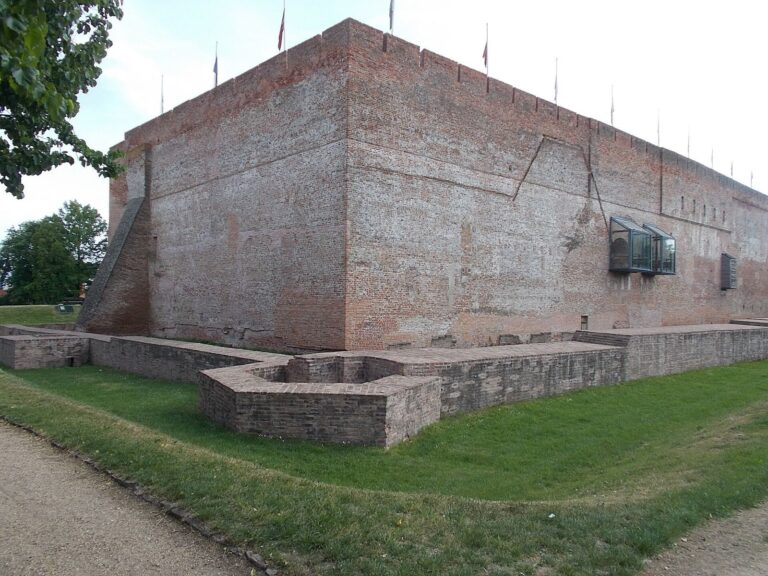
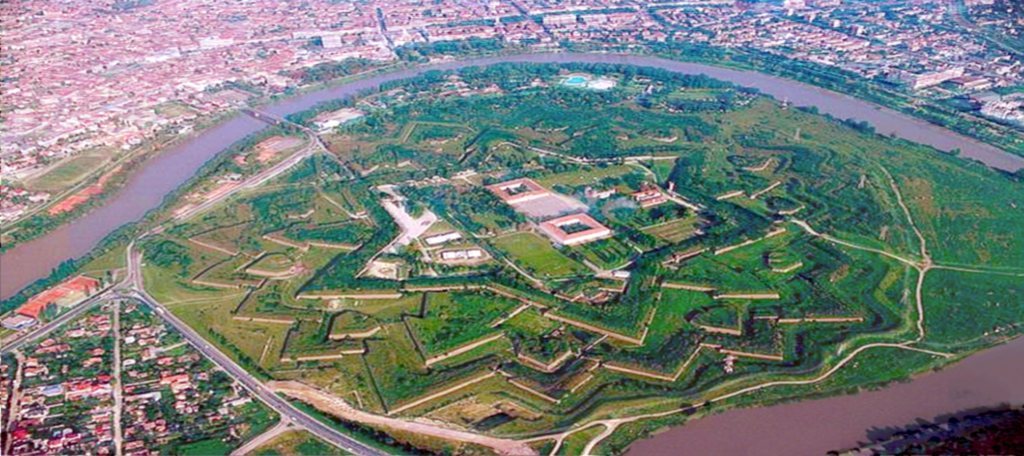
The fortress occupies a peninsula on the left bank of the Mureș, just south of Arad’s center. Its regular plan forms a six-sided star with alternating projecting and recessed angles. Six bastions, projecting sections of the main defenses, make up the inner ring. The enclosure has a circumference of 3,180 metres, with 296 gun openings across its defenses. Three rows of masonry walls are separated by earth-filled spaces, and one wall is three metres thick. Protected vaulted spaces, known as casemates, and three rows of underground bunkers are built into the fortification. Defensive passages were roofed or covered.
The long curtain walls, which connect the bastions, use inward-bent sections in a tenaille arrangement. The main enclosure’s fronts also turn slightly inward. These features reflect the distinctive system developed by Austrian fortress engineers.
Outer defenses
In front of the inner ring are six ravelins, or outer defensive works, and twelve lunettes, smaller detached works with two projecting faces. The ravelins rise to the height of the curtain walls. A covered ditch encloses the fortress, while three outer works could be flooded from the Mureș. The river also fed a water-filled moat, and a sloping earthwork, called a glacis, formed part of the outer defenses.
Gate and interior buildings
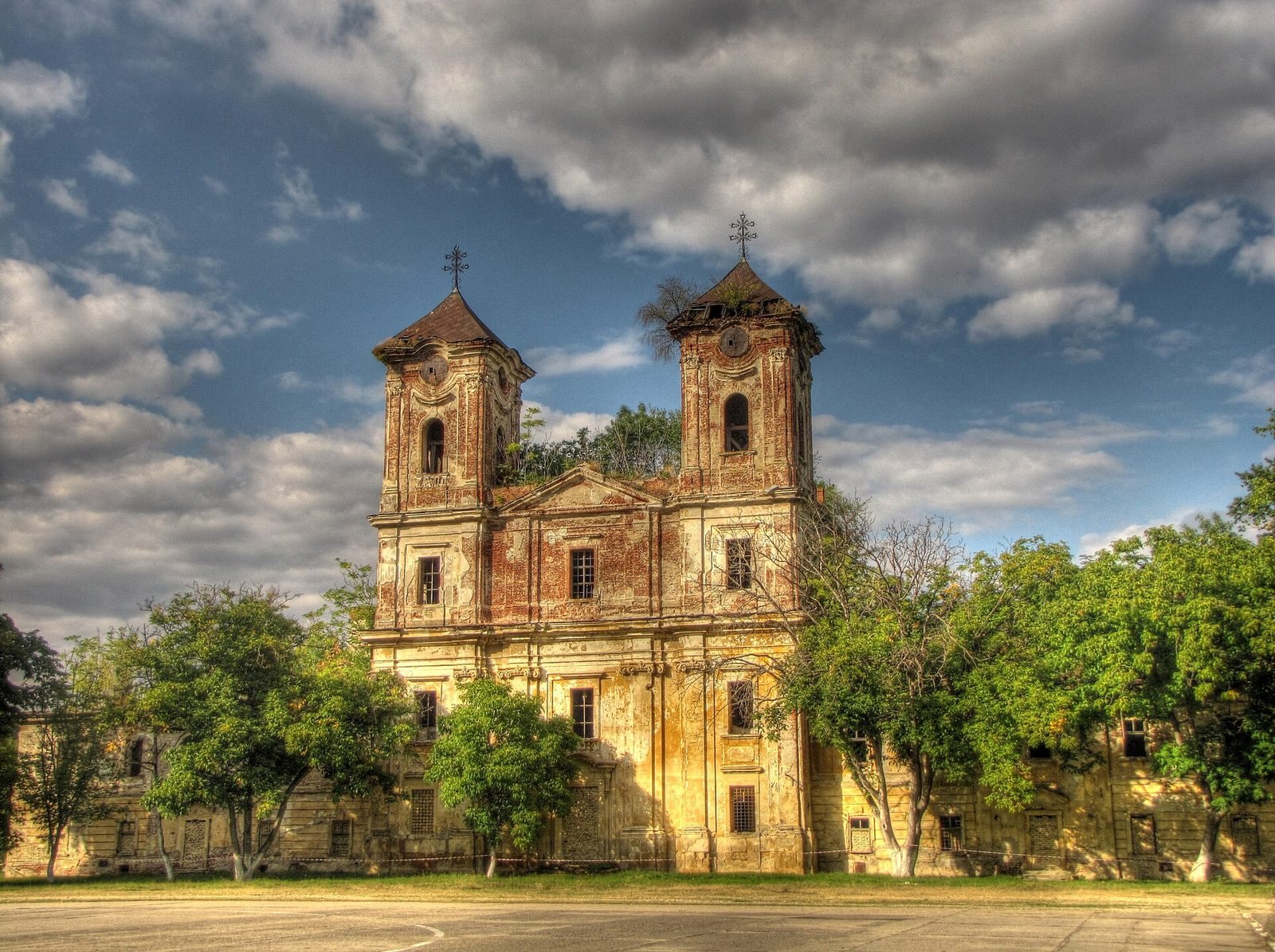
The main gate and buildings within the fortress were built in the Baroque style. Its interior included military administration and guard buildings, barracks, a Catholic church, and a Franciscan monastery complex. The barracks could normally house 2,940 soldiers, with capacity for up to 4,030. The church stood at the center, surrounded by monastery buildings associated with St. John of Capistrano, a fifteenth-century Franciscan preacher. The church and adjoining buildings are now generally derelict.
Memorial plaque
A plaque at the fortress entrance commemorates the Serbian soldiers and civilians who died in wartime detention there.