Gyula Castle: A Gothic Frontier Fortress in Hungary
Site at a Glance
- Rating
- 4.7
- Popularity
- High
- Country
- Hungary
- Primary era
- Medieval
- External website
- Open
- Eras represented
- Medieval, Early Modern
- Civilizations
- Habsburg, Hungarian, Ottoman
- Site type
- Military
- Remains
- Castle
On this page17 sections
History
Gyula Castle is a medieval Gothic brick fortress in Gyula, Hungary, built and developed from the fourteenth century as the center of a major estate and later as a frontier fortress. It stands in central Gyula on the Great Hungarian Plain, a broad, predominantly flat lowland region of central Europe. The settlement gained importance after King Charles I of Hungary made it the center of a newly organized estate and granted it urban privileges. Documents refer to Gyula as a market town from 1419, and the castle became the economic, political, and cultural center of its surrounding region.
Foundation and the Maróti estate
In 1403, King Sigismund granted the Gyula estate to János Maróti, Ban of Macsó, who is associated with the castle’s construction. A legal case from 1405 already names two castle commanders, probably indicating that building work was underway. Much of the present fortress stood by 1445, when its chapel was consecrated on June 10 by Nicholas, Bishop of Tripoli and auxiliary bishop of Eger.
The castle developed in stages as the needs of its lords expanded. Its courtyard buildings grew during the fifteenth century, and the complex combined aristocratic residence, administration, storage, and defense. This development took place during the Zsigmond period, the reign of King Sigismund of Luxembourg, who ruled Hungary from 1387 to 1437.
The Crown and the Hunyadi family
After the Maróti family died out in 1476, Gyula reverted to the Crown. King Matthias Corvinus retained the estate for six years before granting it in 1482 to his illegitimate son, János Corvinus. At that time, the estate included 83 villages and abandoned settlements. A charter of 1484 assigned János Corvinus the office of Békés County’s ispán, the royal official responsible for administering a medieval Hungarian county. The future castle commander also received the office, making Gyula the county’s administrative center.
János Corvinus continued the construction of the castle courtyard and added a gallery supported by buttresses at first-floor level. After his death in 1504 and the death of his son Christopher, his widow Beatrix Frangepán temporarily governed the castle and estate. She also held the office of county ispán, an unusual position for a woman in medieval Hungarian history. Their daughter Elizabeth Corvinus, the last female member of the Hunyadi family, died at Gyula Castle in 1509.
At the king’s request, Beatrix married George of Brandenburg. After her death in 1510, Gyula passed to her husband. During the early sixteenth century, the castle’s residential role declined as firearms forced changes to medieval defenses. The complex increasingly served military purposes, while new artillery arrangements altered its earlier aristocratic character.
Sieges and royal frontier defense
A smaller peasant army attacked Gyula unsuccessfully during the 1514 peasant uprising led by György Dózsa. After the Hungarian defeat at Mohács in 1526, George of Brandenburg supported King Ferdinand. Forces loyal to János Szapolyai then besieged Gyula for almost a year. The defenders eventually surrendered after starvation weakened them, and the castle passed to Imre Czibak, commander of the besieging army.
After Czibak was murdered in 1534, Gyula passed first to Miklós Patócsy and then to his brother Ferenc. In 1552, the Patócsy family exchanged Gyula for Boldogkő Castle with Ferdinand, returning Gyula to royal ownership. That same year, the Ottoman capture of Temesvár and Szolnok made Gyula a first-line frontier fortress, a fortified stronghold positioned to defend a border zone and support military operations. It formed an important barrier north of the Maros.
Gyula’s soldiers collected taxes in competition with the defenders of Eger and conducted raids into the regions east of the Tisza and between the Tisza and Danube. In December 1560, Ferdinand appointed László Kerecsényi, formerly captain of Szigetvár, as castle captain. Kerecsényi began modernizing the fortress, while the Italian military engineer Paolo Mirandola prepared expansion plans in 1562. After Mirandola left Gyula, Kerecsényi continued the work. At one stage, as many as 3,000 people worked on the earthworks, although the planned conversion to a fortress with Italian-style bastions, projecting fortifications designed for artillery and overlapping defensive fire, was only partly completed.
The Ottoman siege of 1566
Ottoman forces under Pasha Pertev surrounded the town and castle on July 2, 1566. The Ottoman army numbered approximately 30,000, while the garrison probably contained no more than 2,000 soldiers. Hungarian, German, Croatian, Serbian, and Czech defenders held the fortress. The first assault began on July 11 against the Hussar Castle, part of the outer defenses. The defenders held it for 13 days before withdrawing across the moat to the main castle on July 23.
The Ottomans turned the captured Hussar Castle into an artillery position against the main fortress. Dried wells, disease, unburied bodies, and a dysentery epidemic severely weakened the defenders. No relief army arrived, and many women and children had taken shelter inside the castle. Kerecsényi therefore negotiated with the Ottomans while seeking to protect the civilian population.
The main castle held until August 20, completing 28 days in the second phase of the siege. Negotiations over surrender began on August 21, and the defenders withdrew on September 2. Ottoman janissaries then plundered the retreating force and massacred many of its members. Kerecsényi was captured and later executed at Belgrade.
The siege lasted 63 days, making it the longest Ottoman siege of a Hungarian frontier fortress. Gyula was not taken by a successful assault. Possession changed after encirclement, starvation, and negotiation rather than unconditional military capitulation. Under Ottoman rule, Gyula became part of the Temeşvar Province, and the governor of the Arad district moved his seat there. The Ottomans repaired the damage from the siege but made few major improvements, even though Gyula was the province’s most profitable district center. The castle later became the seat of pashas and one of the principal Ottoman strongholds east of the Tisza after Temeşvar.
Reconquest and the end of military importance
The Ottomans surrendered Gyula after a blockade and food shortage during the Habsburg reconquest. Representatives of Mehmed Pasha signed an agreement at Szeged on December 21, 1694. The emperor approved it on Christmas Day, and the pasha of Gyula signed on January 10, 1695. Christian forces took possession on January 18, ending 129 years of Ottoman rule. Approximately 2,000 Ottoman inhabitants, including women and children, left for Temeşvar on January 20.
After the Arad fortress was built between 1698 and 1701, Gyula lost its strategic importance. The Court War Council ordered its demolition in 1700. The castle nevertheless played a role in the 1705 Rákóczi uprising, an insurrection led by Francis II Rákóczi against Habsburg rule. On May 31, General Sándor Károlyi attacked a garrison of approximately 300 Serbian and 200 Austrian soldiers with 6,701 Kuruc troops. The Kuruc were insurgents who fought Habsburg rule, especially during Rákóczi’s uprising.
Károlyi’s forces captured the Hussar Castle, but a mine explosion attempted on June 24 failed to bring down the main wall. Gyula remained under the authority of the Arad command until July 26, 1721. It then passed to János György Harruckern, who removed the soldiers living there and began dismantling the outer palisade. During the Péró uprising in 1735, estate hajduks and nobles sheltering in the castle defeated the attacking peasants. The fortress had no further military role.
Memory, reuse, and preservation
In August 1849, after the suppression of the Hungarian Revolution of 1848–49, surrendered Hungarian Honvéd officers were brought to Gyula because of a cholera outbreak. Honvéd referred to soldiers of the Hungarian revolutionary forces. János Damjanich was held there from August 18, and his room was in the gatehouse area at night. The adjacent room served as Lahner György’s cell. Officers assembled between the castle and the palace on August 22 and 23 before Russian troops disarmed them. Tradition places nine of the Thirteen Martyrs of Arad at Gyula, while some research counts ten. The officers were handed over to the Austrians on August 24 and transported to Arad. The Thirteen Martyrs were Hungarian military leaders executed by the Austrian authorities after the revolution’s defeat.
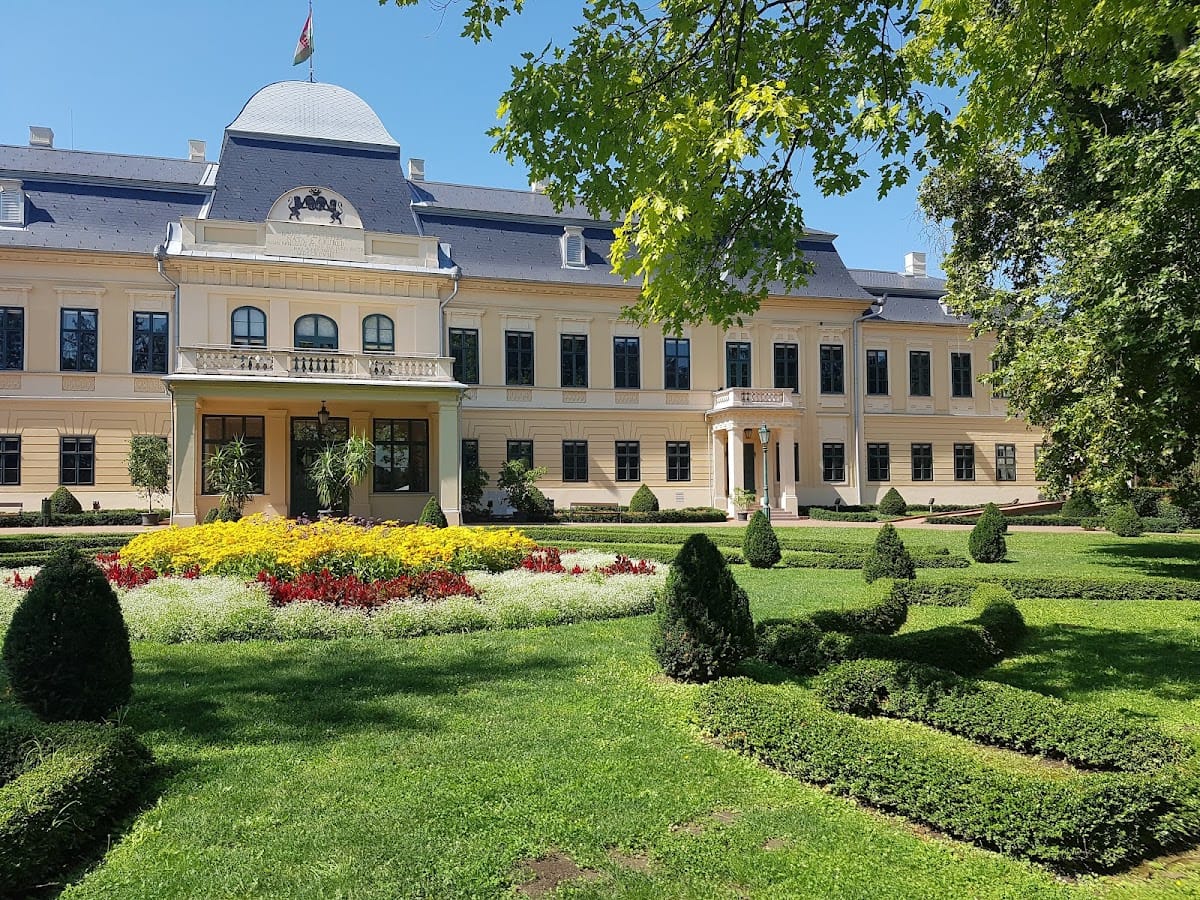
After 1849, servants’ apartments were created in the castle. It became uninhabited after the palace servants’ wing was completed in 1905. Count Dénes Almássy repaired the walls, turning the fortress into a romantic feature of the palace garden. In 1918, the town administration considered demolishing it and reusing its bricks for houses.
During the Second World War, the tower served as a high observation post. Archaeological excavation began after 1956 and continued until 1961. Postwar restoration and reconstruction rebuilt the walls and later renewed the roof. Further renovation received an ICOMOS award in 2006, and work continued from 2017 under the National Castle Program. Gyula Castle and the adjacent memorial site for the Honvéd officers became part of Hungary’s historic memorial sites in 2012. A castle museum now presents nearly seven centuries of history, while the Gyula Castle Theatre has operated within the walls as a summer open-air venue since 1964.
Remains
Setting and overall layout
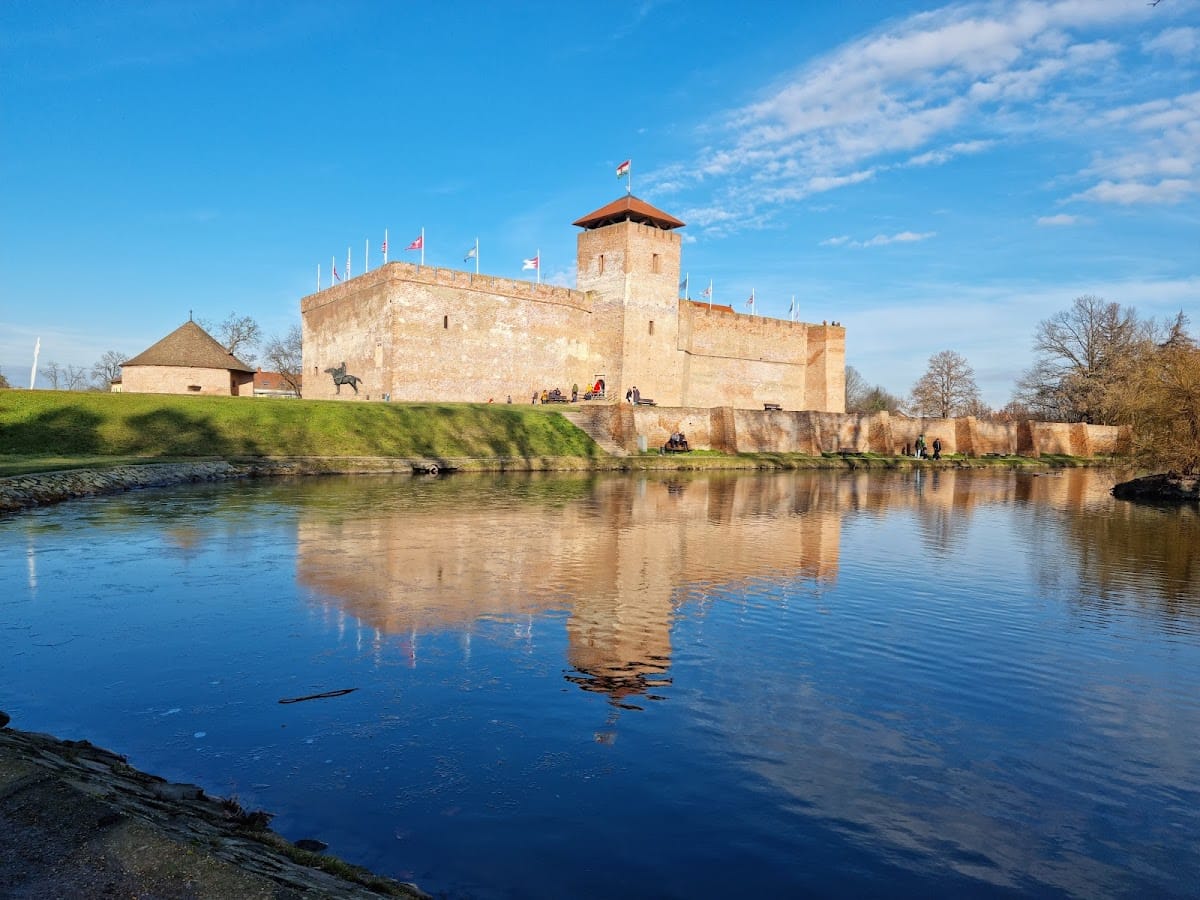
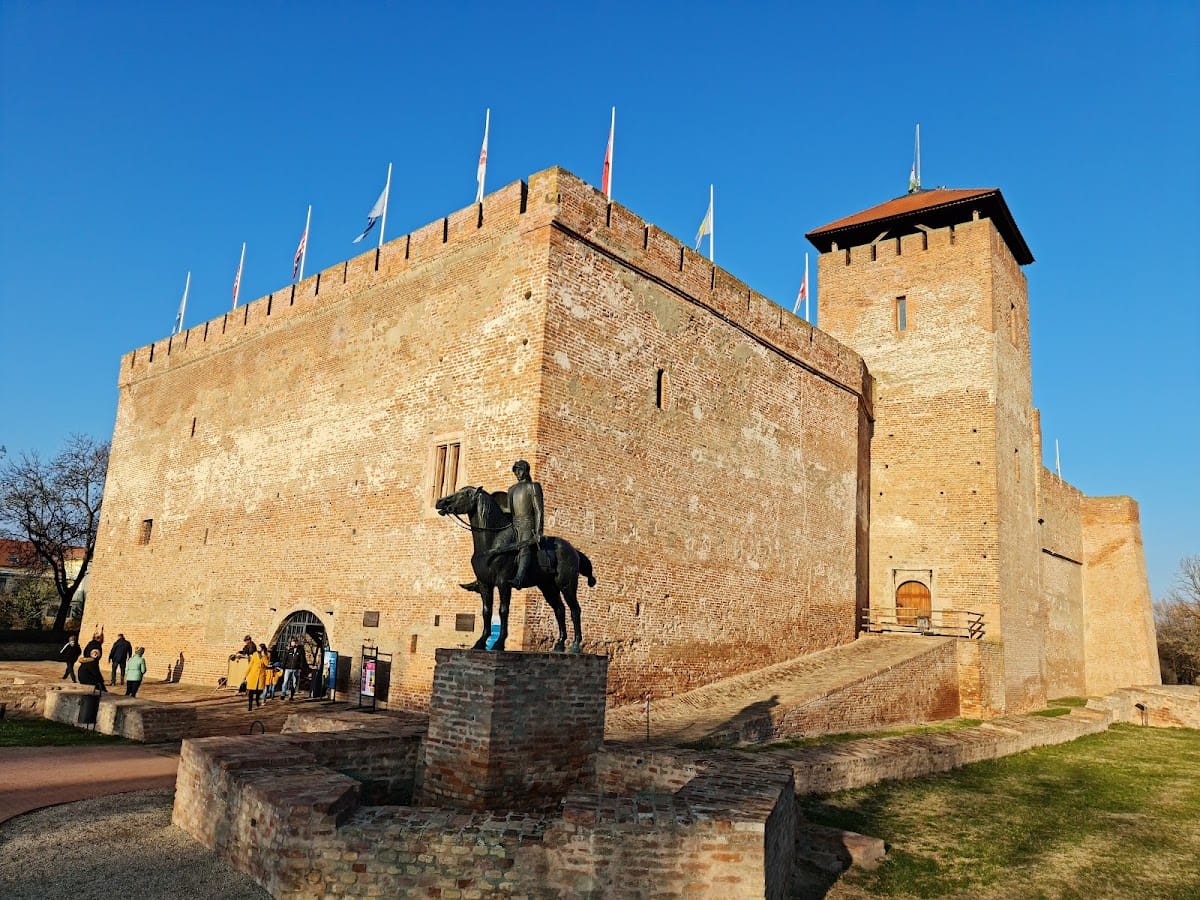
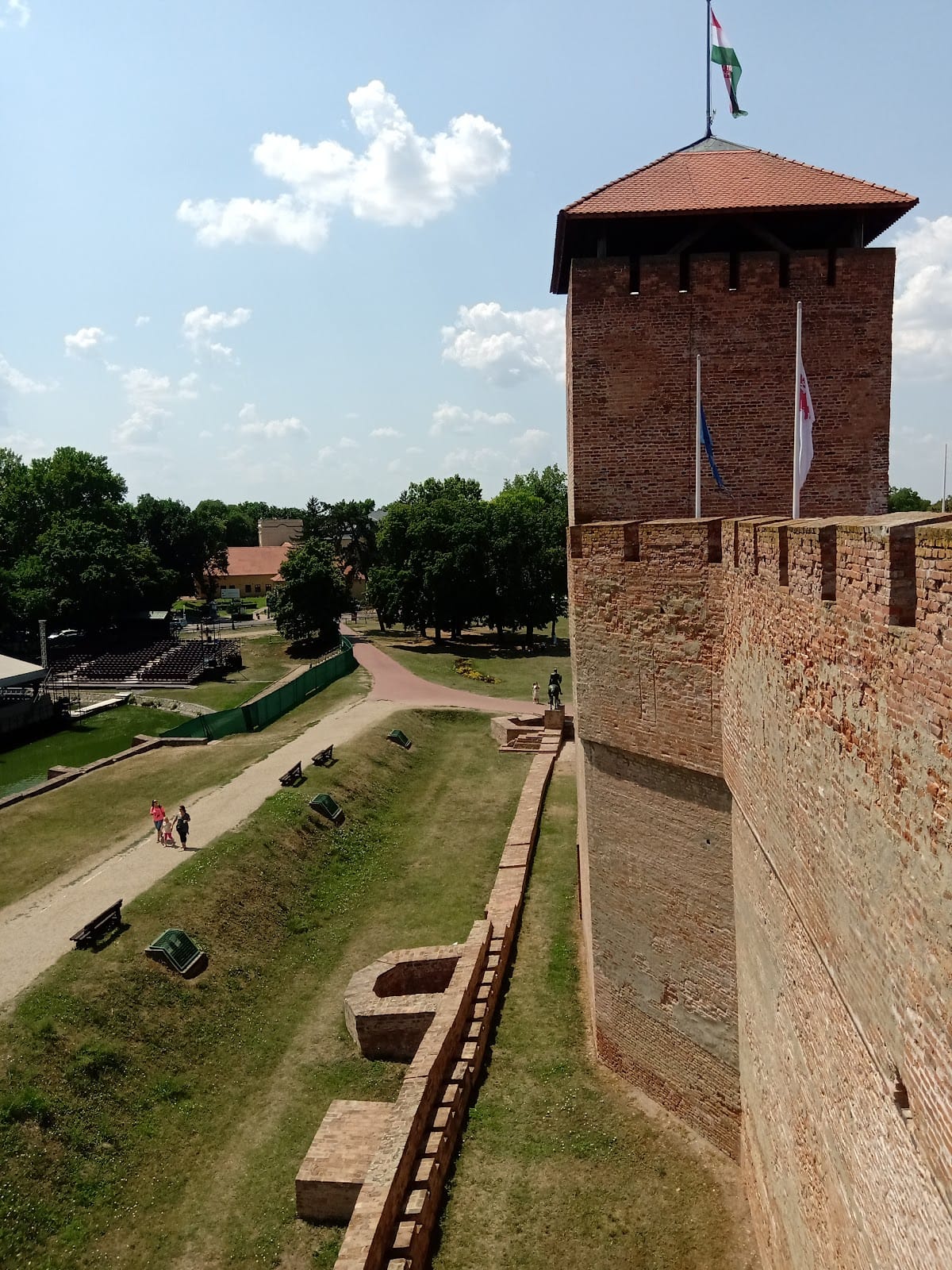
Gyula Castle stands on a slightly elevated island amid the former floodplain of the Fehér-Körös. Marshy branches of the river made approach difficult and contributed to the fortress’s defensive setting. The local landscape offered little suitable building stone, so the walls were made from bricks fired on site. The result is a medieval Gothic brick fortress and the only substantially intact lowland Gothic brick castle of the former Kingdom of Hungary.
The surviving complex consists of an inner, or main, castle and an outer castle that included the Hussar Castle. A palisade, moat, and earthworks formed part of the outer defenses. The courtyard was built up in three stages as the residential requirements of the castle lords expanded. Unlike the usual Hungarian sequence, in which a keep was erected first and later enclosed by walls, Gyula’s tower and enclosing walls were constructed at the same time. The fortress preserves an unusually large number of fifteenth-century Gothic architectural spaces from a Zsigmond-period aristocratic residential and defensive complex.
Inner castle and courtyard buildings
Courtyard galleries
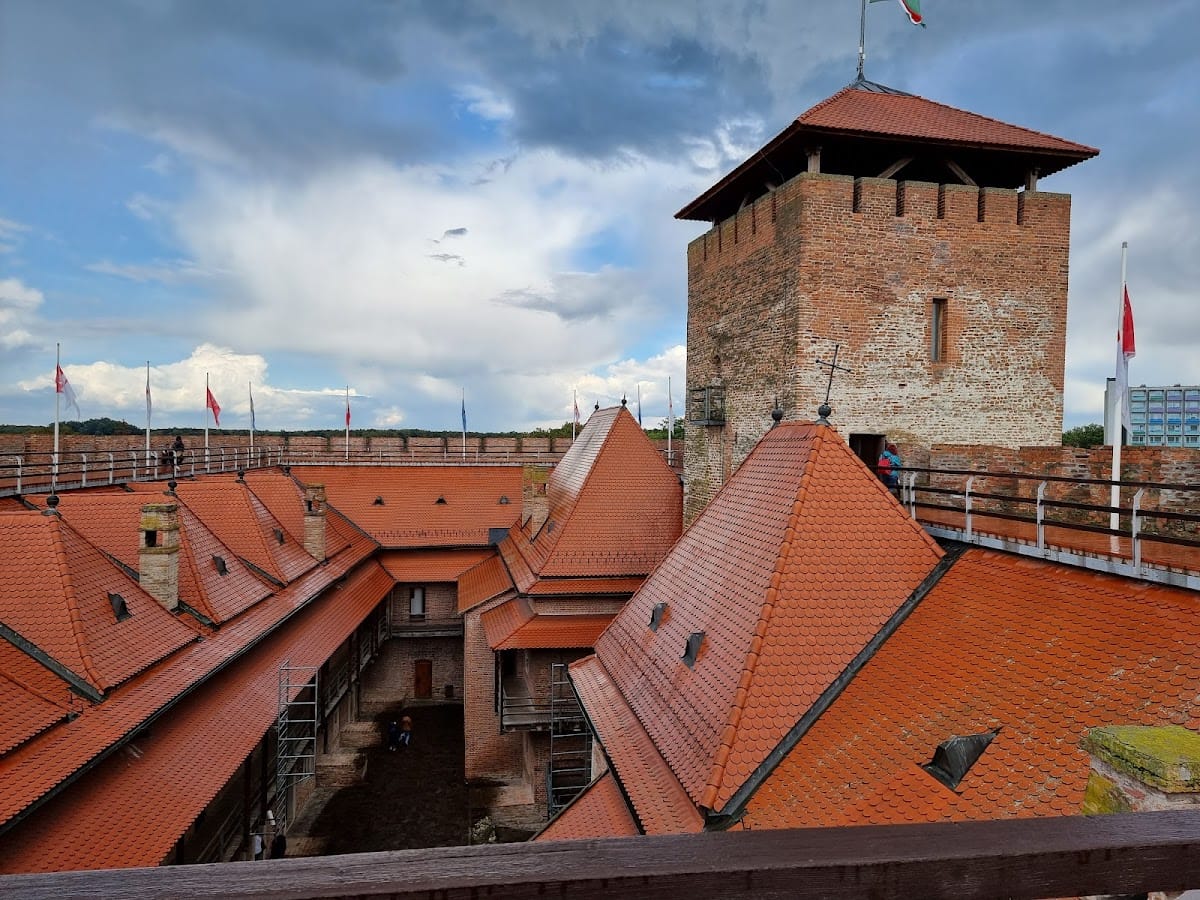
During the period of János Corvinus, the courtyard received additional buildings and a buttressed gallery at first-floor level. By the early sixteenth century, a unified gallery system extended around the courtyard, an arrangement described as exceptional in contemporary Hungarian castle architecture. These galleries formed part of the castle’s residential organization while linking the rooms around the inner court.
Western artillery tower
George of Brandenburg commissioned a large western-corner rondelle, a circular artillery tower, and had artillery loopholes formed in the roof structure. The additions reflect the conversion of the castle from a lordly residence into a fortress adapted to firearms. The castle survived the Ottoman wars without being destroyed, although a mine explosion during the 1705 siege split the wall beside the tower down to its foundations. The crack remains visible, but the wall did not collapse.
Chapel and interior spaces
The chapel consecrated in 1445 remains a physical part of the castle and continues to serve for baptisms and weddings. The ground floor also contains the castle prison, stores, a bakehouse, smithy, pottery workshop, educational room, and wine room. The four-room prison exhibition presents implements associated with execution, mutilation, corporal punishment, torture, and humiliation.
On the upper floor are apartments identified with the castle lady, castle lord, and castle commander, together with the castle lord’s office, the reception room of the Ottoman district governor, an armory, a halberdier’s hall, and a knight’s hall. The knight’s hall is used for receptions, conferences, and other events. The museum’s exhibition spaces use these rooms to present the history of the fortress.
Outer castle and Ottoman remains
Hussar Castle
The Hussar Castle formed part of the outer defenses and was the weakest point attacked during the 1566 siege. After capturing it, the Ottoman forces placed artillery there and fired on the bastions and tower of the main castle. The outer palisade burned during the fighting and was quickly repaired, although the rebuilt wall was narrower than the original.
The Hussar Tower, built no later than the middle of the seventeenth century and possibly earlier, formed the entrance to the Hussar Castle. It is the only surviving Ottoman building in Hungary known to have served a secular purpose. The former Hussar Castle later operated as a separate urban district. During the reconquest, 63 houses were recorded there, while a 1579 record mentions 22 shops and a mosque.
Mosque and minaret
A minaret associated with the mosque appeared in several contemporary representations of the castle, and a slender surviving minaret was still described in the mid-eighteenth century. Around 1715, the mosque was being used by the Serbian population. These remains and references reflect the religious and social functions that developed in the outer castle during Ottoman rule.
Military organization and later performance spaces
During the Ottoman period, the inner castle contained granaries, storehouses, and the commander’s residence. A payroll from 1591 lists 276 mounted soldiers and 112 janissaries, elite Ottoman infantry, defending the inner castle. The outer castle held 36 janissaries, 106 infantrymen, and 74 South Slavic martaloces, irregular auxiliary troops. The total garrison numbered 609 soldiers, including several artillerymen and sailors.
The surviving castle walls now also form the setting for the Gyula Castle Theatre’s summer performances. The wider performance complex includes a lakeside stage beside the castle, a chamber theatre on Kossuth Lajos Street, and an entertainment pavilion in Göndöcs Garden. The castle garden hosts a historical reenactment of the 1566 siege each year during the final weekend of July.