Fort Tombion: A Road-Blocking Fort in Italy
Site at a Glance
- Popularity
- Medium
- Country
- Italy
- Primary era
- Modern
- Eras represented
- Modern
- Civilizations
- Italian
- Site type
- Military
- Remains
- Fort
On this page13 sections
History
Fort Tombion is a road-block fortification in the Canale di Brenta in Italy, built by the Italian military in 1884–1885 to control the main route through the valley. It became the oldest permanent work in the Brenta-Cismon defensive system, guarding a narrow passage near the frontier with the Austrian Empire, later Austria-Hungary.
A strategic route under changing control
The Brenta valley provided a route between northern and southern Italy, and its military importance was recognized long before Fort Tombion was built. Nearby Covolo di Butistone is named in records from the eleventh century. In 1260 the valley was a garrison of the Bishop-Count of Feltre, an office that joined church authority with territorial rule. Cangrande della Scala, lord of Verona, held it in 1322, and the Counts of Tyrol took control in 1337. Authority later shifted among the Carraresi of Padua, the Visconti of Milan, Feltre, and Bassano. After the War of the League of Cambrai (1508–1515), the area was assigned to Feltre.
Construction of the Brenta-Cismon defenses
After Veneto became part of the Kingdom of Italy in 1866, the Italian General Staff prepared plans for defenses around Cismon del Grappa, Primolano, and Arsiè. Funding delays held up the work. From 1875 to 1879, a commission planned the defence of the Alps; in the early 1880s it selected Tombion, one of the narrowest points in the Canale di Brenta, for a fort intended to block the valley road and oppose forces attempting to bypass it. The planners understood that this position could not defend the whole route alone, a principle later reflected in the broader Brenta-Cismon system.
Built in 1884–1885, Fort Tombion was designed to stop movement along the principal road through the valley. The wider system included road-block fortifications at Covolo di Sant’Antonio, Scala, and Fontanelle, as well as Forts Cima Lan, Leone, and Lisser, the rock-cut artillery position of Fort Coldarco, and seven other artillery positions. In 1896, mine chambers were added near Tombion so that routes could be destroyed in an emergency, including the bridge over the Cismon stream south of the fort.
Plans to complete the Bassano–Primolano railway raised concerns in 1910 about protecting the railway without weakening the fort’s defensive purpose. Work in 1911 incorporated a tunnel beside the road and altered the fort’s armament, concentrating its guns toward the north. The newer forts Leone and Lisser later made Tombion appear obsolete.
First World War
Italy’s declaration of neutrality on 8 August 1914 led to the creation of a command for the Brenta-Cismon frontier sector. Its task was to prepare the defenses for action and finish incomplete works. Tombion went on full alert on 22 May 1915. The command ordered mobilization that evening, and the following day the defensive system was declared ready for war.
On 24 May, the 15th Division ordered an advance, with the forts available to support it if necessary. Their artillery was not needed: Austro-Hungarian forces had withdrawn to a more defensible line at Lagorai, Levico, and the Folgaria–Lavarone plateau, leaving the Valsugana open. Italian troops encountered no resistance. By early June, the front had reached Ospedaletto, about 20 kilometres in a straight line from Tombion. The fort kept its 1911 armament until early November, while its garrison was reduced. By late November it belonged to a group of valley-floor defenses with the Scala and Covolo di Sant’Antonio road-blocks.
During the Austro-Hungarian South Tyrol offensive in spring 1916, Italian commanders feared an advance from the Asiago plateau into the Canale di Brenta. On 26 May, Tombion’s artillery was transferred from the northern battery to the southern one, ammunition stocks were replenished, and wire obstacles were laid toward Cismon. Two batteries of 120G guns were placed on Col del Gallo the next day to protect the fort’s flank. When the danger receded, the fort’s activity declined. It briefly held deserters and later served as a reserve store for troops and supplies, leading to further cuts in its garrison and weapons. In late November, the army group command dissolved the Brenta-Cismon system because it was well behind the front. Some road-blocks remained as checkpoints staffed by the Carabinieri, Italy’s national gendarmerie. Fort Tombion was fully disarmed by the end of December 1916.
After the Italian retreat following the Austro-German breakthrough at Caporetto in October 1917, the army prepared to demolish the fort before it could be captured. On 13 November, damp detonators disrupted the planned destruction. An Austro-Hungarian patrol fired on the demolition party before the detonators could be replaced, killing several men. The rushed blast destroyed only parts of the fort, including sections of its gun chambers and the road passage. Austro-Hungarian troops occupied the site and, from December, used it as a medical post or small field hospital. They called it Fort Piovega di Sotto.
In 1918, Italian artillery repeatedly struck areas behind the front, including the railway line repaired by Austro-Hungarian troops. In spring, a shell hit an ammunition train outside the southern tunnel entrance. Its explosion damaged the fort and brought down the southern gate, which had already been weakened. Italian forces regained the site on 3 November, following the Austro-Hungarian retreat during the offensive begun on 24 October.
Second World War and later history
The Italian army abandoned Fort Tombion after the First World War. From 1943, the German Organisation Todt, a state construction and engineering organization, used it to store explosives. On 7 June 1944, partisans led by Paride Brunetti, known as Bruno, carried out a sabotage operation to disrupt German supply traffic. The Valsugana railway had grown more important after Allied attacks interrupted the Brenner line. The partisans took the fort, moved its explosives, including First World War shells, into the neighboring railway tunnel, and detonated them. Rail and road traffic stopped for five days. The operation is regarded as a major action of the Italian resistance and the European partisan movement.
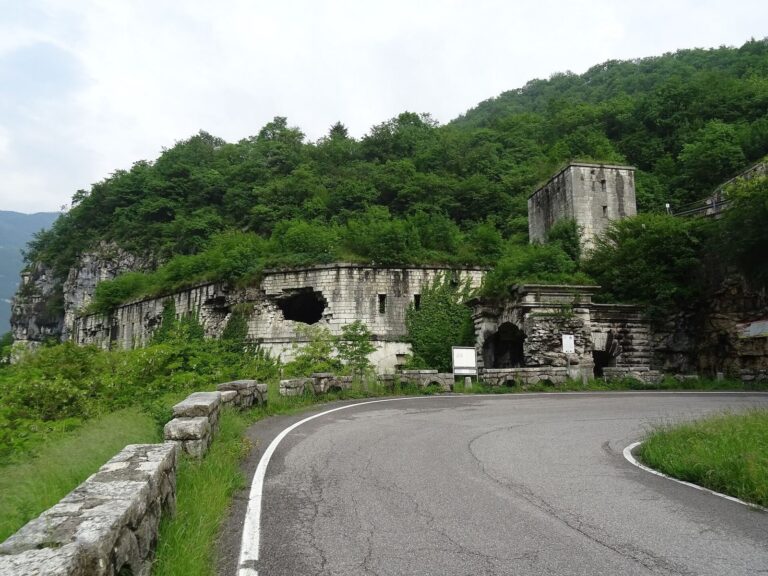
After the Second World War, the fort no longer had a strategic function. From the 1960s onward, and especially as the railway and Valsugana state road were expanded, substantial parts of the structure were demolished.
Remains
Fort Tombion occupied a narrow point in the Canale di Brenta, about 200 metres across, where the Brenta River bends west. Beside the valley road between Cismon del Grappa and Primolano, at about 205 metres above sea level, it extended lengthwise along the valley on two levels and climbed roughly 50 metres up the slopes. Builders used squared limestone blocks quarried nearby.
Layout and defenses
Two artillery blocks stood on opposite sides of the valley road, one facing north toward Primolano and the other south toward Cismon. Earth banks protected the blocks, with ditches between them measuring six metres across and five metres deep. Retractable bridges at the eastern ends of the ditches carried the road through the defenses to gates fitted with iron barriers, narrow firing openings, and small pedestrian doors. On the river-facing western side, a stone wall with firing openings enclosed the fort. An open infantry position on the uphill eastern side faced both approaches.
Buildings and artillery
Artillery blocks
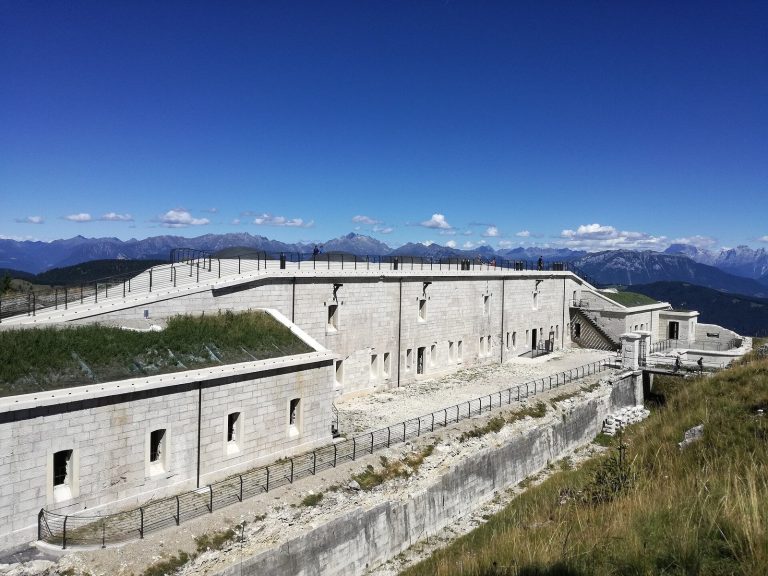
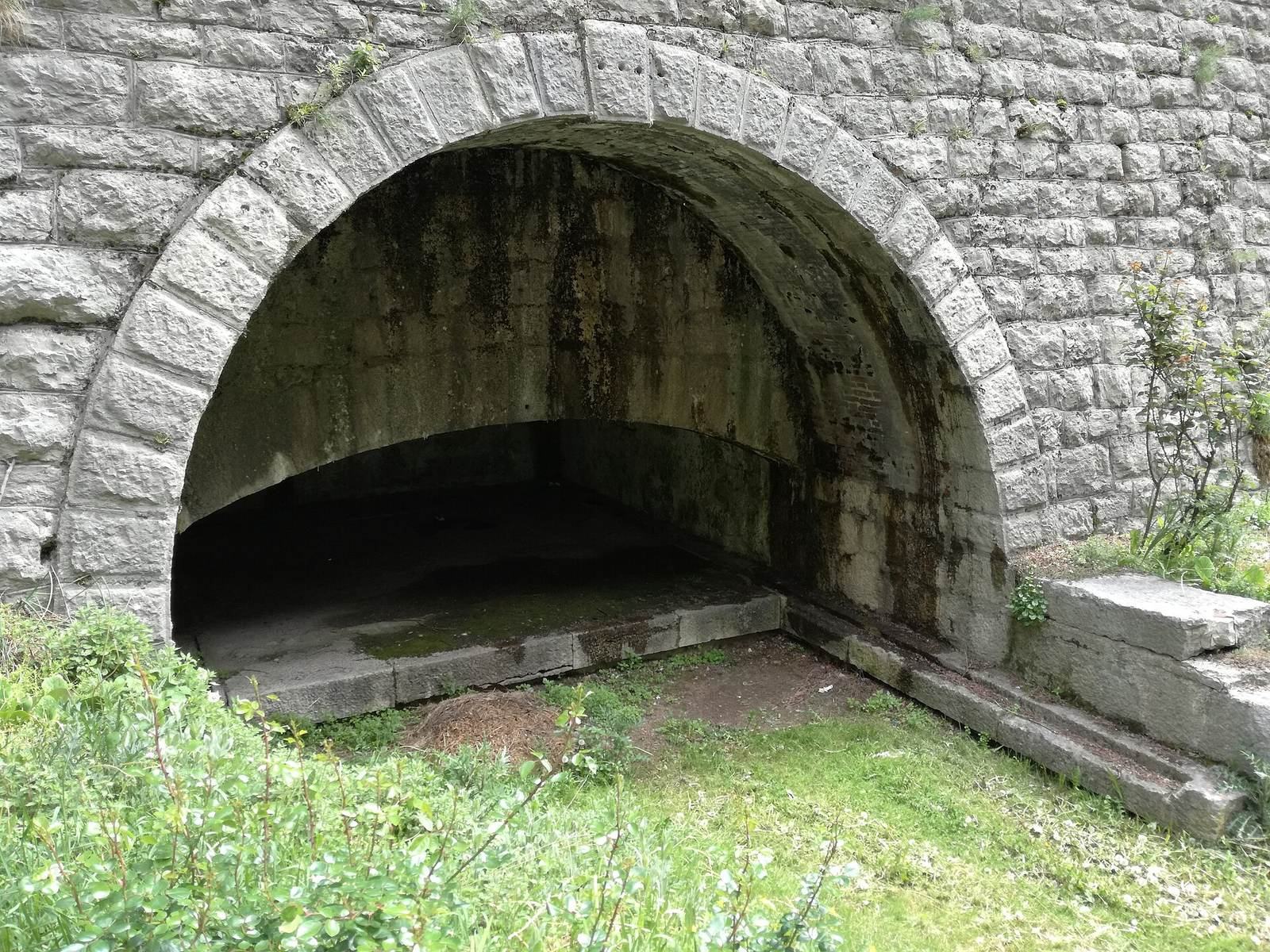
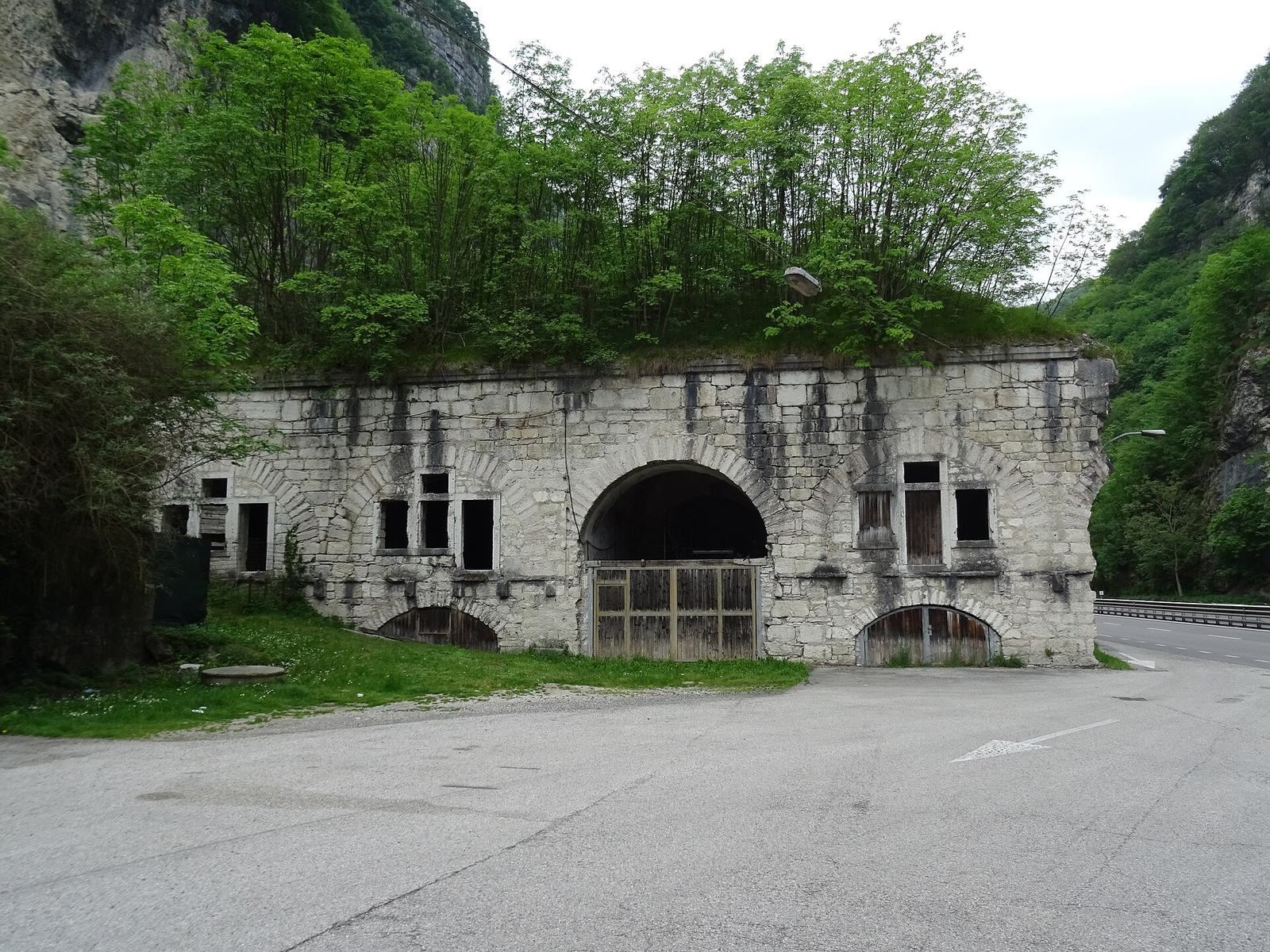
Each artillery block contained five enclosed gun chambers, open at the rear to let smoke escape, along with spaces for ammunition and the readiness of the gun crews. Infantry could fire toward the approaches from protective walls on the roofs. Firing positions beneath the retractable bridges covered the ditches and were reached through passageways. Mortars could be placed in the open courtyard to fire in either direction, including against the defenses at Primolano if they were captured.
At completion in 1885, the fort carried ten 15 GRC/ret howitzers on carriages that could turn, with five guns facing each direction, and a total of 5,000 rounds. Four 15 AR/ret mortars had 1,600 rounds, while two 9 ARC rapid-fire guns covered the ditches. After the 1911 alterations, the armament consisted of four 75 A Model 1906 guns facing Primolano, two 149 mm mortars, and four Gardner Model 1886 machine guns that could be used on either side.
Accommodation and service buildings
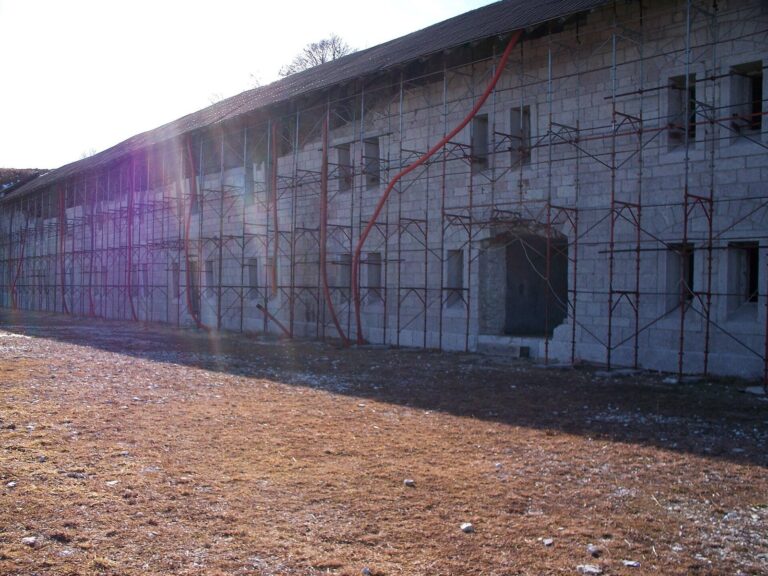
A two-storey accommodation casemate, a protected enclosed chamber, stood between the artillery blocks. Its windows and doors were on the south side. A separate two-storey building ran beside the road along the valley’s eastern edge, against the rock face. It housed offices, an armoury, and a powder room at its southern corner, with officers’ quarters upstairs.
Railway works and surviving fabric
Tunnel defenses
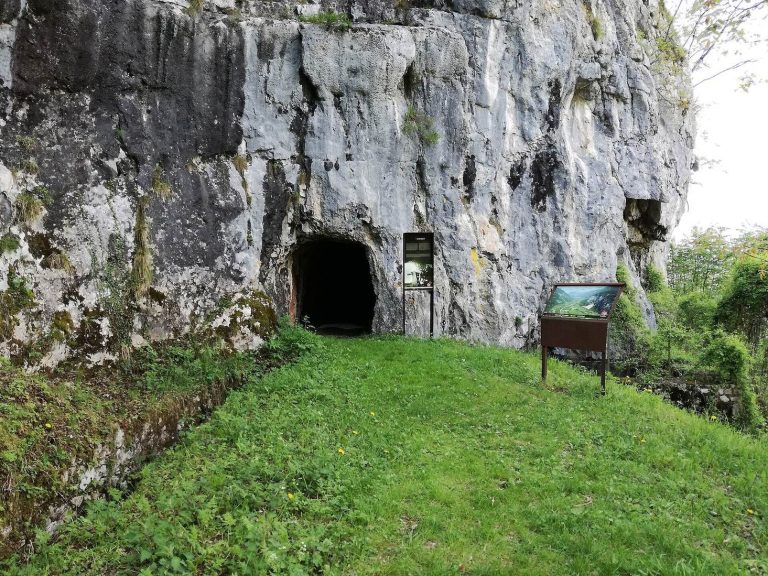
The railway works included a tunnel beside the road, partly cut through natural rock and partly built artificially. Three-metre-high stone walls with narrow openings for rifle fire stood above it and joined the uphill eastern wall of the fort. A passage at the tunnel’s midpoint connected with the building that held the offices and guard rooms. Iron gates with firing openings could close both ends of the tunnel.
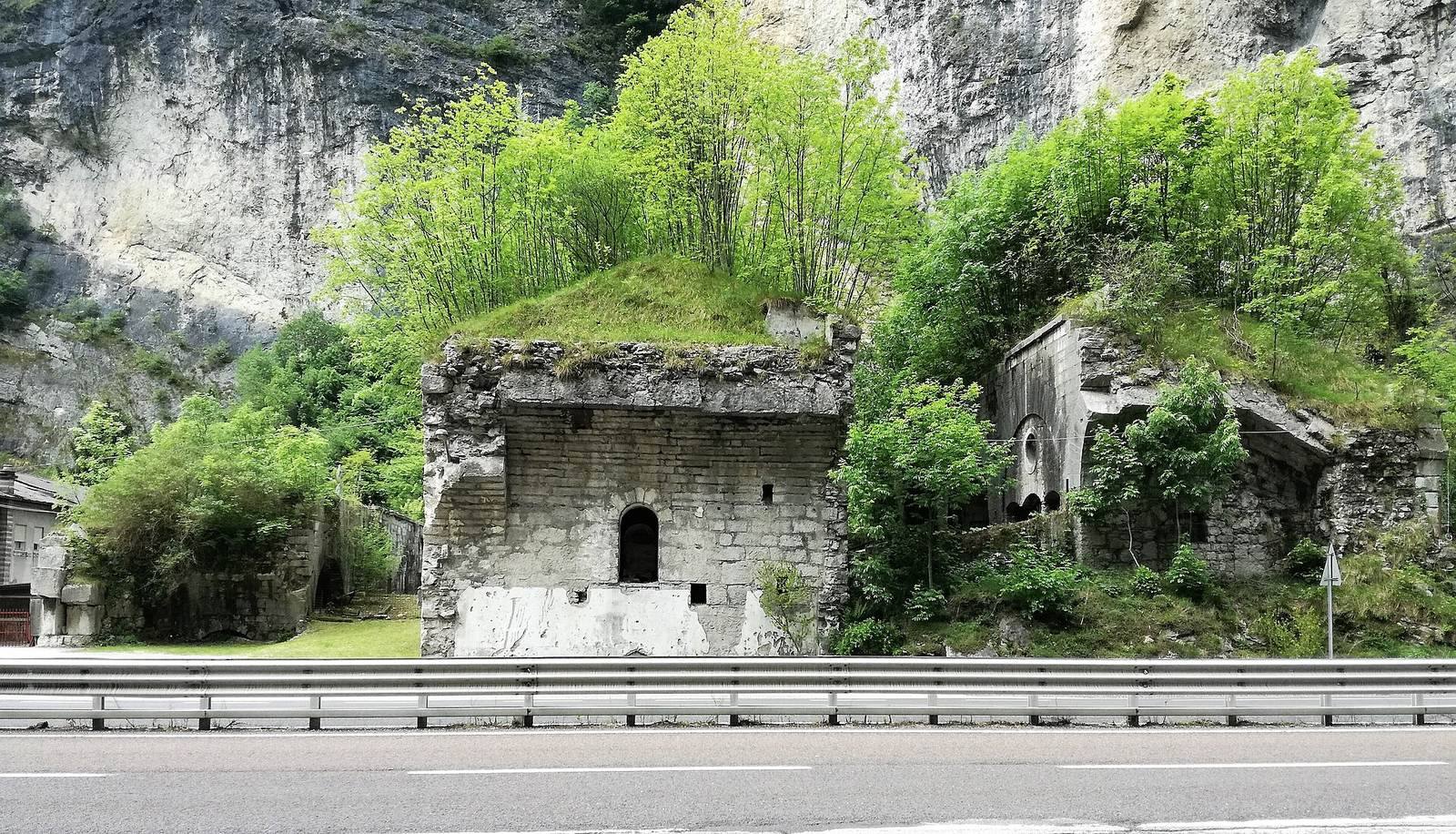
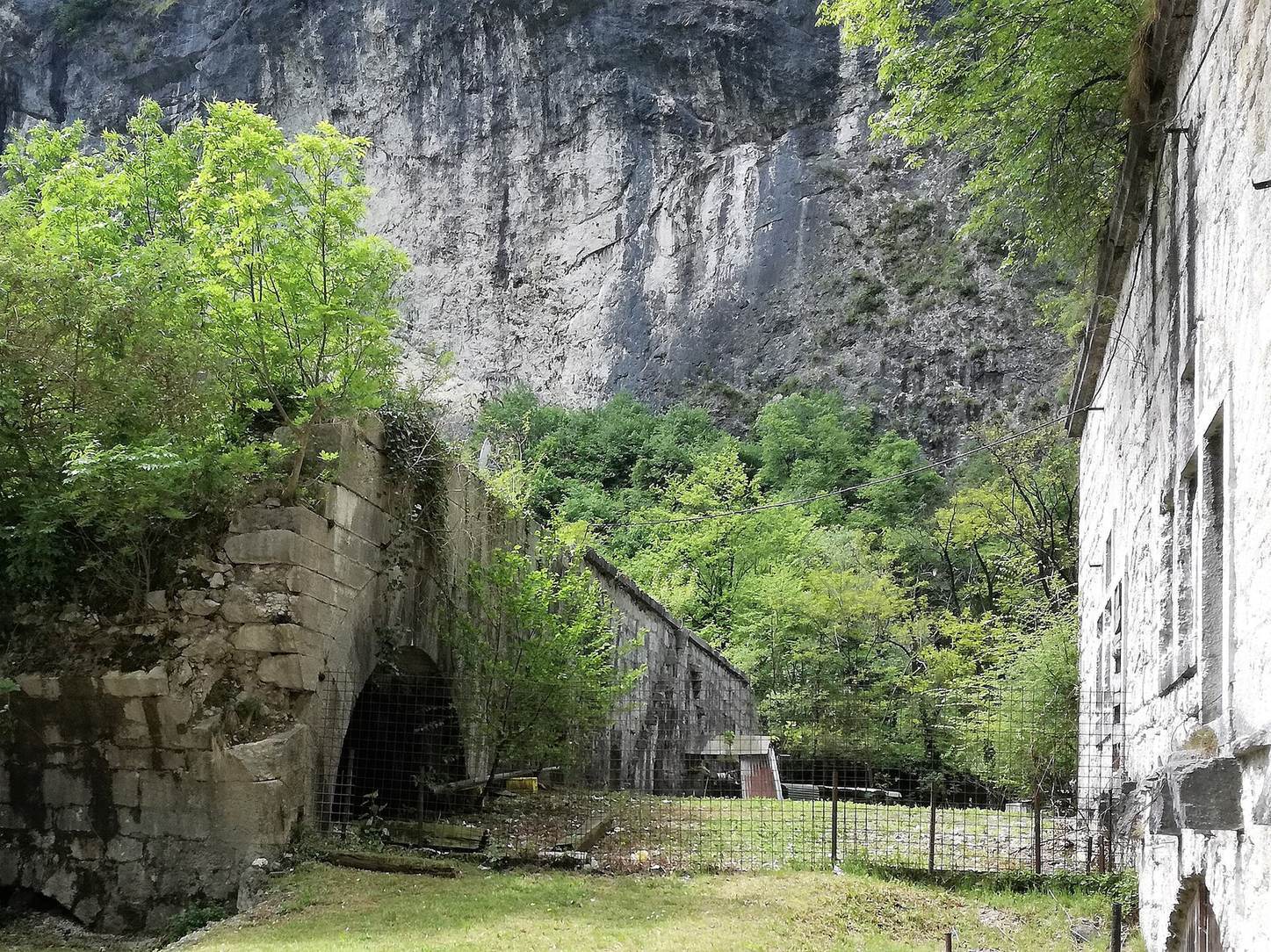
Surviving structures
The fort is partly demolished and in ruins. Its identifiable remains include the southern artillery battery, the accommodation block, parts of the northern battery, and the northern rifle gallery. The recess for one retractable bridge is nearly filled in.