Forte del Colle delle Finestre: An Italian Alpine Supporting Fort


Site at a Glance
- Rating
- 4.7
- Popularity
- Very Low
- Country
- Italy
- Primary era
- Modern
- Eras represented
- Modern
- Civilizations
- Italian
- Site type
- Military
- Remains
- Fort
On this page8 sections
History
Construction and military purpose
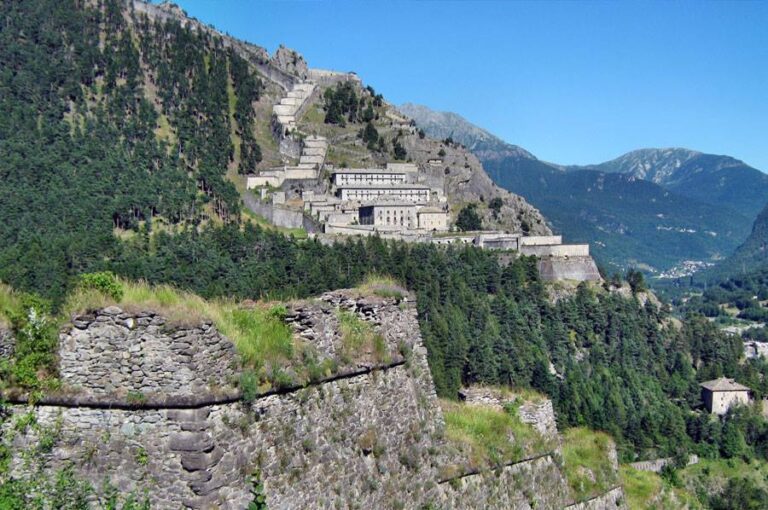
Forte del Colle delle Finestre is an Italian fortification in the municipality of Meana di Susa, Italy, built in 1891 as a supporting work for the forts of the Fenestrelle and Assietta fortified area. Its strategic functions were to block movement through the mountain approaches and protect the surrounding defensive system. Built behind a rocky shoulder, it was concealed from view in Val Chisone while its two 57 mm Gruson guns could still operate.
The fort’s regular complement consisted of 130 men. Artillerymen, operating personnel, riflemen, and machine gunners served there under the ownership of the Italian Ministry of War, which was its first owner. The Italian Ministry of Defence is its current owner.
Disarmament and decommissioning
The fort remained in service for only a few years after its construction. During the First World War, its guns and machine guns were removed and transferred to the Italian eastern front. The position was not rearmed afterward and was definitively decommissioned in 1928.
Forte del Colle delle Finestre was not incorporated into the Western Alpine Wall, a system of modern Italian defensive works along the western Alpine frontier, because it was considered too far from the kingdom’s borders. It therefore saw no use during the Second World War. The fort is now in ruins and in poor conservation condition.
The temporary battery position
When required, a temporary battery could be installed near the Colle delle Finestre beside the military road. This open barbette position, where guns fired over a parapet rather than from an enclosed structure, controlled the military roads on both sides of the pass. It occupied the site of an eighteenth-century redoubt destroyed by the French army in 1797. Traces of the redoubt’s trenches and dry-stone walls remain.
Remains
The fort stands beside the rocky shoulder above the Colle delle Finestre and directly over the military road of the same name. The road connected the position with the valley floors and with the other forts in the defensive area. The main building is a two-storey rectangular structure of stone masonry built against the rock face, leaving only one exposed façade. Its vault was first covered with earth and later strengthened by a concrete shell to resist direct attack.
Building and entrance
The second-storey vault was formed by distinctive masonry arches, while the first-storey ceiling was wooden. A projecting caponier, a fortified structure for close-range fire along the outer defences, protected the approaches. The original entrance used a disappearing drawbridge set at a right angle on a fixed forebody anchored to the access road. The bridge crossed the precipice below the entrance. Both the drawbridge and forebody have disappeared, and the entrance is now reached through breaches in the outer wall.
Gun positions and interior
Two 57 mm Gruson disappearing guns stood in wells cut into the rocky shoulder above the roof. These fortress guns were mounted in armoured turrets that could be lowered by weights and counterweights, placing them out of sight when not firing. A gallery cut through the rock behind the fort led to the storage rooms, command rooms, and gun wells. A path along the side of the building reaches the roof, where both emplacements remain clearly visible.
The ground-floor corridor remains unobstructed, and the rooms can still be entered. The second-storey floor has been completely removed. From the roof-level gun positions, the underground gallery through the rock gives access to the main body of the fort.
Redoubt traces
Near the pass, the temporary battery site retains traces of the earlier redoubt in its trenches and dry-stone walls. These surviving elements occupy the same position later used for the open artillery emplacement beside the military road.
Nearby sites