Fort VII “Zbarż”: An Outer Fortress of Warsaw


Site at a Glance
- Rating
- 4.4
- Popularity
- Low
- Country
- Poland
- Primary era
- Modern
- Eras represented
- Modern
- Civilizations
- Russian
- Site type
- Military
- Remains
- Fort
On this page9 sections
History
Fort VII “Zbarż” is a former artillery fort in Warsaw, Poland, built as part of the outer defensive ring of the Warsaw Fortress during the late nineteenth and early twentieth centuries. The ring was a chain of detached forts intended to keep attacking forces beyond the city’s immediate defenses. Fort VII stood in the Włochy district between Fort VI “Okęcie” and Fort VIII “Służew.” Its construction is dated to 1883–1908, although the precise building date remains uncertain.
Construction and dismantling
The fort formed one element of Warsaw’s wider system of detached artillery positions. In 1909, a decision was made to liquidate the Warsaw Fortress, and Fort VII was partly dismantled as a result. This intervention altered the fort before later military and infrastructural changes further affected its condition.
Flooding and military use
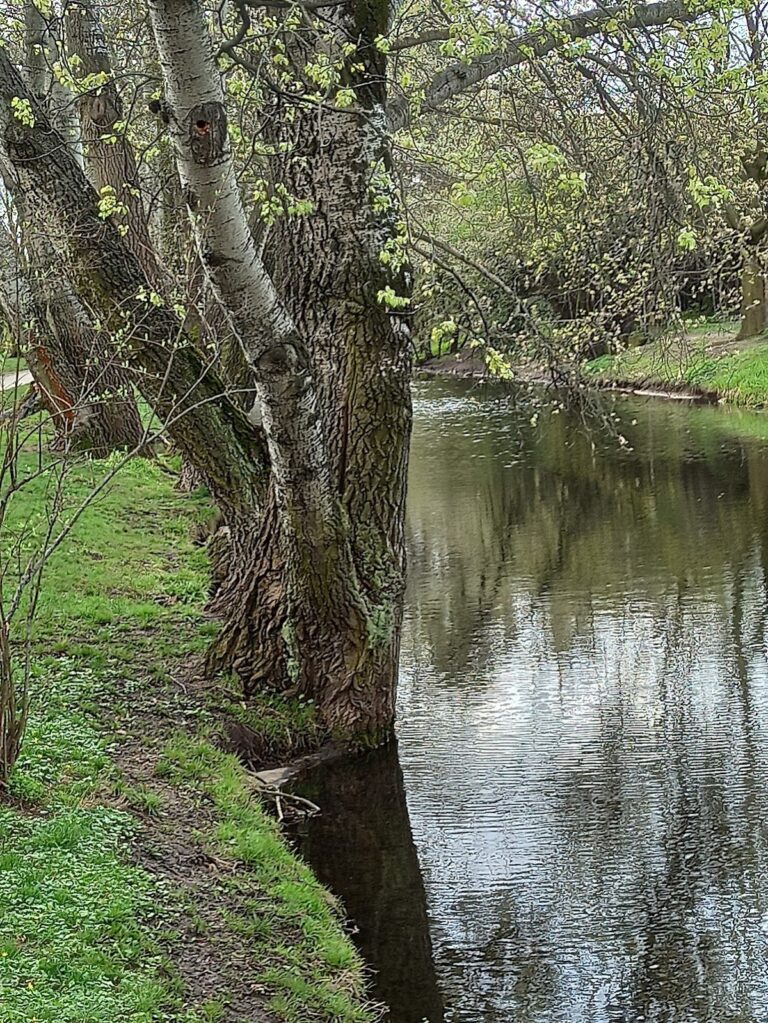
During the early years of the occupation, the drainage system became blocked. Water then flooded the moat and the fort’s courtyard. The defensive ditch, which had probably originally been dry, later flooded the rear part of the fort and the approach to the casemates, fortified chambers intended for protected military use. After the Second World War, the site continued to be used by the military, and military buildings remained there until 1999.
Recent changes
Road construction connected with the nearby S79 expressway affected the fort’s structure. Fortification structures were exposed during road works in 2010, while the flooded rear section was bridged to accommodate the new road alignment. By 2019, the parcels belonged to the Polish Treasury, the state-owned Polish Airports company, and several other investors. Atenor Poland acquired the site that year and planned office and hotel development, with JEMS Architekci responsible for the project. The fort itself remains ruinous and unused.
Remains
Layout and defensive earthworks
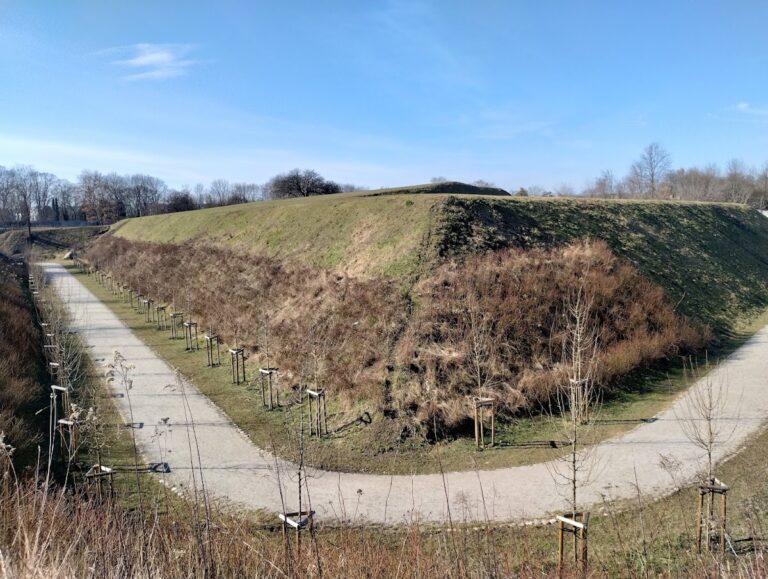
Fort VII occupies approximately 29.7 hectares between Wirażowa, Żwirki i Wigury, Winiarska, and Benetta streets in the Zbarż neighborhood. Its remains lie near Warsaw’s Frédéric Chopin Airport and are partly concealed by office buildings. The fort was laid out as an artillery work on a pentagonal plan, with a single rampart rather than the two ramparts more commonly used in Warsaw’s forts. A defensive moat surrounds the position.
Counter-scarp caponier
Among the modernized elements is a concrete-covered counter-scarp caponier. A caponier is a fortified structure projecting into or beside a ditch, where flanking fire could defend the ditch. The counter-scarp is the outer side of the ditch, opposite the main rampart. The caponier’s massive ruins survive and form one of the fort’s notable remaining structures.
Barracks and casemates
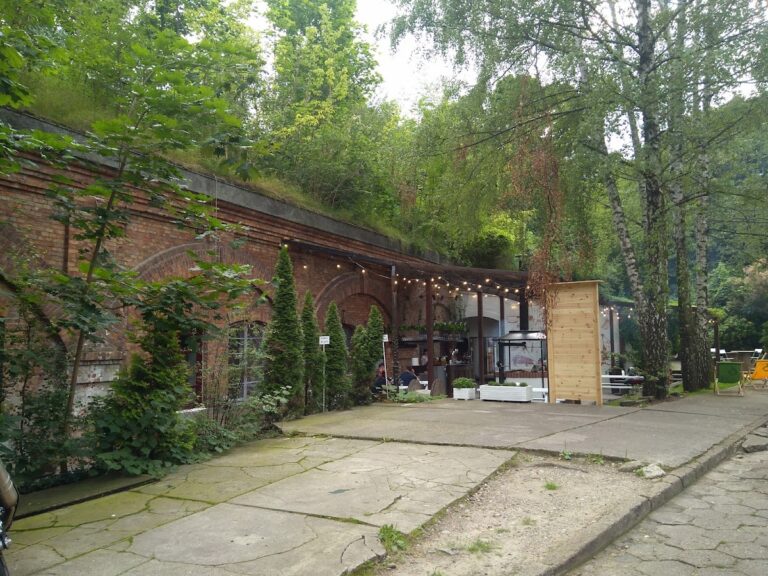
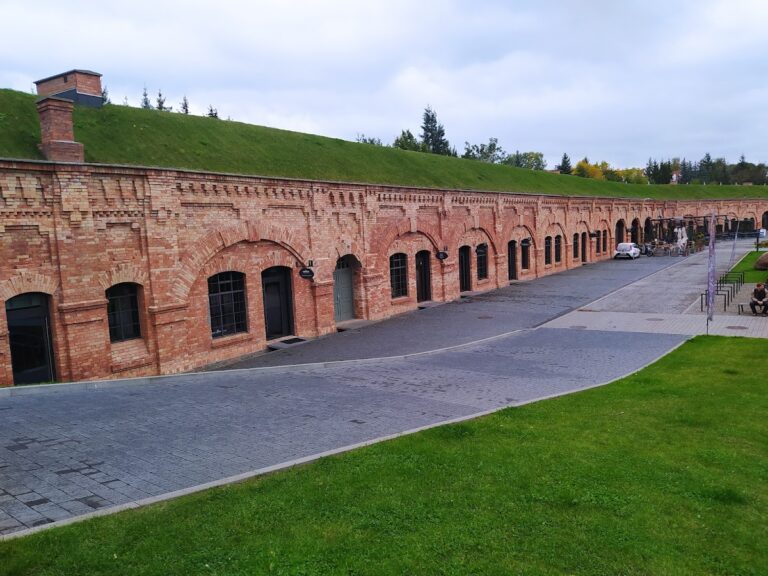
Gorge barracks survive at the rear of the fort. The flooded moat extends into this area and submerges access to the casemates, fortified chambers used for protected military purposes. Erosion affects the casemate abutments around the interior courtyard, while parts of the former interior are now wooded.
Later landscape
Some exterior parts of the fort, including the esplanade and gorge area, have been used as allotment gardens. The flooded ditch is rich in fish and is used as a fishing place, adding a later informal use to the remains of the former defensive work.
Nearby sites