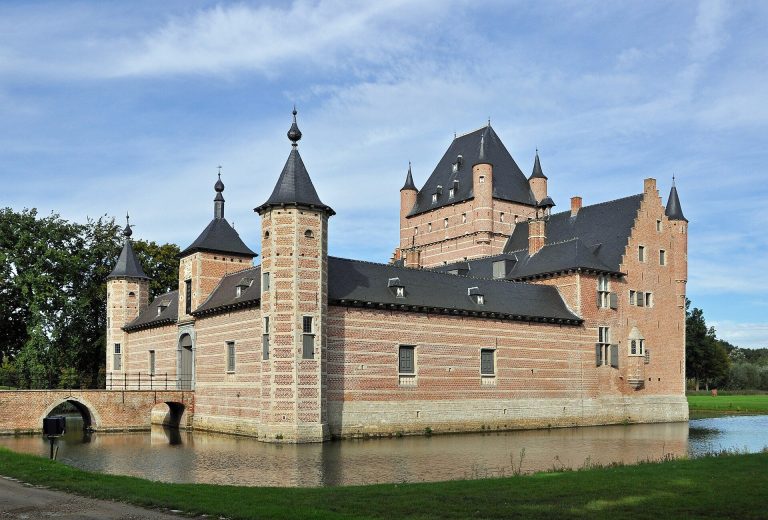
Fort van Kessel: An Outer Defensive Fort of Antwerp, Belgium


Site at a Glance
- Rating
- 4.3
- Popularity
- Low
- Country
- Belgium
- Primary era
- Modern
- External website
- Open
- Eras represented
- Modern
- Civilizations
- Belgian
- Site type
- Military
- Remains
- Fort
On this page10 sections
History
Fort van Kessel is an early twentieth-century Belgian military fort in Nijlen, Belgium, built between 1909 and 1912 as part of Antwerp’s outer defensive belt. It formed part of the system intended to protect Antwerp after the city was designated Belgium’s National Reduit in 1859, the country’s final fortified refuge while it awaited assistance from allied powers.
Antwerp’s defensive system
The National Reduit combined a fortified enclosure around Antwerp, a belt of forts, and areas that could be deliberately flooded to hinder an advancing army. Its first defensive belt consisted of eight Brialmont forts, named for the Belgian military engineer Henri Alexis Brialmont, constructed in 1859 along an approximately 18-kilometre arc from Wijnegem to Hoboken.
After the Franco-Prussian War of 1870, the plans were enlarged to meet the power of modern artillery. They incorporated forts protecting bridgeheads, strategic crossings and their approaches, together with a new outer defensive belt. The Main Resistance Position received legal approval on 30 March 1906. It comprised sixteen forts and ten redoubts, or small fortified positions, on the right bank of the Scheldt, and five forts and two redoubts on the left bank.
Construction and First World War
Land was expropriated for Fort van Kessel on the site of a large farm. Construction continued from 1909 until 1912. When the work was complete, nearby houses were burned to give the garrison an unobstructed view and a clear field of fire. The fort received its armament in 1913.
During the First World War, approximately 330 men occupied the fort under Captain-Commander Piraux. Trenches and barbed wire stretched across the fields between Fort van Kessel and Fort Lier, leaving almost no passage. Livestock was brought inside the ring of forts so that German troops could not use it. The tower of Kessel church served as an aiming reference, while Belgian commanders understood that the fort’s concrete walls and armored turrets could not withstand shells larger than 28 centimetres.
Fort van Kessel entered the fighting on 29 September 1914. On the morning of 4 October, German heavy artillery positioned at Berlaar and Isschot in Itegem, about 8.4 kilometres away, opened fire. The bombardment included a 42-centimetre Big Bertha siege howitzer and 30.5-centimetre motorized mortars, which together fired 123 shells. The fort’s own artillery could not reach the attackers. At 11:00, three vaults, a passage, and the 15-centimetre gun turret collapsed. The fort was abandoned, and its garrison fled into the woodland behind it. Further direct hits destroyed much of the structure.
Later military and civilian use
Before the Second World War, Fort van Kessel was adapted mainly for machine-gun use. Gas-tight rooms, improved accommodation, and better communications installations were added, and Lieutenant De Middeleer occupied the fort with Belgian troops serving in an infantry support role. On 16 May 1940, the Belgian soldiers fled, and the German 56th Infantry Division occupied the fort that same day.
After the Second World War, the fort remained inhabited until 1974. The municipality of Kessel sought to purchase it in 1968, and the deed of sale dates from 1973. A subsidy later supported its use as public green space, while a 1976 regional plan designated the domain as a recreational area.
Fort van Kessel now has recreational uses, including fishing, and the fort itself serves principally as a wintering site for bats. During the winter of 2008 to 2009, 378 bats representing approximately eight species were counted, with Natterer’s bat, Daubenton’s bat, and Brandt’s bat among the principal species. The fort forms part of Antwerp’s protected historical fortification belts and lies within a Natura 2000 area, the European Union network for conserving important habitats and species, under the Habitats Directive. The municipality of Nijlen manages the site in cooperation with the Fort van Kessel guide organization.
Remains
Artillery and defensive works
Long-range artillery
The fort’s principal long-range artillery was arranged in armored turrets. One turret carried two 15-centimetre guns, two turrets held 12-centimetre howitzers, and four turrets mounted 7.5-centimetre guns. Two armored observation bells, protected raised positions used to direct artillery fire, supported these weapons. Cockerill supplied the guns and observation bells. The 15-centimetre guns had an effective range of more than 7 kilometres and an absolute maximum range of 8.4 kilometres.
Ditch and flank defense
Quick-firing 12-centimetre guns defended the ditch. A large flank-defense battery, known as a traditore battery, was protected so that it could fire laterally along the defensive line and into the interval between forts. It carried four 7.5-centimetre guns and four 12-centimetre howitzers, providing support to neighboring positions.
Bombardment damage and later adaptations
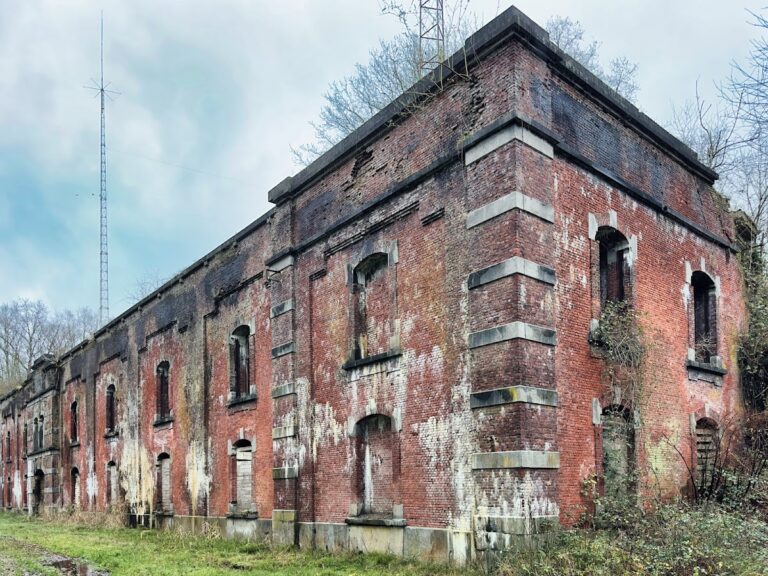
The German bombardment of 4 October 1914 left major structural damage. Three vaults, a passage, and one 15-centimetre turret collapsed during the attack, and later direct hits destroyed much of the fort. The surviving fabric also reflects the changes made before the Second World War, including round concrete machine-gun positions called abri-tourelles and abri élémentaires. Gas-tight rooms, improved living spaces, and updated communications installations formed part of the same adaptation.
Paleontological evidence
Shark teeth and teeth from other marine fish were found in the ground around the heath and station area near the fort. These fossils indicate that the sea once extended as far as Kessel. The teeth were also used at the school near the fort to sharpen slate pencils.