Fort Sumter: A Coastal Fort and Civil War Battlefield
Site at a Glance
- Country
- United States
- Primary era
- Modern
- Eras represented
- Modern
- Civilizations
- Unclassified
- Site type
- Military
- Remains
- Fort
On this page12 sections
History
Planning and construction
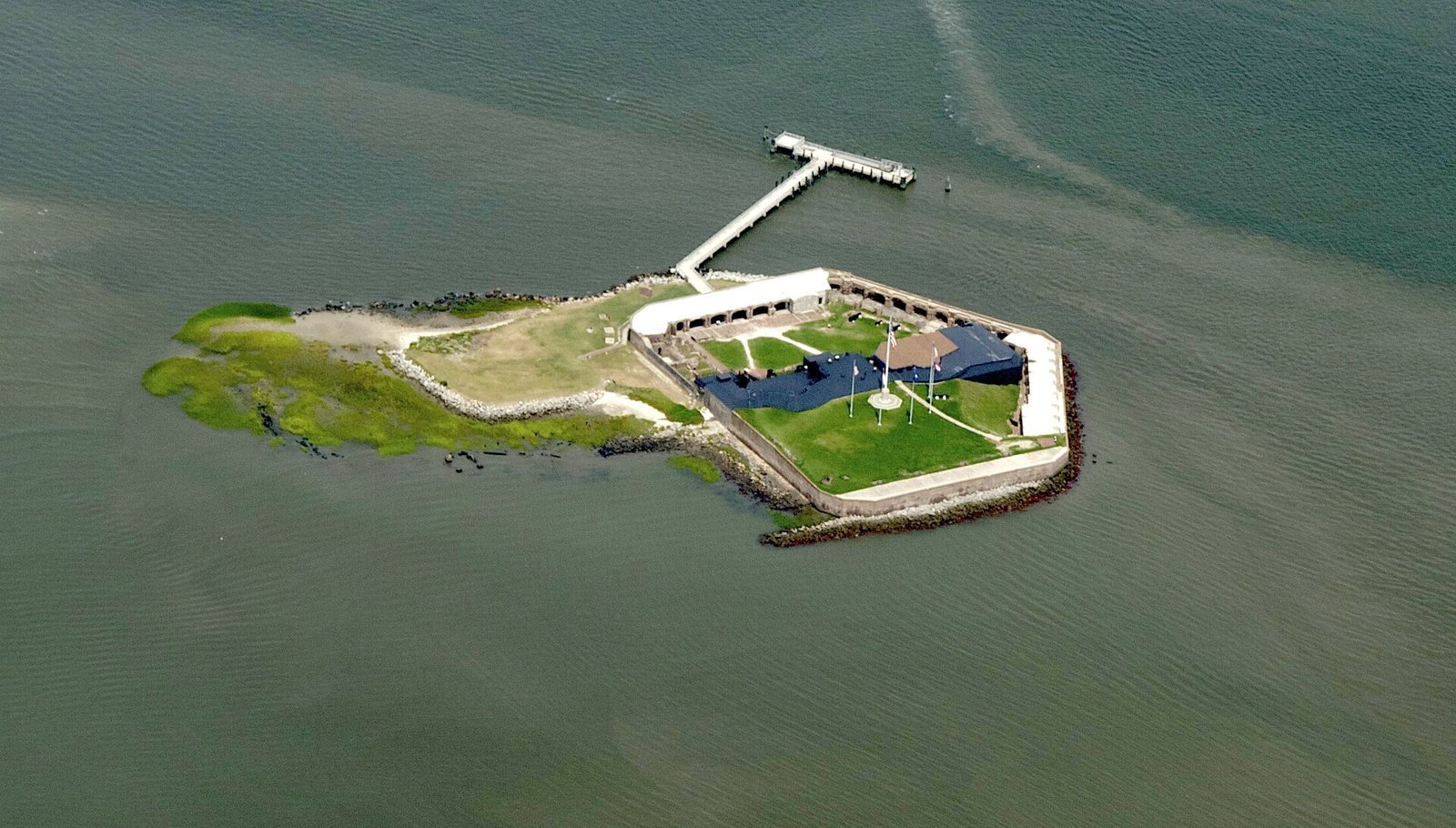
Fort Sumter is a coastal fort on an artificial island in Charleston Harbor, United States. Named for Revolutionary War military leader Thomas Sumter, it was built as part of the Third System, a U.S. program of permanent masonry forts developed after the War of 1812 exposed weaknesses in harbor defenses. Construction began in 1829, and the fort was intended to reinforce Charleston’s shore batteries. Its bombardment on April 12, 1861, opened the American Civil War.
Planners selected a shoal south of the channel near Sullivan’s Island in 1826, and Army engineers surveyed it the following year. Secretary of War John C. Calhoun approved construction in 1827; Congress approved the project and its general plan on December 5, 1828. Henry Brewerton directed construction, with Brigadier General Charles Gratiot overseeing the work. South Carolina had transferred several existing forts and future fort sites to the federal government in 1805, but ownership of the shoal became contested. Governor Robert Hayne opposed the project amid concerns about expanding federal influence, while William Laval claimed the land under a state grant. The state ceded its claims in 1836, a state legal adviser rejected Laval’s claim in 1837, and the dispute was settled in 1841, when the federal government acquired about 50 hectares of harbor territory.
Construction faced repeated delays. A 1829 contract for 30,000 tons of stone produced only about 1,000 tons in a year and was cancelled; a replacement contract went to a quarry in Braintree, Massachusetts. The stone breakwater was completed by 1834, by which time about 50,000 tons of granite rubble and slabs had arrived. Deliveries continued, reaching about 109,000 tons by 1851. Title disputes, funding problems, weather, disease, and the technical difficulty of building on the shoal all slowed progress.
Army engineer A. H. Bowman took charge in 1841 and revised the foundation plan, substituting a granite base for timber supports. Tests by military engineer Joseph Totten supported the use of brick for the fort. After Calhoun objected to the project, Congress appropriated $25,000 for its completion in 1844. By 1851, only a caretaker was stationed at the fort. A request for two or three artillery companies in 1853 went unanswered, and a shortage of experienced masons prevented completion of the barracks. Work had largely stalled by 1858–59, leaving the fort unfinished as sectional conflict intensified.
The secession crisis and first battle
After South Carolina seceded, U.S. Army Major Robert Anderson moved companies E and H of the 1st U.S. Artillery from Fort Moultrie to Sumter on December 26, 1860. The force numbered 127 men, including 13 musicians. Anderson acted without orders from his superiors: he considered Moultrie indefensible and hoped Sumter’s stronger position would delay an attack by South Carolina militia. The fort was incomplete and poorly armed, in part because of military reductions under President James Buchanan.
South Carolina Governor Francis W. Pickens demanded the fort’s surrender in January 1861, and Confederate Brigadier General P. G. T. Beauregard later made similar demands. On January 9, South Carolina Citadel cadets fired on the steamer Star of the West, turning back a Union attempt to bring troops and supplies to Sumter. President Abraham Lincoln ordered a relief expedition under Gustavus V. Fox on April 6. Its ships included the Pawnee, Powhatan, Pocahontas, the revenue cutter Harriet Lane, and the troop-carrying steamer Baltic, which held about 200 men. Three hired tugboats towed supply barges, and about 300 sailors were assigned to the expedition. The first ships set out on April 6; Harriet Lane reached the harbor on the evening of April 11.
Earlier that day, Beauregard sent Colonel James Chesnut Jr., Captain Stephen D. Lee, and Lieutenant A. R. Chisolm to demand Sumter’s surrender. Anderson refused. After consulting the Confederate secretary of war, Beauregard sent the officers back and authorized Chesnut to decide whether to use force. Further exchanges followed, then Chesnut ordered Fort Johnson to fire on Sumter.
Confederate artillery opened fire at 4:30 a.m. on April 12, 1861. Secessionist Edmund Ruffin later claimed to have fired first, but Lieutenant Henry S. Farley’s battery fired the opening shot. Anderson held his fire for more than two hours; the garrison lacked suitable ammunition and fuses for explosive shells. Captain Abner Doubleday fired the Union’s first shot. Anderson did not use the guns on the exposed upper level, which could have engaged the Confederate batteries more effectively.
The bombardment lasted about a day and a half, and the Union garrison surrendered and evacuated on April 13. When the Union flag fell during the attack, Lieutenant Norman J. Hall risked his life to raise it again, an effort that permanently burned off his eyebrows. A Confederate soldier died after being wounded by a cannon that misfired. After the surrender, a permitted 100-shot salute ended in tragedy: a gun misfired on the 47th shot, killing one Union soldier and mortally wounding another. The salute was reduced to 50 shots. Anderson took the flag north, where it became a popular patriotic emblem, while Charleston residents watched and celebrated the opening of hostilities.
Siege and return to federal control
On April 7, 1863, Rear Admiral Samuel Francis Du Pont led a Union naval attack on Charleston Harbor with the New Ironsides, the Keokuk, and seven monitor warships. The Union vessels fired 154 rounds and received 2,209 in return, and the attack failed. Damaged in the action, the Keokuk sank the next day about 1,400 yards off Morris Island. Confederate forces salvaged its two 11-inch Dahlgren guns the following month, placing one at Sumter.
Confederate forces strengthened the fort during the siege. Nearly 500 enslaved African Americans worked under Confederate army engineers, filling enclosed gun positions with sand, shielding the rear wall with sandbags, and building protective internal walls and shelters against bombardment. Some guns were removed, but 40 remained mounted.
A Union boat assault on the night of September 8–9, 1863, failed amid poor reconnaissance and coordination between the Army and Navy. Low tide near Morris Island delayed the Army flotilla, while the Navy attack proceeded with 400 sailors and Marines in 25 boats. Fewer than half the boats reached land, mostly at the fort’s right side rather than at the accessible breach. The landing party could not scale the walls. Confederate defenders fired on the attackers and threw hand grenades and bricks, prompting the Union force to surrender. Union losses were eight killed, 19 wounded, and 105 captured, including 15 wounded; the Confederates had no casualties. Bombardment resumed and continued at varying intensity until the war ended.
As General William Tecumseh Sherman advanced through South Carolina, Confederate forces evacuated Charleston and Fort Sumter on February 17, 1865. The federal government formally took possession on February 22. On April 14, Anderson returned to raise the flag over the ruined fort at a widely announced end-of-war celebration. President Lincoln was assassinated that evening, soon overshadowing the ceremony.
Military use and preservation
After the Civil War, the U.S. Army worked to restore Sumter as a military installation. From 1876 to 1897 it served only as an unmanned lighthouse station. Military work resumed during the Spanish-American War, and Battery Huger never saw combat before its deactivation in 1947. During World War I, the fort had a small garrison and two 11-inch guns. It returned to military use in World War II, when 90-millimeter antiaircraft guns were installed.
Fort Sumter became a National Monument in 1948 and is administered by the National Park Service as part of Fort Sumter and Fort Moultrie National Historical Park. It was added to the National Register of Historic Places in 1966.
Remains
Fort structure and defenses
The five-sided fort occupies an artificial island built over a former sandbar in the channel leading into Charleston Harbor. The channel offered natural shelter, and Sumter was planned to work with shore batteries rather than serve as a stand-alone defense. Its brick walls, granite foundation, and interior gun levels formed a large masonry work facing the harbor.
Island, walls, and entrance
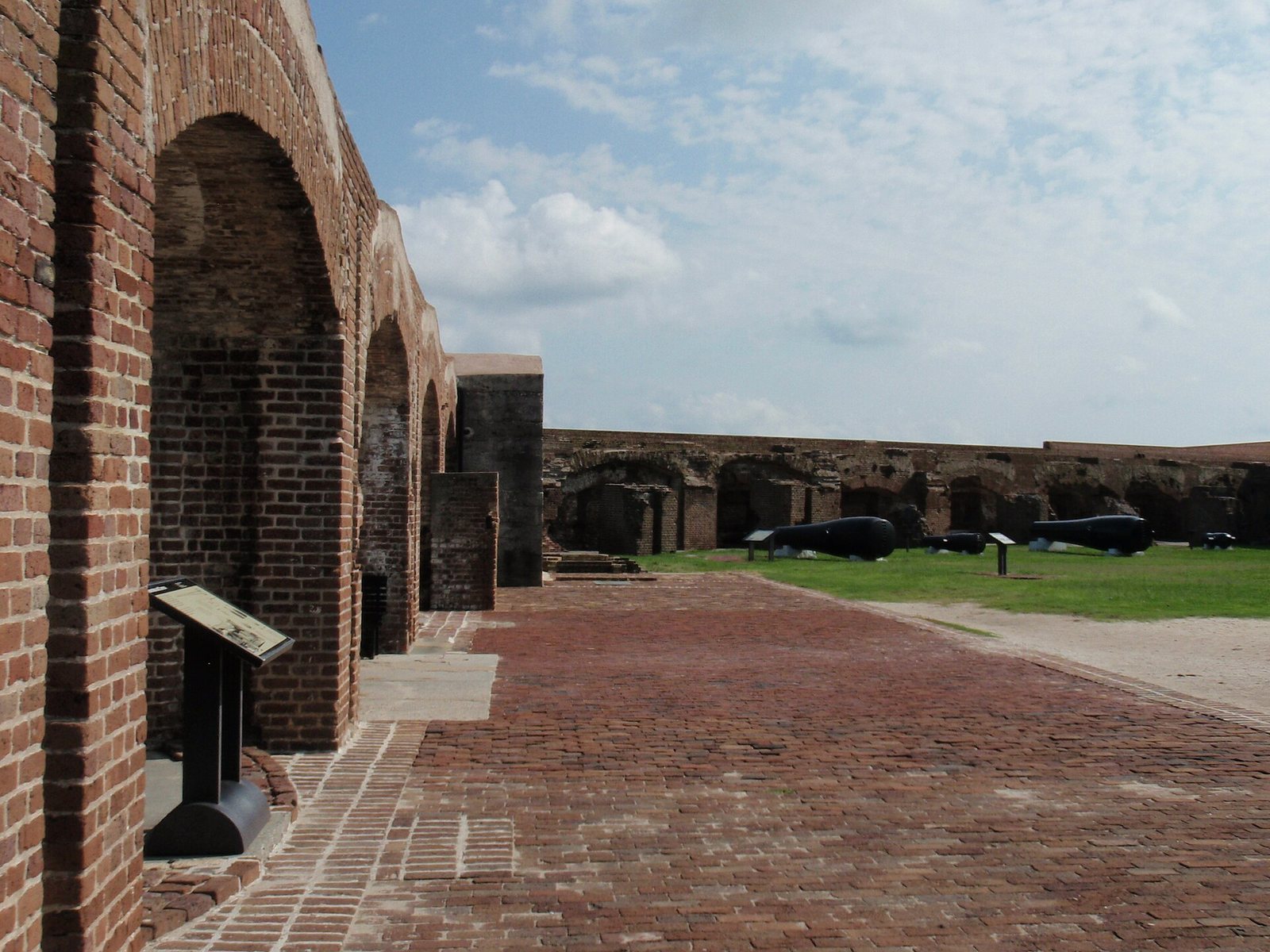
The fort’s sides measure 170 to 190 feet (52 to 58 meters), and its walls are five feet (1.5 meters) thick and rise 50 feet (15.2 meters) above the low-tide mark. Granite from New England, as well as stone shipped from New York and Maine, was used to build up the island and form the foundation. The brickwork consists of handmade, dark-brown bricks called Carolina gray; contracts covered 11 million bricks. A stone ledge 3.5 meters wide ran around the fort, and a 52-meter pier extended from the entrance. The longest wall, the rear wall or gorge, measured 96 meters and contained officers’ barracks. The entrance included a controlled defensive passage and a battery for three guns.
Interior and gun positions
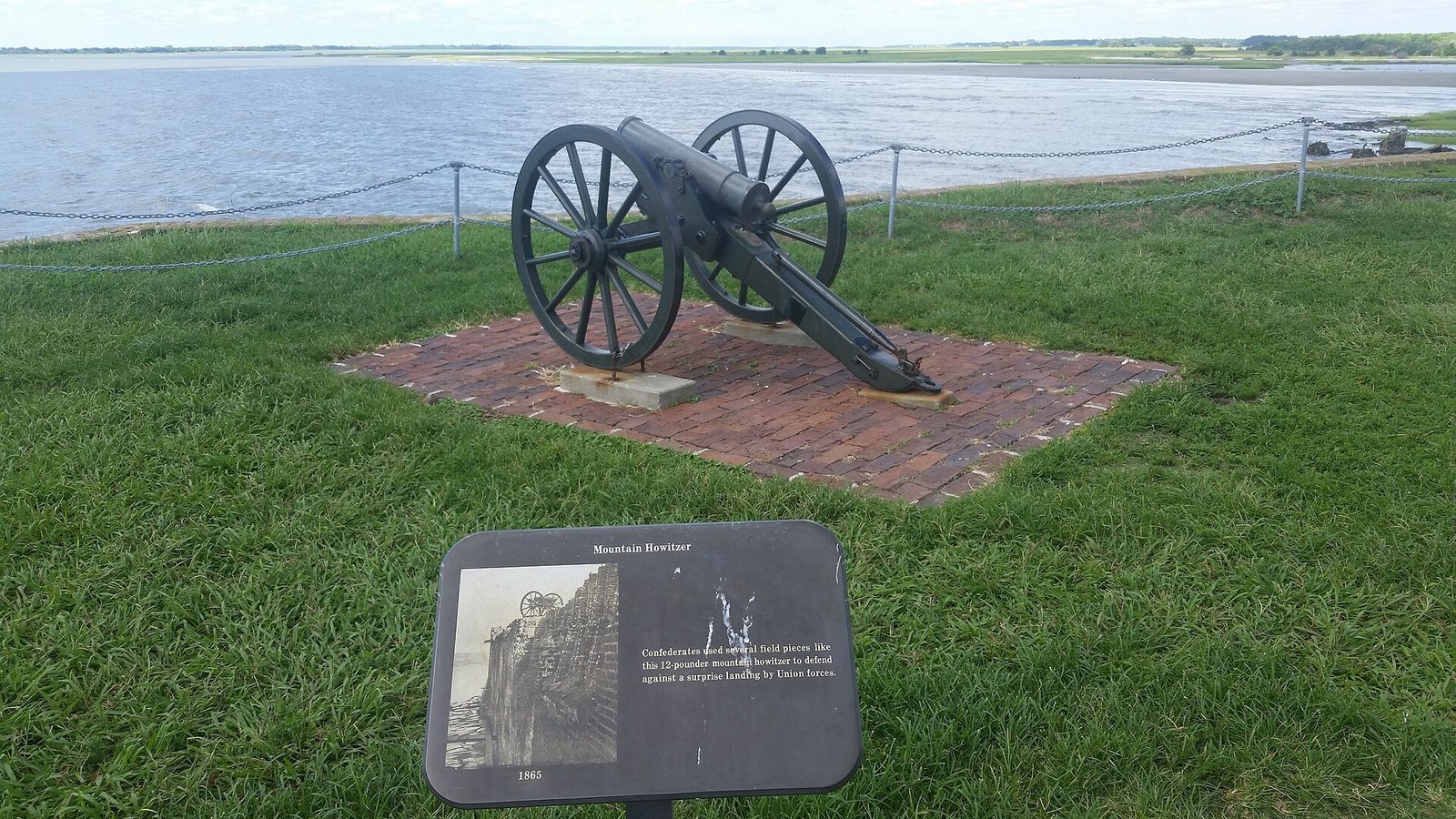
The interior parade ground covers about 0.5 hectares. The design provided for a garrison of 650 men and 135 guns arranged across three levels. The two lower levels contained casemates, enclosed and protected gun positions; the highest, or barbette, level was an open gun platform with wider firing angles but greater exposure to enemy fire. By 1858–59, 15 guns were mounted, the heaviest weighing 32 pounds, and the second-level embrasures, openings for guns in the walls, remained unfinished square openings. The fort also had two furnaces for heating cannonballs before firing, a lighthouse, northwest gun rooms, and defensive sections at the rear corners and along the left wall and adjoining side. A 10-inch columbiad, a large-bore cannon, stood at the fort’s right shoulder and pointed toward Charleston.
Wartime damage and rebuilding
The 1863 bombardment created a breach in the fort. Confederate forces later placed four 10-inch columbiads, one rifled 8-inch columbiad, and two rifled 42-pounder guns in the lower gun rooms along the left wall. A defensive barrier of sharpened stakes ran along the top of the fort. After the Civil War, workers lowered damaged walls to the height of surviving sections and rebuilt parts of them. They removed the third level of gun positions and restored 11 gun rooms on the first level, fitting them with 100-pounder Parrott cannons, which had grooved barrels to spin their projectiles.
Battery Huger
Built within the original fort walls in 1898, Battery Huger is a concrete installation in a blockhouse-like form. It held two 12-inch M1888 guns on carriages that lowered the guns behind protective walls after firing. The battery was deactivated in 1947.
Flags and parade ground
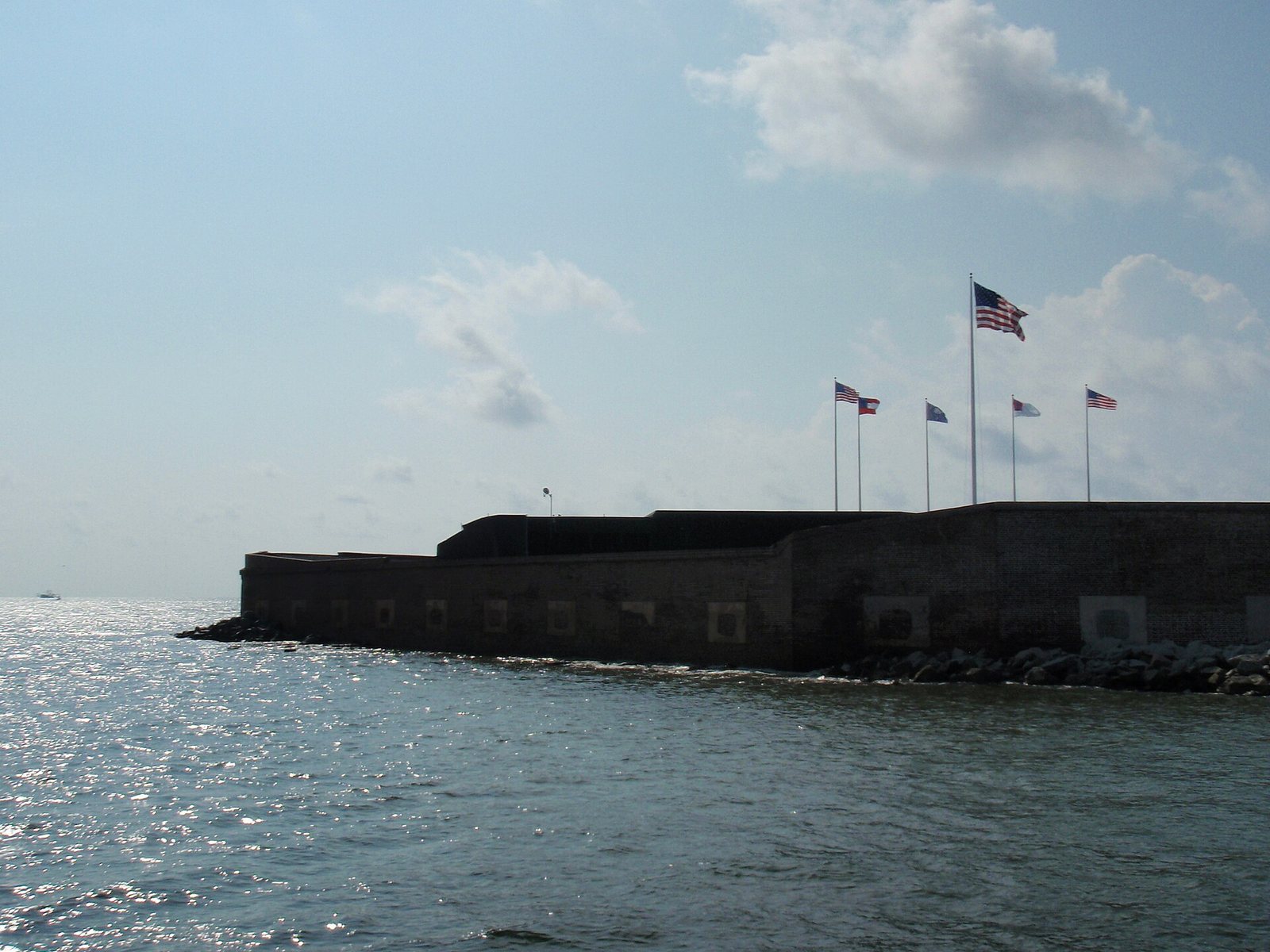
The Union flag Anderson carried away after the 1861 surrender is displayed in the Fort Sumter Museum. A semicircle of five small flags around a large flagpole bearing the 50-star U.S. flag was added in the 1970s. Those flagpoles were removed in August 2015, and four historic national flags now fly on the lower parade ground.