Dalby Church: A Medieval Parish Church in Sweden
Site at a Glance
- Country
- Sweden
- Primary era
- Medieval
- Eras represented
- Medieval, Early Modern, Modern
- Civilizations
- Swedish
- Site type
- Religious
- Remains
- Church
On this page12 sections
History
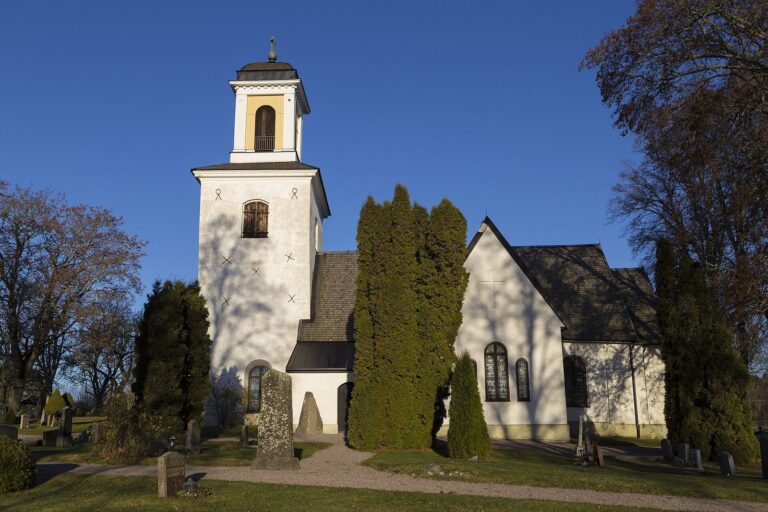
Dalby Church is a medieval parish church in Dalby, Sweden, on a headland in Lake Ekoln, part of Lake Mälaren. It serves Dalby parish in the Diocese of Uppsala and belongs to the Church of Sweden and Balingsta pastorate. The church was consecrated in the thirteenth century.
Medieval church and enlargement
The earliest church, built in the thirteenth century, had a chancel (the area around the altar) narrower than its nave (the main body of the church). During the Folkunga period, from 1250 to 1350 and associated with the House of Folkung, the building was extended at least to the south and east. Its earlier eastern part was demolished and replaced by a chancel as wide as the nave.
Brick vaults were added inside during the fifteenth century. Toward the end of that century, the vaults received wall paintings attributed to the Swedish late-medieval painter Albertus Pictor and his workshop.
Rebuilding and later changes
In 1659, Baron Knut Jöransson Posse, the church’s patron (a person with patronage rights), undertook extensive building work. The wall paintings were covered with plaster, and the fixed furnishings were replaced.
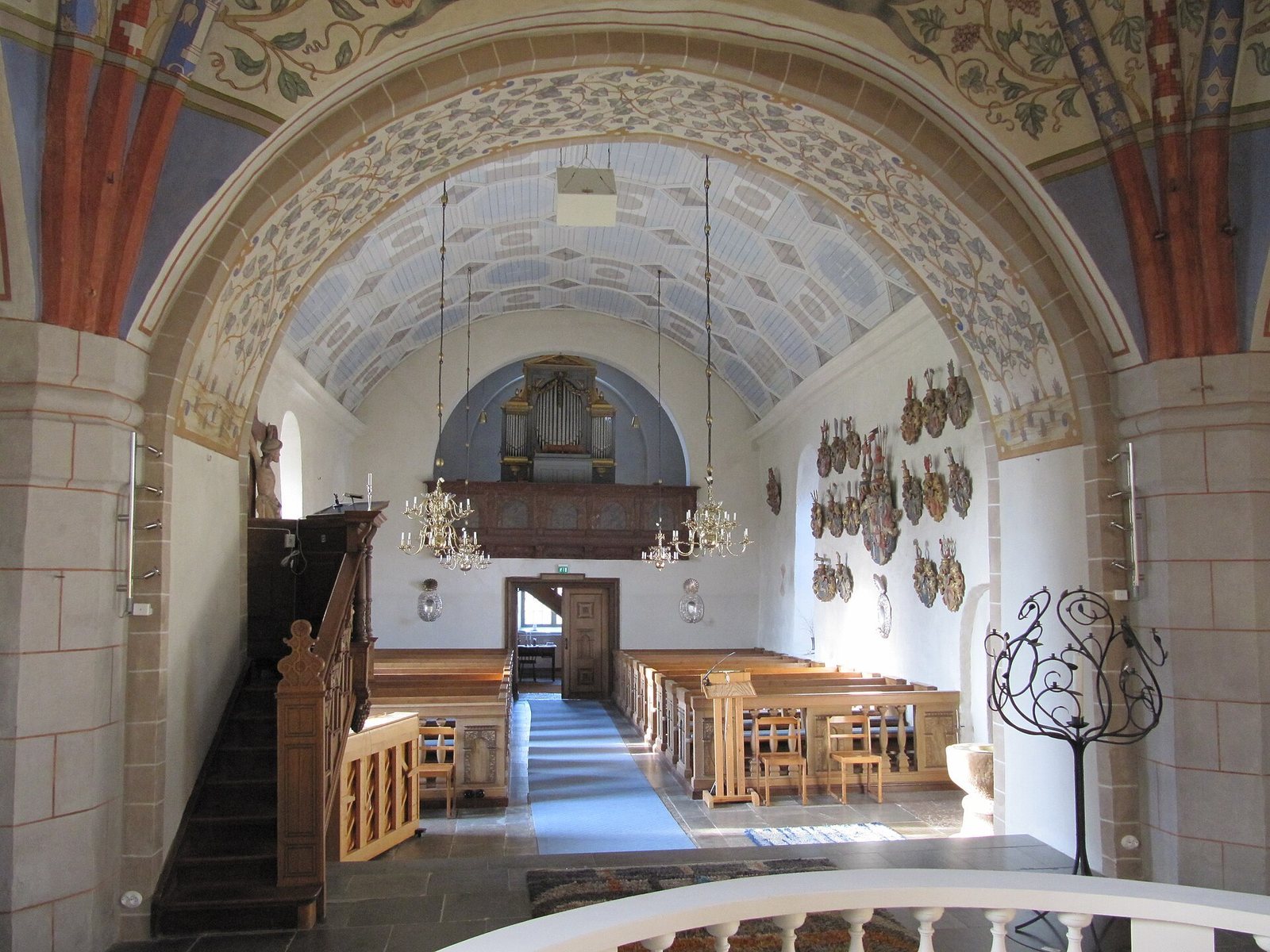
The windows were enlarged in the eighteenth century. In 1845, extensive alterations reduced the nave, created the present west gable, and replaced the nave’s vaults with a timber barrel vault, a continuous, tunnel-shaped ceiling. A renovation in 1901–1902 gave the church a National Romantic character and changed its interior and exterior. In 1958, adjustments to the colors and whitewashing of the walls partly restored the interior’s seventeenth-century appearance, while some medieval paintings were uncovered.
Remains
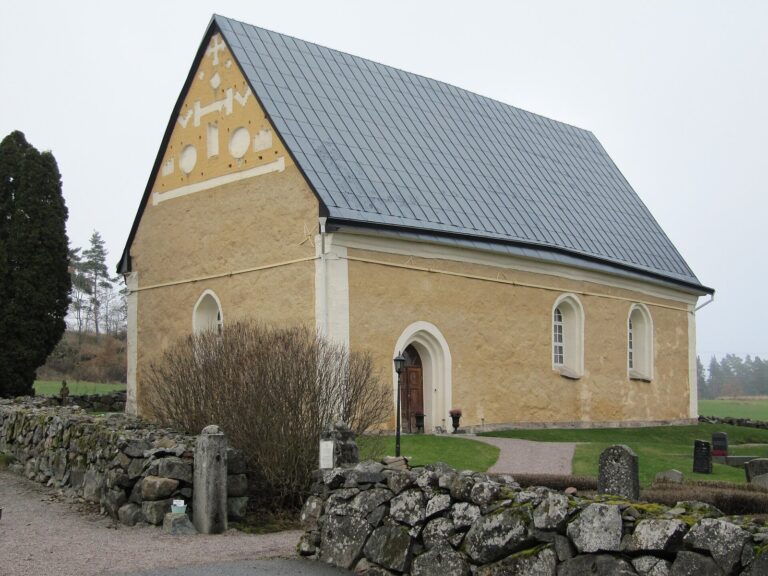
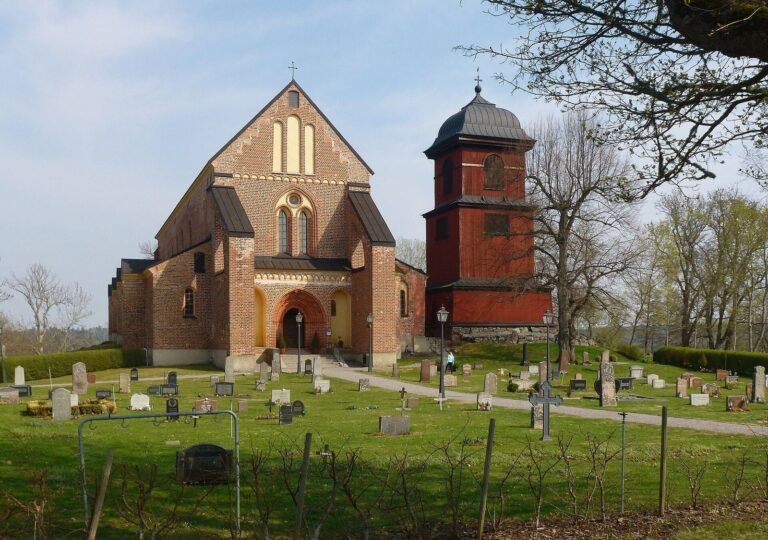
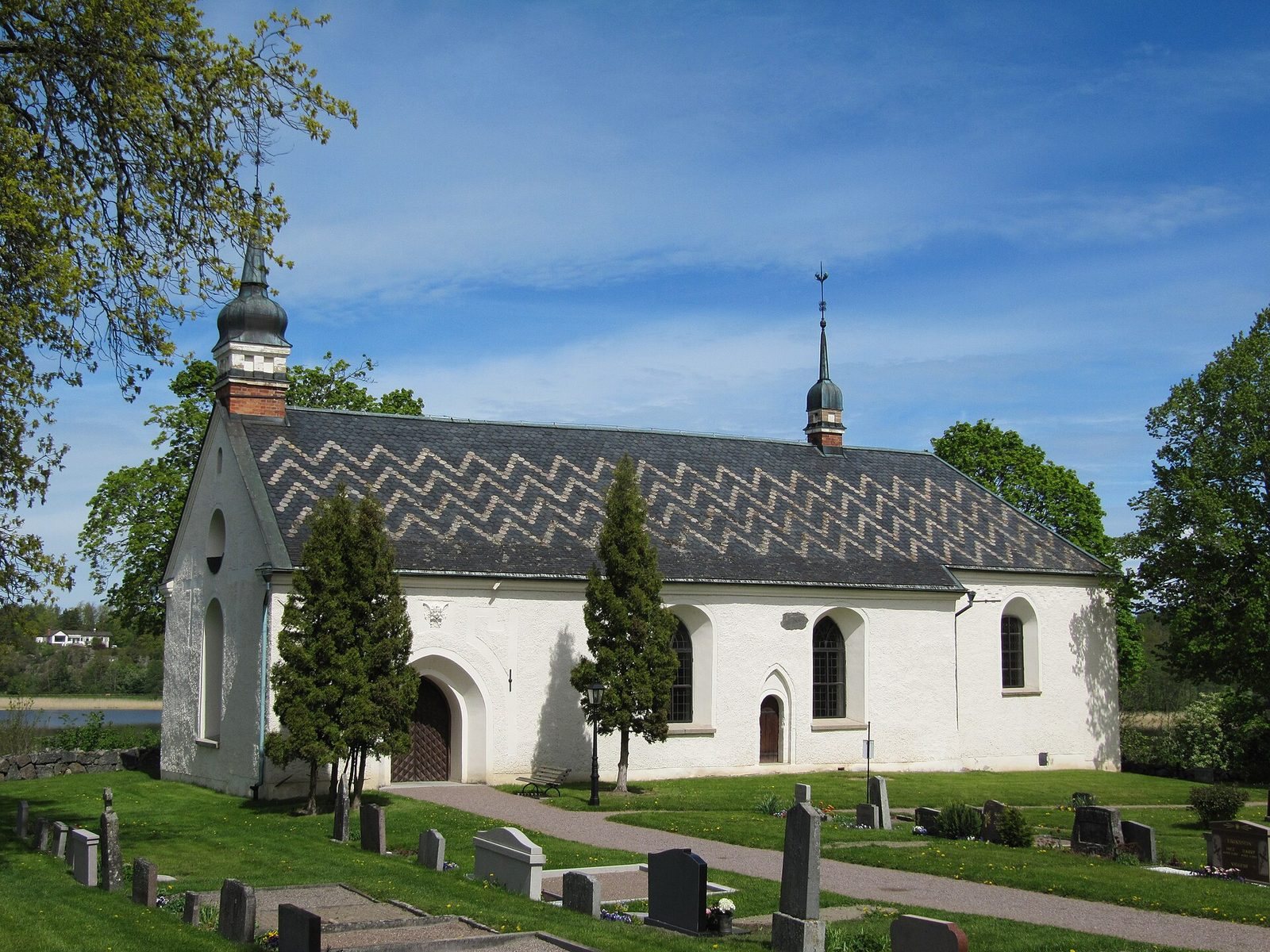
The church’s present plan consists of a rectangular nave, a narrower chancel at the east end, and a sacristy, a room for clergy’s vestments and worship items, attached to the north. Its walls are white-plastered natural stone, except for the brick chancel. The church stands on a headland, with Dalbyviken to the east.
Plan and fabric
Nave and chancel
The oldest surviving fabric is in the western stretches of the nave’s north and south walls, which extend as far as the sacristy. The present chancel was created in 1659 as a burial chapel for the Posse family. Its star vault has ribs arranged in a star pattern, and a burial chamber lies beneath the floor.
Sacristy and roof
A runestone, a stone bearing a runic inscription, is built into one wall of the sacristy. The church’s pitched roof is covered with slate laid in white and gray zigzag patterns. Two small brick towers rise from the roof ridge, each with a copper-clad spire.
Entrances and west end
The main entrance is in the south wall, where a medieval chancel doorway is preserved. A porch, possibly dating from the late Middle Ages, once stood outside it. The porch was removed during the 1901–1902 renovation, and a vestibule now occupies the west end, with an organ gallery above.
Furnishings and artworks
Baptismal fonts
The church’s oldest inventory item is a sandstone baptismal font, a basin used in baptism, probably made in the early thirteenth century. It was likely set aside in 1659, when Posse donated a hexagonal oak font. Painted in 1678, the oak font remained in use until 1902 and held an octagonal copper basin large enough for immersion. The sandstone font returned to use in 1902 and received a brass basin in 1959.
Pulpit
Posse also donated the oak pulpit, which has rich inlay work. It was moved from the north side of the interior to the south during the 1902 renovation.
Religious objects and images
A bronze incense burner dates to the thirteenth century. On the south wall is a fourteenth-century crucifix associated with the arch between the nave and chancel, attributed to the artist conventionally known as the Dalby Master. The altarpiece, an artwork placed at or behind an altar, includes an image of Mary. The infant Jesus holds a carnation that symbolizes one of the nails associated with the coming Crucifixion. An angel figure stands above an entrance.