Fort Saint Michael: Senglea’s Landward Defense
Site at a Glance
- Popularity
- Medium
- Country
- Malta
- Primary era
- Early Modern
- Eras represented
- Early Modern
- Civilizations
- Crusader, Knights Hospitaller
- Site type
- Military
- Remains
- Fort
On this page16 sections
History
Fort Saint Michael was a fort built by the Order of Saint John, a Catholic military-religious order that governed Malta, at the landward end of the Senglea peninsula in Malta. Construction began in 1552 to protect the island’s landward approach and help defend Il-Birgu, a fortified city across Grand Harbour.
Early defenses and construction
In 1537, d’Homedes renovated a villa at the site and enclosed it with a protected chamber, or casemate. After Ottoman attacks on Malta and Gozo in 1551, Grand Master Juan de Homedes y Coscon ordered new defenses. An Order council gave the planning to its general Leone Strozzi and two other knights, who commissioned military engineer Pedro Pardo d’Andrera to prepare the design. De Homedes laid the first stone on 8 May 1552.
Strozzi considered a continuous defense across the Xiberras Peninsula impracticable and recommended fortifying its tip instead. Fort Saint Elmo was built there in 1552. Fort Saint Michael occupied the smaller Senglea peninsula across from Il-Birgu, with the Sainte-Marguerite hills on its landward side.
Siege and rebuilding
From 1553 to 1556, Grand Master Claude de la Sengle had a fortified wall built around the island, with Nicolo Bellavanti overseeing the work. Raised defensive platforms, called cavaliers, and works protecting the gates strengthened Fort Saint Michael. These defenses developed into the fortified city of Senglea.
During the Great Siege of Malta, the Ottoman attack on the island in 1565, Fort Saint Michael came under heavy bombardment from the Sainte-Marguerite and Corradino hills. It withstood ten assaults. Fort Saint Angelo also held out, while Fort Saint Elmo fell. At the request of the knight Francesco de Sanoguera, defenders reinforced the Spur, a separate seaward fortification, with large earth-filled boxes. Pierre de Monte served as a commander, and Don Carlo Ruffo was killed while leading the defense at the entrance on French Creek.
After the siege, Grand Master Jean de Valette asked military engineer Francesco Laparelli to rebuild Senglea’s defenses. Laparelli advised that the damage was so severe the defenses should be demolished, but they were retained. Restoration was assigned to Ġlormu Cassar in 1568, and rebuilding continued until 1581 as Senglea developed. Fort Saint Michael was reconstructed as a raised defensive work, or cavalier.
Later defensive schemes
Renewed concern about Ottoman attack led Grand Master Antoine de Paule to strengthen Senglea’s defenses in 1633. The seaward Bastion of Saint Michael, a projecting defensive work, replaced the Spur, while the landward fort received further raised works and gate defenses. In 1638, de Paule’s successor, Jean-Paul de Lascaris-Castellar, commissioned the Margherita Lines, designed to enclose Il-Birgu and Senglea within a shared defensive line.
During the 1660s, the Order’s military engineer Médéric Blondel repeatedly urged the addition of artillery platforms, particularly near the water. After Candia fell and Crete was captured, Grand Master Nicolas Cottoner y de Oleza chose to build the Cottonera Lines instead. Designed by Antonio Maurizio Valperga, the 4.5-kilometre defenses were intended to shelter 40,000 people with their arms, belongings, and livestock. Cottoner laid the first stone on 28 August 1670 and financed the project.
In 1687, military engineer Don Carlos de Grunenbergh recommended a low outer defensive work for Fort Saint Michael and offered to fund it. At his request, the Order paid for seaward artillery defenses facing Fort Saint Angelo in 1690. The battery had seven guns by 1785, and guns transferred from Fort Saint Angelo strengthened it on 3 December 1792. By the French landing in 1798, the landward defenses had lost much of their strategic value, and Fort Saint Michael carried only seven firearms.
Demolition and wartime damage
Port-quay extensions substantially altered the fort in the late nineteenth century. It was largely dismantled in 1921 to make way for a primary school built the following year, and its old tower was demolished. Bombing of the adjacent dock area during the Second World War badly damaged the remaining defenses. In April 1942, 3,156 tonnes of bombs fell on the dock area beside the fort. The ruins were cleared after the war, while proposals to restore or rebuild the defenses were debated. Fort Saint Michael has Grade 1 heritage status.
Remains
Landward fort and setting
The fort and peninsula
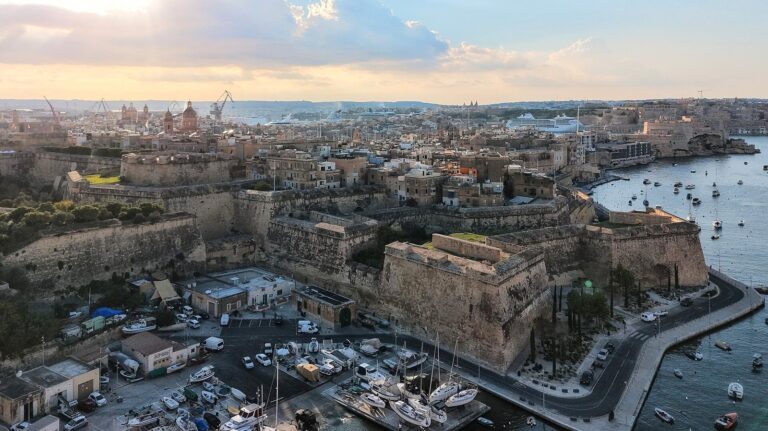
The fort stood at the landward end of the Senglea peninsula, between Dockyard Creek and French Creek in Grand Harbour. It marked the city’s land entrance; a separate fortified point lay at the peninsula’s seaward end. The original structure was a low, four-sided limestone tower, with walls beside the channel separating the island from the mainland and an upper level for artillery. In its later form, the tower had a protected-chamber interior and a terraced gun platform with ten openings, or embrasures.
Hilltop features
The island’s central hill was known in turn as Saint Julian Hill and Monte dei Molino. Its features included a chapel of Saint Julian dating to 1311 and two windmills. Frescoes of the Great Siege by Matteo Pérez d’Aleccio in the Grand Master’s palace depict the island with the two mills inside a small makeshift fortification, but without the chapel.
Harbor works and entrances
The Maċina and harbor chain
The Maċina, an extension facing Galley Creek, was built by Bellavanti in 1554. A strong crane-like frame, known as sheerlegs, stood on its upper structure to step galley masts and lift heavy loads. A heavy chain brought from Venice that year could be drawn across the creek between Senglea and Fort Saint Angelo. A capstan at the base of the Spur operated the chain.
Entrance defenses and the Italian Gate
The French Creek entrance defenses became known as the Bastion of Ruffo. The works beside the Maċina were called the Bastion of the Maltese, and a lower fortification was known as the Bastion of the Italians. In the late seventeenth century, Senglea’s Baroque entrance was moved to the Maċina side and became known as the Italian Gate.
The seaward point
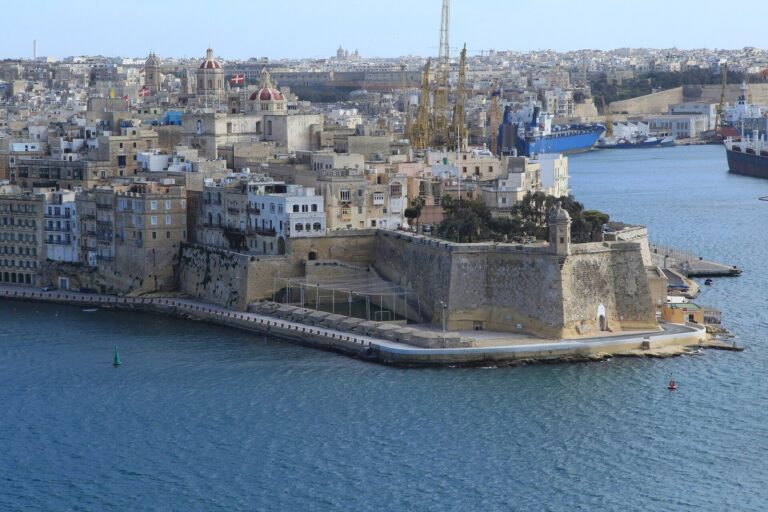
The Spur and the Bastion of Saint Michael occupied the seaward end of Senglea, opposite Fort Saint Angelo. The Spur is often mistaken for Fort Saint Michael, which stood at the city’s landward end. The interior of the seaward bastion was leveled and turned into a public garden overlooking Grand Harbour and Valletta.
Surviving features
Remaining fort fabric
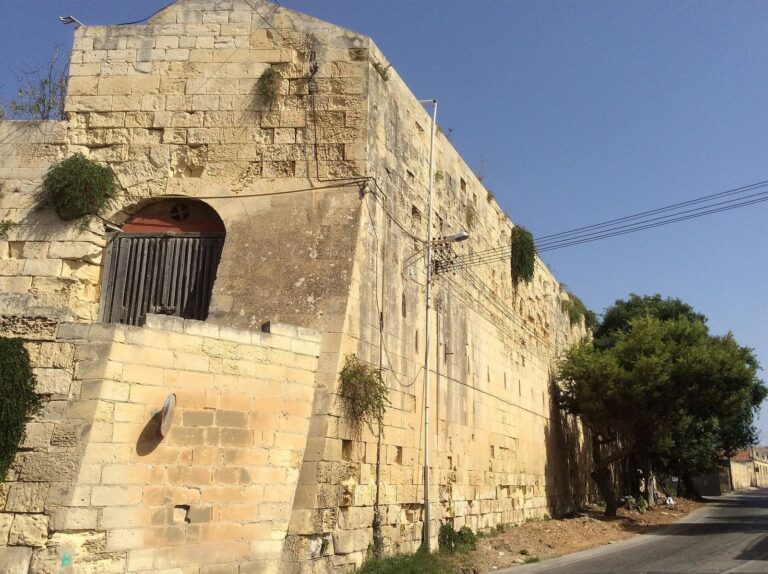
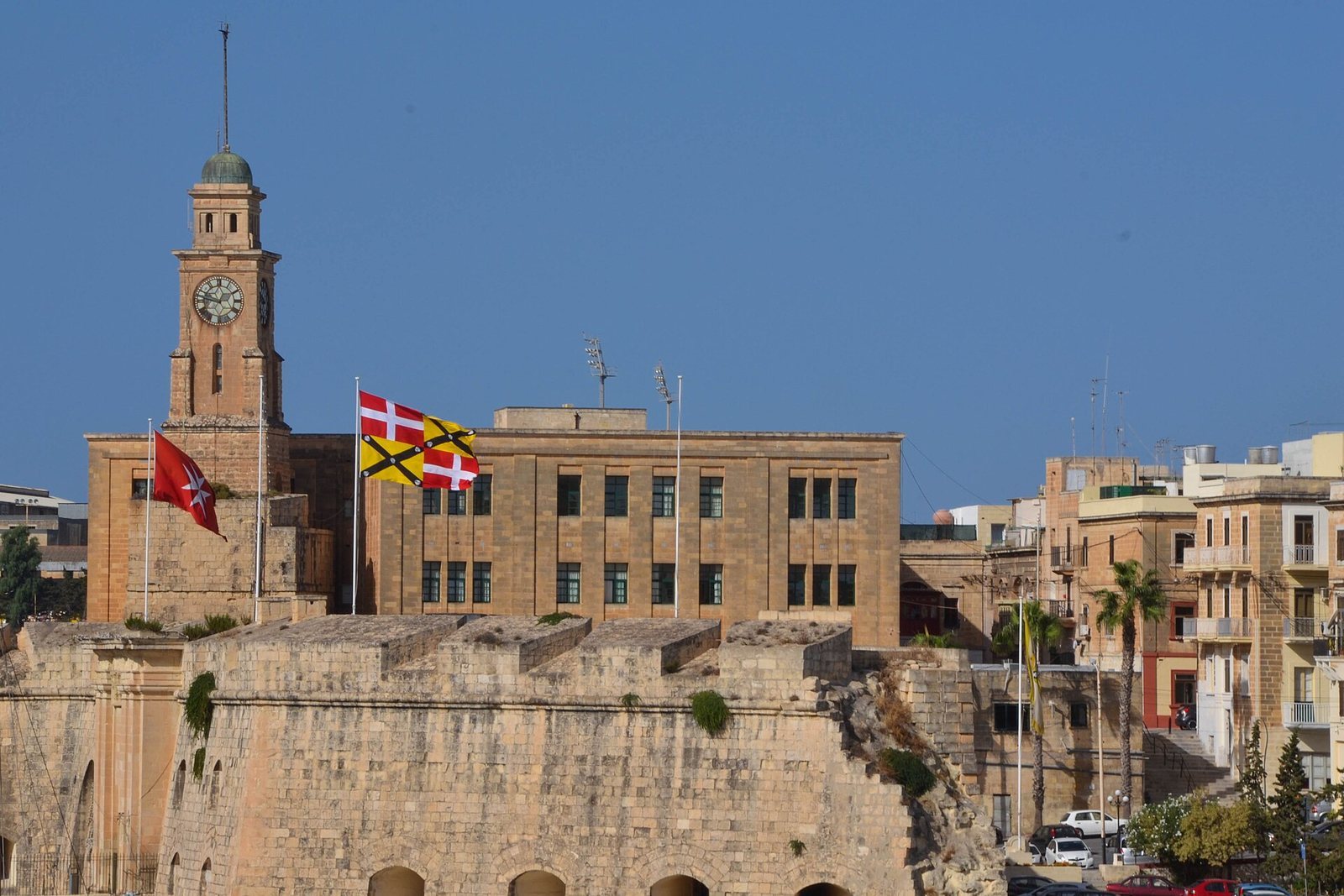
A small portion of the fort’s lower structure survives as the base of a clock tower. A large opening in the defenses lies between the city gate and the Maċina.
Sentry turrets
Both the fort and the seaward Bastion of Saint Michael retain a projecting sentry turret known as a gardjola. Sculptures of an eye, an ear, and a pelican on the fort’s turret represent vigilance and the self-sacrifice expected of troops defending the walls.