Church of St. Julian: A Historic Roman Catholic Church in Senglea, Malta


Site at a Glance
- Rating
- 4.6
- Popularity
- Very Low
- Country
- Malta
- Primary era
- Early Modern
- Eras represented
- Early Modern
- Civilizations
- Crusader, Knights Hospitaller
- Site type
- Religious
- Remains
- Church
On this page8 sections
History
The Church of St. Julian is a small Roman Catholic church in Senglea, Malta, dedicated to Saint Julian Hospitaller and commemorated liturgically on 27 January. Its present Baroque building was completed in 1712, while the church itself developed from a chapel completed in 1311. Regarded as one of Malta’s oldest churches, it is associated with the early settlement of the peninsula and belongs to the parish of the Nativity of Mary.
Medieval Chapel and the Order of Saint John
The first chapel dedicated to Saint Julian was completed in 1311, when Malta was under Aragonese rule. It stood on Saint Julian’s Hill, a low rise only a few metres above sea level, beside a cemetery. The site is believed to have held the first building erected on the peninsula. In the medieval period, the surrounding area was sparsely planted with olive trees.
The chapel was rebuilt in 1539 by Fra Diego Perez de Malfreire, Prior of Portugal and chief military engineer and architect of the Order of Saint John. The Order, a Catholic military and religious organisation, had ruled Malta since 1530, after Charles V granted the islands to it following its expulsion from Rhodes by the Ottomans in 1522. Malfreire demolished the ruined medieval structure, replaced it with a church of his own design at his own expense, and left an endowment for its maintenance. The new building retained the earlier orientation and had a gabled roof with a small bell-cot, an open belfry for church bells.
The church appears in frescoes by Matteo Perez d’Aleccio depicting events from the Great Siege of Malta in 1565, when Ottoman forces attacked the islands ruled by the Order of Saint John. These images preserve the church’s appearance with its gabled roof during a formative period in Senglea’s history.
Growth of Senglea and Religious Functions
After the Great Siege, Senglea grew rapidly. During Bishop Pietro Dusina’s visitation on 19 February 1575, residents petitioned for a priest to be appointed to the church. The request was accepted, and the church became a vice-parish church of Birgu. Erazm Balzan served as its first vice-parish priest, making it the first vice-parish church established in the Maltese diocese.
A Confraternity of the Blessed Sacrament was founded at the church in 1577. From 1588, Vincent Caruana also gathered young people there and helped them receive secondary-level education. This made the small church one of Malta’s earliest schools. On 2 November 1624, Bishop Baldassare Cagliares transferred the church to the Augustinian Order, but the friars departed after only six months, in May 1625.
Earthquake, Rebuilding, and Later History
The earthquake of 11 January 1693 caused serious damage to the church. The earthquake affected buildings across Malta and brought down some church domes. In 1699, during the tenure of Senglea parish priest Mikiel Testaferrata, the ruined building was marked for demolition. A new church was completed in 1712 to designs by Lorenzo Gafà, a prominent Maltese Baroque architect of the seventeenth and early eighteenth centuries.
The former facade arch, which contained two bells, was removed in 1729. A new bell tower designed by the Senglea-born Francesco Azzopardi was added on the same occasion, and the sacristy was enlarged. On 27 January 1730, Bishop Paul Alphéran de Bussan visited the church for the feast of Saint Julian and proclaimed Saint Julian, together with Marija Bambina, the Nativity of the Virgin Mary, a special patron of Senglea.
Enemy bombing during the Second World War caused heavy damage. Because the bell tower had become unsafe, it was dismantled in 1998 and rebuilt to its original dimensions and design. The interior underwent major restoration in 2001, followed by the restoration of the titular painting and its Baroque frame in 2003. The church no longer holds regular Masses, but marriages may be celebrated there, and it serves as a chapel for Eucharistic adoration. Its patronal feast remains on 27 January and includes a tribute by hunters, for whom Saint Julian is a patron, with a salute fired into the air. The church was listed in Malta’s National Inventory of the Cultural Property of the Maltese Islands in 2012. The statue of Saint Paul at the corner is listed separately.
Remains
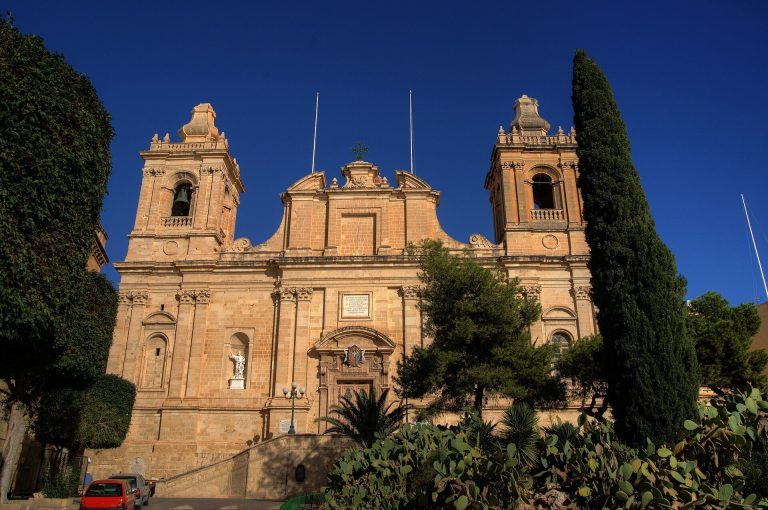
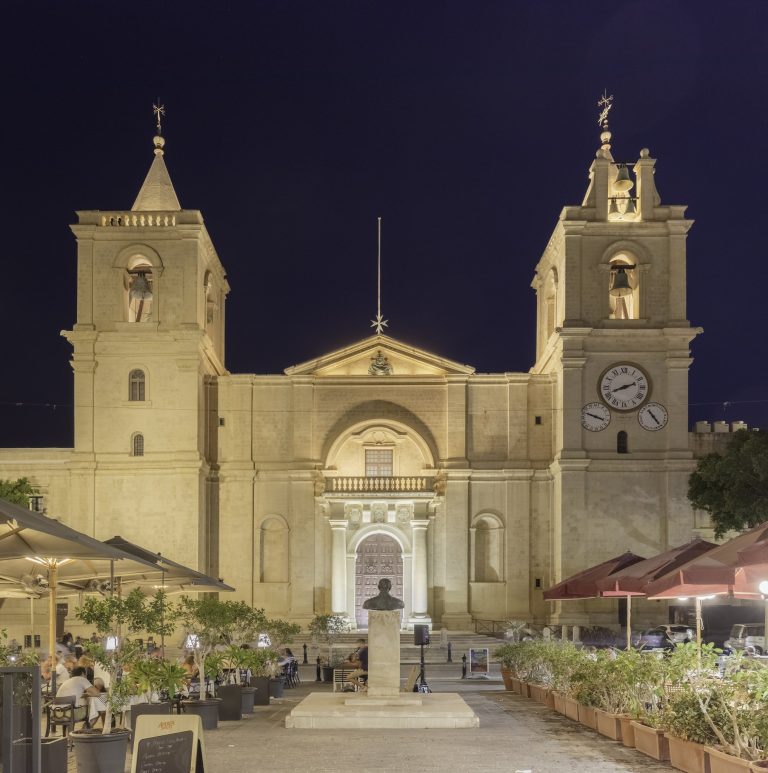
The present church stands at the junction of Triq San Ġiljan and Triq iż-Żewġ Mini. Built from Maltese limestone in the Doric style, it follows the proportions and facade arrangement of the sixteenth-century church erected by Fra Diego Perez de Malfreire. The main entrance faces Triq San Ġiljan and is reached by a short flight of steps, while the bell tower occupies the side facing Triq iż-Żewġ Mini. A single elliptical dome crowns the building and carries a stone lantern with windows.
Facade and Bell Tower
The facade bears the coat of arms of Bishop Davide Cocco Palmieri and the date 1710. The bell tower contains four bells. One, hanging on its eastern side, dates from 1723 and was cast in Messina by Alberto Bertuccelli. It was originally one of the two bells housed in the small bell-cot incorporated into the earlier facade. The other three bells were cast in 1905 and 1906 by Premiata Fonderia Daciano Colbachini of Padua. The tower was rebuilt in 1998 according to its former dimensions and design after wartime damage and later deterioration.
Corner Statue
A stone statue of Saint Paul stands at the church’s corner. The apostle, an early Christian missionary whose writings form a major part of the New Testament, was represented in the statue carved by Anton Masuttil in 1868. The statue is separately listed in Malta’s cultural-property inventory.
Interior and Sacred Art
The church has three altars, including side altars dedicated to Saint Vincent de Paul and Our Lady of Sorrows. Saint Vincent de Paul was a seventeenth-century French Catholic priest associated with charitable work and assistance to the poor. The titular painting, made in 1821 by the Birgu painter Giovanni Battista Bonomo, portrays Saint Julian dressed as a knight, with Fort Saint Angelo and Fort Saint Michael behind him. It is enclosed in an artistic Baroque retable, an ornamental framework behind an altar. Above the painting, a decorative cartouche carries the words “Protegam Civitatem Istam,” meaning “I will protect this city,” from Isaiah 37:35, and refers to Saint Julian’s protection of Senglea. A small circular image of Our Lady Help of Christians is placed above the cartouche.