Fort of Trafaria: A Seventeenth-Century Defence and Quarantine Complex in Portugal


Site at a Glance
- Rating
- 4
- Popularity
- Very Low
- Country
- Portugal
- Primary era
- Early Modern
- External website
- Open
- Eras represented
- Early Modern
- Civilizations
- Portuguese
- Site type
- Military
- Remains
- Fort
On this page8 sections
History
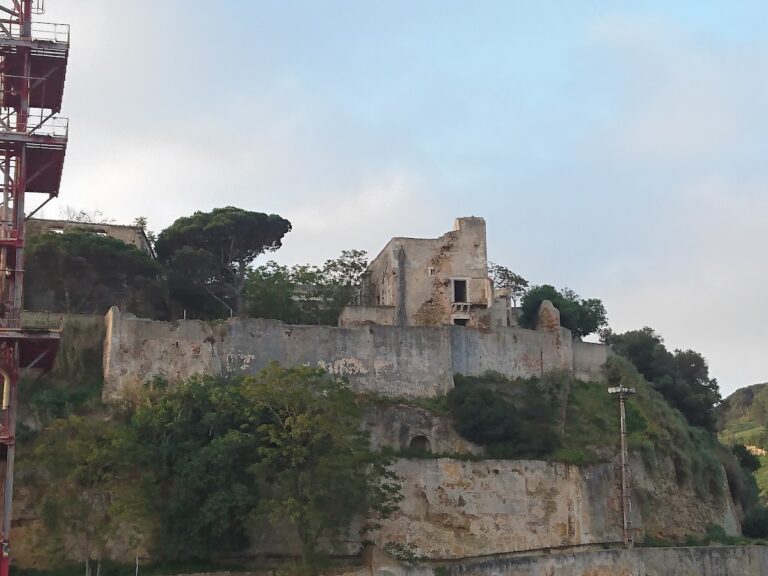
The Fort of Trafaria in Portugal is a seventeenth-century Portuguese fort built in 1683 during the reign of Pedro II to help defend Lisbon. Located on the left bank of the Tagus in Trafaria, it was intended mainly to prevent a possible landing on the river’s southern shore. Its military effectiveness was questioned throughout its history, and it was never used in battle.
Foundation and quarantine functions
The site’s religious and medical functions began before the fort was completed. The Nossa Senhora da Saúde chapel was built in 1678 beside a lazaretto, an institution used to isolate people, ships, or goods suspected of carrying contagious disease. Established in the late seventeenth century, the quarantine hospital was later incorporated into the fort’s uses.
In 1725, the chapel and the hospital’s principal buildings were rebuilt. A boundary wall was added in 1743 to prevent the general public from entering the chapel while quarantine patients were present. The 1755 Lisbon earthquake extensively damaged the area, and restoration was completed in 1786.
Nineteenth-century military use
The quarantine function ended in the early nineteenth century, after which the fort was vacated. During the Portuguese Civil War of 1828 to 1834, a conflict between supporters of Pedro IV’s constitutional monarchy and supporters of his brother Miguel’s absolute monarchy, the fort was repaired and used as a military prison. It was deactivated after the conflict ended.
Industrial, state, and naval uses
The Algarve Fisheries Company later occupied the fort for fish-guano production, making fertilizer from fish waste or decomposed fish remains. The activity was eventually halted for public-health reasons. After the State reoccupied the site, it served as a nursery for the national forests and as a shelter for royal galleys, oared vessels used by European monarchies before steam-powered ships became dominant.
On 17 April 1901, the fort received a message from a transmitting station at the Fort of Alto do Duque on the opposite bank of the Tagus, 4,300 metres away. This was Portugal’s first wireless connection. Between 1908 and 1910, the facilities were adapted for use as a military prison, a detention facility operated under military authority. The fort was subsequently used by the Portuguese Navy, abandoned again by 1917, briefly occupied as a private residence, and later returned to military-prison use first by the Navy and then by the Army.
Municipal ownership
The fort entered a degraded state during the second half of the 1990s. The Municipality of Almada acquired it in 2000. The site was under restoration in 2020.
Remains
The Fort of Trafaria consists of the Nossa Senhora da Saúde chapel, the principal hospital buildings, and fortifications constructed around them. Together, these elements form a complex in which religious, quarantine, and defensive functions were physically combined.
Chapel and hospital buildings
The Nossa Senhora da Saúde chapel dates from 1678 and stands alongside the hospital established on the site in the late seventeenth century. The chapel and the hospital’s principal buildings were rebuilt in 1725. The chapel was restored during adaptation works carried out between 1908 and 1910, when the wider complex was converted for military-prison use.
Fortifications and boundary wall
The fortifications were constructed around the chapel and hospital buildings after the fort was established in 1683. A wall added in 1743 controlled access to the chapel during periods when quarantine patients were held there. The surrounding defensive structures later accommodated the site’s changing functions, including its use as a military prison and naval facility.
Nearby sites