Fort Kijkduin: A Napoleonic Coastal Fortress in the Netherlands


Site at a Glance
- Rating
- 4.4
- Popularity
- Medium
- Country
- Netherlands
- Primary era
- Modern
- External website
- Open
- Eras represented
- Modern
- Civilizations
- Dutch, French, German
- Site type
- Military
- Remains
- Fort
On this page14 sections
History
Fort Kijkduin is a Napoleonic coastal fortress in the Netherlands, located at Huisduinen west of Den Helder. Ordered by Napoleon Bonaparte after his visit to Huisduinen in 1811, it was built between 1811 and 1813 as part of his plan to develop Den Helder into a major naval base. Napoleon regarded the area’s strategic position as highly valuable and envisioned it as the “Gibraltar of the North.”
Napoleonic foundation
Construction employed craftsmen from North Holland and hundreds of Spanish prisoners of war. The estimated cost was approximately 230,000 French francs. The fortress was initially named Fort Morland in honor of Colonel François-Louis de Morlan, a Napoleonic officer who was mortally wounded at the Battle of Austerlitz on 2 December 1805 and died three days later.
After Napoleon’s defeat, Fort Kijkduin was not immediately abandoned or demolished, unlike many other French defensive positions in the Netherlands. It remained under the control of the Dutch-French admiral Carel Hendrik Verhuell until 4 May 1814. A decree issued on 28 June 1814 changed the name to Fort Kijkduin, before the establishment of the Kingdom of the Netherlands in 1815.
Expansion and changing military roles
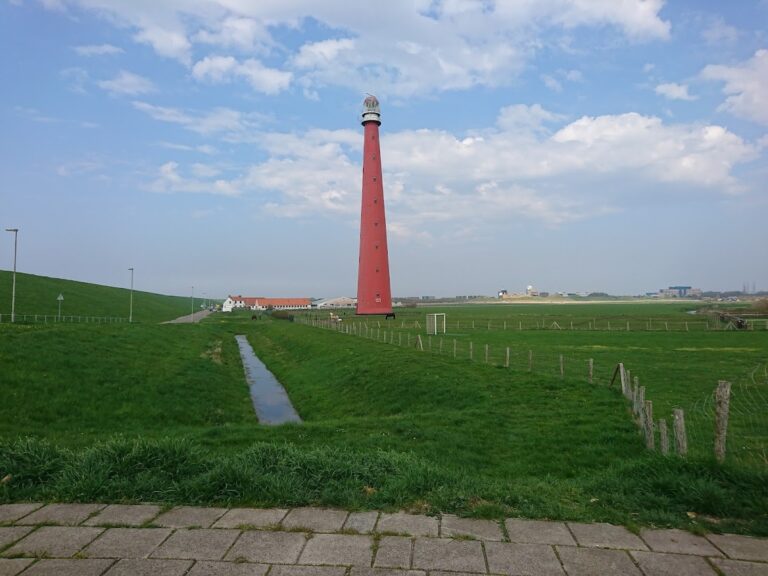
A fortified lighthouse was erected on the highest part of the fort in 1821 and 1822. It was demolished in 1877 and replaced that same year by the Lange Jaap lighthouse. A new Fort Kijkduin was begun south of the original fort in the early twentieth century, but the project was never completed. Its remaining traces disappeared during reinforcement of the sea dike in the 1970s.
During the First World War, command of Fort Kijkduin and the other positions in the Den Helder defensive line was assigned to the commander of the Willemsoord naval base. In 1916, reinforced-concrete anti-tank obstacles were tested on the beach southeast of the fort.
Second World War and later preservation
During the mobilization before the Second World War, the fort held only a small detachment responsible for coordinating artillery fire. German forces took it over without combat in May 1940, strengthened its defenses, and incorporated it into the Atlantic Wall, the German coastal defense system built along the western European coast.
During the German occupation, installations were added for unloading trucks without detection. New torpedoes and anti-aircraft weapons were also tested at the fort. Although Den Helder experienced at least 117 documented bombardments during the war, Fort Kijkduin itself was not bombed.
Fort Kijkduin was restored and opened as a museum and North Sea aquarium in 1996. The southern section was restored in 2015, and the museum and aquarium exhibitions were renewed and modernized in 2021 and 2022. The fortress has been a Rijksmonument, the Netherlands’ national heritage status for a protected historic monument, since 23 August 1989, under monument number 46768.
Remains
Enclosure and defensive layout
Fort Kijkduin stands west of Den Helder at Huisduinen, within sight of the beach and the North Sea. A high enclosing defensive wall, known in this context as a tamboer, surrounds the grounds. Behind it are the guardhouse and the fort keeper’s residence. From this area, a ramp approximately 65 metres long leads to the central reduit, the fortified structure intended to provide a defensible stronghold within the larger fort.
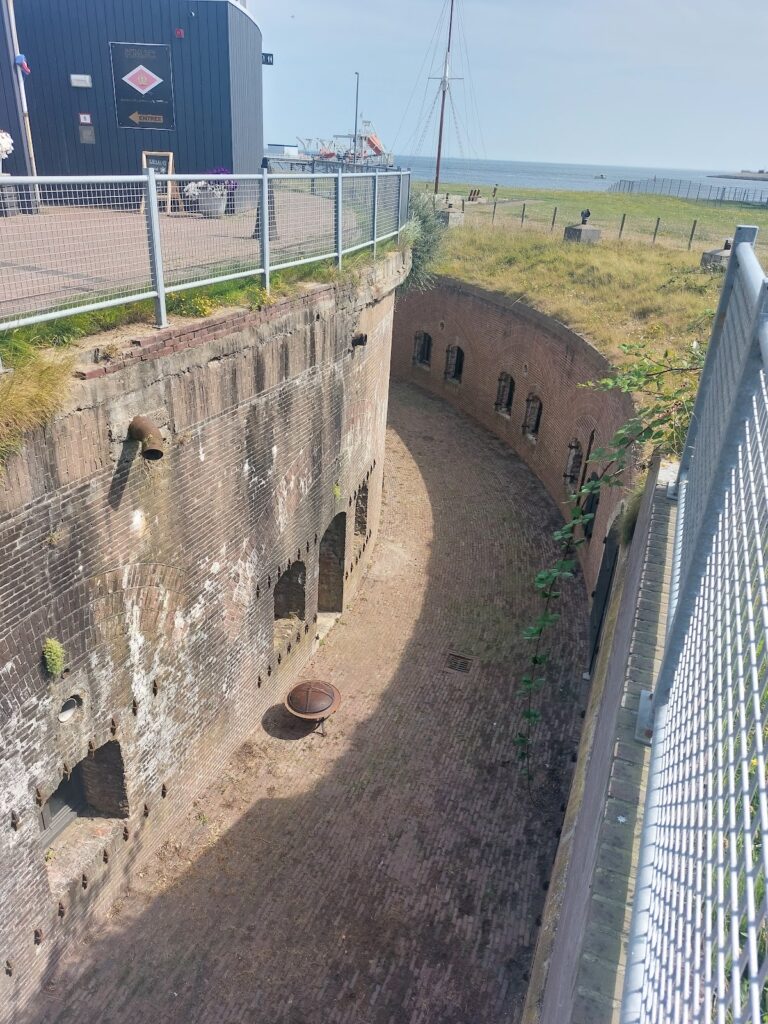
The fortress was designed as a brick reduit with two bastions on its southern side. A bastion is a projecting part of a fortification that allows defensive fire along adjoining walls. The complex was also surrounded by a dry moat. The reduit remains intact, while the dry moat and the sea-side counterscarp, the outer slope or retaining structure beyond a moat, have largely disappeared through reinforcement of the sea dike. The contours of the southern bastions and part of the moat wall were reconstructed in modern form during the 2015 restoration.
Central reduit
The central reduit is a brick structure approximately 64 metres long, 39 metres wide, and 7 metres high. Its northern and southern walls are about 3.5 metres thick, while the eastern and western walls measure about 0.9 metres. Eight covered or vaulted spaces, traditionally called bays, occupy the interior. Each measures approximately 39 metres by 6 metres and is about 4.5 metres high. These spaces originally accommodated a garrison of more than 700 soldiers.
Lighthouse and artillery observation
Fortified lighthouse
A 22-metre-high brick lighthouse occupied the highest point of the fort from 1821 and 1822. Its walls included loopholes. The structure was demolished in 1877 and replaced by the Lange Jaap lighthouse, which was built that year.
Armored observation post
In 1897, an armored observation post for directing artillery fire was installed on the roof on a concrete base. Its cast-steel cupola, made by Schneider et Cie of Le Creusot, weighed 48 tonnes and contained viewing openings that provided an all-round view. Two rooms beneath it served as workspaces for recording observations at a drawing table and for telegraph operators.
Twentieth-century defensive remains
Several bunkers remain visible east of the fort. Among them is a double gun casemate dating from approximately 1916. A casemate is a reinforced defensive chamber designed to house artillery or other weapons. This structure protected two rapid-fire guns with a calibre of 10 centimetres. The Kroontjesbunker, built east of the fort in 1942, served as an anti-aircraft command post.
Museum, aquarium, and surrounding landscape
Interior exhibitions
The former underground vaulted spaces now contain the museum and aquarium. The first two bays hold aquaria, while the remaining six contain exhibitions about the fort’s history and military weapons, including weapons from the Second World War.
North Sea aquarium
The North Sea aquarium contains approximately fourteen aquaria devoted to different themes. Its coastal species include sea anemones, rays, red gurnards, and smooth sharks. A glass tunnel passes through the aquarium. The fort also contains a marine-mammal exhibition with the skeleton of a sperm whale. In July 2015, the aquarium received a zoo licence authorizing it to keep animals in captivity.
The grounds have views toward the North Sea and the protected natural monument of the Grafelijkheidsduinen. Human intervention in nature development created a dune valley inhabited by many waterfowl, and a small herd of Scottish Highland cattle grazes in the area.
Nearby sites