Fort Borstal: A Nineteenth-Century Defensive Fort in the United Kingdom
Site at a Glance
- Country
- United Kingdom
- Primary era
- Modern
- Eras represented
- Modern
- Civilizations
- British
- Site type
- Military
- Remains
- Fort
On this page7 sections
History
Construction and defensive purpose
Fort Borstal is a nineteenth-century defensive fort in the United Kingdom, built as part of the fortification programme prompted by the 1859 Royal Commission. This British inquiry into national defence led to recommendations for new fortifications. One of four forts arranged around Chatham, Borstal was intended to secure high ground southwest of Rochester.
Work began in 1875 using convict labour, then stopped in 1885 before the fort was completed around 1895. Captain Siborne of the Royal Engineers, the British Army corps responsible for military engineering, was identified as its builder. The fort was initially unarmed.
Wartime and later uses
During the Second World War, Fort Borstal became the base for an anti-aircraft battery. In later years it was used as a pig farm and as storage for the nearby Young Offenders Institution. A company bought the fort in 1991 with plans to create a museum, but that project did not proceed; the site was instead converted into living accommodation. Fort Borstal is a scheduled monument, a site legally protected for its archaeological or historic importance, and is privately owned.
Remains
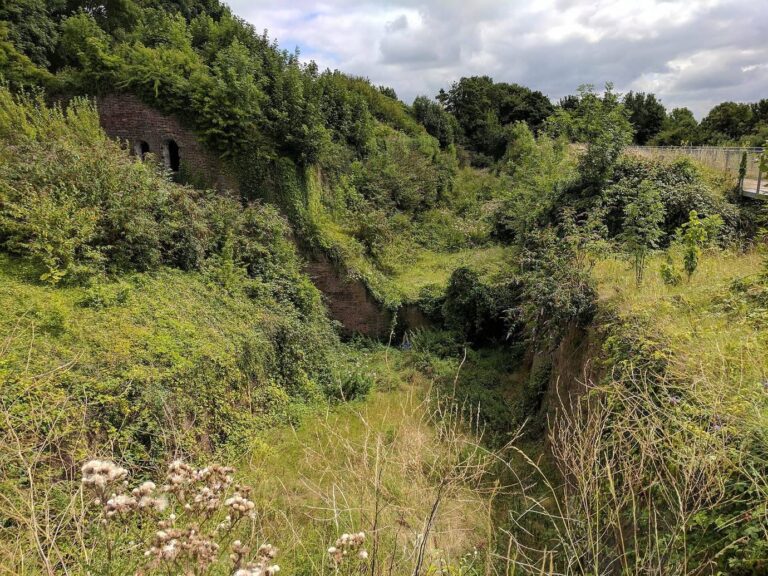
The fort has a polygonal plan, with brick structures and earthworks forming its main fabric. Its surviving transport features include a narrow-gauge railway and a rope-worked incline that connected the fort with nearby resources and transport routes.
Transport infrastructure
Railway
An 18-inch (457 mm) gauge railway connected Fort Borstal with the forts at Bridgewoods, Horsted, and Luton. About 600 yards (550 m) of track survives at Borstal.
Rope-worked incline
A rope-worked incline ran west from the fort to a gravel pit and a wharf on the River Medway.