Forest Abbey: A Benedictine Women’s Monastery in Belgium
Site at a Glance
- Popularity
- Medium
- Country
- Belgium
- Primary era
- Early Modern
- Eras represented
- Early Modern, Modern
- Civilizations
- Belgian, Habsburg, Holy Roman Empire
- Site type
- Religious
- Remains
- Monastery
On this page15 sections
History
Forest Abbey was a Catholic Benedictine women’s monastery in Belgium, first established as a priory in 1096 at Meerhem near Lede and moved to Forest between 1105 and 1110. The community followed the Rule of Saint Benedict. Its early purpose included caring for women whose relatives had left on the First Crusade, a Western European military expedition to the eastern Mediterranean that began in 1096.
Foundation and transfer
In 1096, the knight Gilbert of Aalst donated land to Affligem Abbey for the new women’s priory. Among those left behind by crusaders were Gilbert’s mother and sister. Fulgentius, the abbot of Affligem, established the community at Meerhem. In 1105, Bishop Odo of Cambrai transferred Forest’s parish church to Affligem, and Fulgentius subsequently moved the priory there, with support from Duke Godfrey I of Leuven. The new site stood on land given by Francon I, castellan of Brussels. The first explicit record of nuns installed at the church dates to 1110.
For more than a century, Forest remained under Affligem’s authority. Its abbot chose the priory’s leader, while monks from Affligem managed its spiritual and economic affairs. By 1205, five monks were attached to Forest, among them a provost, a prior and three other monks.
Growth, independence and the cult of Saint Alena
In 1239, Forest became an independent abbey under the bishop of Cambrai. Pétronille, daughter of Siger II, castellan of Ghent, was elected its first abbess after serving as its last prioress. Women from aristocratic and wealthy urban families joined the community; by the time it separated from Affligem, it included more than fifty aristocratic women with substantial incomes.
Gifts and land acquisitions expanded the abbey’s wealth. Its estates reached across Brabant, Flanders and Zeeland. In 1245, confirmation was secured for thirteen major farms and estates, including properties at Waterloo, Uccle, Schaerbeek, Anderlecht and Lede, as well as Zaamslag in Zeeland. The abbey also held farms near Evere, Zaventem and Dilbeek, together with many smaller properties. It received tithes, payments traditionally based on a tenth of produce or income, from more than a dozen parishes. Six of them produced linen, and the related tithes connected the abbey to the linen market. Its lands supported farming, while the community also provided food and medical assistance.
The cult of Saint Alena added to Forest’s regional reputation. In 1193, Abbot Godescale promoted the cult and raised Alena’s relics, partly to increase the priory’s income. Reports of miracles associated with the relics also drew attention, and a dispute led to their division between the abbey and parish church. The 13th-century Vita Alenae, the sole account of Alena’s life, borrows material from other saints’ lives and does not establish that she was a historical person. Scientific examination of relics attributed to her found that they consisted chiefly of remains from one person, who died at about 35 years of age. The person’s sex could not be determined; the remains date, with 95 percent probability, to 780–980, centuries before the priory’s foundation.
Jurisdiction, war and reform
In the late 14th century, Duchess Jeanne of Brabant incorporated Forest into Brussels’s jurisdictional territory, prompting a dispute over authority on the abbey’s lands. A ruling by the late 17th century assigned low justice, covering less serious cases, to the abbey and high justice, generally concerning more serious cases, to the city. From the 14th century, the abbey also maintained a refuge within Brussels’s second line of fortifications. It was enlarged toward rue d’Or in the 15th century and near Steenpoort in the 16th century; the area was later displaced by the North–South railway junction.
Fighting between King Charles VIII of France and Maximilian of Austria in 1489–1490 brought plundering and damage to the abbey. Plague and famine followed, leaving a community of 26 nuns. Around 1500, Bishop Hendrik van Bergen intervened in the abbey’s affairs, replaced the abbess and brought in nuns from Ghislenghien. One of them became abbess and reorganized the community’s legal, religious and economic life.
During the religious wars of the 16th century, the nuns took refuge in Brussels in 1566. On 12 November 1582, a militia burned the abbey to prevent Spanish royal troops from occupying it, and the nuns were forced to leave their city refuge. Reconstruction began in the late 1580s under Abbess Adrienne de Petit-Cambrai, and the community returned permanently in 1602. Wars with France from 1684 to 1689 caused further destruction and impoverished the surrounding region.
Rebuilding and the end of the community
An accidental fire in 1764 destroyed part of the abbey and prompted a new building project. Abbess Marie-Josèphe de Bousies de Rouveroy had commissioned a design in 1761. Charles-Alexandre de Lorraine laid the first stone on 12 September 1764, but the work was handed to another designer in 1770 and the scheme remained incomplete.
The abbey escaped the suppression of religious houses deemed unnecessary by Emperor Joseph II because it educated girls. In 1787, its residents included 17 nuns and 20 lay sisters, as well as religious staff, an infirmary surgeon and two secular teachers. The teachers served 34 boarding pupils. At the end of the ancien régime, the political and social order before the French Revolution, the abbey owned 75 percent of the territory that would form the future municipality of Forest. Its economic, judicial and religious reach was unusually extensive for the Brussels region.
Under French rule, the abbey faced war contributions from 1792. In June 1794, as another French occupation approached, the nuns fled to the Abbey of Saint Cecilia in Cologne with valuables, including Alena’s relics and their reliquary, a container for relics. They returned to Forest in September 1795 without them. Religious orders in Belgium were suppressed in 1796. In August 1797, the Forest community comprised 19 nuns and 17 lay sisters; later that year, it was evacuated. The nuns took refuge in Würzburg and returned to Brussels in 1810. The last survivor died in 1837.
The abbey’s property was sold between 1795 and 1798. In 1797, contractor Jean-Louis Rousseau acquired the estate and dismantled medieval buildings for their materials, while retaining structures from the 18th-century building scheme. Philippe Papin bought the estate in 1808 and sold much of it to other owners. By about 1810, the abbey church and cloister had been demolished, and a calico-printing factory occupied the church site. Other buildings became part of workshops and manufactures. After the abbey mill disappeared when the Geleytsbeek was vaulted in the 1880s, parts of the former priory and its east, west and curved west wings were adapted as workers’ housing.
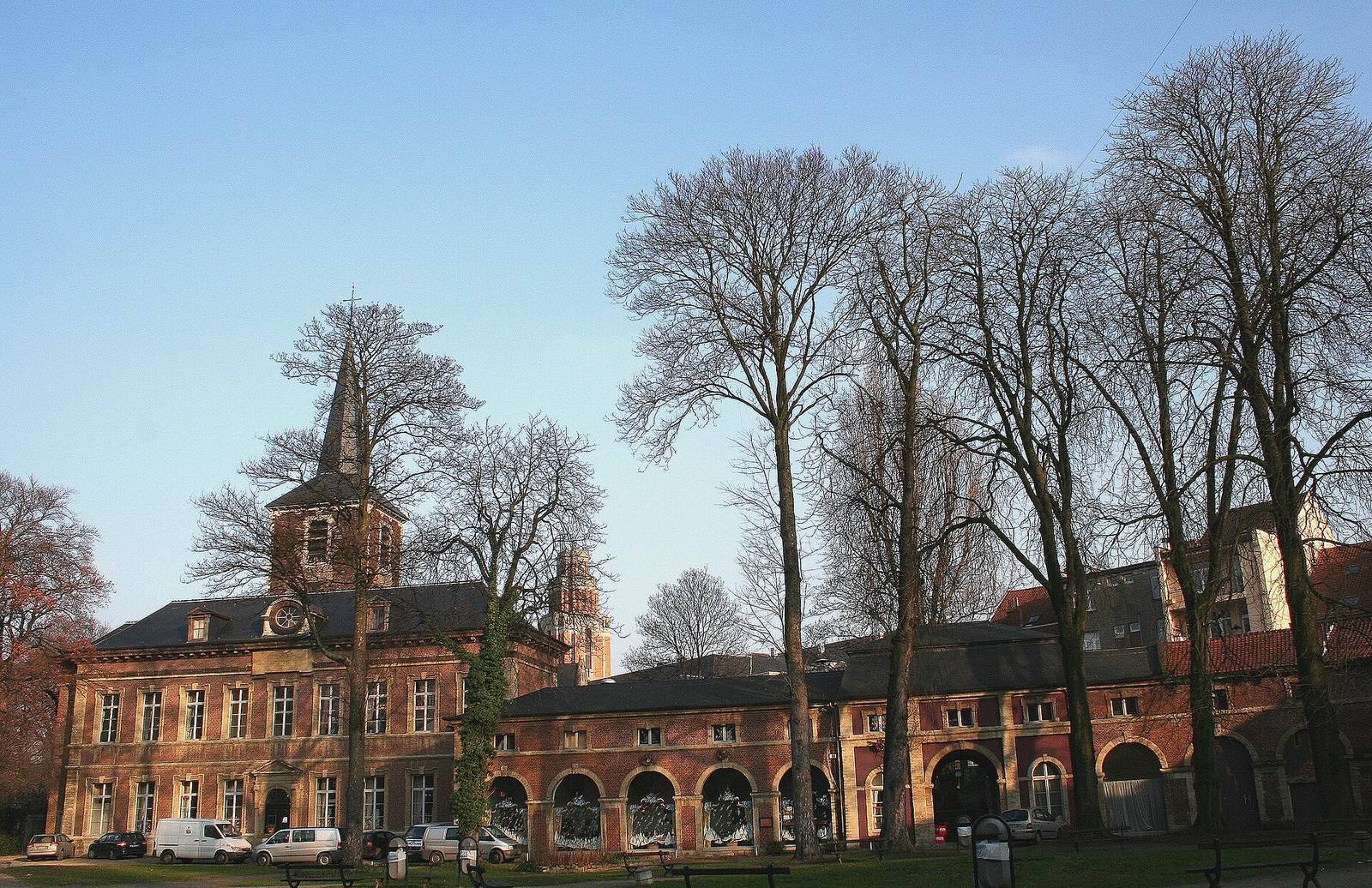
The Decker-Papin family owned the site until the municipality of Forest acquired its surviving buildings in 1964. Restoration took place in 1968, followed by further renovation from 1991. The remaining buildings and their surroundings were designated a historic monument and site in 1994. The complex now serves as a cultural centre.
Remains
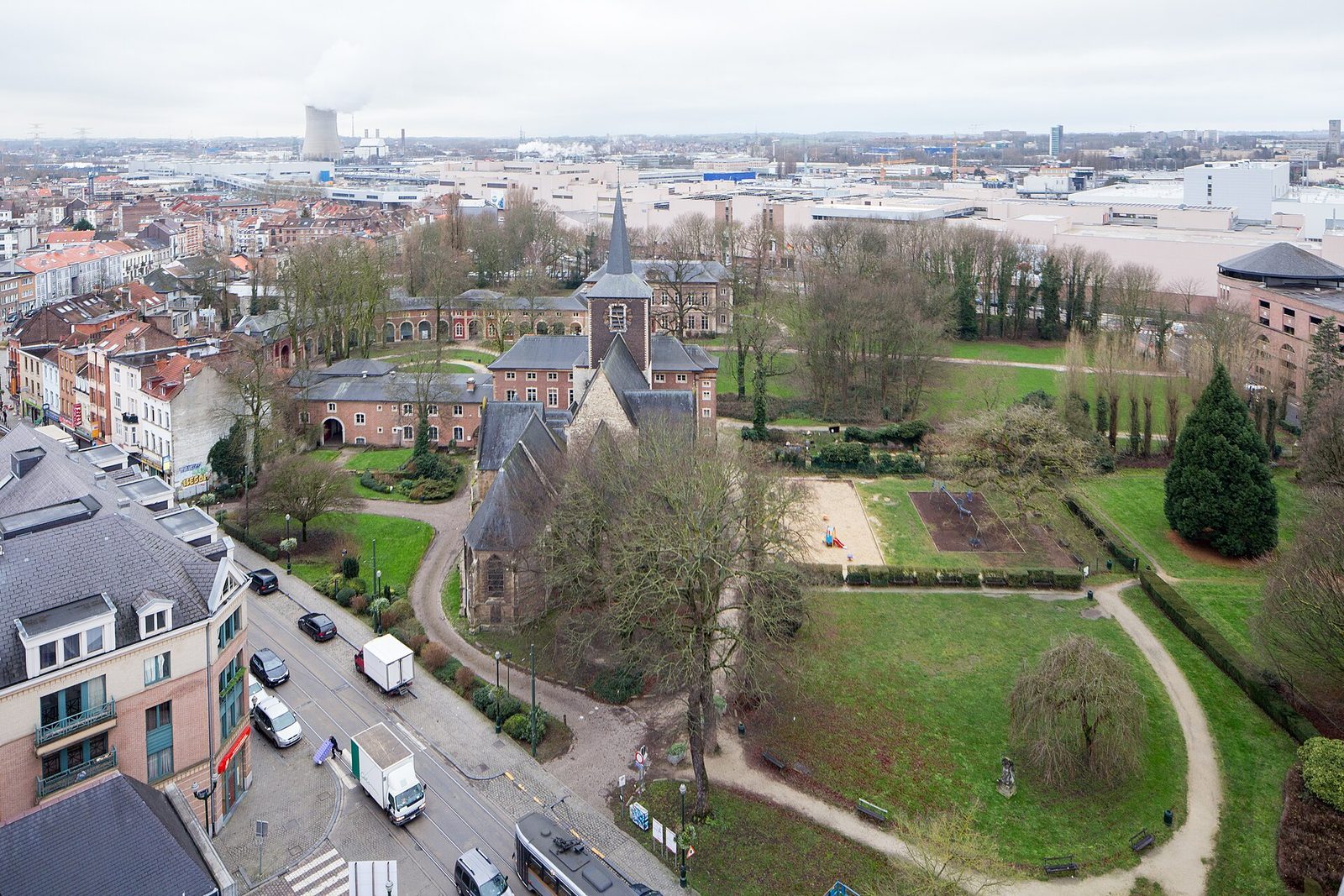
The abbey developed beside the Geleytsbeek, near the castle of the lords of Aa. Its medieval complex combined churches for the nuns and parishioners with convent buildings and agricultural services. The principal remains today are the surviving 18th-century structures.
The medieval church and abbey
Churches and chapel
The early church complex grew around a parish church used by both parishioners and nuns, with separate altars and a double dedication to Saint Denis and Saint Mary. A chapel dedicated to Saint Alena stood to its south and limited expansion in that direction, so the monastic complex extended north. Between 1122 and 1150, a new parish church dedicated to Saint Denis was built beside the chapel. In the later arrangement, the earlier church became an inner church within the nuns’ enclosed domain, while a separate outer church served parishioners. Its north entrance was used by the nuns and its south entrance by parishioners; the Alena chapel was later moved against the outer church.
A 70-metre Gothic abbey church, a medieval style associated with pointed arches and ribbed vaults, replaced the earlier Saint Denis church and was completed in 1447. The 1764 rebuilding scheme left the church and monastic enclosure unchanged. A playground now occupies the former church site.
Convent and service buildings
By the 13th century, the convent included a meeting room, library, dining hall, infirmary, sacristy for liturgical vessels and clothing, cellar and guesthouse. Service buildings within the enclosing wall included a bakery, stables, mill, farm buildings, barns and brewery. Drainage and water channels, fishponds and mills supported cultivation on land along the Senne.
The surviving 18th-century complex
Guest buildings and courtyard
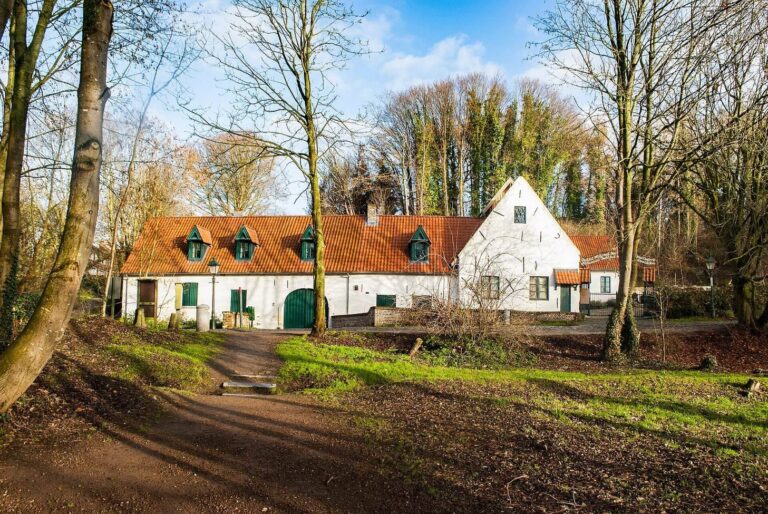
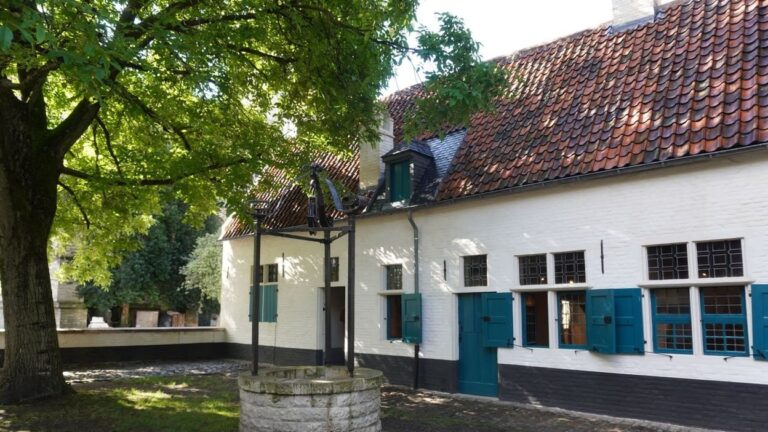
The realized portion of the 18th-century design included guest buildings comprising a residence and a priory, arranged around a courtyard of honor. These structures form the principal surviving buildings of the abbey.
Portal and outbuildings
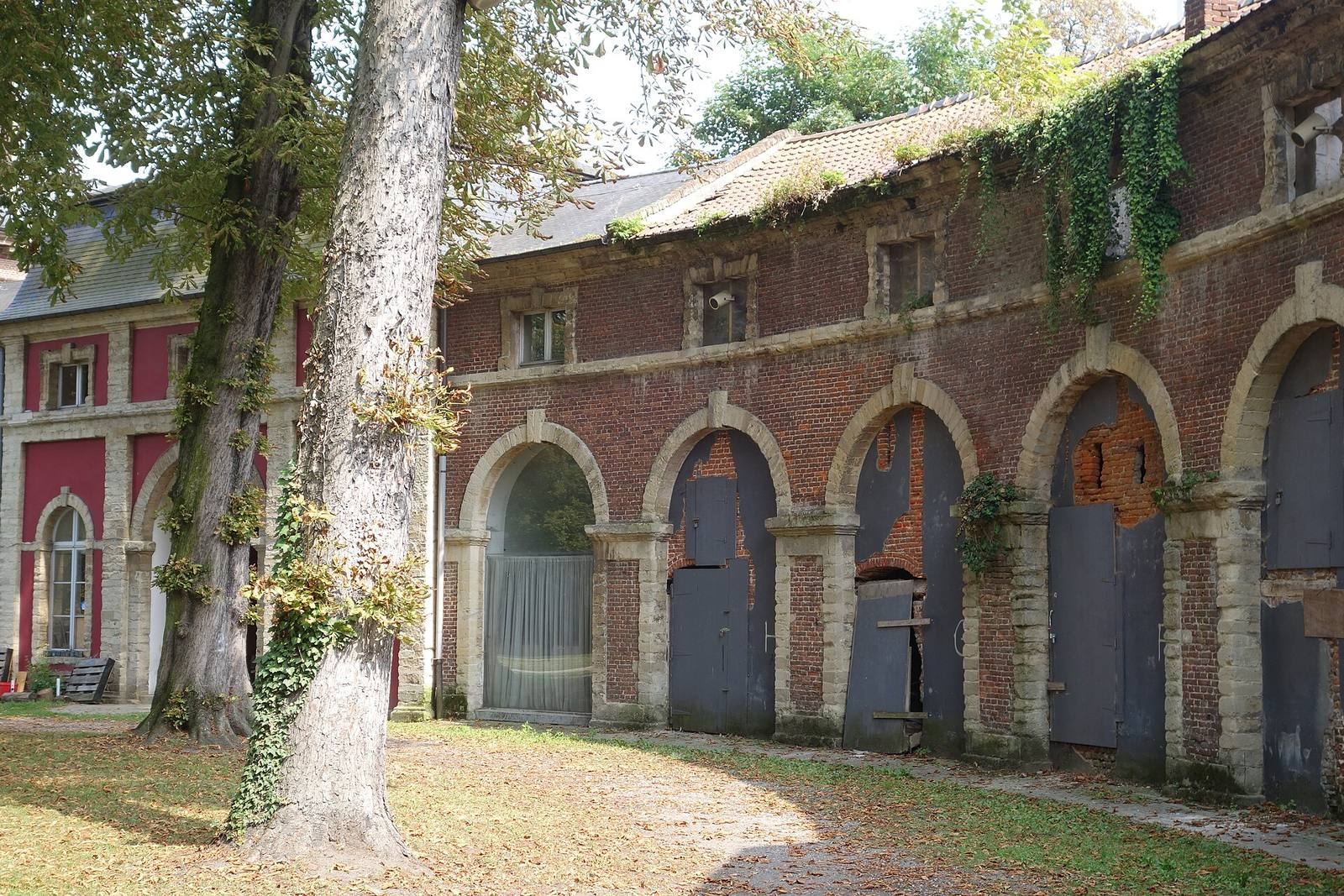
The entrance portal dates to 1765. Sheds, stables and staff accommodation were arranged with other outbuildings in a semicircle. Some were later converted for workers’ housing. This reuse altered the curved west wing, where openings were cut into the exterior wall and new interior partitions were added.
Relics and works preserved elsewhere
Saint Denis parish church
Saint Alena’s relics are now kept in the nearby Saint Denis parish church, where her Romanesque tomb is also located. Romanesque architecture is characterized by rounded arches and substantial masonry. The church became a parish church in 1823. A 16th-century multi-panel painting of episodes from Alena’s life and a large 12th-century Romanesque cross were also transferred there.
Other liturgical works
The abbey’s choir stalls were moved to the Cathedral of St Michael and St Gudula. Its richly illustrated Great Antiphonary of Forest, a liturgical book of short chants made for Margaretha van Liedekerke, is now at Westmalle Abbey.