Fontana Maggiore: Perugia’s Medieval Public Fountain
Site at a Glance
- Popularity
- Very High
- Country
- Italy
- Primary era
- Medieval
- Eras represented
- Medieval
- Civilizations
- Papal States
- Site type
- Civic
- Remains
- Fountain
On this page12 sections
History
Construction and civic purpose
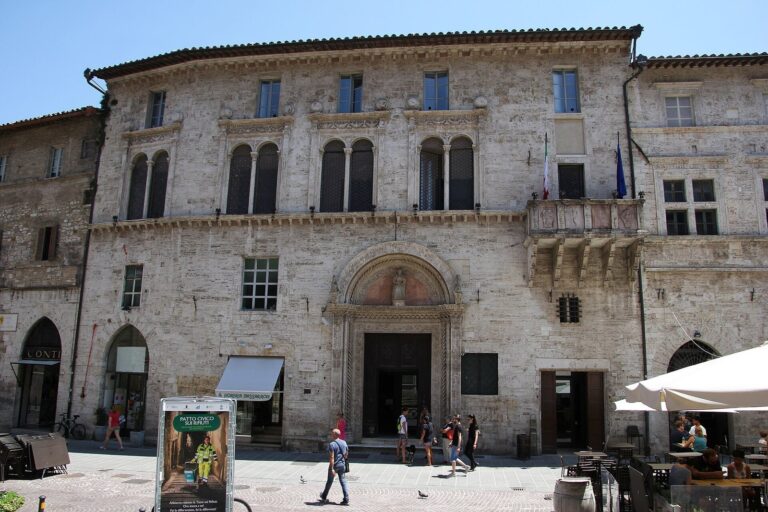
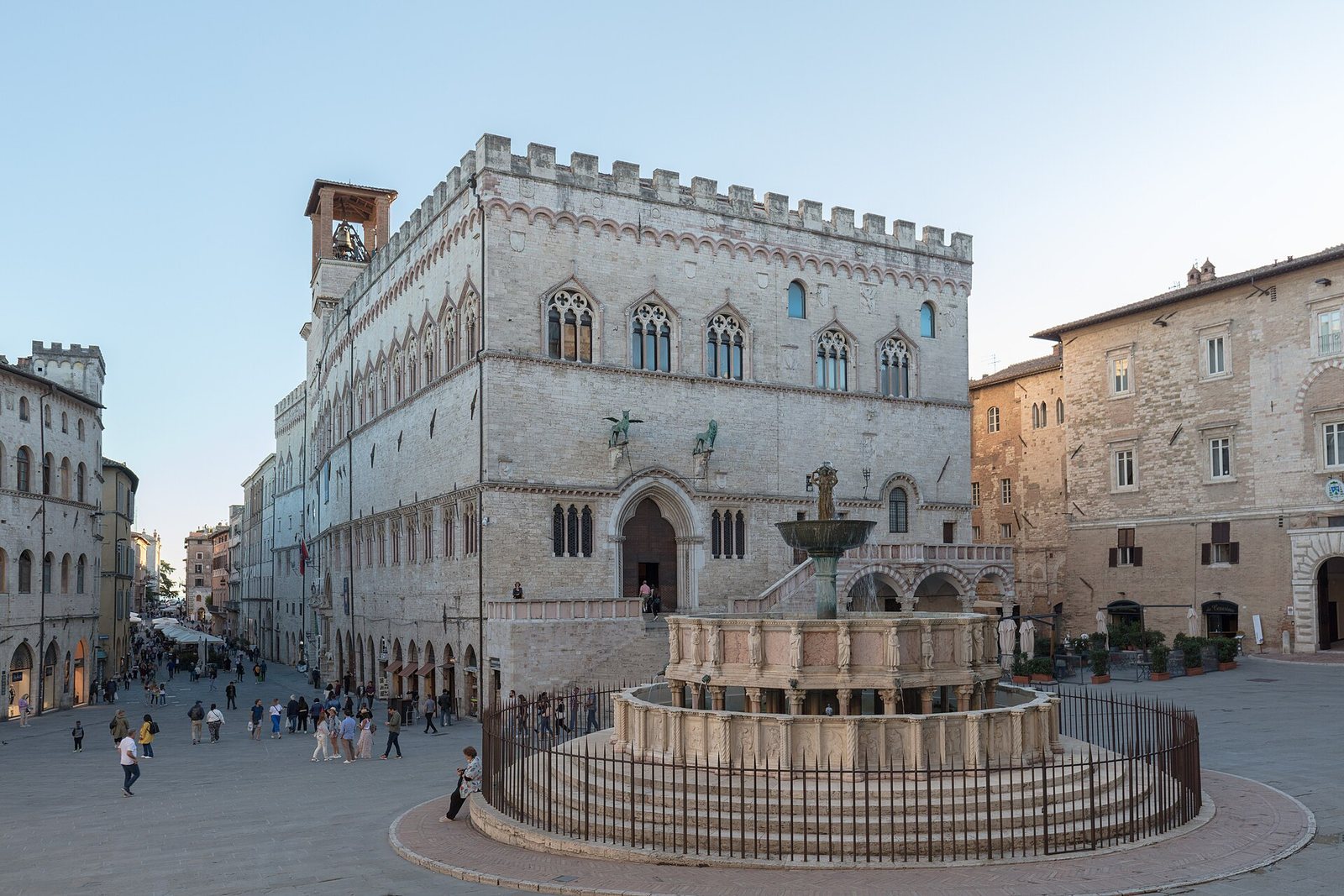
Fontana Maggiore is a medieval public fountain in Perugia, Italy, completed in 1278. Fra Bevignate da Cingoli designed it and directed the work, while Umberto the Master Builder is credited with its construction. Work was underway by 1275. The fountain marked the arrival of water in the elevated centre of Perugia through a new aqueduct from Mount Pacciano, several kilometres away. Hydraulic engineer Boninsegna Veneziano brought the water uphill through a pressurized conduit, a pipe carrying water under pressure, without pumps.
Conceived as a monumental feature of public urban space, the fountain was among the earliest public fountains of its kind and the first to have an iconographic program of such breadth. Its civic patrons used the images to express Perugia’s political power. Nicola Pisano and his son Giovanni carved the marble reliefs, and their installation began in 1278. A tight commission deadline led the Pisanos to direct a large workshop, whose assistants worked successively on the same sculptures. Both Nicola and Giovanni were also architects, so their contribution may have extended beyond carving.
Damage and restoration
An earthquake damaged the fountain in 1348. During reconstruction, workers rearranged the relief panels, disrupting their original sequence. The fountain later inspired Jacopo di Grondalo’s design for the Sturinalto Fountain in Fabriano, built in 1285. Architect Giuseppe Sacconi restored Fontana Maggiore in the early twentieth century; further restoration campaigns followed in 1948–49 and 1995–99.
Remains
Setting and structure
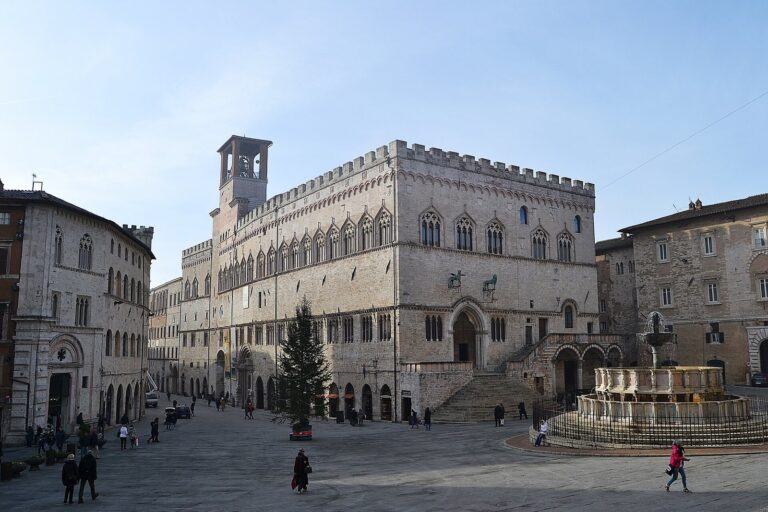
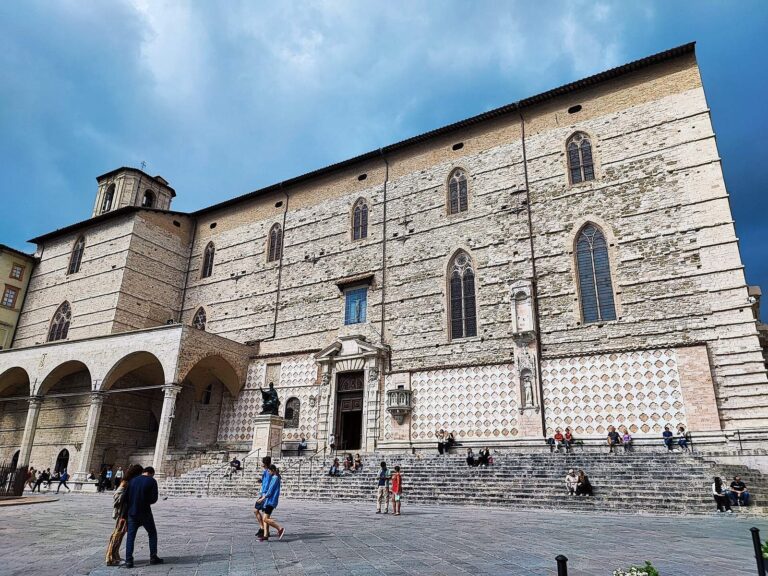
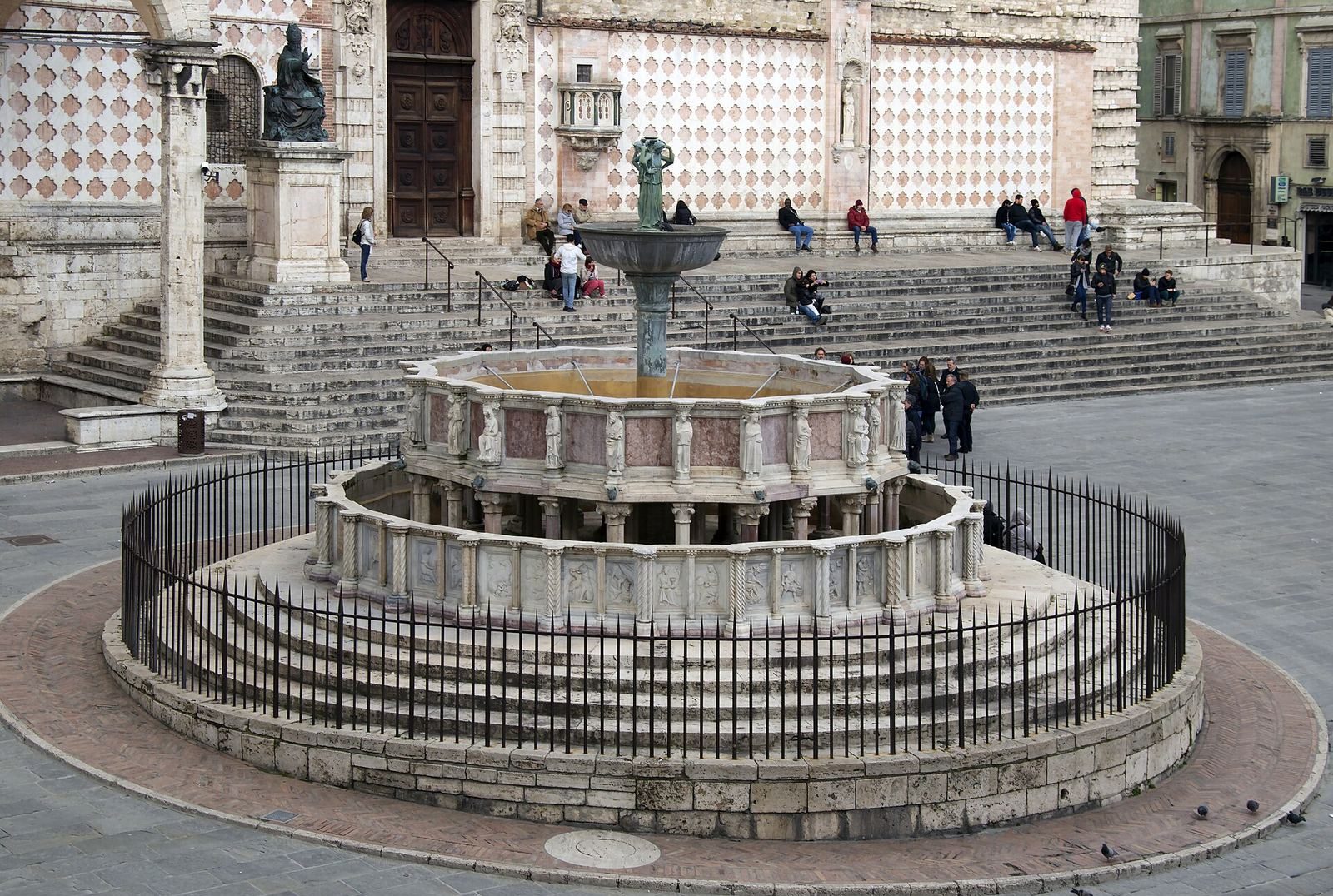
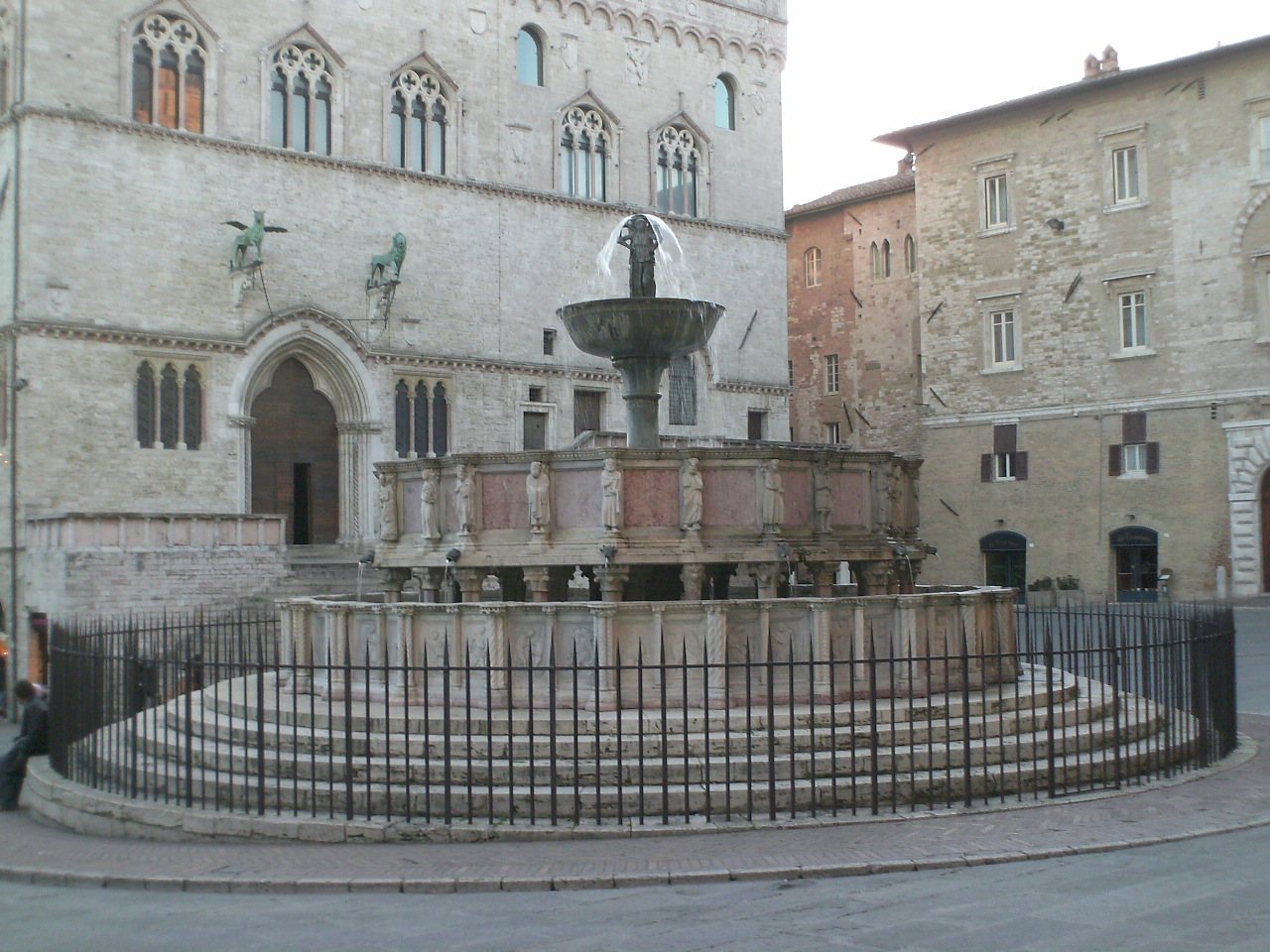
The fountain stands at the centre of Piazza IV Novembre, formerly Piazza Grande, between the Palazzo dei Priori and the Cathedral of San Lorenzo. Made from Assisi stone, marble, and bronze, it was prepared in a workshop and assembled in the square. A circular, stepped base supports two concentric polygonal marble basins. Their white and pink stone sides curve slightly inward rather than forming straight faces.
Lower basin reliefs
Months and seasonal work
The lower basin has 25 sides, each divided into two carved panels, for a total of 50 reliefs. Columns separate the panels and carry spiral fluting or other geometric patterns. One sequence pairs the months with zodiac signs and work or activities associated with the seasons. January shows a couple beside a hearth, February two fishermen, and March the Spinario, a figure removing a thorn from his foot, alongside vineyard pruning. April presents spring allegories, while May shows falconry. June depicts harvesting and flailing, and July threshing and separating grain from chaff. The remaining scenes show fig gathering in August, grape harvesting and pressing must in September, filling and making barrels in October, ploughing and sowing in November, and pig slaughter in December.
Other reliefs
Other panels show the Guelph lion, emblem of the medieval political faction, and Perugia’s griffin. The liberal arts appear as Grammar and Dialectic, Rhetoric and Arithmetic, Geometry and Music, and Astronomy, alongside Philosophy. Further subjects include Original Sin and the Expulsion from Eden; Samson tearing open a lion’s jaws and Samson with Delilah; a frightened lion and the punishment of a small dog; and David and Goliath. Roman foundation stories appear in scenes of Romulus and Remus as falconers, the she-wolf nursing the twins, and their mother Rhea Silvia. Two panels illustrate Aesop’s fables of the fox and the crane and the wolf and the lamb. Together, the reliefs connect the natural and human worlds, the Fall and redemption, learning, and the work of everyday life.
Upper basin and crown
Statues and civic imagery
The upper basin has 24 statues alternating with smooth panels of pink marble. Alternating compound columns, with grouped shafts, and single columns support it. The figures include Euliste, Perugia’s legendary founder; Melchizedek, a priest-king in the Hebrew Bible; Ermanno di Sassoferrato, a civic magistrate; Victory; Saints Peter and Paul; the Roman Church; Rome; and Theology, also identified as Divinitas Excelsa. Others are a cleric of Saint Lawrence, Saint Lawrence, the nymph of Chiusi, Augusta Perusia, the nymph of Lake Trasimene, Saint Herculan, a traitorous cleric, Saint Benedict, Salome, John the Baptist, Solomon, David, Moses, Matteo da Correggio, and Saint Michael the Archangel. Matteo was captain of the people, a medieval civic magistrate.
The statues can be read as a wind rose, a compass-like arrangement of directional figures. Euliste is placed to the north, Rome to the west, and John the Baptist to the east. Augusta Perusia personifies the city and holds a cornucopia; the nymphs of Chiusi and Lake Trasimene bring her wheat and fish. The figures of Saint Herculan, Perugia’s bishop and patron saint, and the traitorous cleric refer to a tradition about Totila, an Ostrogothic king. Herculan saved the city from destruction during Totila’s invasion, while a cleric enabled the king to enter it.
Bronze crown
A bronze cup tops the upper basin. Perugian founder Rosso Padellaio cast it in 1277. Three bronze female figures support a vessel from which water pours. They have been interpreted as the Charites, Greek goddesses associated with grace and beauty, or possibly as nymphs. The figures are also described as having once supported two griffins, Perugia’s emblem, and two lions, symbols of the Guelph faction.
Inscriptions and collaborative carving
Latin verses run along the lower frame of the upper basin. Abbreviations there identify information about the makers and the fountain’s date, while the verses invite close attention and interpretation. Another inscription names participants’ roles and gives the completion date. The arrangement of figures and reliefs is now disordered; some inscriptions no longer correspond to the statues they were intended to accompany because statues or inscribed stones were moved.
The workshop’s shared production gives the fountain’s sculptures an overall stylistic unity, making individual hands difficult to distinguish. Giovanni Pisano’s work has been associated with the more expressive upper-basin statues, the animated figures in many month scenes, and the forcefully rendered eagles. His signature appears on the right-hand eagle in one of the lower basin’s reliefs.