Michael’s Gate: Medieval Town Gateway in Bratislava
Site at a Glance
- Popularity
- High
- Country
- Slovakia
- Primary era
- Early Modern
- Eras represented
- Medieval, Early Modern, Modern
- Civilizations
- Austria-Hungary, Habsburg, Hungarian
- Site type
- Military
- Remains
- Gate
On this page15 sections
History
Michael’s Gate is a medieval town gate in Bratislava, Slovakia, built around 1300 as the northern entrance to the fortified town. Its history reaches back to the late 13th century, and the tower’s present appearance reflects a later Baroque rebuilding.
Medieval origins and coronation processions
The gate was named for St Michael’s Church and cemetery, which stood outside the town walls near present-day Hurban Square. The church was later demolished, and its building materials were reused in further construction of the walls. A deteriorated Gothic tower stood over the entrance before a replacement tower’s cornerstone was laid in 1513. That tower was razed between 1529 and 1534.
The first written record of the gate dates to 1411. In that year, Bratislava citizen Jakob Aigner bequeathed half a Dreiling, a historical measure of wine, from that year’s supply toward building the tower. From 1563 to 1830, Bratislava was a coronation city of the Kingdom of Hungary. Processions for 19 Hungarian monarchs entered through Vydrica Gate and included St Martin’s Cathedral and Michael’s Gate. At Michael’s Gate, each monarch swore an oath before the archbishop before the procession continued toward Coronation Hill Square.
Dismantling of the fortifications
By a decree of Maria Theresa, a Habsburg ruler who reigned from 1740 to 1780, the town’s inner fortifications were dismantled by 1778 because they hindered the city’s growth. Michael’s Gate, a short adjoining stretch of wall, and about 200 metres of wall near the road to the New Bridge were retained. The town’s three other gates were removed.
The old shooting trench beside the gate appears in Bratislava’s town books in 1502. It served as a civic shooting range during the 16th and 17th centuries. From 1750 to 1780, German touring companies and Italian opera companies performed in a wooden theatre built beside it.
Baroque rebuilding and later use
The tower was rebuilt between 1753 and 1758. A statue of St Michael was placed at its summit in 1757. Its maker, Peter Eller, recorded that he completed the work on 20 June 1758 and received 200 gold gulden, a historical European currency. In 1845, weather damage led the city administration to have the statue removed for renovation. Carpenter Johannes Sprinzl supervised its transfer to the town hall. On 14 September, following a blessing and Mass at St Martin’s Cathedral, the statue was carried back in procession and ceremonially raised to the tower.
Reconstruction began in July 2021 to repair damage accumulated since the 1845 rebuilding and restore the tower’s Baroque appearance. The tower now houses the Bratislava City Museum’s weapons exhibition, which covers the origins and rebuilding of the town’s fortifications and their eventual dismantling.
Remains
The surviving complex centres on a seven-storey brick tower, 51 metres high, with features of the former gate and its defensive approaches around it. Together, these remains show how the entrance was connected to walls, a moat, bridges and the shooting trench.
Tower and summit
The tower
The tower’s brick exterior has strongly profiled stone rustication, masonry finished with pronounced joints and rough-faced blocks, and divisions in the German Renaissance style. Its plan is square through the first four storeys, with four small roofs at the corners; the upper section is octagonal. A copper Baroque roof with a lantern containing bells crowns the tower. It formerly stood clear of nearby structures, with openings on both sides for observing the city garden.
Statue and capsule
The summit statue depicts the Archangel Michael, a high-ranking angelic figure in Christian tradition, defeating a dragon with a sword. Weather-damaged and missing portions of the statue and dragon were reconstructed from historical documents and the statue was gilded during the 2021 restoration. A silver capsule concealed in the statue’s head was opened that year. It held documents, contemporary coins and a small reliquary, a container for sacred remains, with relics associated with nine saints. The papers included Eller’s letter and a letter from the four carpenters who made the roof, Hans Michl Preinfolg, Andreas Richl, Johannes Gehmacher and Anton Hocheter, asking for prayers for their souls. A parchment found in the statue in 1845 had indicated that it was made during Maria Theresa’s reign.
Gate and defenses
Entrance and bridges
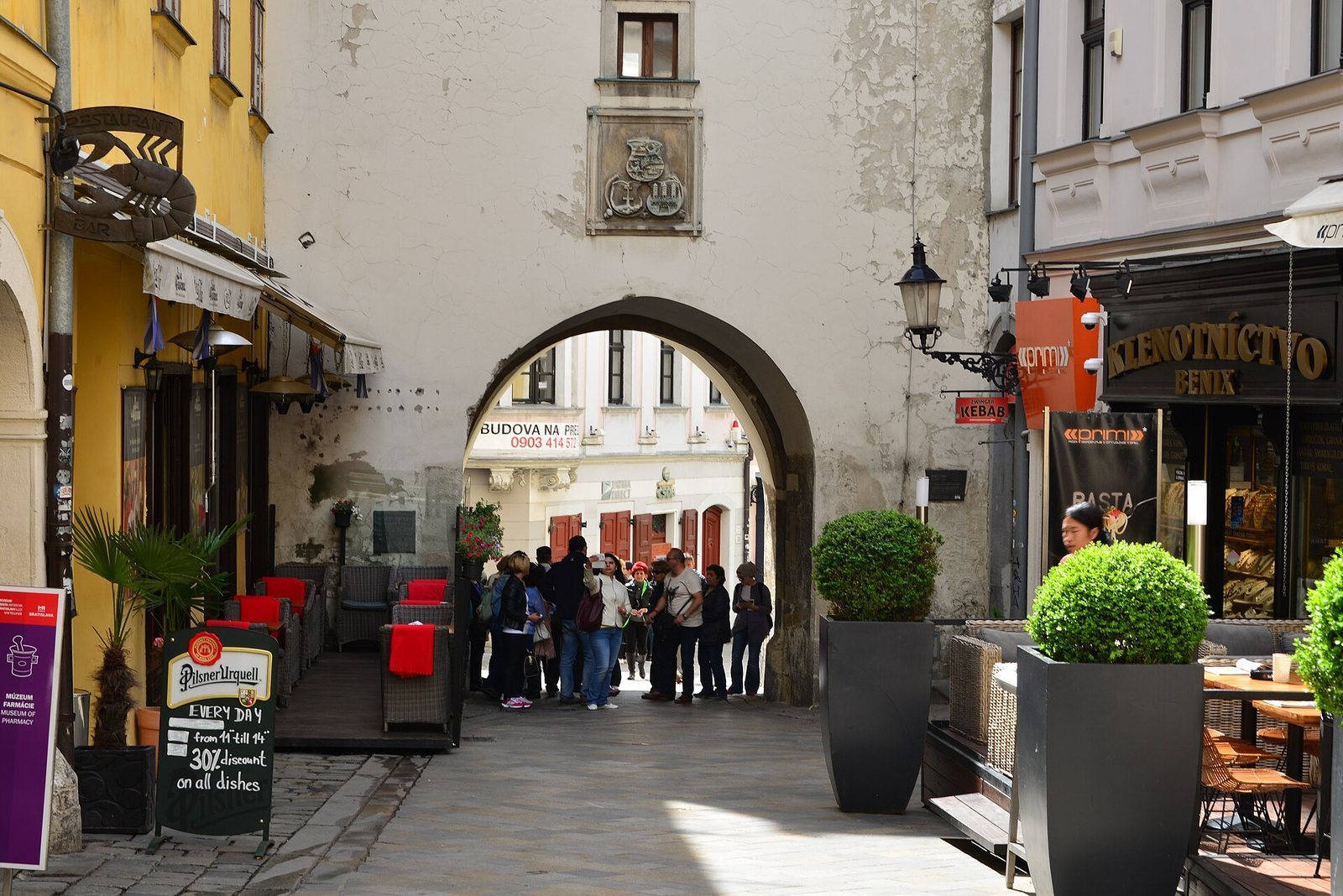
A portcullis, a heavy gridded gate lowered vertically to block an entrance, and a wooden door protected the gateway. A drawbridge crossed the moat, and some remains of it survive. A wooden bridge later replaced the drawbridge; the brick Michael’s Bridge was built in 1727 and is the oldest bridge in the city. The arch associated with the drawbridge bears a 1723 inscription: “Every kingdom divided against itself will be laid waste.” Its wording adapts Luke 11:17 and also appears in the Golden Bull issued by Charles IV in 1356, an imperial law that set out procedures for choosing the Holy Roman Emperor.
Barbican and moat
The gate formed the centre of a defensive complex with two rings of town walls, two bastions, a barbican, an outer defensive structure guarding an entrance, and a moat. The barbican is partly incorporated into later buildings, including the house at Michalská Street No. 25. The last surviving stretch of Bratislava’s moat lies in this area, and the curved street plan inside the gate is also preserved.
Trench, stonework and city marker
Shooting trench and bridge statues
The old shooting trench lies to the left of the gate. A bridge crosses it, with statues of the Archangel Michael and St John of Nepomuk above the trench. The Pressburg Beautification Society erected these figures in 1897. St John of Nepomuk was a 14th-century Bohemian priest venerated as a saint.
Coats of arms and inscriptions
A Gothic stone panel dated 1515 is fixed to the outer arch. On its north face, the arms of Louis II of Hungary and Bohemia appear above the arms of the Kingdom of Hungary and Bratislava. Louis II ruled both kingdoms in the early 16th century as a member of the Jagiellonian dynasty. On the city-facing side is a Baroque coat of arms dated 1758 and a separate Gothic stone inscription recording repairs made that year by the town council and Bratislava’s population.
Kilometre marker
A circular marker beneath the tower identifies Bratislava’s kilometre zero and displays distances to cities around the world. The distances shown for the North Pole and South Pole are incorrectly equal.