St. Nicholas’ Church: A Medieval Evangelical Church in Bordelum, Germany
Site at a Glance
- Rating
- 4.6
- Popularity
- Very Low
- Country
- Germany
- Primary era
- Medieval
- External website
- Open
- Eras represented
- Medieval, Early Modern
- Civilizations
- Danish
- Site type
- Religious
- Remains
- Church
On this page14 sections
History
St. Nicholas’ Church is an Evangelical church in Bordelum, Germany, whose brick building was probably erected around 1200 or somewhat later. It stands between Oster-Bordelum and Wester-Bordelum, in an isolated position that reflects an earlier settlement probably abandoned by its inhabitants in the fifteenth century. Archaeological finds confirm that the settlement existed, although claims that the site was once a pagan cult place have not been substantiated.
Medieval church and seventeenth-century reconstruction
The medieval church originally had a thatched roof. In 1629 it burned, reportedly after the sexton tried to shoot pigeons, destroying its medieval furnishings. Reconstruction was completed by 1640. King Christian IV, who was king of Denmark and Norway from 1588 to 1648, donated building materials from Fruu Mettenhof, the manor house of Meta von Ahlefeld in Uphusum, after the house had been destroyed during the Thirty Years’ War.
Some replacement furnishings came from the church at Röhrbeck on the former island of Strand. Strand was devastated by the Burchardi Flood of 1634, a catastrophic North Sea storm surge that destroyed or severely damaged settlements and churches there. The altar and black-marble baptismal font were found in the tidal flats after the flood and were traditionally said to have come from Strand. Their having been carried there by the flood is considered unlikely. Survivors may instead have sold furnishings salvaged from churches that faced demolition or decay.
Radical Pietism in Bordelum
Around 1733, the theological candidates Peter Lorenzen and Franz Barsonius began holding Pietist conventicles, small private religious gatherings outside regular parish worship, in Bordelum and neighboring parishes. Lorenzen was the son of Bordelum pastor Ägidius Lorenzen and had succeeded his father as pastor. Father and son both died in 1736, only weeks apart.
Under the influence of their tutor David Bähr, the movement turned toward radical Pietism, a Protestant current that emphasized personal religious experience and could depart sharply from established doctrine and worship. In 1739, the Flensburg Consistory, an ecclesiastical governing and disciplinary body, investigated a group of about twenty Bordelum residents who called themselves the “Perfect Ones.” They believed that they could no longer sin, stopped attending services at St. Nicholas’ Church, deliberately disregarded Sunday rest, and accepted personal revelation as their only authority. They also treated baptism and Communion as unimportant, rejected marriage as binding, and practiced a form of communal ownership.
The group resembled the so-called Buttlarsche Rotte. Bähr allowed himself to be venerated as the Messiah, then fled and was arrested and imprisoned in Glückstadt. After his release in 1743, he returned to Bredstedt, but his former followers refused to accept him, and he died soon afterward. The so-called Bordelumer Rotte continued for several decades, sometimes tolerated and sometimes opposed by the successors of the Lorenzen pastors.
Later congregational history
The Bordelum congregation belongs to the North Frisia church district and shares its pastor with the congregation of Ockholm. Ockholm’s church, built in 1639, also contains furnishings said to have come from Strand, linking the two congregations to the traditions surrounding the island’s lost churches.
Remains
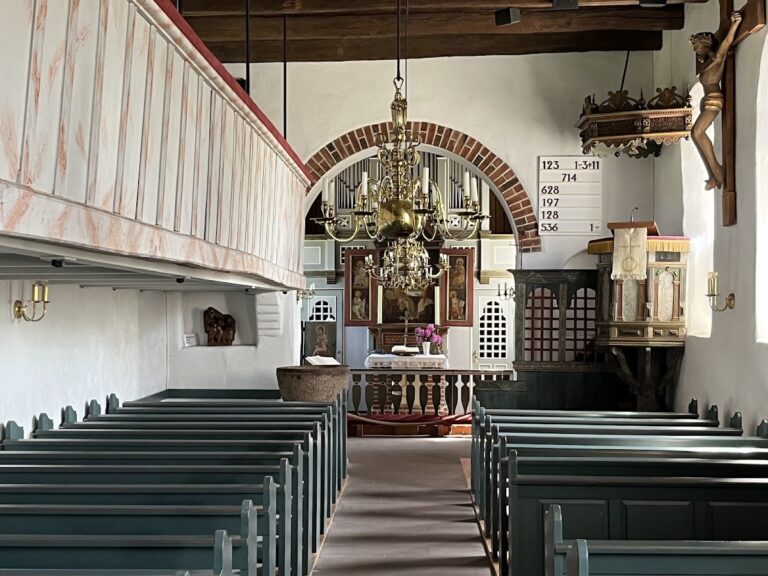
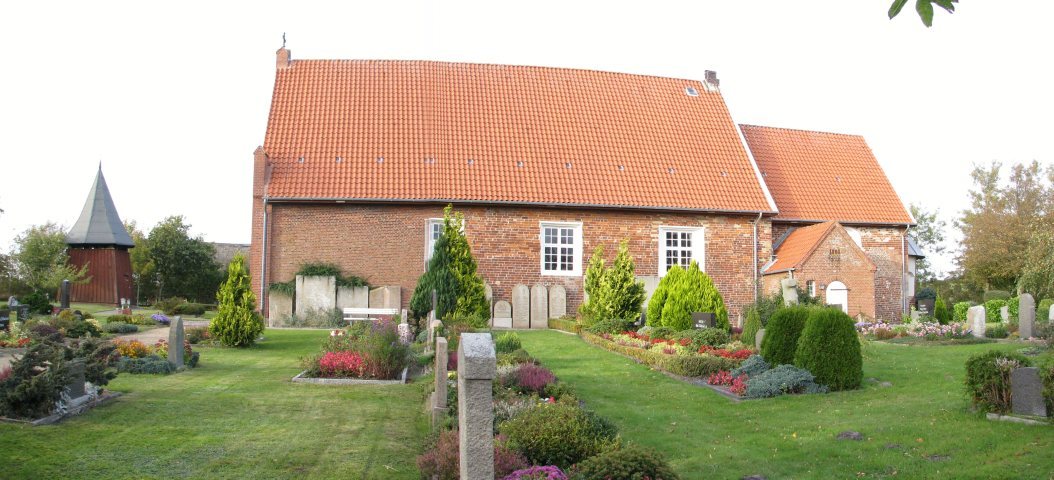
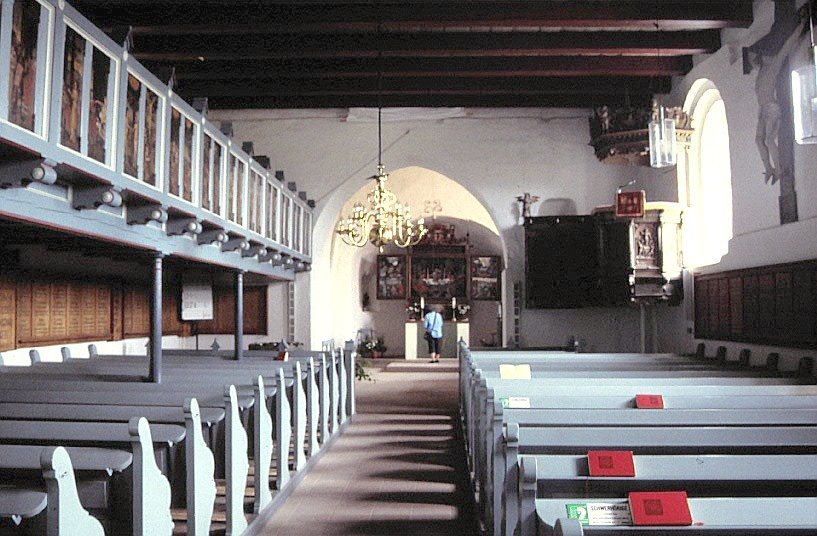
St. Nicholas’ Church stands in open fields on the edge of the Stollberg, outside the present settlement. The brick building has a single-nave main body with a flat-beamed ceiling, a narrower choir covered by a Gothic vault, and a low, semicircular Romanesque apse. Two sacrament niches survive in the apse, while the windows in the south wall were enlarged after the medieval period. The western entrance wall was renewed in 1888 and again in 2003.
Exterior structures
Bell tower
A separate wooden bell tower stands away from the church. It dates from 1633 and was renewed in 1793, forming a distinct part of the church’s surviving seventeenth-century arrangement.
Altar and baptismal font
Black-marble baptismal font
The late-Gothic baptismal font is made of black marble and was produced in Belgium, possibly at Namur. It originally belonged to the church at Röhrbeck and is traditionally associated with the furnishings brought from the lost island of Strand.
Winged altarpiece
The winged altarpiece also came from Röhrbeck. Its retable, the ornamental structure behind an altar, was made within the workshop circle of Marten van Achten, who was active from 1588 to 1610. Five paintings show the Nativity and Crucifixion on the left wing, the Last Supper in the central shrine, and the Resurrection and Pentecost on the right wing. A small upper painting between masks represents the Annunciation, while the predella, the lower part of an altarpiece, shows Christ praying in the Garden of Gethsemane.
Choir and nave furnishings
Pulpit and pastors’ seating
The pulpit dates from 1633 and belongs to the transitional period between the Late Renaissance and Early Baroque. Its basket and access gallery are divided by herm pilasters, decorative supports shaped as stylized human figures or upper-body forms, and contain carved round-arched panels. The choir has pastors’ seating from the second half of the seventeenth century, with painted panels showing the Evangelists and biblical scenes.
Triumphal cross and epitaph
A triumphal cross carved in the early sixteenth century formerly hung in the chancel arch. Since at least 1904 it has hung on the south wall of the nave, and it may also have come from Strand. Beside it is an 1686 epitaph for a married couple named Lorentzen. The memorial has a carved acanthus frame, a painted Entombment, and portraits of the couple in its gable.
Gallery paintings
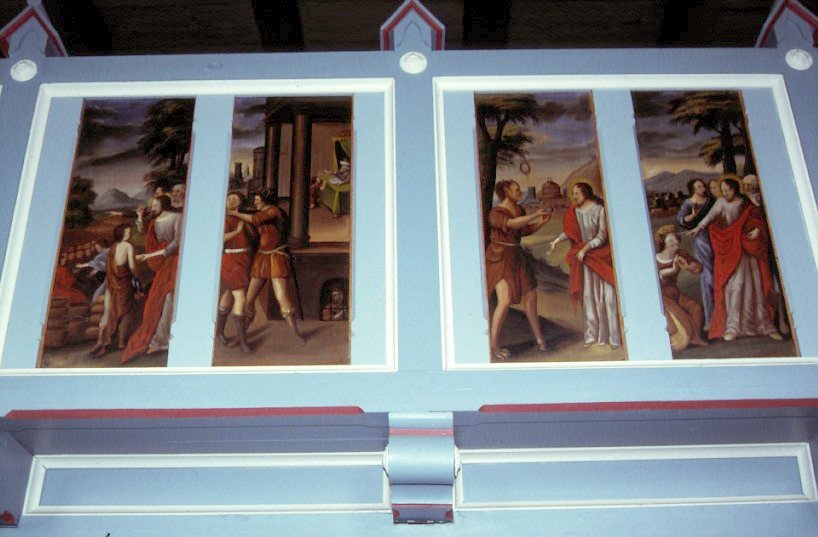
A long series of paintings by several artists is attached to the gallery. The oldest paintings are dated 1684, and they were inserted into a gallery renewed in the nineteenth century. The paintings show scenes from the Old and New Testaments as well as the Protestant worship service. Their arrangement is not chronological. Instead, it follows the principal sections of the Lutheran catechism, the systematic summary of Lutheran teaching covering the commandments, the Creed, the Lord’s Prayer, Baptism, and Communion. Part of the selection follows the biblical illustrations used in the 1562 Leipzig publication Catechismus Deutsch, although the sequence associated with the Ninth Commandment differs from that model.
The paintings connected with the commandments include the Golden Calf, the Stoning of the Blasphemer, a worship service, Noah’s Sons, Cain and Abel, David Seeing Bathsheba, Achan’s Theft, Susanna Accused, Jezebel and Ahab, and Joseph and Potiphar’s Wife. The Creed is represented by Adam and Eve in Paradise, the Crucifixion, and Pentecost. The Lord’s Prayer section includes the Sermon on the Mount, with Jesus teaching the prayer; the baptism of the Ethiopian eunuch by Philip; Jesus in Gethsemane; the Feeding of the Five Thousand; the Unforgiving Servant; Jesus tempted by the Devil; and the Canaanite woman pleading for her daughter, who is possessed by an evil spirit.
The sections associated with Baptism and Communion are identified within the gallery sequence. A further group concerns Peter, including his meeting with the risen Jesus, the election of Matthias as an apostle, Peter and the death of Ananias, and another panel identified simply as Peter. Together with the font, organ, congregational seating, pastors’ seating, and free-standing bell tower, the painted gallery forms part of the church’s surviving interior furnishings.