Etchmiadzin Cathedral: Mother Church of the Armenian Apostolic Church
Site at a Glance
- Rating
- 4.7
- Popularity
- Medium
- Country
- Armenia
- Primary era
- Classical
- External website
- Open
- Eras represented
- Classical, Early Modern, Modern
- Civilizations
- Armenian, Sassanid
- Site type
- Religious
- Remains
- Cathedral
On this page17 sections
History
Etchmiadzin Cathedral is the historic mother church of the Armenian Apostolic Church in Vagharshapat, Armenia. Traditionally founded between 301 and 303, after King Tiridates III adopted Christianity as Armenia’s state religion, it is regarded as Armenia’s first cathedral, although the related claim that it was the country’s first church remains disputed. The cathedral became the principal spiritual center of Armenian Christianity and the administrative headquarters of the Mother See, the church’s chief ecclesiastical center.
Foundation and Early Christian Armenia
Armenian tradition credits Gregory the Illuminator, the missionary traditionally regarded as Armenia’s first Catholicos, with directing the cathedral’s construction near the royal palace on the site of a pagan temple. The building symbolized the conversion of Armenia from pagan worship to Christianity. Earlier sources called it the Cathedral of Vagharshapat, while the name Etchmiadzin came into use only in the fifteenth century.
The cathedral’s foundation legend tells that Gregory saw a vision of the Only-Begotten Son descending from heaven and striking the ground with a golden hammer. The blow marked the place where the church should be built. An annual feast held 64 days after Easter commemorates the event, and a hymn attributed to the eighth-century Catholicos Sahak III recounts the vision and the cathedral’s construction.
The original building suffered severe damage when the Sasanian king Shapur II invaded Armenia around 363. Much of Vagharshapat was also affected. Catholicoi Nerses the Great and Sahak Parthev carried out only partial repairs because Armenia’s economic circumstances made extensive rebuilding difficult. In 450, the Sasanian king Yazdegerd II attempted to impose Zoroastrianism, the ancient Iranian religion associated with sacred fire, on Armenia. A fire temple was installed inside the cathedral, and excavations later found remains of its fire installation beneath the altar of the eastern apse.
The Fifth-Century Rebuilding
By the last quarter of the fifth century, the cathedral had become badly dilapidated. Vahan Mamikonian, the Persian-appointed governor of Armenia, rebuilt it from its foundations in 483 and 484, after the struggle for religious freedom against Persia had brought more stable conditions. Most scholars regard this rebuilding as the source of the basic form that survives today.
The Catholicos’s seat was transferred to Dvin during the fifth century, perhaps in the 460s or 470s, or in 484. Etchmiadzin nevertheless remained one of the Armenian Church’s principal shrines. Catholicos Komitas undertook a major renovation in 618, and Catholicos Nerses III carried out further alterations during the seventh century. In 982, an Arab emir reportedly removed the cathedral’s cross.
Long periods of neglect followed. In 1300, Archbishop Stepanos Orbelian wrote his Lament on Behalf of the Cathedral, portraying the building as a mourning woman recalling its former splendor after the Mongol and Mamluk invasions.
Return of the Catholicosate and Safavid Plunder
In 1441, a council of several hundred religious figures voted to restore the Catholicosate at Etchmiadzin after the decline of the See of Sis. Catholicos Kirakos restored the cathedral between 1441 and 1443. Since then, the Mother See of Holy Etchmiadzin has remained the administrative headquarters of the Armenian Church.
Shah Abbas I of Safavid Iran plundered Etchmiadzin in 1604. He intended to move the cathedral to New Julfa near Isfahan, but the planned transfer did not take place. Important stones, altar materials, the traditional stone associated with Christ’s descent, the baptismal font, other architectural elements, and the Right Arm of Gregory the Illuminator were taken to New Julfa. They were incorporated into Saint George Church, built there in 1611.
Major renovation began in 1627 under Catholicos Movses. The work repaired the dome, ceiling, roof, foundations, paving, and other parts of the cathedral. Monks’ cells, a guesthouse, and other buildings were added, and the complex was enclosed by walls with a defensive appearance. The Ottoman-Safavid War of 1635 and 1636 interrupted the work, although the cathedral remained intact. Construction later resumed under Catholicos Pilippos.
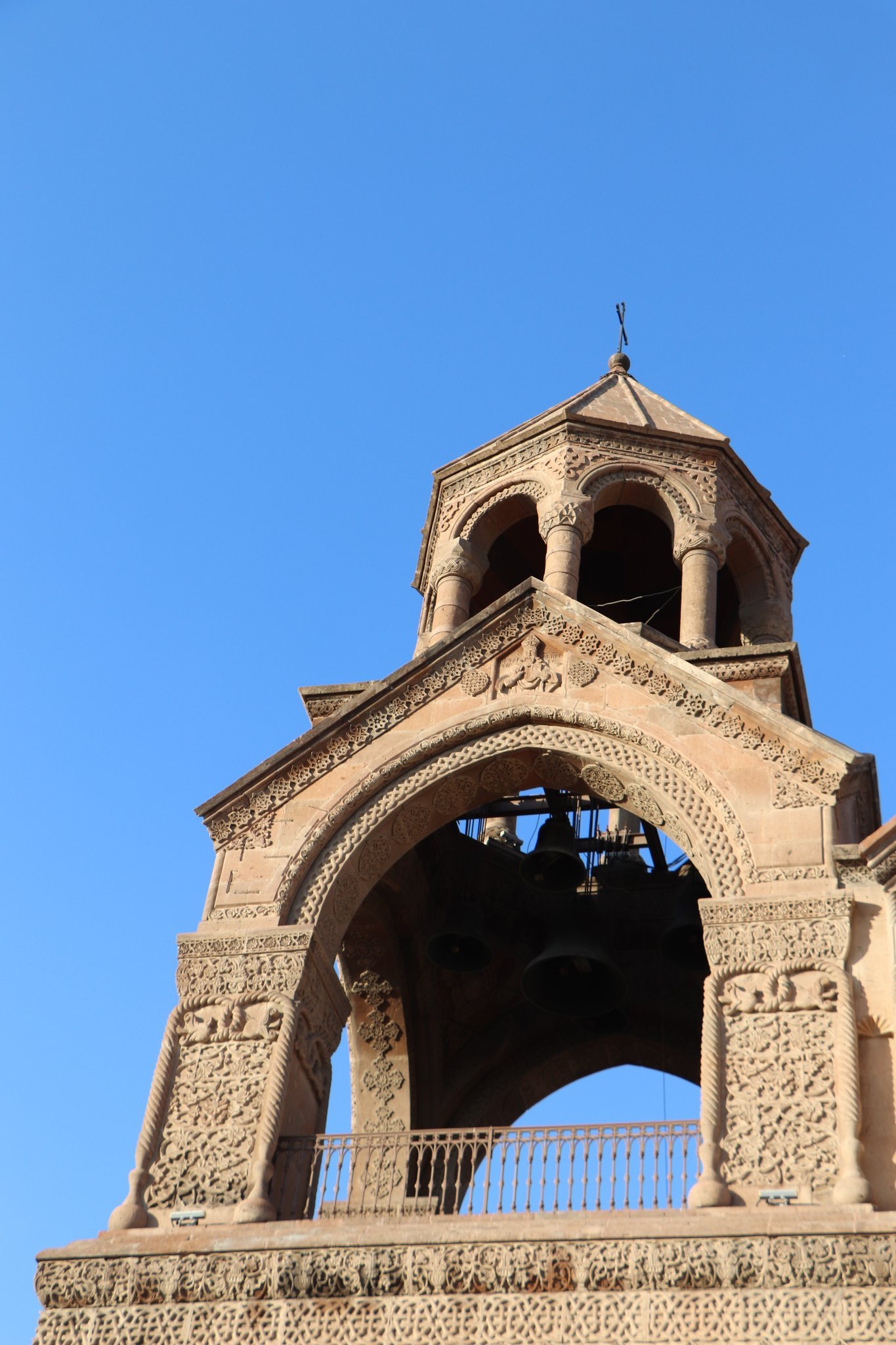
The western belfry was begun in 1653 and 1654 and completed in 1658 under Catholicos Hakob IV. In 1682, Catholicos Yeghiazar added smaller belfries with red stone turrets on the southern, eastern, and northern sides. Further conservation took place in 1720, between 1777 and 1783, and between 1784 and 1786. Under Simeon I of Yerevan, the monastery was fully separated from Vagharshapat by walls.
Russian Rule and the Armenian National Center
Russian troops led by General Pavel Tsitsianov entered Etchmiadzin during the Russo-Persian War in 1804 and looted it, causing serious damage to Armenian religious buildings. On 13 April 1827, General Ivan Paskevich captured Etchmiadzin without a battle. The area was formally annexed to the Russian Empire by the Treaty of Turkmenchay in 1828, and in 1836 Etchmiadzin formally became the religious center of Armenians living within the empire.
Catholicos Gevorg IV added the eastern sacristy in 1868 and founded the Gevorgian Seminary on the cathedral premises in 1874. Catholicos Markar I restored the interior in 1888. In 1903, Russian authorities attempted to confiscate Armenian Church property and occupied the cathedral. Popular resistance, together with the opposition of Catholicos Mkrtich Khrimian, led to the cancellation of the measure in 1905.
During the Armenian genocide, the cathedral and its grounds became an important refuge and organizational center for Armenians fleeing the Ottoman Empire. About 70,000 refugees were in the Etchmiadzin district by the end of 1918. A hospital and an orphanage had been established on the grounds by 1919.
In 1918, during the Turkish offensive that preceded the Battle of Sardarabad, Catholicos Gevorg V refused proposals to leave the cathedral for safety. The defeat of the offensive helped preserve Eastern Armenia and contributed to the establishment of the First Republic of Armenia.
Soviet Period and Religious Revival
Armenia was Sovietized in December 1920. During the February Uprising of 1921, Etchmiadzin was briefly controlled by the Armenian Revolutionary Federation. In December 1923, the southern apse and its associated belfry foundation collapsed. Restoration under Toros Toramanian became the first restoration of an architectural monument in Soviet Armenia.
During the late 1930s, Soviet atheist policies and the Great Purge severely restricted the cathedral’s activity. Catholicos Khoren I was murdered by the Soviet security service in 1938. Soviet Armenian authorities formally resolved to close the cathedral and convert it into a museum, but the Soviet leadership did not approve the closure. Etchmiadzin remained isolated and barely operational, while reportedly becoming the only church in Soviet Armenia not seized by the Communist government.
The cathedral’s religious role began to recover during and after the Second World War. Its official periodical resumed publication in 1944, the seminary reopened in 1945, and Gevorg VI was elected Catholicos after a seven-year vacancy. Baptisms at Etchmiadzin rose from about 200 in 1949 to about 1,700 in 1951.
Under Catholicos Vazgen I, the cathedral revived after the Khrushchev Thaw. Archaeological excavations took place in 1955 and 1956 and again in 1959. Extensive restoration followed, assisted by Armenian benefactors in the diaspora, including Calouste Gulbenkian and Alex Manoogian.
Modern Restoration and Heritage Status
A renovation in 2000 prepared the cathedral for the 1700th anniversary of Armenia’s Christianization. In 2003, the Armenian Church commemorated the 1700th anniversary of the cathedral’s consecration and designated the year as the Year of Holy Etchmiadzin.
The most recent major restoration began in 2012, initially concentrating on the dome and roof. The work revealed severe deterioration in columns, arches, vaults, and the dome. It also addressed the exterior and roof and restored about 2,600 square metres of frescoes and painted surfaces. The cathedral was ceremonially reopened and reconsecrated on 29 September 2024.
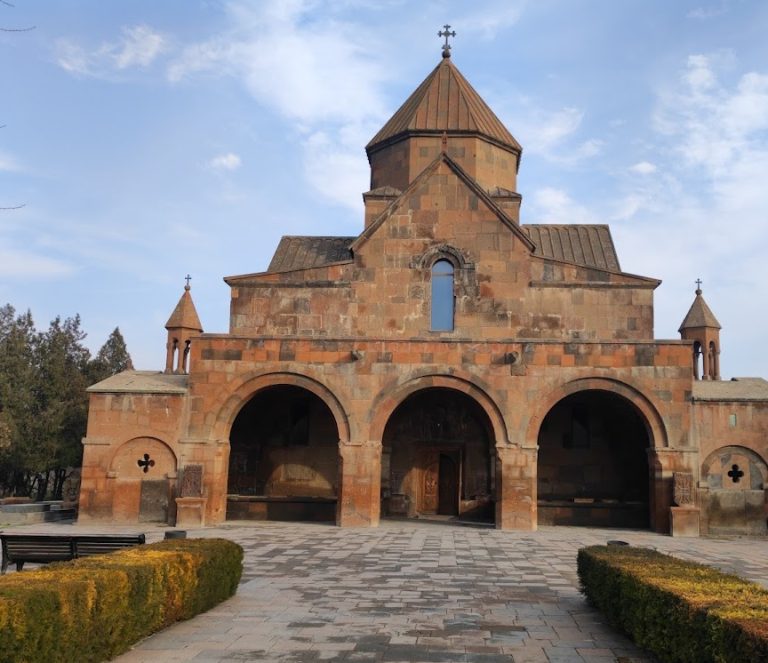
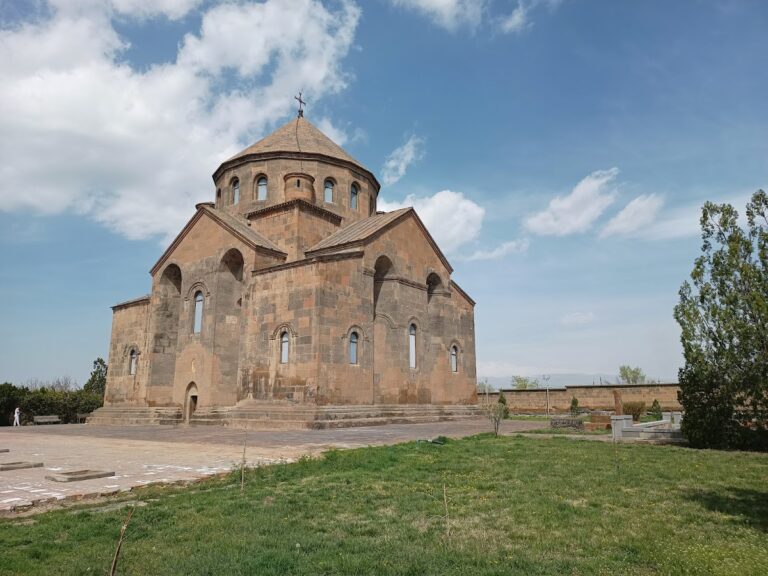
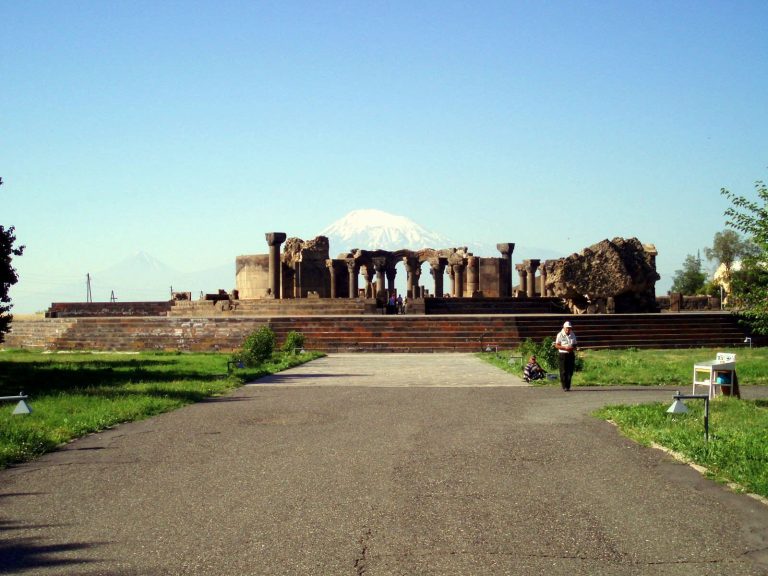
Etchmiadzin remains a major pilgrimage center and a political and cultural symbol for Armenians. During periods without an independent Armenian state, it was described as a national and political center. The cathedral and the churches of Saint Hripsime, Saint Gayane, Shoghakat, and the ruined Zvartnots Cathedral were inscribed together in 2000 as the UNESCO World Heritage property “Cathedral and Churches of Echmiatsin and the Archaeological Site of Zvartnots.” The cathedral complex became a national monument in 1983, a status reaffirmed by Armenia in 2002.
Remains
Courtyard and Cathedral Layout
The cathedral stands at the center of the Mother See of Holy Etchmiadzin, within a large quadrangular courtyard measuring approximately 106.53 by 102.16 metres according to measurements recorded in the 1890s. The surrounding monastery historically included the Catholicos’s residence and was enclosed by walls about 9.1 metres high. Built of brick or cob, the enclosure had eight circular towers and four gates. Its fortified appearance led nineteenth-century observers to compare it with a fortress.
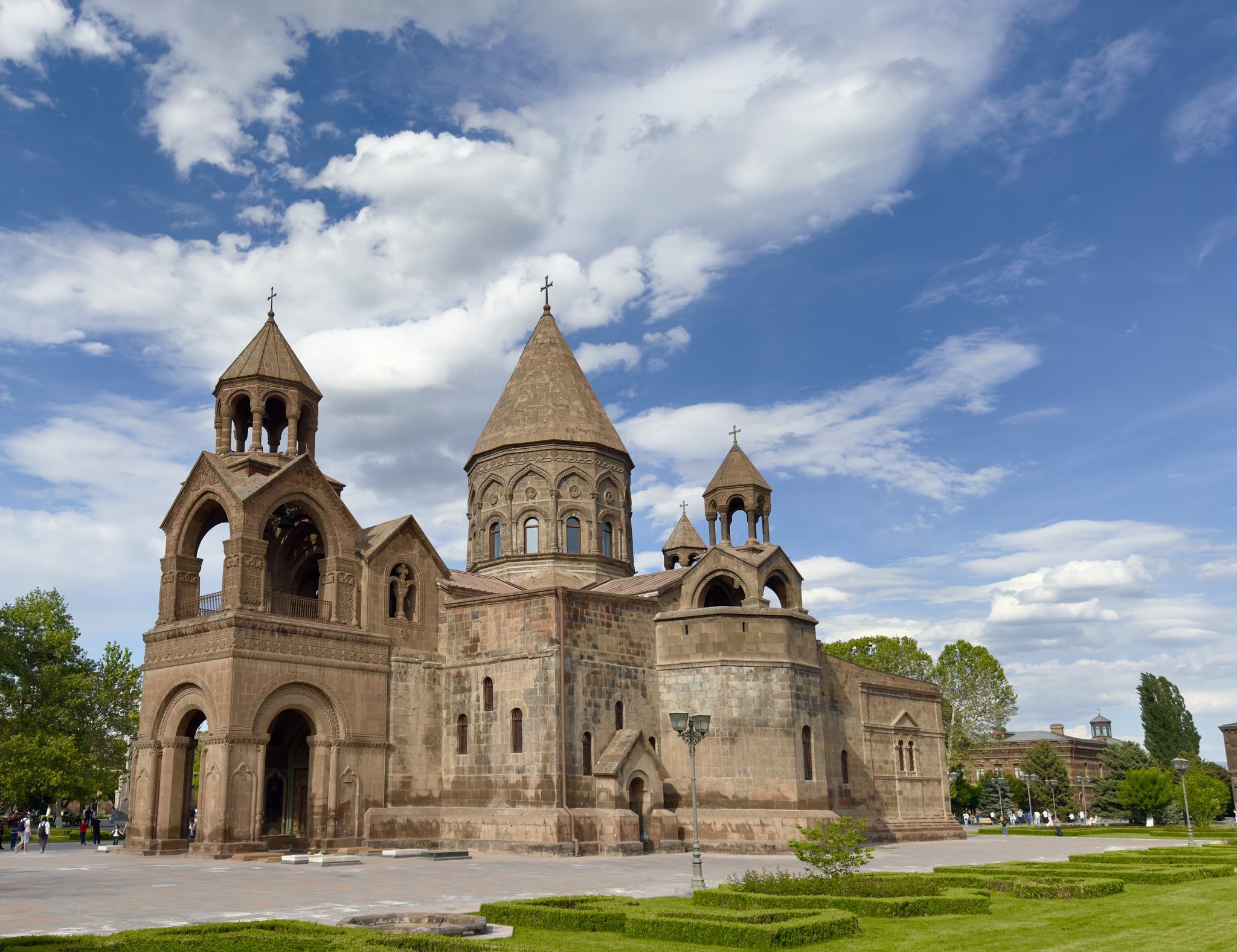
Etchmiadzin Cathedral has a cruciform plan organized around four free-standing, cross-shaped piers. Four projecting apses, semicircular inside and polygonal outside, extend from the central space. The piers divide the interior into nine nearly equal square compartments. The building measures approximately 33 by 30 metres, and the outer dome rises about 34 metres.
The fifth-century rebuilding forms the core of the present structure. The stone dome, the principal belfry, the smaller turreted belfries, and the eastern rear extension belong to later phases. The dome may originally have been wooden before being replaced in stone, while portions of the original northern and eastern walls survive. The roof is largely flat apart from the central cupola, a domed structure with a polygonal drum and a typically Armenian conical roof. Four smaller belfries rise above the apses.
Interior and Decoration
Frescoes and Painted Surfaces
The interior contains Persian-influenced frescoes of flowers, birds, scrollwork, and arabesque ornament. Naghash Hovnatan painted parts of the interior between 1712 and 1721. Surviving works include paintings on the dome and an image of the Mother of God beneath the altar. Members of the Hovnatanian family and later generations continued the decoration during the eighteenth and nineteenth centuries.
Early interior frescoes were restored in the eighteenth century, by Lydia Durnovo in 1956, and under Vardges Baghdasaryan in 1981 and 1982. The stone floor was replaced with marble in the 1950s. The wooden doors were carved in Tiflis in 1889. Paintings removed from the cathedral in 1891 are now held in Armenian museums, including the National Gallery of Armenia.
Eastern Sacristy and Relics
The eastern sacristy was constructed in 1868. It now functions as a museum and room of relics. The cathedral museum displays manuscripts and religious objects, including the Holy Lance, relics attributed to apostles and John the Baptist, and a fragment associated with Noah’s Ark.
Exterior Sculpture and Belfries
The exterior is enriched with geometric and floral patterns, blind arcades, and medallions depicting saints. The northern wall contains reliefs of Saint Thecla and Paul the Apostle, with Paul seated on a cross-legged stool. It also bears an equal-armed cross accompanied by Greek inscriptions containing several personal names.
The northern-wall reliefs have been dated variously between the first and sixth centuries. Some scholars place them before the introduction of the Armenian alphabet around 405, while others assign them to the fifth or sixth century. Vahagn Grigoryan argued for an early fourth-century date. They are regarded as among the earliest examples of Christian Armenian sculpture. The relief stones measure approximately 52 by 69 centimetres and 47 by 66 centimetres.
The western belfry, completed in 1658, forms the principal later addition to the west. Three smaller belfries with red stone turrets were added on the southern, eastern, and northern sides in 1682. One bell formerly housed in the seventeenth-century belfry carried a Tibetan Buddhist inscription. Soviet authorities reportedly removed it in the late 1930s, and it has since disappeared. The inscription survives in a nineteenth-century copy, while the bell’s origin and route to Etchmiadzin remain uncertain.
Archaeological Foundations
Earlier Church Structures
Excavations beneath the cathedral revealed remains of the original fourth-century building. Two levels of earlier pillar bases lie beneath the present supports, together with paving and foundation remains. A narrower altar apse survives beneath the existing eastern apse. The plan of the original church remains disputed. Proposals include a three-aisled vaulted basilica, a rectangular domed building supported by four pillars, a cross-shaped canopy structure, and a building broadly similar to the present cathedral.
Urartian and Fire-Temple Remains
A granite Urartian stele, dating from the eighth to sixth centuries BC, was found beneath the main altar. Urartu was an ancient kingdom centered in the Armenian Highlands during the first millennium BC. An amphora found in the same area was interpreted as possibly associated with a fire temple.
Excavations beneath the eastern altar uncovered a fire altar with surviving charcoal. Its foundation stone lay directly over the fire installation, a physical arrangement interpreted as expressing the replacement of pagan worship by Christianity. The fifth-century rebuilding produced a square structure enclosing a Greek cross, a cross with four equal arms, with four free-standing cross-shaped supports, four apses, a stone cupola, and two chapels beside the eastern apse.
This architectural arrangement is known in Armenian architectural history as the Etchmiadzin type, a square, four-apsed church with a domed canopy over the altar. Its design has been interpreted as combining features of a Zoroastrian fire temple and a classical mausoleum, although repeated rebuilding makes its precise development difficult to reconstruct. The type influenced later Armenian churches, including nineteenth-century buildings in Iran and Shushi and churches in the Armenian diaspora.
Recent Structural Conservation
The restoration carried out from 2012 to 2024 used injection compounds, waterproofing materials, mortar, and other structural materials to stabilize deteriorated columns, arches, vaults, the dome, and the roof. The severely deteriorated seventeenth-century cross, made from thin brass sheets, was replaced by a bronze cross closely reproducing its style and size.