Emir Zade Mosque: An Ottoman Monument in Chalcis, Greece


Site at a Glance
- Rating
- 4.3
- Popularity
- Low
- Country
- Greece
- Primary era
- Medieval
- External website
- Open
- Eras represented
- Medieval, Early Modern
- Civilizations
- Ottoman
- Site type
- Religious
- Remains
- Mosque
On this page11 sections
History
Emir Zade Mosque is an Ottoman mosque in Chalcis, Greece, on the island of Euboea. Built after the Ottoman conquest of Euboea and Chalcis in 1470, it probably dates from the late fifteenth century and is also placed in the 1480s. The building became one of the principal surviving monuments of Ottoman rule on the island.
Foundation and Ottoman Chalcis
The mosque was erected within the medieval fortifications, on the site of an earlier Christian church probably dedicated to Saint Mark or Saint Paraskeva. Its exact construction date remains uncertain, but its foundation followed the Ottoman takeover of the city. Under Ottoman rule, Chalcis was known as Eğriboz and served as the capital of the Eğriboz sanjak, an administrative district governed by an appointed official. It was also one of the Ottoman fleet’s winter quarters.
The seventeenth-century Ottoman traveller and writer Evliya Çelebi visited Greece between 1667 and 1669 and described Chalcis as a city containing eleven mosques. His account places Emir Zade Mosque within the religious and administrative landscape of the Ottoman city.
Rebuilding and Change of Use
The mosque was probably rebuilt during the first half of the eighteenth century. After the Greek War of Independence ended Ottoman rule in Chalcis, the building was deconsecrated and converted into a barracks for two battalions. The army later used it as a hay store.
The portico and minaret were destroyed during the nineteenth century, although an image from that century shows both features still standing. In 1937, the building was declared a historical monument. Restoration began in the late 1950s in support of plans to create a museum of medieval art and architecture, followed by further campaigns in 1971–1972 and 2013.
The former mosque was later used to store archaeological artefacts, including Ottoman-period gravestones. Following the 2013 restoration campaign, it became an exhibition space that includes, among other material, the print collection of Ioánnis Karakóstas. The protected building remains under the Ministry of Culture of Greece.
Remains
Emir Zade Mosque is built principally of stone, brick, and marble. Its simple plan centers on a rectangular prayer room covered by a single large dome. The surviving structure retains most of its original form, while the lost portico and minaret are represented by their remaining architectural evidence.
The Domed Mosque
Prayer Room and Dome
The main prayer room is rectangular and is lit by two parallel rows of windows. Its dome is hemispherical inside and octagonal outside. Four semi-conical squinches, curved architectural supports that transfer a dome onto a square or rectangular room, carry the dome at the corners.
Entrance and Prayer Features
The marble frame around the entrance bears an Arabic inscription translated as, “Enter here in peace and be immortal in the name of the All-Merciful God.” Two additional marble plaques with Quranic excerpts crown the arch. On the east wall, the mihrab, the prayer niche indicating the direction of Mecca, retains traces of polychromy and parts of its original decoration. The artistic treatment of the entrance inscription resembles that of a surviving fragment from the mihrab of the Altunizade Mosque in Üsküdar, a historic district on the Asian side of Istanbul.
Portico and Minaret
The mosque originally had a three-arched portico supported by four columns, with three smaller domes above it. A columned gallery, or revak, was roofed with hemispherical calottes. The portico has been lost. The minaret formerly stood beside the mosque, but only its square base survives.
Forecourt and Earlier Remains
Ottoman Fountain
An Ottoman fountain stands in the paved forecourt. Khalil Pasha built it in 1655, and it was repaired in 1796. The fountain carries inscriptions and elaborate embossed Arabic decoration. It was moved to the forecourt in 1960, where it forms part of the surviving architectural setting of the mosque.
Christian and Ancient Materials
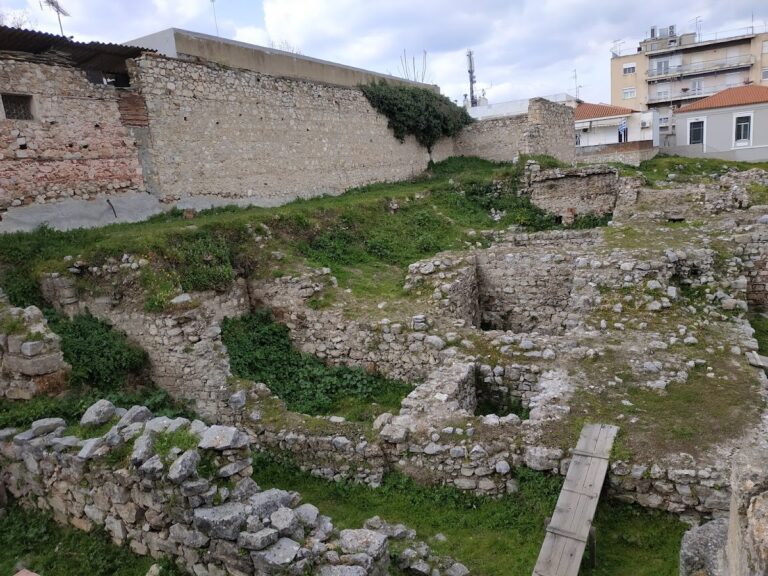
Remains of the earlier Christian church can be seen outside the mosque. Fragments of ancient columns and capitals are scattered around the building, preserving physical evidence of the site’s earlier architectural history.
Nearby sites