Ein Gedi: An Ancient Jewish Settlement on the Dead Sea
Site at a Glance
- Popularity
- Medium
- Country
- Israel
- Primary era
- Classical
- Eras represented
- Stone Age, Iron Age, Classical, Medieval
- Civilizations
- Achaemenid, Assyrian, Byzantine, Israelite, Roman
- Site type
- City
On this page17 sections
History
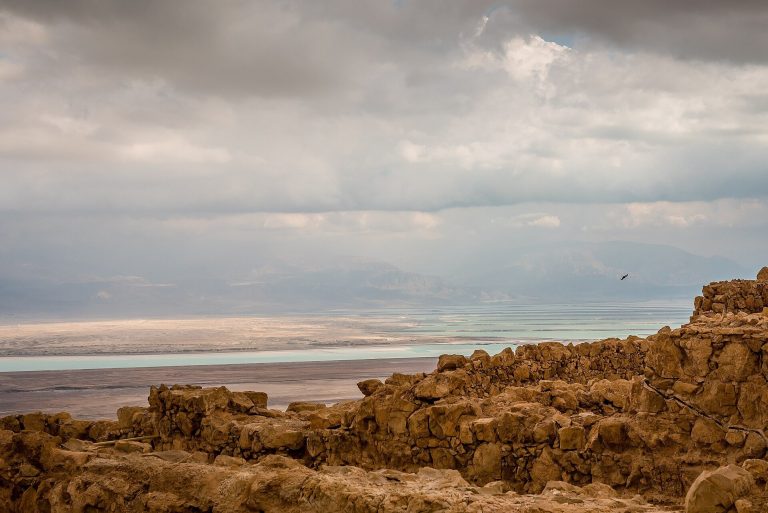
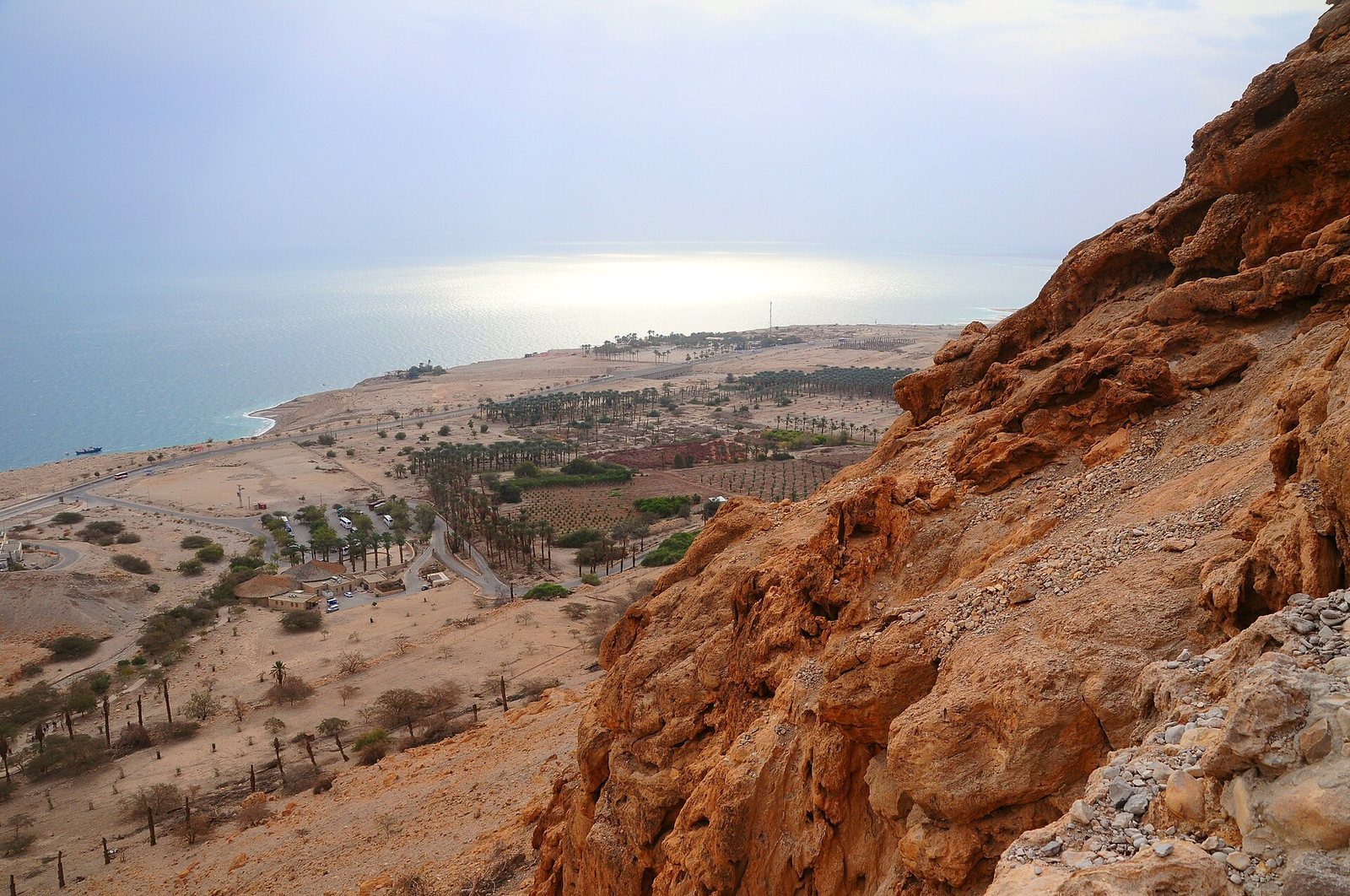
Ein Gedi was an important ancient Jewish settlement on the western shore of the Dead Sea in Israel’s Judaean Desert. Activity at the site extended from the Chalcolithic period through the Byzantine era, while Jewish settlement is known from the Iron Age into the 6th or 7th century CE. Ein Gedi developed into an agricultural and economic center, especially associated with date palms and balsam.
Chalcolithic activity and biblical traditions
The earliest identified activity at Ein Gedi was a temple of the Ghassulian culture, a southern Levantine society of the Chalcolithic, the period between the Neolithic and Bronze Age. The temple dates to about the middle of the fourth millennium BCE. Copper objects found in a nearby cave have sometimes been linked to the temple, although that connection is uncertain.
Biblical texts place Ein Gedi among the wilderness towns of Judah and tell how David, presented as a future king, hid there while fleeing Saul. Other passages associate the area with Hazazon-tamar, including accounts involving Jehoshaphat, a king of Judah, and Chedorlaomer, a king named in Genesis. The Song of Songs refers to vineyards at Ein Gedi, while Ezekiel imagines its shore becoming a fishing village. These passages are literary and religious traditions, not independent proof of the events they describe.
Judahite settlement
As the Kingdom of Judah expanded into the Judaean Desert in the late 8th or 7th century BCE, a small outpost was established near the oasis. It was active in the first half of the 7th century and may have been commissioned by the monarchy. By about the middle of that century, activity had shifted to a settlement at Tel Goren. Some evidence has also been interpreted as pointing to a foundation there as early as the late 8th century BCE.
The settlement’s growth was probably tied to opportunities in Dead Sea salt and bitumen, alongside valuable crops that may have included plants used for perfume. Ein Gedi became an important center for prized Judaean dates, perhaps encouraged by the Neo-Assyrian Empire, a major Near Eastern power whose influence extended over Judah. Two personal seals probably date to the reign of Josiah, king of Judah. One names Uriyahu, son of Azarayhu.
In its final century, the Iron Age village was an economic center within Judah. It was destroyed around 582 BCE, possibly during an Edomite raid, near the time of the Babylonian exile, when many people of Judah were deported to Babylonia after the conquest.
Persian and Hasmonean periods
A new settlement arose in the Persian period, after the return from exile. Jar handles marked with the letters YHD indicate that Ein Gedi belonged to the province of Judah. This settlement was destroyed in the 4th century BCE.
A later fortified settlement probably met destruction in the 1st century BCE. During the late Hasmonean period, when the Jewish Hasmonean dynasty ruled, Ein Gedi was likely inhabited by tenant farmers. The settlement reached its greatest extent under Herodian rule, spreading across the site’s natural terrace.
Roman rule and revolts
In the Herodian period, Ein Gedi was known for its date fruit and balsam, an aromatic plant product used in perfumes, oils, and medicines. Josephus, a 1st-century Jewish historian, described the settlement as the center of a toparchy, a territorial administrative district, and noted its palms and balsam. Pliny the Elder praised the fertility of the land and ranked its date groves just below Jerusalem’s. Rabbinic and early Christian writings also refer to balsam plantations, and the physician Galen connected the special oil called Shemen Afarsimon with Ein Gedi.
During Passover in 68 CE, the Sicarii, a radical Jewish group, raided Ein Gedi from their base at Masada. Josephus says they drove away the men, killed 700 women and children, and looted homes for supplies. After Jerusalem fell in 70 CE, control of the balsam plantations passed to the Roman treasury.
A Greek document from 124 CE describes Ein Gedi in terms suggesting that it belonged to the emperor’s private property. It also notes the stationing there of a Roman cohort, a unit of the Roman army, associated with Thracians. A second document, from 127 CE, indicates that Ein Gedi was no longer the center of a district and had become part of one governed from Jericho.
Documents in the archive of Babatha, a Jewish woman known through her legal and administrative papers, reveal family, property, and marriage ties between Jewish communities at Ein Gedi and Maḥoza, south of the Dead Sea. These links probably developed after the First Jewish Revolt, the uprising against Roman rule from 66 to 73 CE, when Roman attacks led some families from Ein Gedi to seek refuge in Maḥoza.
During the Bar Kokhba revolt, another Jewish uprising against Rome that lasted from 132 to 136 CE, some residents fled to caves in the surrounding wilderness. Some refugees died during the Roman siege of caves in Nahal Hever, and suppression of the revolt severely damaged the settlement.
Byzantine village and later activity
Ein Gedi was resettled after the revolt and grew into a large Jewish village during the Byzantine era, the eastern continuation of the Roman Empire. In the early 4th century, the Christian writer Eusebius called it a very large village of Jews. Archaeologist Gideon Hadas estimated a population of about 1,000, cultivating roughly 1,000 dunams, units of land area. A synagogue was built in the early 3rd century. Its mosaic inscription warns against revealing the town’s secret. Most researchers have connected the warning with the method of producing balsam oil, while Jodi Magness has proposed that it concerned betrayal of the Jewish community to non-Jews.
The village was destroyed by fire in the late Byzantine period, and its balsam plantations disappeared. The date and cause remain uncertain. The synagogue’s excavators associated the destruction with Emperor Justinian’s persecution of Jews in the early 6th century; another explanation is a Bedouin raid before the Persian invasion, probably in the late 6th or early 7th century. The loss of knowledge about balsam cultivation may have followed the displacement of the Jewish population.
A Mamluk-period archaeological layer and several coins suggest that a small settlement may have existed in the medieval period. Finds include two late-14th-century coins and another generally dated to the 14th century, as well as two further late-14th-century coins found near the spring. The layer was later dismantled when the area was cleared for modern farming.
In 1838, Edward Robinson described gardens, mainly of cucumbers, belonging to the Rashaideh tribe. An American expedition led by Lieutenant William Francis Lynch stopped at Ein Gedi in 1848, and investigations between 1865 and 1925 identified Tel Goren as an ancient settlement and noted its water systems. Excavations began at Tel Goren in 1949. Later work uncovered the temple and burial remains, investigated Roman buildings, and identified and excavated the synagogue. From the 1980s, Hadas and then Yizhar Hirschfeld led further excavations, including work on the Roman-Byzantine village and medieval settlement. The synagogue’s mosaic inscription is now displayed at the National Archaeology Campus in Jerusalem.
Remains
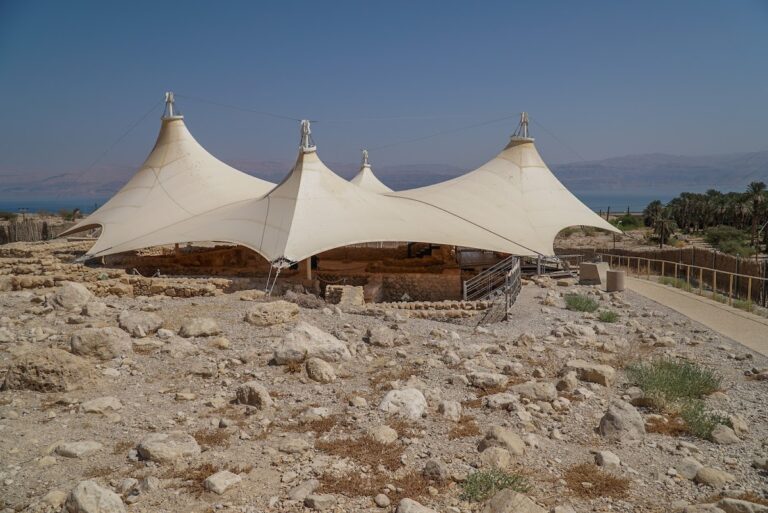
Ein Gedi’s archaeological remains include a Chalcolithic building on a slope between two springs, the settlement remains of Tel Goren, village structures across a natural terrace, and caves in the surrounding desert. Excavated architecture ranges from a stone platform and settlement walls to a Roman bathhouse and a multi-phase synagogue.
Temple and Chalcolithic finds
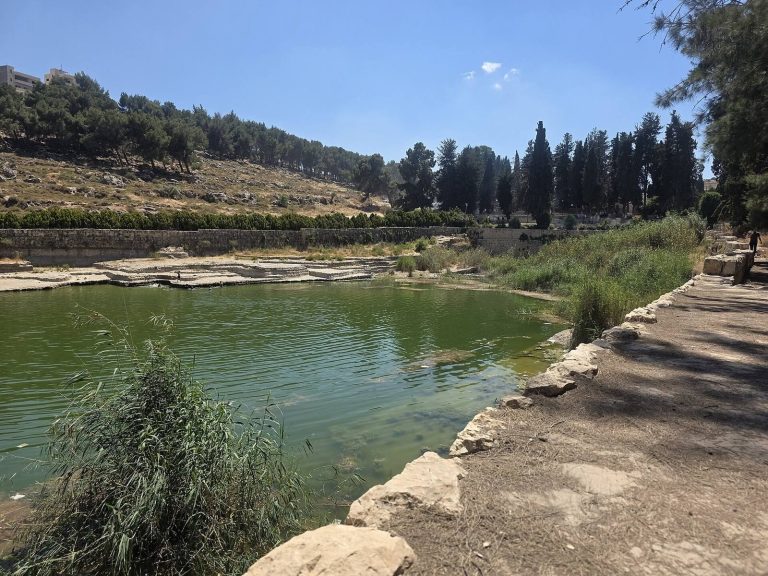
The Chalcolithic temple stood on a slope between the Ein Shulamit and Ein Gedi springs. A large building above the Ein Gedi spring was later identified as the temple. Chalcolithic finds also came from Moringa and Mikveh caves. A Hebrew inscription on a stalagmite at Nahal Yishai, about 1.2 kilometres northeast of the spring, belongs to the period of the early Judahite presence. Nahal Mishmar cave yielded roughly 400 copper objects, most of a ritual character. Their association with the temple remains uncertain.
Early settlement and burial remains
Judahite outpost
The early outpost consisted of a stone platform. It has been interpreted either as the base of a tower or as a place of worship comparable to a bamah, an elevated worship site.
Tel Goren
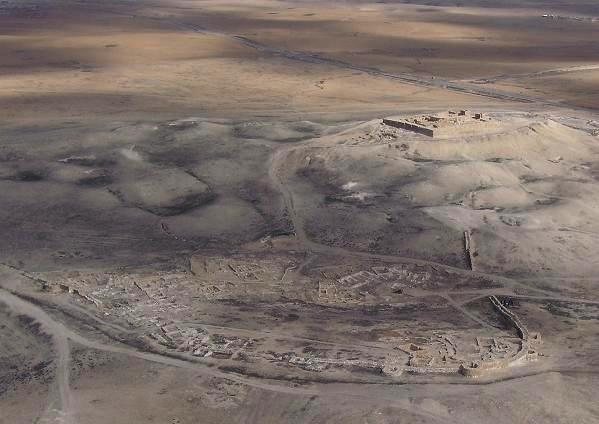
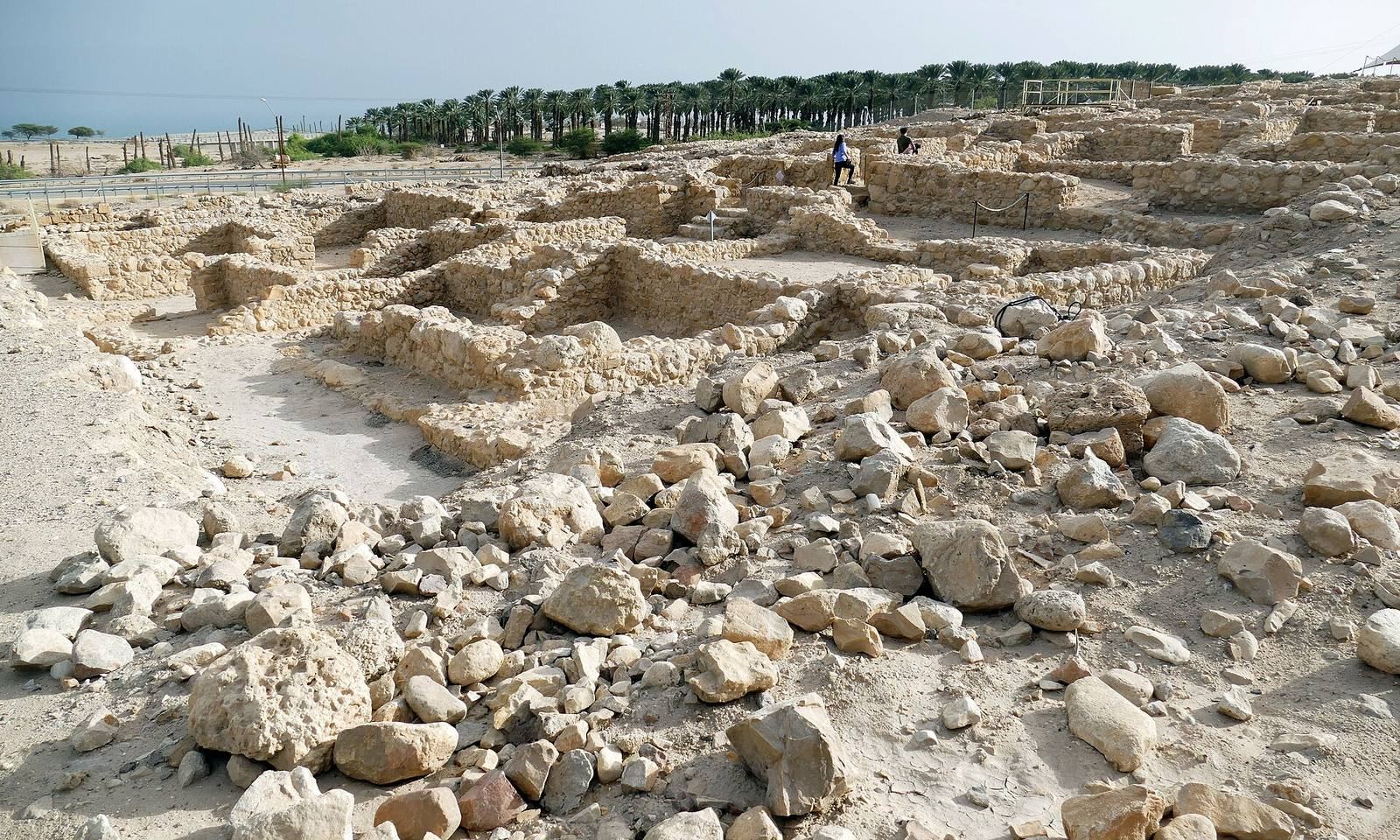
Tel Goren, also called Tell el-Jurn, lies between Nahal David and Nahal Arugot. Excavations revealed walls, pillars, houses, and other buildings that trace the settlement’s expansion eastward and northward. A mikveh, a Jewish ritual bath, was also found.
Cave tombs
Cave tombs from the late Hasmonean period held multiple burials. Several wooden coffins dating to the 2nd and 1st centuries BCE show the influence of Hellenistic design. The local climate and soil also preserved other wooden grave goods unusually well.
Village buildings and finds
Roman bathhouse
A Roman bathhouse associated with the garrison was probably built for the Roman administration around the period after 70 CE. Its construction incorporated reused stones from the Herodian period.
Synagogue
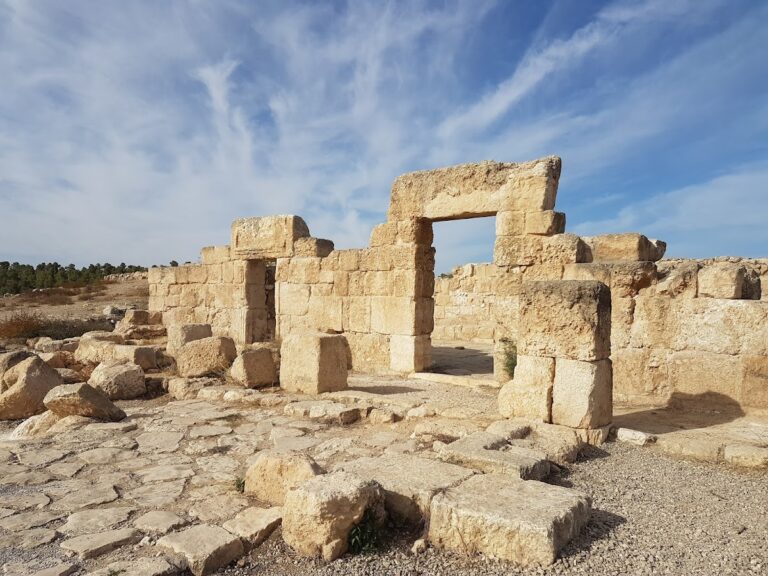
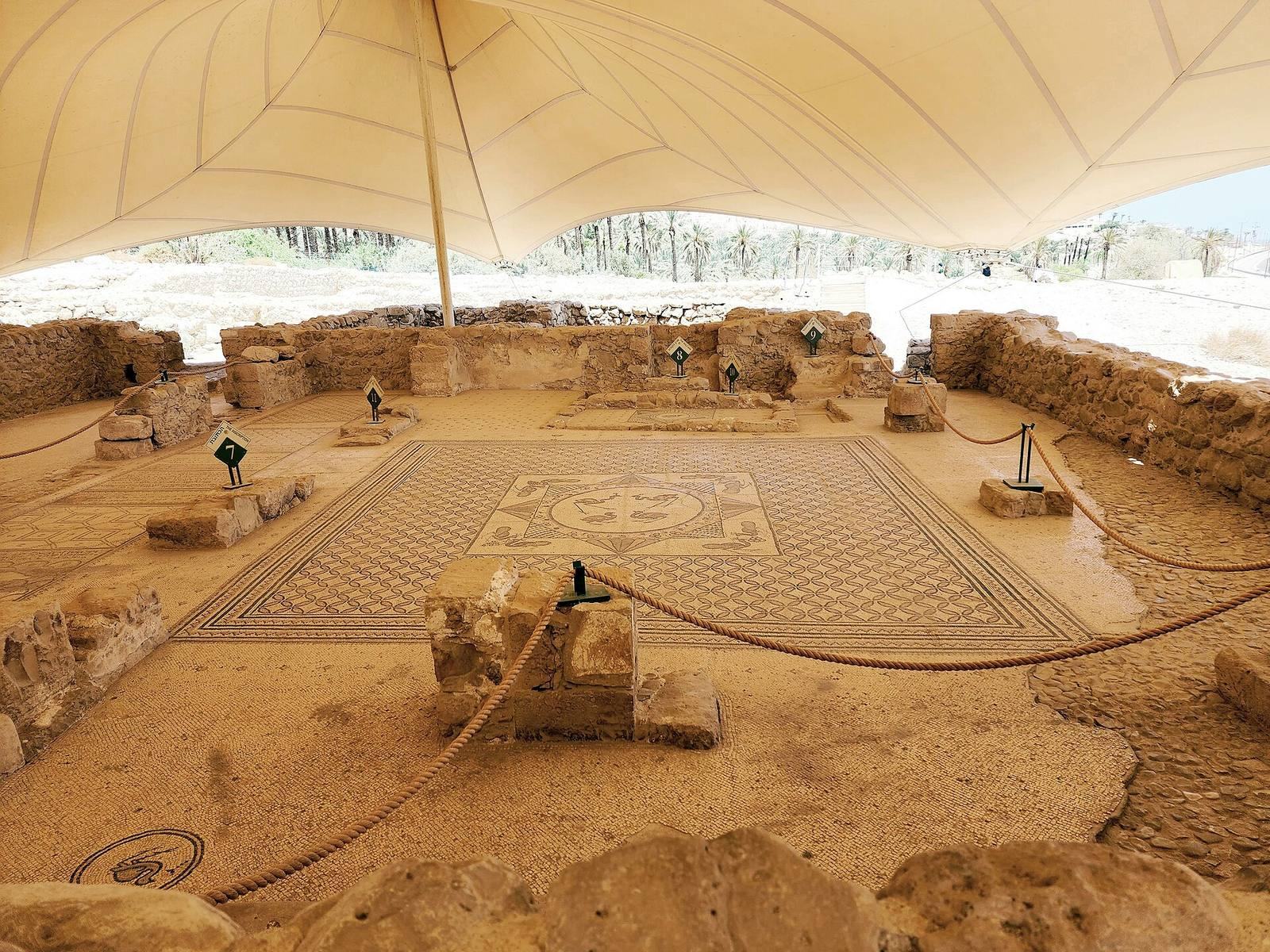
The synagogue underwent three major building and renovation phases. A simple hall with a geometric mosaic floor was transformed into a larger basilica-style building, with a central hall flanked by side aisles, a raised bema, and an ark for Torah scrolls. Its colorful mosaics depict birds, probably crowned cranes and francolins or partridges, along with menorahs, seven-branched lampstands.
A mosaic in the western aisle, among the longest known from an ancient synagogue, lists biblical figures, zodiac signs, months of the year, and dedications. It names Halfi and his sons Yosi, Ezrin, and Hezkin, as well as Rabbi Yosi and Yonathan Hazana, identified as a cantor. A separate mosaic bears the warning about the town’s secret; that inscription is displayed in Jerusalem.
Fire destroyed the synagogue, leaving impressions of burnt roof beams on the floor. A burnt scroll identified as the Book of Leviticus was found in a reed ark. It is the only scroll known to have been found in an ancient synagogue. The ark also held silver pendants, lamps, coins, glass fragments, and 132 animal bones, mainly from goats and sheep, as well as from chickens and fish. The bones bear butchery marks and may be remains of religious meals. They may instead, or also, have been placed there as a genizah, a deposit for worn sacred texts or objects.
Other synagogue finds included a metal, probably silver, seven-branched menorah described as unique for its time, and coins found with a hoard in an ark. Graffiti depicting ships survives on plastered walls and pillars; the images may have been decorative or made as offerings.
Oil production, gate, and residential remains
Two specialized production facilities east of Perfume Street were used to make Shemen Afarsimon, the special oil associated with Ein Gedi. At the northern gate, distinctive lintels and doorposts lack fittings for bolts, a feature that suggests a ritual or halakhic, meaning related to Jewish religious law, purpose.
Residential finds include ceramics of different sizes and plain or decorated lamps. Excavations also recovered thousands of plant remains, mostly Byzantine and some Roman. Indigo, hoary nightshade, lilac chaste tree, and Abraham’s balm were associated with making cloth and wool. Finds also include date pits from at least two palm varieties, Arabian jujube, pomegranate peel, and Assyrian plums used to make glue for bird hunting. Small-grain wheat, two-rowed barley, lentils, faba beans, and broad beans were identified.
Refuge caves
Objects from caves used during the Bar Kokhba revolt include everyday vessels, documents, personal belongings, and house keys. The Cave of Letters, about six kilometres south of the oasis, also yielded human remains of three men, eight women, and six children. Religious finds include a copy of Psalm 15 and fragments of biblical texts written in Greek. The surviving material preserves about 50 names of Ein Gedi inhabitants or people connected with them, most of them Hebrew.