Église Saint Pierre (Avignon): A Gothic Collegiate Church in France


Site at a Glance
- Rating
- 4.6
- Popularity
- Low
- Country
- France
- Primary era
- Medieval
- External website
- Open
- Eras represented
- Medieval, Early Modern
- Civilizations
- Papal States
- Site type
- Religious
- Remains
- Basilica
On this page18 sections
History
Église Saint Pierre is a Roman Catholic church in Avignon, France, dedicated to Saint Peter, the apostle regarded in Catholic tradition as the first pope. Built in the Gothic style on the site of a seventh-century church, it developed from a local place of worship into a collegiate church and later a minor basilica.
Early church and Gothic rebuilding
Tradition holds that the first church on the site was destroyed by the Saracens, a medieval European term commonly used for Muslim forces, particularly Arab or Berber forces. Bishop Foulques II of Avignon began rebuilding the church on the earlier ruins. The present Gothic building dates from 1358, when Cardinal Pierre des Prés supported its construction.
Cardinal Pierre des Prés also financed buildings for the canons, the community of clergy who served the church, and a cloister. The cloister has since disappeared. During the fourteenth century, Pope Innocent VI raised Saint Peter to the rank of collegiate church, placing it under a college of canons rather than a monastic community.
Fifteenth- and sixteenth-century expansion
The church was enlarged during the fifteenth century. Two bays were added to the nave, and new chapels increased the space available for worship and devotion. The parvis, an open forecourt in front of a church, was created in 1486. The bell tower followed in 1495, and work on the decoration of the facade began in 1512. The facade was completed in 1524.
The church’s musical history also reaches back to this period. An organ was recorded at Saint Peter in 1515, but the instrument was destroyed during the French Revolution. A replacement was commissioned in 1819 from the Milanese builder Ludovica Piantanida. Théodore Puget enlarged it during the 1860s, and further restoration and expansion took place in 1892 and 1925. By June 2024, the instrument had 37 stops, meaning sets of organ pipes with distinct sounds, and preparations were under way for a major restoration.
Later changes and recognition
During the Restoration, the period of restored Bourbon rule in France after Napoleon, a large bell was cast in Avignon in 1825 for the city cathedral. It broke in 1830 and was recast. Two additional bells were made in 1848 and 1853. They were later installed in Saint Peter’s bell tower and remained there.
Saint Peter was listed as a French historic monument in 1840. On 4 May 2012, Pope Benedict XVI granted it the title of minor basilica, an honorific designation given by the pope to churches of particular religious or historical importance. The former seventeenth-century high altar of the collegiate church was transferred to Notre-Dame-de-Bon-Repos in Montfavet.
Remains
Facade and bell tower
Bell tower
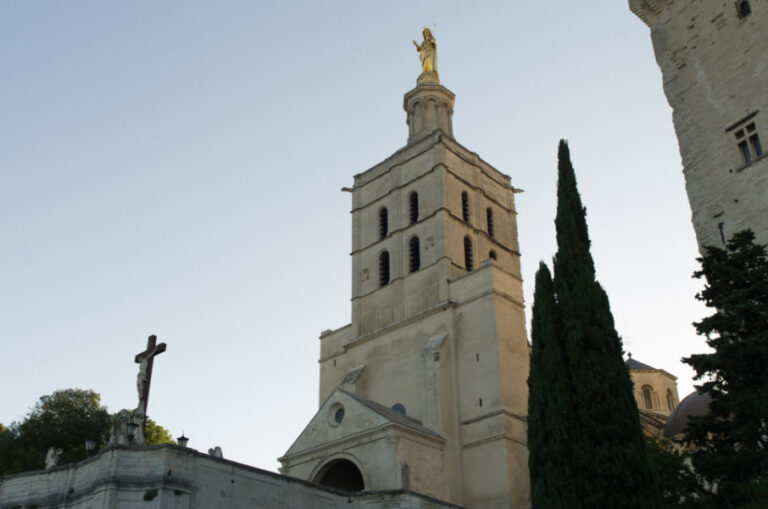
The bell tower, built in 1495 by Jean-Baptiste Lécuyer, follows a characteristic Avignon arrangement. Its square lower body supports an octagonal upper section, which rises to a hooked spire. The tower also houses the bells made in 1848 and 1853, together with the recast bell associated with the 1825 casting.
Facade and doors
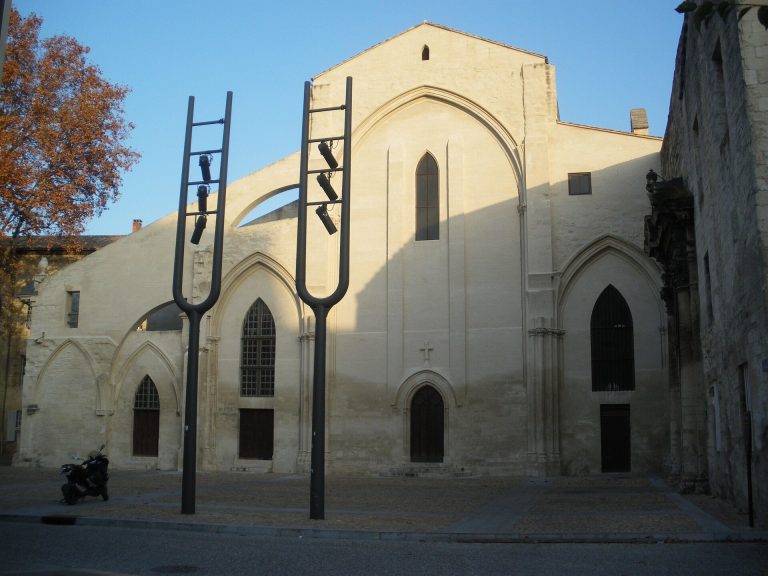
The slender facade, completed in 1524, is framed by two small turrets. Its design was based on a study by Philippe Garcin and was executed or designed by Nicolas Gasc and Perrin Souquet. The monumental doors are made of solid walnut and were carved by Antoine Volard in 1551. A statue of the Virgin and Child, attributed to Jean Péru, separates the two doorways.
The left door shows Saint Jerome with a lion at his feet and the archangel Michael striking down a dragon with a sword. The right door represents the Annunciation, in which the archangel Gabriel delivers his message to Mary. Beside the individual door leaves are two caryatids, sculpted human figures used as architectural supports or decoration. Above each door, a wooden relief panel contains arabesques and chimerical figures. Each panel is topped by a mask and two putti holding a cornucopia, the horn-shaped emblem of abundance, while scattering flowers and fruit.
Interior architecture and furnishings
Nave and chapels
The interior is organized around a central nave with side aisles, six lateral chapels, and baptismal fonts. The nave measures 25.5 metres in length, 9.6 metres in width, and 15 metres in height. It is divided into four bays and covered by a pointed ribbed vault, a ceiling carried by intersecting stone ribs. Here, the ribs rest on capital-like wall consoles rather than on free-standing pillars.
Choir and high altar
The choir is 17.5 metres long. Its finely worked wooden stalls are topped by paintings set into the woodwork and decorated with floral motifs. Larger paintings above the stalls represent scenes from the Gospels. The gilded choir woodwork was made in 1670 after designs by François de la Valfenière.
The high altar is framed by a gilded wooden retable, an ornamental structure placed behind or above an altar, made in 1617 after designs by the Jesuit architect Etienne Martelange. Its principal painting by Guillaume-Ernest Grève depicts Christ giving the keys to Saint Peter. The retable also represents the four Doctors of the Church, Christian theologians whose teaching has received special recognition in Catholic tradition. Above the altar, a radiant gilded wooden crown contains a stylized dove representing the Holy Spirit.
Older retables and choir remains
A retable by Perrinet Parpaille dates from 1526, while a gilded wooden altar from the eighteenth century was deposited by the Calvet Foundation. Antoine Le Moiturier began a large choir retable for the collegiate church in 1461. Fragments of that work survive behind the later gilded woodwork. The church also contains a nineteenth-century choir carpet.
Paintings, sculpture, and relics
Paintings and sculptural works
The church’s paintings include Saint Barbara and Saint Margaret Adoring the Blessed Sacrament, made by Nicolas Mignard in 1652, and The Holy Family with the Goldfinch, painted by Mignard in 1641. Simon de Châlons produced The Adoration of the Shepherds and The Immaculate Conception around 1550. Saint Peter Walking on the Water was painted by Pierre Duplan in 1589.
Other works include The Holy Family, Saint Agatha, and Saint Margaret by Guillaume-Ernest Grève, dated uncertainly to 1614, and the Entombment of the Gallieni or Galliens family, dated 1431 and attributed to Jacques Morel. Grève also produced The Delivery of the Keys to Saint Peter and The Four Doctors of the Church in 1634. A retable by François de Royers de la Valfenière is likewise dated 1634.
Relics of Pierre de Luxembourg
Saint Peter preserves relics associated with Blessed Cardinal Pierre de Luxembourg. They include a fourteenth-century dalmatic, stole, and cardinal’s hat, retaining a material connection with the religious history of the church and its medieval collegiate tradition.
Organs
Main organ
The main pipe organ stands in the gallery at the rear of the church. Its pipes are enclosed within a richly carved Neo-Gothic wooden case. The instrument descends from the replacement commissioned from Ludovica Piantanida in 1819 and later enlarged by Théodore Puget. Its subsequent restoration and expansion in 1892 and 1925 contributed to the form that had 37 stops by June 2024.
Choir organ
A second organ, built by Théodore Puget in 1901, is concealed behind the choir stalls on the right. It has nine stops distributed across two manuals, the keyboards played by the hands, and pedals, the keyboard played by the feet.