Burg Blomendal: A Medieval Moated Castle and Administrative Seat in Bremen


Site at a Glance
- Rating
- 4.5
- Popularity
- Low
- Country
- Germany
- Primary era
- Medieval
- External website
- Open
- Eras represented
- Medieval, Early Modern, Modern
- Civilizations
- Holy Roman Empire
- Site type
- Military
- Remains
- Castle
On this page9 sections
History
Burg Blomendal is a medieval moated castle complex in Blumenthal, Bremen, Germany, built by the knights von Oumünde in the thirteenth century. Also known as Hus Blomendal or Haus Blomendal, it is regarded as the oldest secular building in Bremen. The name Blomendal is the Low German form of Blumenthal.
The first and second castles
The first castle stood on the Burgberg above the Aue valley in the Lüssum area. The knights von Oumünde, also called von Aumund, built it in the thirteenth century. A medieval conflict known as the Bremen Council Feud led to its destruction in 1305.
The same family built a second Burg Blomendal in 1354. Among its recorded owners were the lords von Oumünde, Diderich von Reken, and Johann von der Hude. In 1436, the knights Johann and Otto von Borch sold dat slot Blomendale to the Bremen Council, the governing civic body of medieval and early-modern Bremen, for 1,400 Rhineland guilders.
Bremen administration and territorial change
After the sale, Bremen leased the castle and its extensive revenues to councillors or mayors considered deserving. The leases ran for successive ten-year terms. Bremen mayor Diedrich Hoyer the Elder moved into Blomendal as a lessee in 1542. His son Erich Hoyer, who also became mayor, commissioned the surviving ceiling painting.
From the sixteenth century, the castle functioned as the seat of the Amt Blomendal. An Amt was an administrative and judicial office or district. Johann Hoppe served there as bailiff from 1638 to 1652, administering the territory on behalf of its governing authority. A street in Blumenthal was later named after him.
During preparations for the First Bremen-Swedish War in 1653, Swedish troops under Count Königsmarck, a Swedish military commander, occupied the castle, then called Haus Blomendal, along with the settlements of Lesum and Burg. The Second Stade Compromise of 1742, a territorial settlement that redistributed regional jurisdictions, separated Haus Blomendal from its connection with Bremen and assigned it to the Electorate of Brunswick-Lüneburg, a major territorial state of the Holy Roman Empire.
Prussian administration and conservation
After Prussia annexed the Kingdom of Hanover in 1866, Blumenthal came under Prussian administration. In 1884, district administrator Paul Berthold established the district office of the Blumenthal district at Haus Blomendal. When Blumenthal was incorporated into Bremen in 1939, the castle returned to Bremen administration.
Extensive restoration took place in the 1970s. Since 1973, the castle buildings and their nineteenth-century outbuildings have been protected as monuments. The restored complex now supports archive, cultural, educational, social, and exhibition uses, while retaining its historical buildings and courtyard.
Remains
Moated castle complex
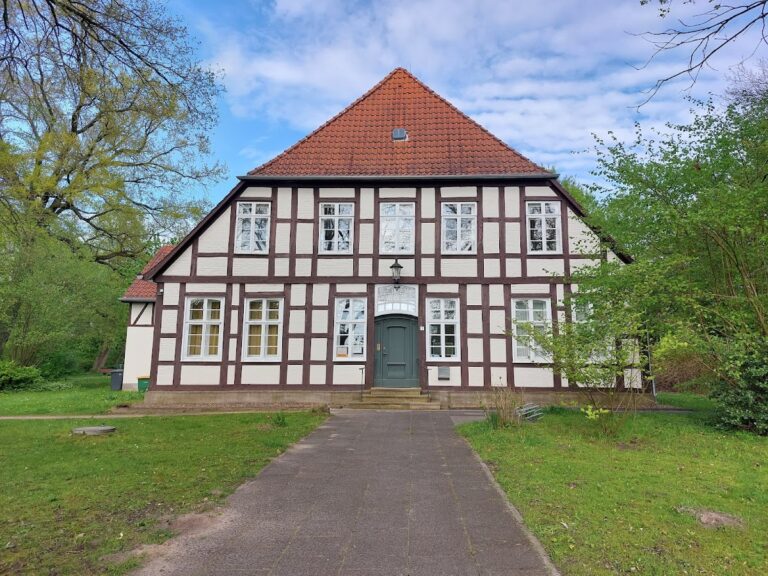
Burg Blomendal is a brick-built medieval moated castle at the confluence of the Blumenthaler Aue and Beckedorfer Beeke. Its surviving complex consists of a main building, a north wing, nineteenth-century outbuildings, and a castle courtyard. A 1600 view by Wilhelm Dilich, a German cartographer and engraver known for historical and topographical views, records the appearance of the moated castle at that time.
Main building
The restored main building contains the archive rooms of the Heimatverein Blumenthal. Its surviving ceiling painting is associated with Erich Hoyer’s commission and preserves evidence of the building’s sixteenth-century period as a residence of Bremen’s civic elite.
North wing
The north wing contains a kindergarten. Its rooms, like other parts of the premises, have been adapted for concerts, stage plays, lectures, private celebrations, conferences, and exhibitions.
Nineteenth-century outbuildings
The nineteenth-century outbuildings form part of the protected castle buildings. Together with the main building, north wing, and courtyard, they preserve the material organization of the later castle complex.
Nearby sites