Dunglass Castle: A Barony Seat in West Dunbartonshire
Site at a Glance
- Popularity
- Medium
- Country
- United Kingdom
- Primary era
- Early Modern
- Eras represented
- Early Modern
- Civilizations
- Kingdom of Scotland
- Site type
- Military
- Remains
- Castle
On this page13 sections
History
Dunglass Castle is a ruin on a rocky cliff above the River Clyde in West Dunbartonshire, United Kingdom. It served as the principal seat of the Barony of Colquohoun, a territorial estate associated with the Laird of Luss, a Scottish landholder. Its construction date is uncertain.
Attacks in the sixteenth century
Soldiers serving Lord Fleming at Dumbarton Castle attacked Dunglass in November 1568 and again in February 1569. The second assault was repelled, and Lord Fleming’s half-brother was captured.
Decline and stone removal
The castle had fallen into ruin by the eighteenth century. In 1735, on the order of the Commissioners of Supply, Scottish county bodies responsible for local administration and public works, much of the castle’s stone and that of its courtyard was taken for repairs to the quay. Andrew Buchanan of Auchentorlie bought the property in 1812 and halted further removal of the masonry.
Leases and interior design
In July 1893, Scottish graphic artist and designer Talwin Morris leased the castle and remodelled its interior. Charles Macdonald took a lease in July 1899. He and Scottish architect and designer Charles Rennie Mackintosh then altered Morris’s interiors and created further interiors and furniture. The design of a white room they made was later developed further at Mackintosh’s Hill House in Helensburgh.
The castle is classified as high risk on Scotland’s Buildings at Risk Register.
Remains
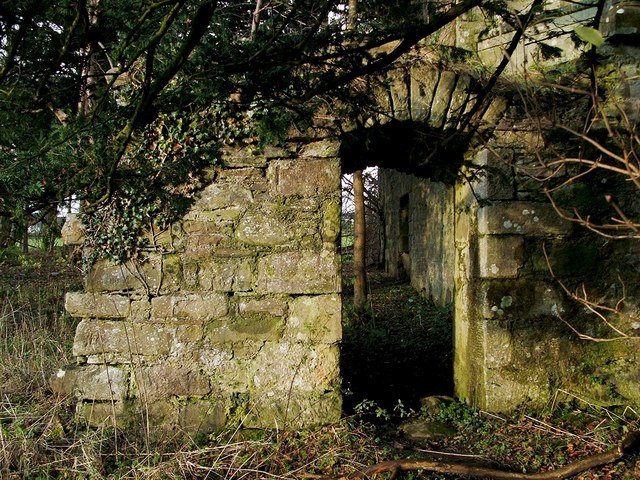
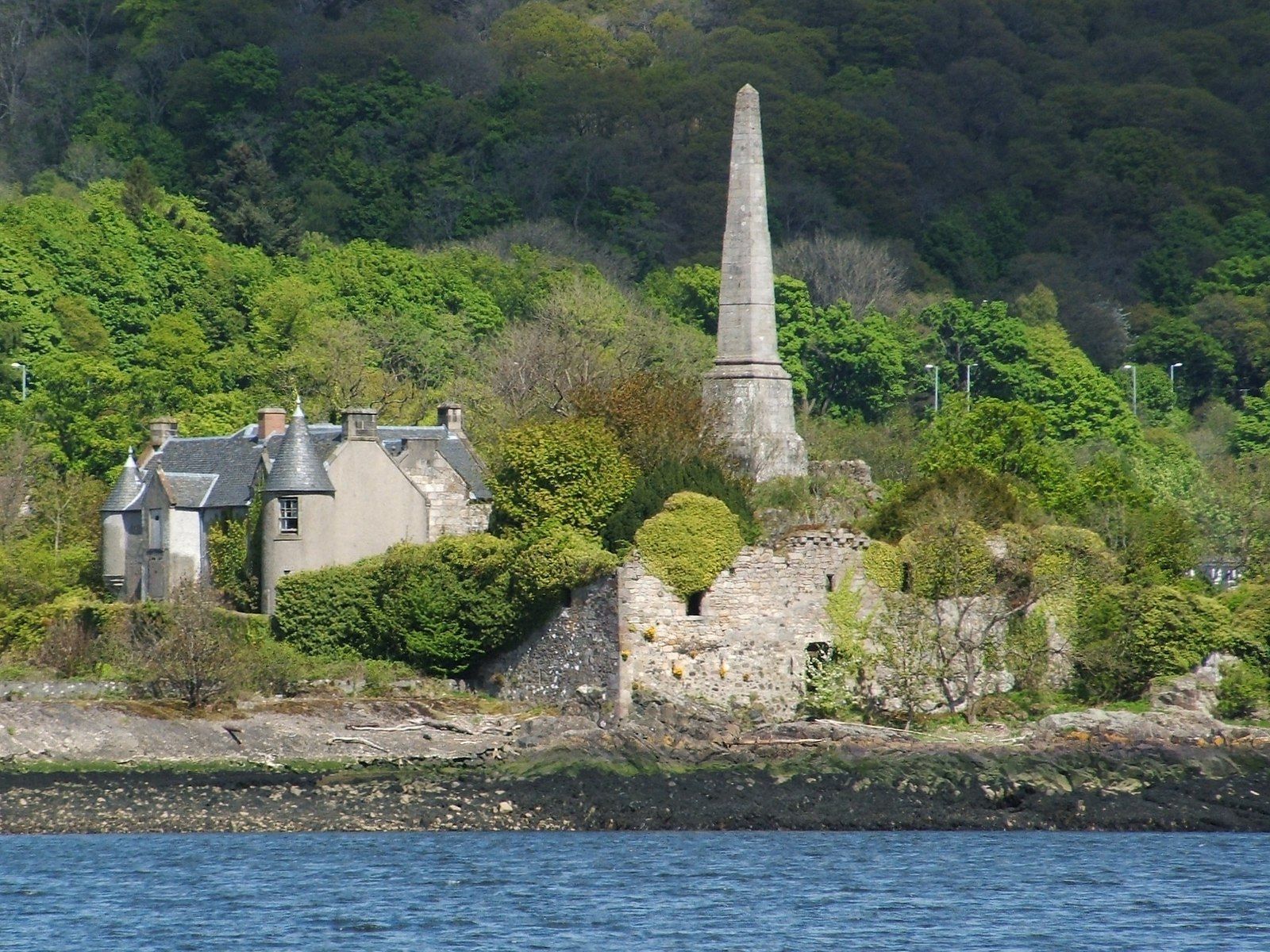
The ruined castle occupies a rocky cliff above the River Clyde. Its enclosure is marked by a substantial boundary wall, built in different periods and still standing about 7–8 metres high.
Enclosure and associated structures
South wall and dovecot
A small, cone-shaped dovecot, or pigeon house, survives on the south wall as a complete ruin.
Boat landing
Near the western end of the wall, outside the south side, a small landing place served boats. It appears to have been shielded by a projecting hoarding, a defensive shelter often made of timber. Some corbels, projecting supports for such a structure, remain.
Northwestern dwelling
A dwelling house stands at the enclosure’s northwest corner. Part of it may date to about 1590, while most of the building is later; its interior is entirely modern.
Round tower
A round tower, probably built in the seventeenth century, appears to have been used as a pigeon house.
Interior remains and memorial
Interior design and surviving object
A remnant of Morris’s interior is held in the West Dunbartonshire Council collection. A bookcase made by Mackintosh and Macdonald is now in the National Museum of Scotland, and Mackintosh’s work has been removed from the property.
Henry Bell memorial
An obelisk commemorating Henry Bell, a Scottish engineer and early pioneer of steam-powered navigation, stands on the castle grounds.