Dolmen de la Bouissière: A Chalcolithic Tomb in Cabasse, France
Site at a Glance
- Popularity
- Very Low
- Country
- France
- Primary era
- Stone Age
- Eras represented
- Stone Age
- Civilizations
- Unclassified
- Site type
- Burial
- Remains
- Tomb
On this page12 sections
History
The Dolmen de la Bouissière, a tomb built from large stones, stands on La Bouissière hill in Cabasse, in the Var region of France. It is classified as Chalcolithic, or Copper Age, a period between the Neolithic and Bronze Age. Two radiocarbon dates from charcoal fell between 3,970 and 3,985 BP, with a stated uncertainty of ±260 years. BP means years before 1950.
Chalcolithic burial and repeated use
The tomb was used repeatedly, as shown by four distinct occupation levels and broken bones and objects in the lower deposits. Their contents indicate that burial activity took place over more than one episode.
Later burial and cremation
A child was later buried in a pit cut through all four levels. The nearby cremation area remained in use into the Iron Age, the period when iron became widely used for tools and weapons.
Discovery and interpretation
Georges Bérard discovered and excavated the dolmen in 1950. He considered it contemporary with the Dolmen de la Gastée and the standing stone known as Pierre Plantée. A later analysis revised the first assessment of the human bones and established that they had all been cremated outdoors in an intense fire.
Remains
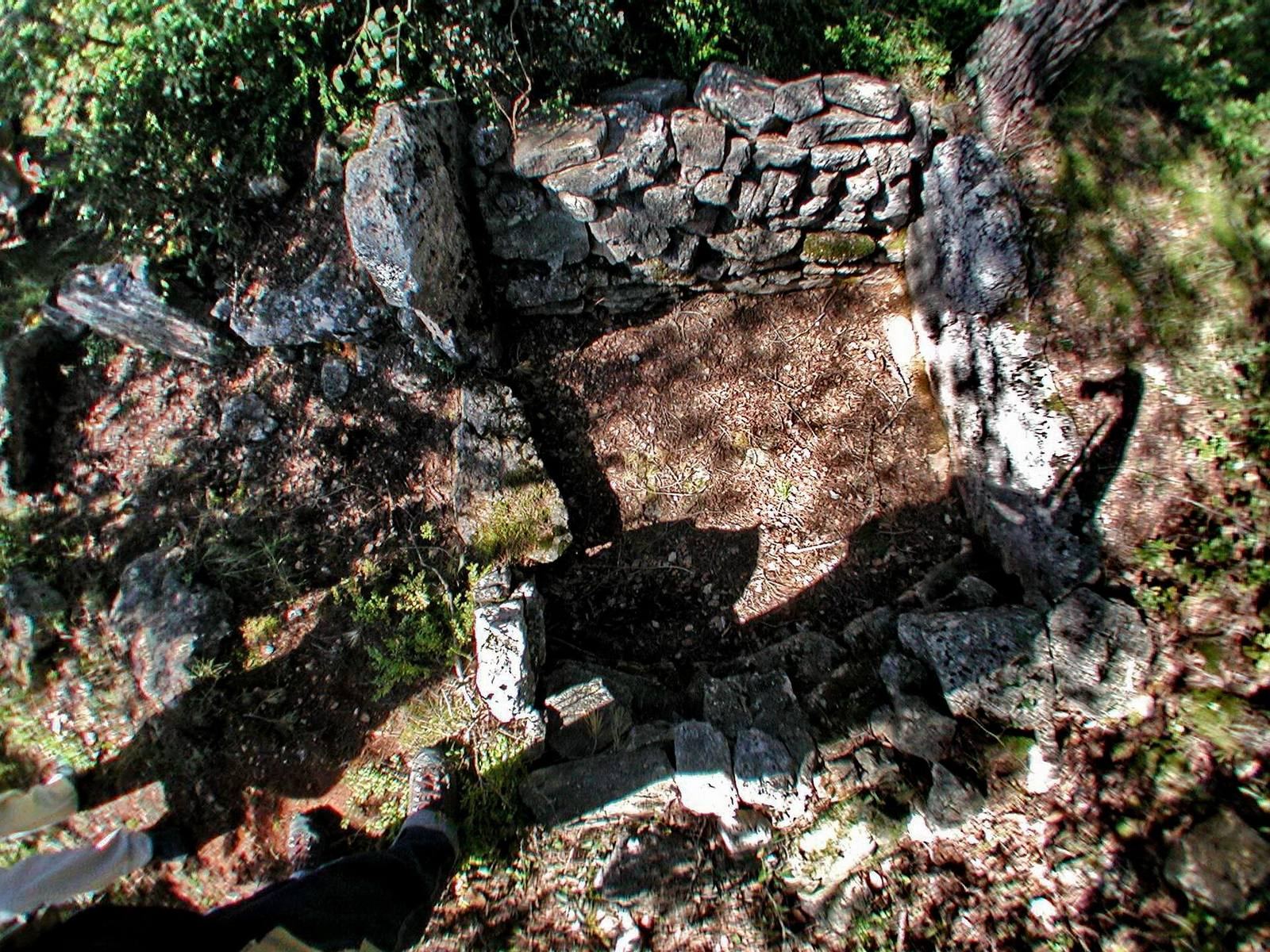
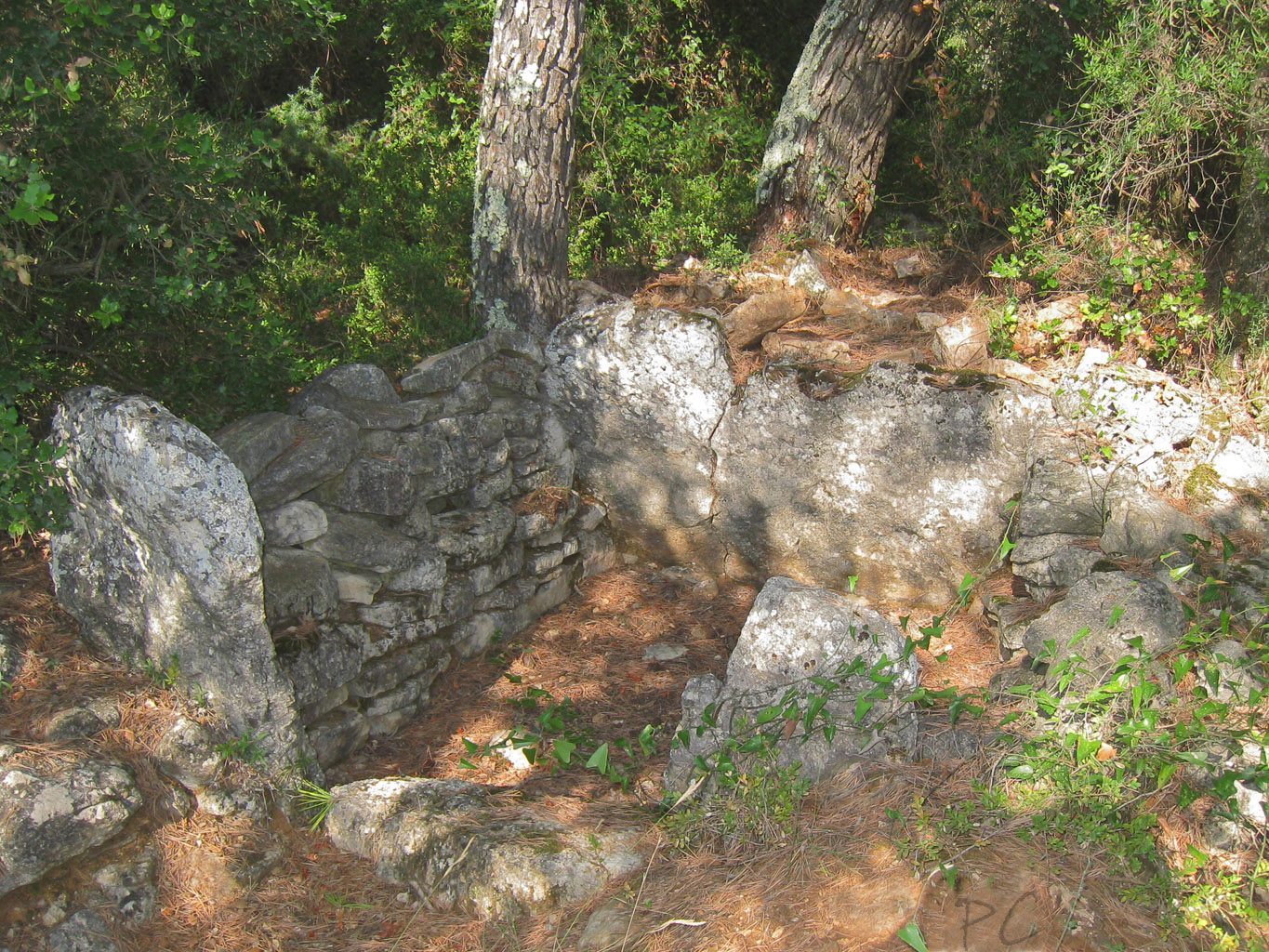
The dolmen is at 322 m above sea level. Its burial mound surrounds a central, east–west chamber with an entrance to the west. A separate arrangement of upright stones lies to the north, while the Dolmen de la Gastée and Pierre Plantée lie to the east and west respectively.
The tomb and its setting
Mound and burial chamber
The mound measures 6.20 m across, and upright slabs around its edge average 0.70 m in height, with gaps of 1–1.50 m between them. At its centre, the rectangular chamber is 1.70 m long and reaches 1.10 m in height. Low dry-stone walls, 0.40 m high, bound it on the north and south; a slab measuring 1.70 by 1.80 m closes its eastern end. Two unequal pillars frame the western entrance. The northern pillar is 1 m high and the southern one 0.65 m. A threshold stone marks the entrance, beyond which a corridor measures 1 m long and 0.80 m wide. Stone slabs carefully pave both the corridor and chamber floors.
Northern stone arrangement
About 170 m north of the dolmen, four upright stones stand in pairs, forming the upper end of a V-shaped arrangement whose southern point is the tomb. The Dolmen de la Gastée lies about 1.3 km east, and Pierre Plantée, a standing stone, about 3 km west. The three monuments are almost aligned.
Burial deposits and cremation remains
Occupation levels and grave goods
The chamber contained four occupation levels, numbered from I, the youngest, to IV, the oldest. Flat-stone pavements separate them. Together they measure 0.53–0.65 m thick, and the layers become thinner with depth. Human remains from the levels represent about 15 people of varied ages; excavators recovered approximately 400 teeth. Objects were distributed unevenly, with the oldest, lowest levels containing the richest finds. Beads include ring-shaped and barrel-shaped examples made from materials such as blue-to-green serpentine and calcite.
Child burial
A pit in the chamber’s southwest corner cut through all four levels. It held the long bones, cranial vault and teeth of a child no older than 11. The lower-limb bones lay along the south wall, while the upper-limb bones were placed against the western pillar. The pit was too small for the child’s body in a crouched position, suggesting that the body was dismembered and defleshed before burial. Above the bones were ten arrow points, a blue serpentine ring-shaped bead, a cockle-shell valve, a boar’s tusk and an awl made from hare bone. The tusk and awl may have fastened clothing.
Cremation area
The cremation area lies about 50 m east of the tomb. Its excavated cremation layer measured 15 m long, 7 m wide and 0.50 m thick. Finds included a crystal pendant, a barrel-shaped bead matching serpentine beads from the dolmen, a boar’s-tusk fragment, an arrow point, flint flakes and pottery sherds. Other finds were a twisted fragment of bronze or copper and grey pottery sherds.