Dolmen Casas de Don Pedro: A Prehistoric Burial Tomb in Spain
Site at a Glance
- Popularity
- Low
- Country
- Spain
- Primary era
- Bronze Age
- Eras represented
- Bronze Age
- Civilizations
- Unclassified
- Site type
- Burial
- Remains
- Burial Mound
On this page7 sections
History
Dolmen Casas de Don Pedro is a prehistoric stone-built tomb in Belmez, Córdoba, Spain. An earlier human occupation at the site dates to about 5000 BCE, while the dolmen itself was built around 2000 BCE. It belongs to Megalithism, the prehistoric tradition of building monuments from large stones.
Construction and burial use
The tomb was used for burials on at least two occasions. The earliest identified burial was followed by probable reuse for at least one additional person, accompanied by metal objects.
Excavation and protection
Prehistorians Beatriz Gavilán and Juan Carlos Vera discovered and excavated the monument in 1986, after part of its mound had been damaged and stones in the burial chamber displaced. Their initial work focused on the chamber and revealed the earlier occupation. A second excavation campaign in 2001 examined the passage and a 105-square-metre area around the tomb. On 12 March 1996, the site received Spain’s Property of Cultural Interest designation in the Archaeological Zone category, a protected cultural-property classification. It is also classified as Andalusian immovable heritage.
Remains
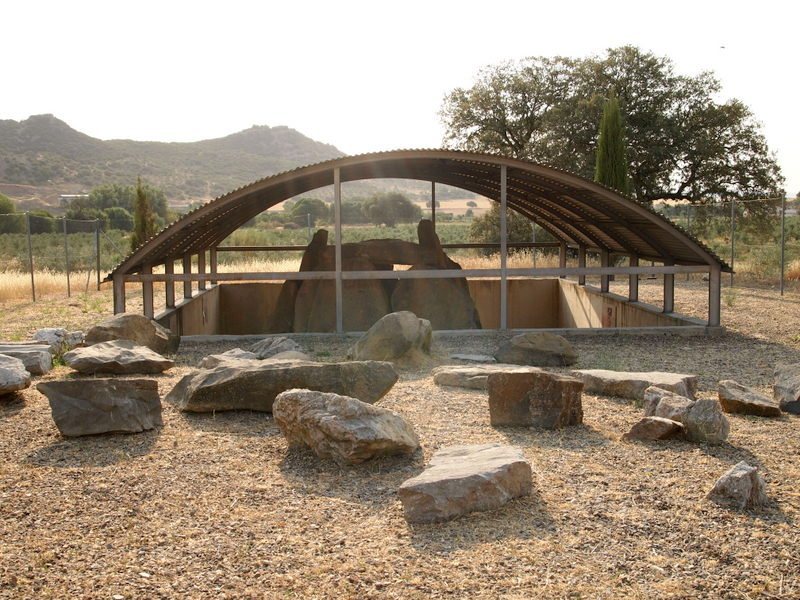
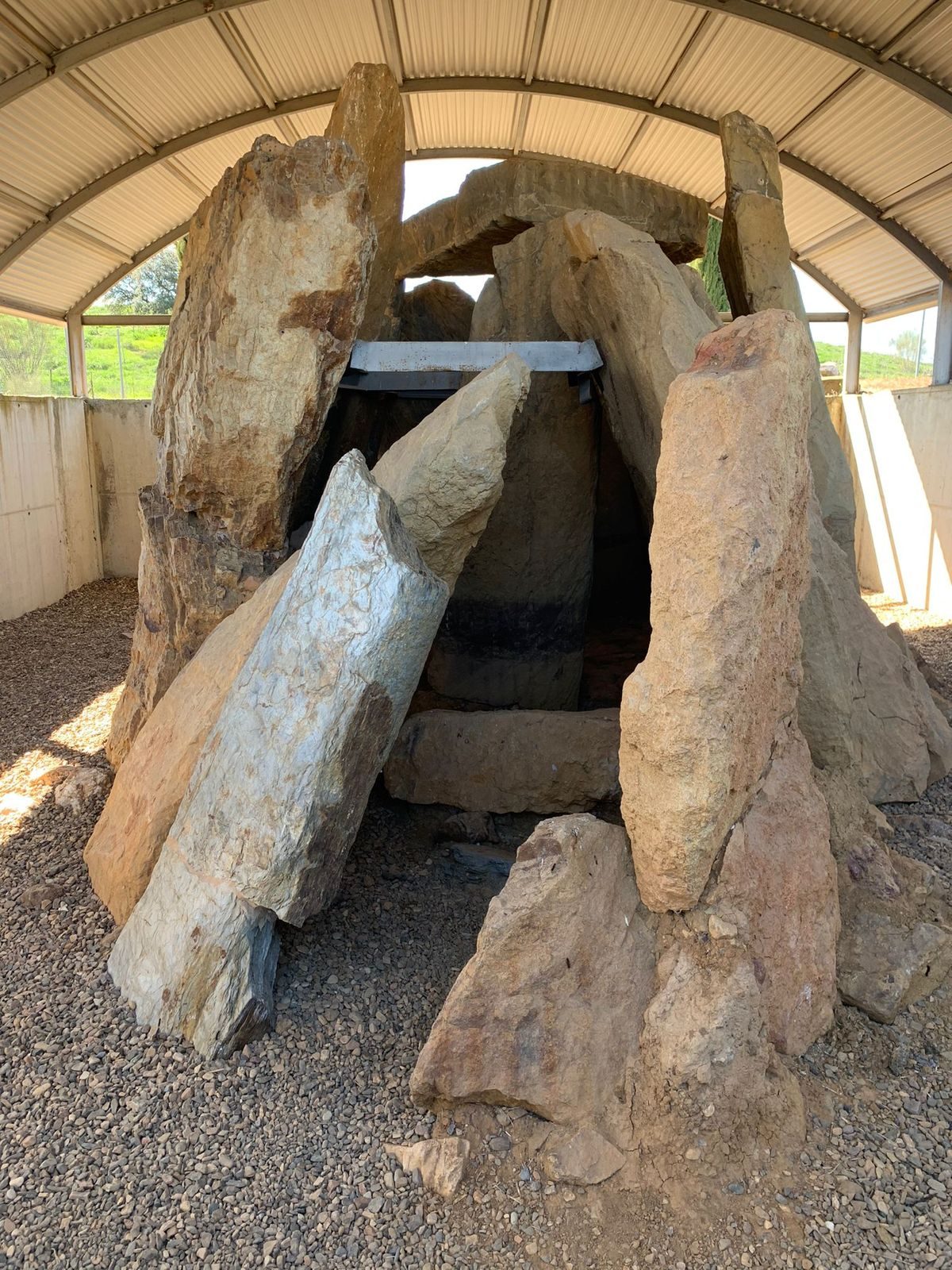
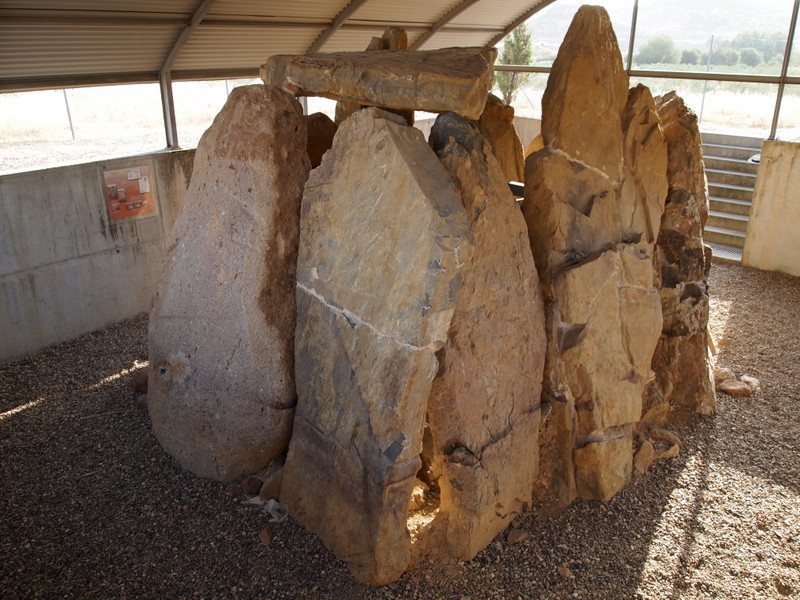
The monument comprises a burial chamber connected to a passage that faces west, within an ellipsoidal mound. Its surviving upright stone slabs are made from several types of stone found in the surrounding area.
Burial chamber and passage
The chamber is roughly trapezoidal, measuring about 2.15 metres long and up to 1.35 metres wide inside. A small, block-shaped stone on its east side may have provided an entrance from the passage. Twelve upright slabs survive, each approximately 3 metres high, 1 metre long, and 0.20 metres thick. They include limestone, sandstone, conglomerate, amphibolite, mica schist, and quartzite. About 0.75 metres from the passage’s presumed end, another slab is set like a pilaster, probably to support part of the roof’s weight. The roof was destroyed and probably consisted of two large stone slabs.
Burial mound
The mound has an ellipsoidal plan, measuring about 31 metres along its longest axis and 26.5 metres across. A ring of medium-sized river pebbles encircled it.
Burial finds
Finds from inside the monument include copper awls and arrowheads, large flint blades and flint arrowheads, stone beads, and fragments of decorated and incised pottery. These objects were associated with skeletal remains belonging to several individuals.