Denghoog: A Neolithic Passage Grave on Sylt
Site at a Glance
- Popularity
- Medium
- Country
- Germany
- Primary era
- Stone Age
- Eras represented
- Stone Age
- Civilizations
- Unclassified
- Site type
- Religious
- Remains
- Tomb
On this page8 sections
History
Denghoog is a Neolithic passage grave on the northern edge of Wenningstedt-Braderup, on the island of Sylt in Germany. Built by people of the Funnel Beaker culture, a prehistoric farming society known for its distinctive pottery, the tomb’s construction and use are dated broadly to 3200–2800 BC. The pottery’s forms and decoration point to a date around 3200–3000 BC. In a regional chronology, Denghoog belongs to stages Ib–V of the Middle Neolithic. Its deposits indicate use over generations and have been interpreted as evidence of organized ancestor worship.
Neolithic use and interpretation
Archaeologist Maria Wunderlich identified four phases of activity. Around 3200–3100 BC, the tomb received an initial burial accompanied by offerings, and small offering pits were made near the passage. During approximately 3100–3000 BC, the largest share of burials probably took place. Pottery and amber beads were deposited, and vessels were broken outside the tomb. Use of the exterior intensified around 3000–2950 BC, when at least six pottery deposits were placed outside and two inside. In the final phase, around 2950–2800 BC, burials probably continued in the chamber, while the pits had been filled and deposits ceased in the entrance area.
Deposits outside the tomb continued for roughly ten generations. At least 86 vessels were placed outside and another 23 inside. Their distribution has been interpreted as suggesting an average of about one burial per decade and a form of institutionalized ancestor worship. Denghoog may have served a family or clan across several generations, although the layers of objects do not establish a secure sequence for individual deposits.
The name is traditionally interpreted as meaning ‘Thing hill.’ A Thing was an assembly that could also have judicial functions, but the proposed connection does not establish that court proceedings took place at the tomb. Another interpretation derives the name from a word meaning ‘meadow.’
Archaeological investigation
Geologist Ferdinand Wibel opened the mound for archaeological research on 17–19 September 1868 and found the burial chamber undisturbed. The Sölring Foriining, a North Frisian cultural association, bought the property in 1928. In 1960, archaeologist Ernst Sprockhoff measured the tomb and listed it as number 4 in his atlas of German megalithic tombs. Denghoog also gave its name to the Denghoog Stage, an older term for a subdivision of the Neolithic used in Germany.
A collapsed part of the passage had impaired ventilation, leading to a new excavation from 5 May to 25 June 1982. Archaeologists Joachim Reichstein and Hans-Jörg Repkewitz concentrated on the passage and the ground in front of it, surveyed the surroundings, and prepared a contour map and scaled plans. Maria Wunderlich reassessed the excavation and its finds in 2013 as part of a master’s thesis published in 2014.
Remains
Physical layout and finds
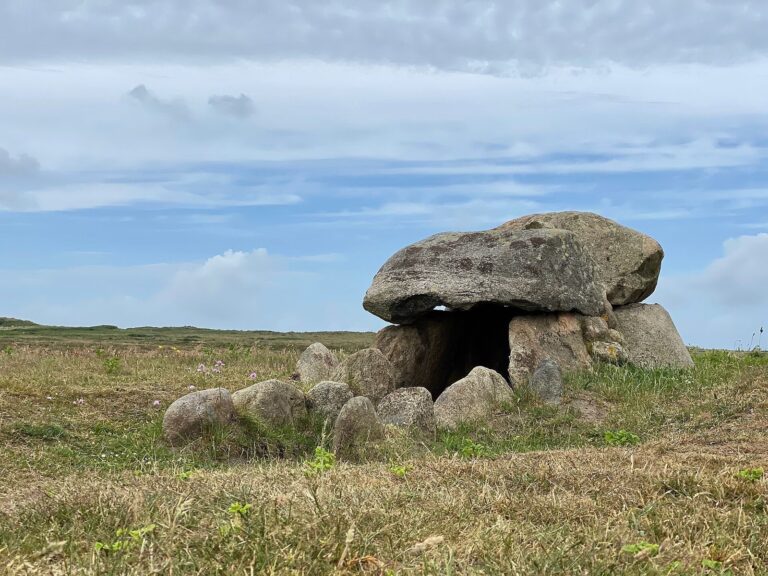
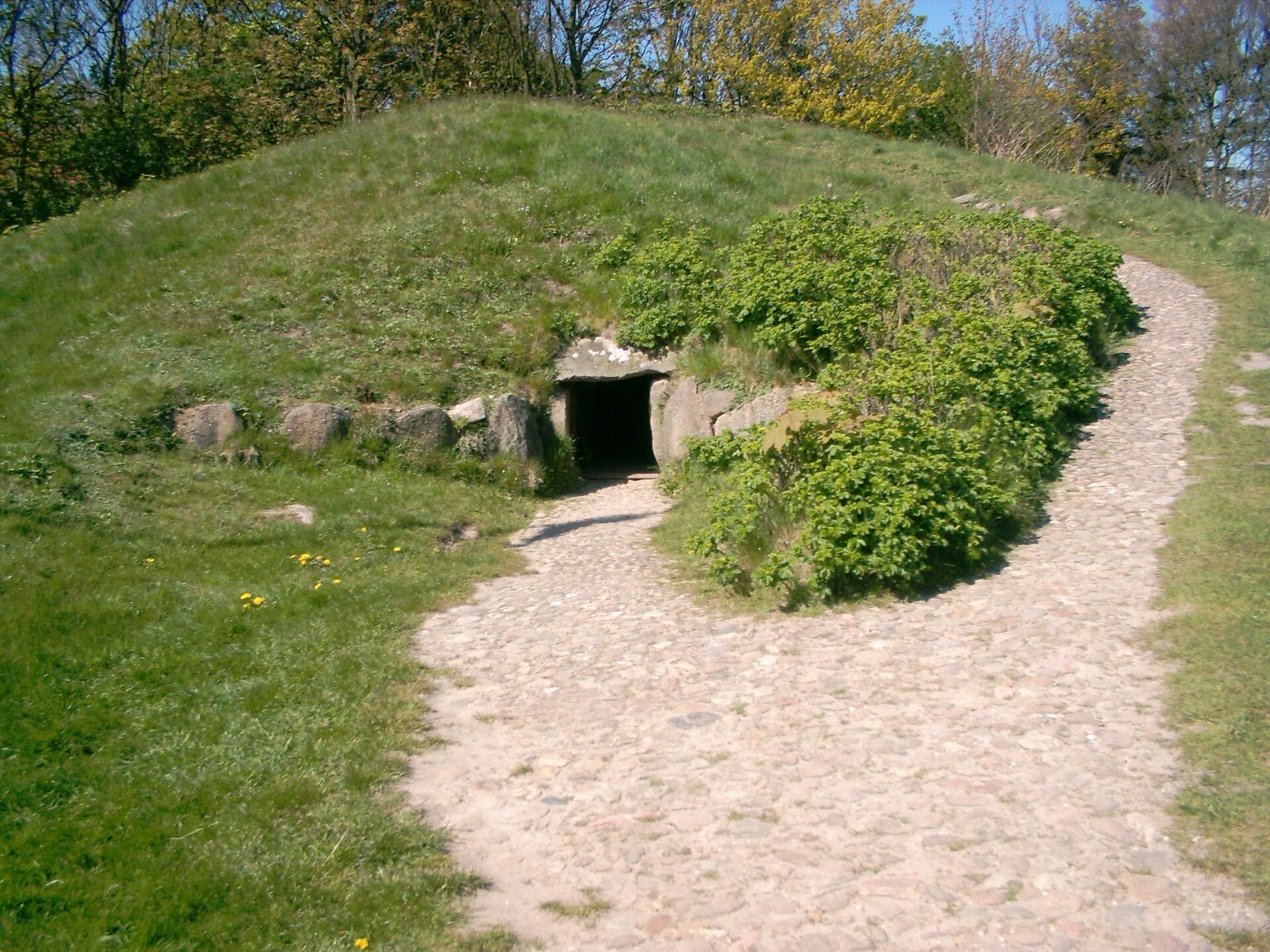
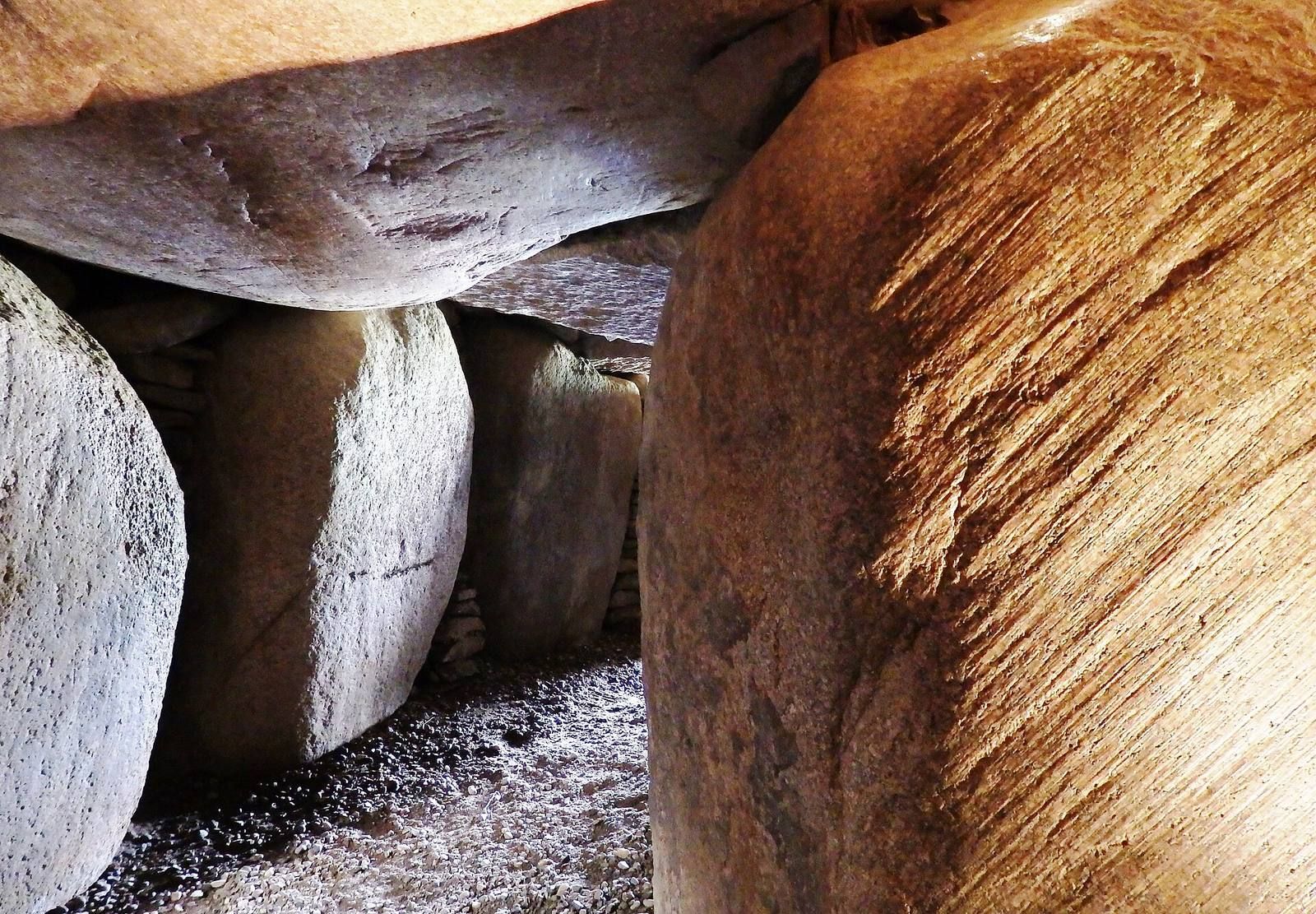
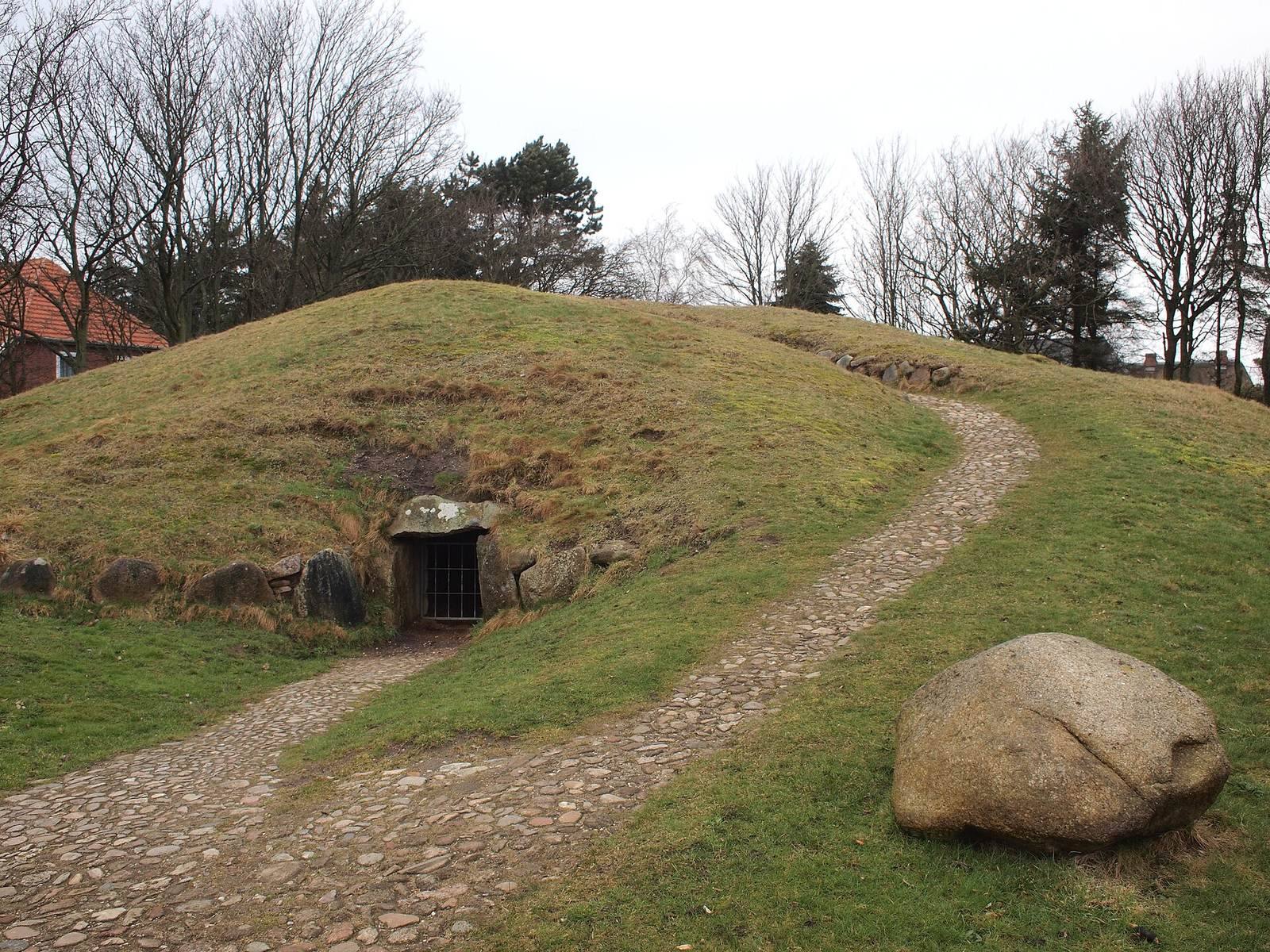
The tomb lies beneath an artificial mound and consists of an oval stone chamber reached originally through a passage from the south. Large glacial erratics, rocks transported from their original locations by glaciers, form the main structure. The mound and the exterior stone arrangements surround this central burial complex.
Mound and exterior arrangements
The mound is about 3.2 m high and approximately 32 m across at its base. In 1868 it was described as a truncated cone about 4.5 m high and as having once been taller. Several blocks scattered around its base have been interpreted as possible remains of a stone circle that may have stood on top of the mound.
Excavation in 1982 identified stones arranged in a funnel shape leading toward the passage entrance. Nearby, shallow pottery deposits were covered with boulders ranging from fist-sized to head-sized; the pottery was richly ornamented. After the excavation, some stones in the funnel arrangement were put back in position.
Burial chamber
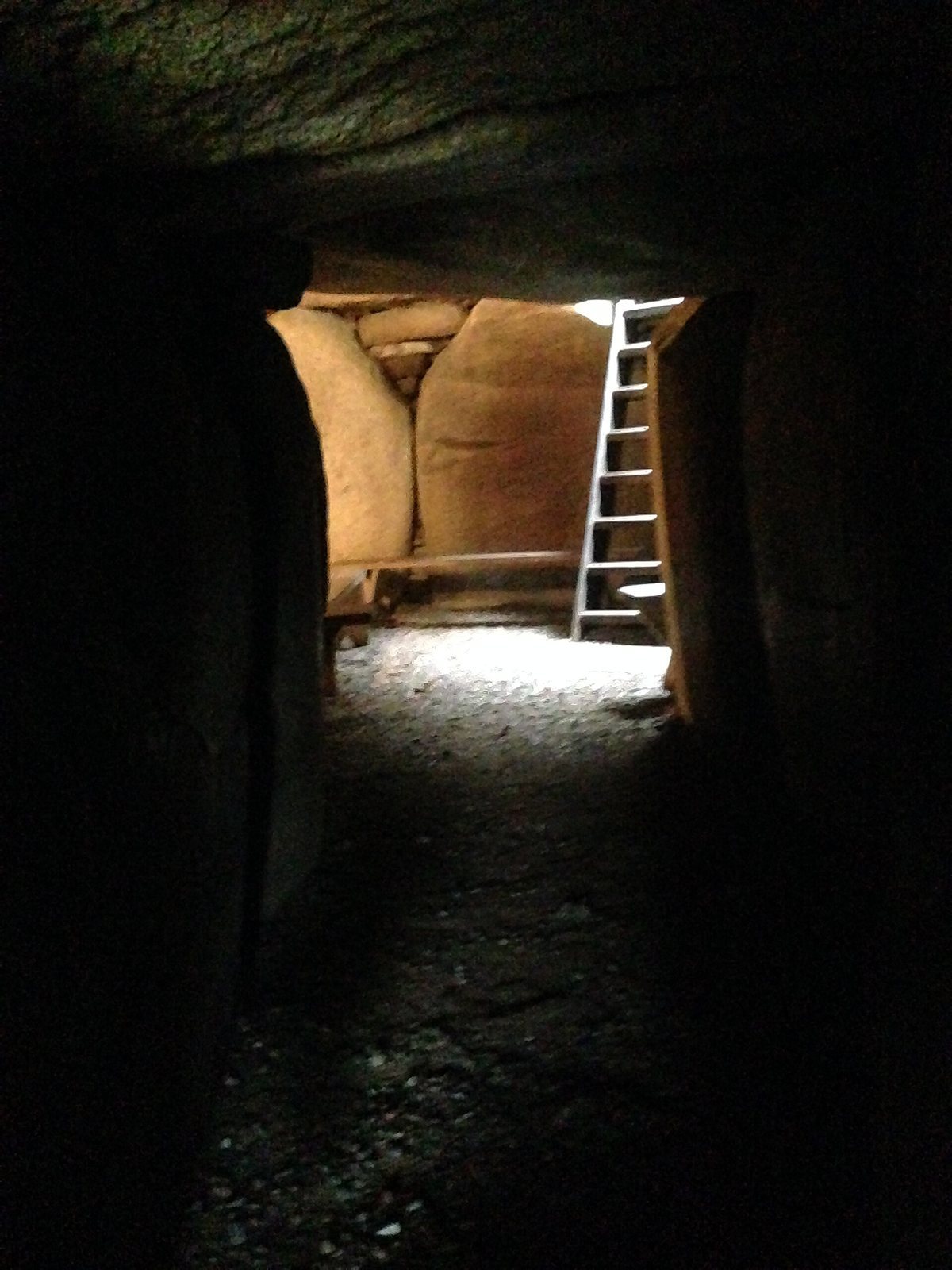
The oval chamber measures about 5 m from east to west and 3 m from north to south. It is approximately 1.9 m high on the west side and 1.5 m on the east. Twelve supporting stones, three perimeter stones, and three large roof slabs form its stone structure; the tomb also has 12 perimeter stones and two door stones associated with the passage. The largest stones weigh roughly 18–20 metric tons. Each roof slab is about 75 cm thick and weighs around 20 metric tons.
Wedge stones and stonework fitted without mortar fill the gaps, including red-sandstone slabs. Around the chamber, gneiss or quartz slabs were arranged like shingles. A firm layer of blue clay mixed with stone fragments, brought from Sylt’s eastern side, made the roof nearly waterproof. Yellow sand and humus lay above it.
Two rows of upright slabs divided off the eastern part of the chamber. That area had a carefully laid stone floor covered with small stone fragments, as well as a hearth. The western and northwestern areas contained numerous slab-like stones, some placed in a semicircle.
Passage and burial evidence
The original passage approached the chamber from the south and was about 6 m long, 1 m high, and 1 m wide. Upright granite and gneiss blocks lined it, while flagstones formed its floor and roof. A door-frame structure stood near its middle, and two worked stones served as door leaves, an unusual arrangement for this kind of tomb. The low outer opening, described in 1868 as about 1 m high and 1⅓ m wide, was closed with earth. The entrance is now approached from above, from the north.
Wibel’s excavation found about 20 cm of sand on the chamber floor, gray above and yellow beneath. It contained remains of an unburned human body and a cow’s tooth, while remains from other burials were scattered through the chamber. Wibel also recovered one complete pottery vessel and sherds from 24 others; 11 vessels could be reassembled or completed. The largest, a shouldered vessel with a distinct change between body and neck, is 38 cm high and 31 cm across.
Other finds included stone axes, flat and hollow chisels, 20 flint blades, a pyrite lump used for making fire, two perforated disc-shaped mace heads measuring 10–12 cm across, and six amber beads, one shaped like a double axe, together with fragments of a seventh. The original finds are held at the Archaeological State Museum at Gottorf Castle in Schleswig; copies of major pieces are at the Sylter Heimatmuseum in Keitum.