Danilov Monastery: A Russian Orthodox Monastery in Moscow
Site at a Glance
- Popularity
- Very High
- Country
- Russia
- Primary era
- Early Modern
- Eras represented
- Medieval, Early Modern, Modern
- Civilizations
- Golden Horde, Russian
- Site type
- Religious
- Remains
- Fortified Monastery
On this page26 sections
History
Danilov Monastery is a Russian Orthodox men’s monastery on the right bank of the Moskva River in Moscow, Russia. Tradition dates its foundation to the late thirteenth century, when Prince Daniil Alexandrovich of Moscow, the youngest son of Alexander Nevsky, established the community. Since its revival in 1983, the monastery has been stauropegial, meaning directly subordinate to the patriarch rather than governed through the regular diocesan structure. It now serves as a spiritual and administrative center of the Russian Orthodox Church, including as the location of the Department for External Church Relations, the Patriarchal residence, and meetings of the Holy Synod, the Church’s senior governing body.
Foundation and relocation
Tradition connects the monastery’s founding with Daniil, whom the Russian Orthodox Church venerates as a saint. Historian Alexander Voronov dates the foundation to 1282 and associates it with Daniil’s peaceful settlement of a dispute between his brothers over the Vladimir grand principality and the right to rule in Novgorod. Daniil was buried in the monastery cemetery. In 1293, a Golden Horde campaign into northeastern Rus brought plunder to the monastery.
In 1330, Moscow ruler Ivan Kalita ordered the monastic community transferred to the Church of the Savior on the Bor. The community moved again to Krutitsy Hill in the late fifteenth century, during the rule of Ivan III. Its cemetery and villages came under the management of the Kremlin’s Spaso-Preobrazhensky Monastery, and Danilov declined. Voronov has suggested the later move was intended to create a religious center near the prince’s palace and a burial place for the ruling family. By the fifteenth century, the wooden Church of Daniel the Stylite was the sole church remaining at the original site.
A revival began under Ivan IV, also known as Ivan the Terrible, around 1560. A church dedicated to the Holy Fathers of the First Seven Ecumenical Councils, major church-wide meetings that established central Christian doctrines, was completed in 1561 and consecrated by Metropolitan Macarius of Moscow.
Fortified monastery and seventeenth-century conflicts
Danilov formed part of the defensive line of monasteries protecting Moscow from the south during the sixteenth and seventeenth centuries. In 1591, as the forces of Crimean Khan Kazy-Girey advanced toward the city, Russian forces set up a fortified mobile camp near the monastery. Troops led by commander Mikhail Skopin-Shuisky were stationed there in 1606 to fight the forces of Ivan Bolotnikov. The following year, Ileyka Muromets, an impostor who claimed to be Tsarevich Peter, a son of a Russian tsar, was executed nearby.
In September 1610, forces loyal to False Dmitry II shelled the monastery, damaging its walls and towers. The attack took place during the Time of Troubles, a period of political crisis and warfare in Russia in the late sixteenth and early seventeenth centuries. In 1652, Patriarch Nikon and other clergy opened Daniil’s grave and placed his relics in a wooden shrine near the right choir of the church dedicated to the First Seven Ecumenical Councils. In 1930, the relics were moved to the Church of the Resurrection of the Word, where services continued until 1932. In 1986, Metropolitan Feodosy of the Orthodox Church in America presented the monastery with particles of Daniil’s relics that had been in America since 1932.
Monastic life and work in the eighteenth and nineteenth centuries
After the secularization of monastery lands in 1764, Danilov became a third-class monastery, a lower rank in the historical Russian monastic system. The community numbered 30 monks in 1710 and 12 in 1764; it had 17 monks in 1900 and, in 1917, 19 monks and four novices. The earliest listed landholding, in 1785, comprised 18 desyatinas, a traditional Russian measure of land. Holdings reached 178 desyatinas by the end of the nineteenth century and totaled 164 in 1917.
A cemetery for plague victims was established at the monastery in 1771 and later covered over. A larger cemetery developed after burials within cities were prohibited. In 1805, the monastery opened an almshouse for elderly women, later repurposed for elderly clergy and their widows. Before French troops occupied Moscow in 1812, the monastery’s treasury was moved to the Trinity-Sergius Lavra and its sacristy to Vologda. French forces ransacked the monastery and stole the metal covering from Daniil’s tomb; a new silver-gilt reliquary, a container for sacred relics, was made in 1817.
The cemetery’s expansion led to an extension of the monastery’s western boundary in the mid-nineteenth century. A free parish school opened in 1892 under the supervision of the Moscow Cyril and Methodius Brotherhood. By 1903, it had 52 pupils and taught religious instruction, church singing, Church Slavonic and Russian literacy, arithmetic, history, geography, and handwriting. A shelter for monks established in the late nineteenth century became a hospital in 1902 for personnel of the Moscow diocese. Its wards were connected to the Gate Church of Simeon the Stylite, which was renovated with funds from V. S. Lyamina, the widow of a state councillor.
Revolution, closure, and Soviet use
In 1917, Bishop Theodore (Pozdeevsky) became the monastery’s superior. The authorities nationalized its property and formally closed the monastery in 1919, but the community continued as the clergy of the Danilov parish community. A higher theological school opened there in 1918, with Theodore among its teachers. It closed in 1920 after his arrest on charges of anti-Soviet agitation.
In the early 1920s, bishops appointed by Patriarch Tikhon but prevented by the authorities from taking up their diocesan posts stayed at Danilov. They included Seraphim (Chichagov), Hilarion (Troitsky), and Tryphon (Turkestanov). The group, led by Theodore and opposed to Renovationism, a reform movement within the Russian Orthodox Church that arose after the 1917 Revolution, and to Soviet rule, became informally known as the Danilovtsy. Many later clergy associated with the group were non-commemorators, who refused to recognize church authorities they considered illegitimate.
A closure decree was issued in 1929. That October, the Trinity Cathedral was assigned to the Soyuzkhleb organization for use as a flour warehouse. On 6 October 1930, the Danilov community lost the keys to the monastery buildings; Daniil’s relics were moved the next day, and monastic activity ended. From 1931, the buildings housed an NKVD reception and distribution center for homeless children and juvenile offenders, including children whose parents had been arrested. Initially designed for 1,000 children, the center was expanded in the mid-1930s to accommodate another 1,000, with 100 places for girls. Authorities required siblings and even acquaintances to be separated during placements. Children became ill and died at the center, and some were buried within the grounds. A monument to Vladimir Lenin was installed in the courtyard in 1931.
Return and revival
By the turn of the 1970s and 1980s, the monastery buildings had deteriorated. In autumn 1982, Patriarch Pimen and the Holy Synod asked Soviet leaders to return a former Moscow monastery for religious and administrative use ahead of the 1988 millennium commemorations of the Christianization of Rus. On 18 May 1983, the Soviet government transferred the Danilov buildings to the Russian Orthodox Church without charge. They had been occupied by several organizations, including a juvenile detention center, a restoration workshop, and a factory branch.
Archimandrite Evlogy (Smirnov) became the superior of the revived monastery. A church commission oversaw restoration and construction, and specialist workshops carried out the work, with icon painters Zinon and Sergey Fedorov among those involved. The project returned the complex to use as a spiritual and administrative center of the Russian Orthodox Church. Restoration of the Church of the Holy Fathers’ icons and icon screen was completed in 1988, when the church was reconsecrated. Danilov is designated a cultural heritage site of federal significance in Russia.
Remains
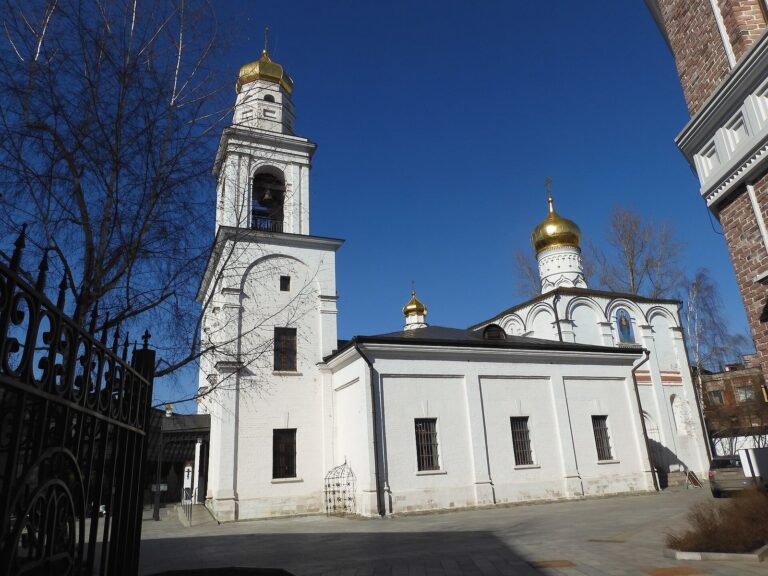
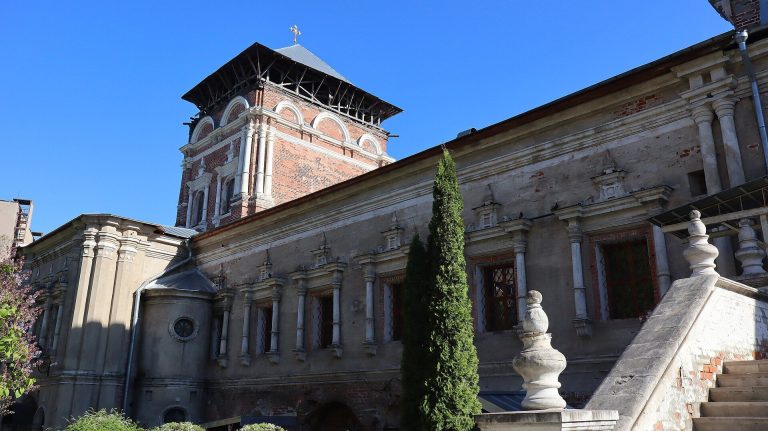
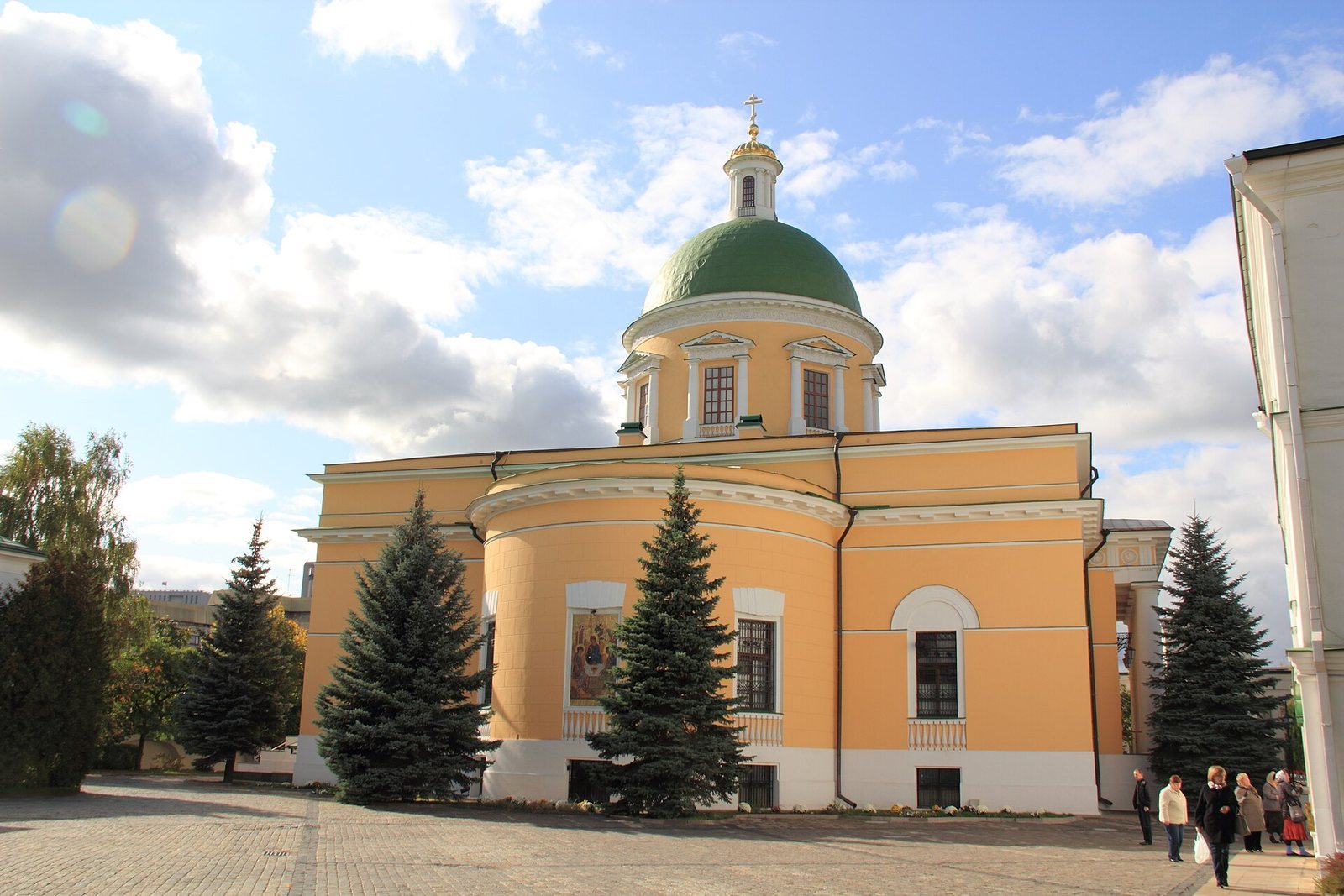
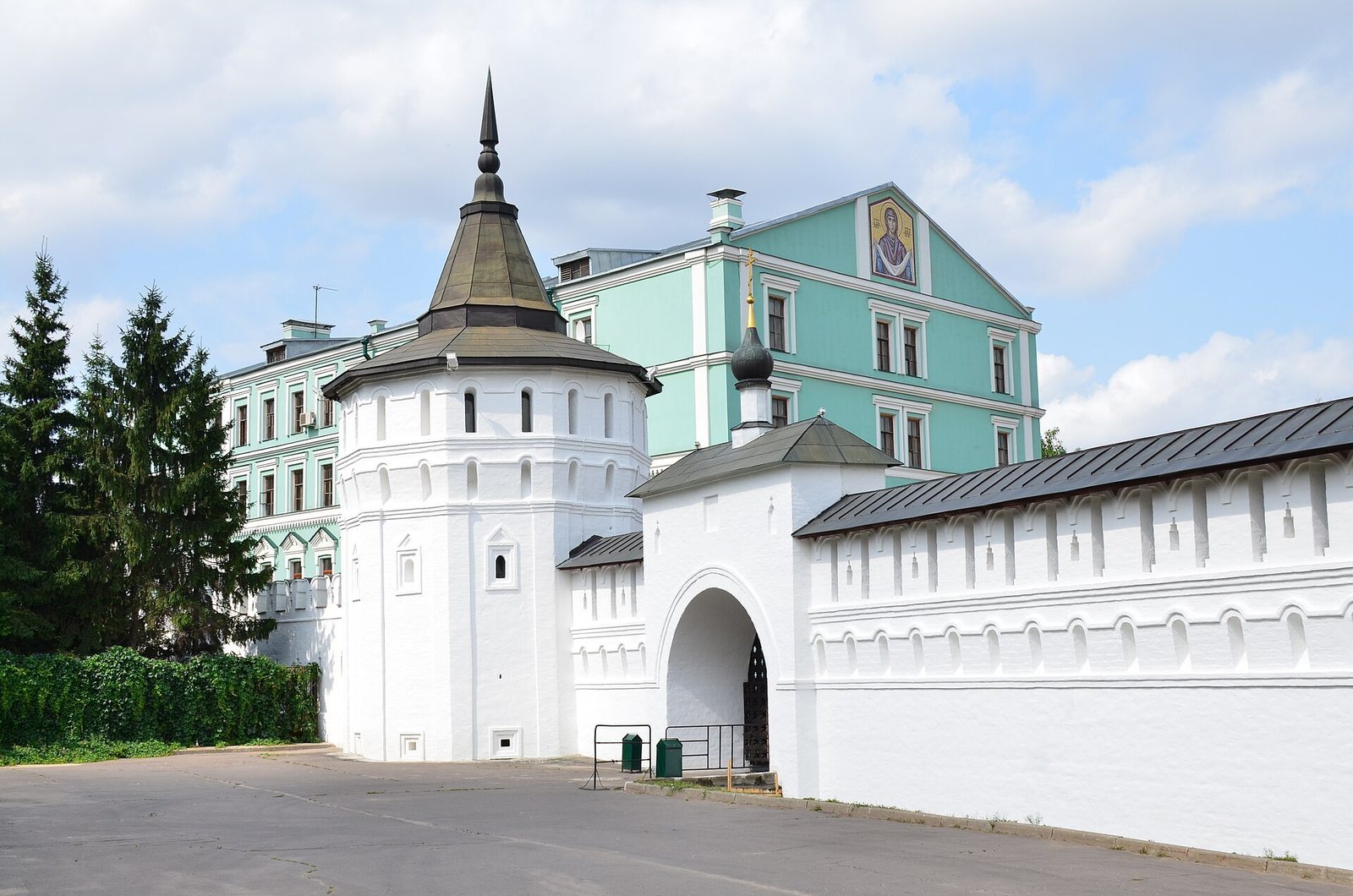
The monastery occupies an enclosed site on the right bank of the Moskva River. Brick defensive walls and towers surround a complex of churches from different periods, including a central group arranged as two upper churches above one lower church. The buildings combine older Russian church forms with Baroque and neoclassical designs, alongside later residential, administrative, and memorial structures.
Enclosure and early precinct
Early monastic precinct
The earliest precinct centered on a wooden church dedicated to Daniel the Stylite, an early Christian ascetic associated with living atop a pillar. Monks’ cells and service buildings stood around it, and a palisade of large logs set into an earth rampart enclosed the grounds. Stables and peasant yards were nearby. An old-book library was later transferred to the sacristy of the Kremlin’s Spassky Monastery.
Walls and towers
A brick defensive wall with seven towers was built in the early seventeenth century. In the mid-nineteenth century, its western section was dismantled and replaced by a new wall with two corner towers. Eight restored towers now bear the names New Danilov, Blacksmith’s, St Alexius’s, Abbot’s, St George’s, Hill, Patriarchal, and Synodal.
Central church complex
Church of the Intercession and Church of the Holy Fathers
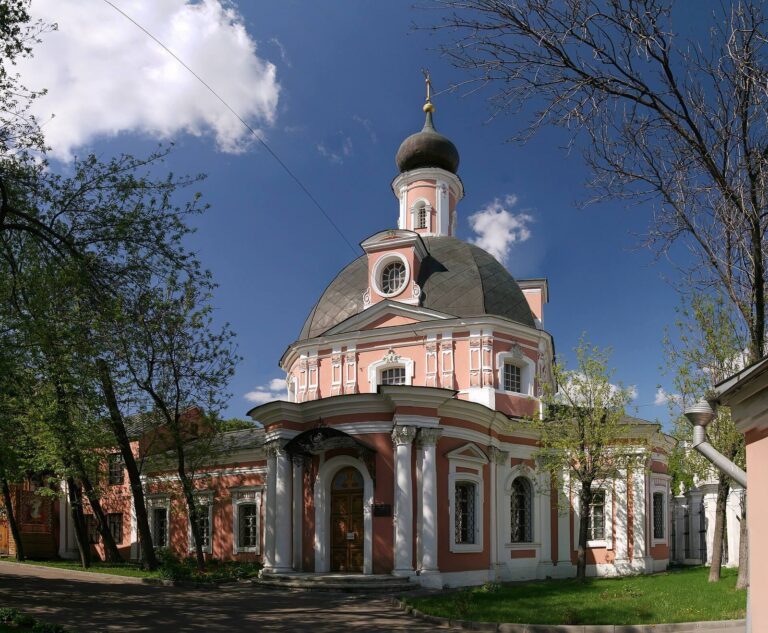
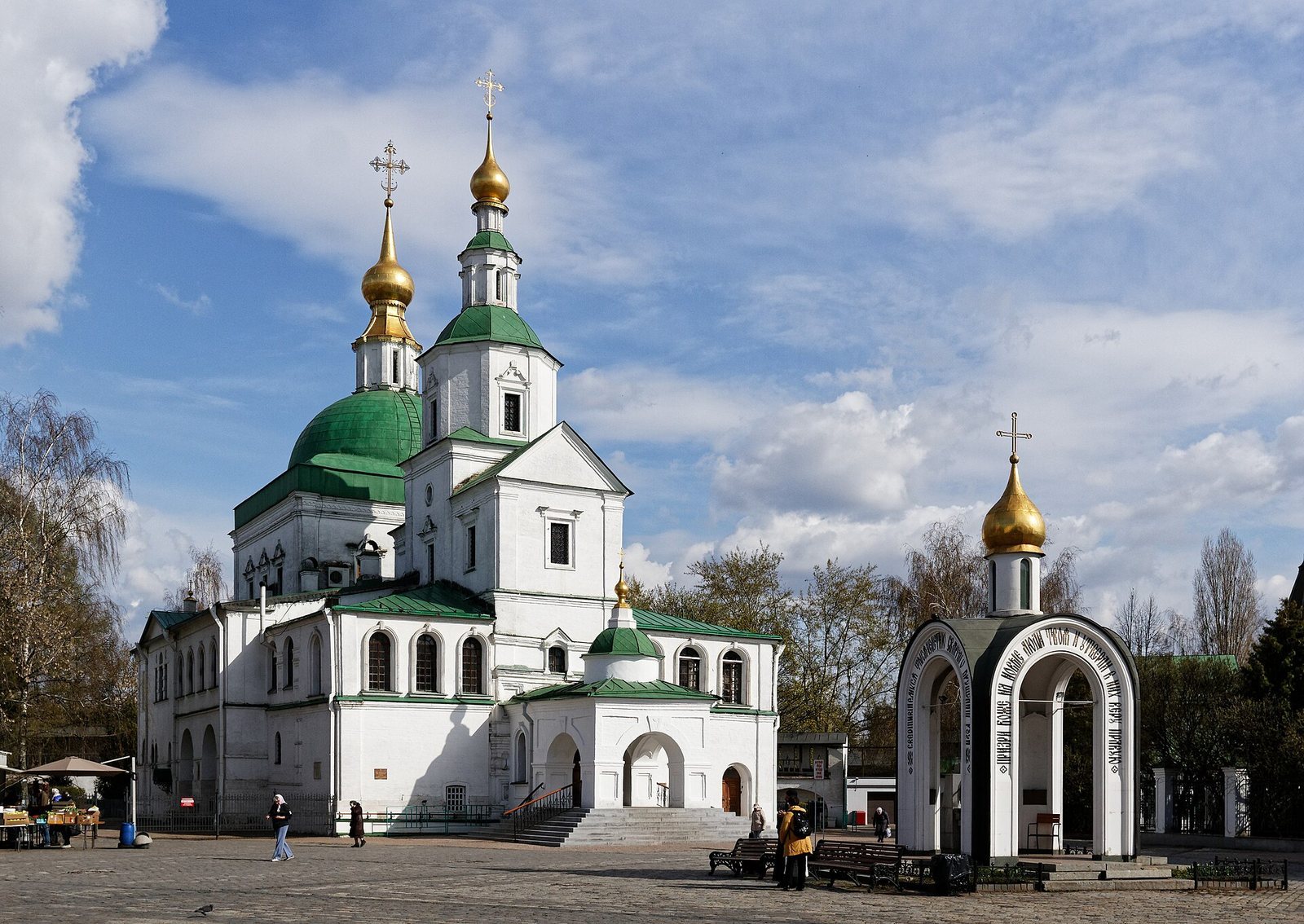
The lower church in the central group is dedicated to the Intercession and has a northern chapel for the Prophet Daniel. Above it stands the summer Church of the Holy Fathers of the First Seven Ecumenical Councils, built in 1729 in Moscow Baroque forms. The central church was rebuilt that year as a two-storey structure with an open gallery along three sides and two porches. A drum, the structure supporting a dome, carried an onion-shaped dome and cross. Grigory Yakovlev painted its interior in 1736.
The Church of the Holy Fathers contains the monastery’s largest and oldest iconostasis, an icon screen separating the sanctuary from the main body of an Orthodox church. Its local tier includes a Vladimir Mother of God image with an akathist, a devotional hymn, in the margins, and a Kazan Mother of God icon surrounded by narrative scenes. Above these is an ensemble of 67 icons in the Kostroma style, a regional Russian icon-painting tradition of the late seventeenth century. The icons were transferred from the Trinity-Sergius Lavra and the Moscow Theological Academy. The Prophet Daniel chapel has icons of the Image Not Made by Hands and the Mother of God known as the Mountain Not Cut by Hands.
Church of Daniel the Stylite
A tiered church dedicated to Daniel the Stylite was added above the lower church’s western vestibule and porch in 1752. Reconstruction of the associated tent-roofed bell tower had begun in 1746; its upper tier was removed and a church formed above the two lower tiers, with an octagonal drum and dome. The Daniel chapel’s four-tier iconostasis includes seventeenth-century Royal Doors, the central doors leading into the altar sanctuary, transferred from the Moscow Kremlin museums. Its festal tier contains eighteenth- and nineteenth-century icons; the Deesis tier, a row showing Christ with interceding figures, includes five early seventeenth-century icons in a northern Russian style.
Refectory and adjoining structures
A refectory, or monastic dining hall, was built near the main church in the 1670s, extending from east to west. It contained chapels dedicated to the Intercession of the Virgin and the Prophet Daniel, a tent-roofed bell tower, three stone chambers, and two adjoining treasury chambers. The chapels had curved altar ends, onion domes, and decorative window surrounds and cornices. Tiled images of the four Evangelists by Stepan Ivanov, known as Polubes, adorned the building. In 1736, the refectory vaults and the chapels’ domes, supporting structures, and roofs were rebuilt or renewed.
Lyapin family tomb
In the early twentieth century, architect Fyodor Schechtel designed a two-level tomb for the merchant Lyapin brothers within the Church of the Holy Fathers. The lower level was a crypt in the basement; above it, a chapel on the first floor had stained-glass windows.
Other churches and chapels
Gate Church of Simeon the Stylite
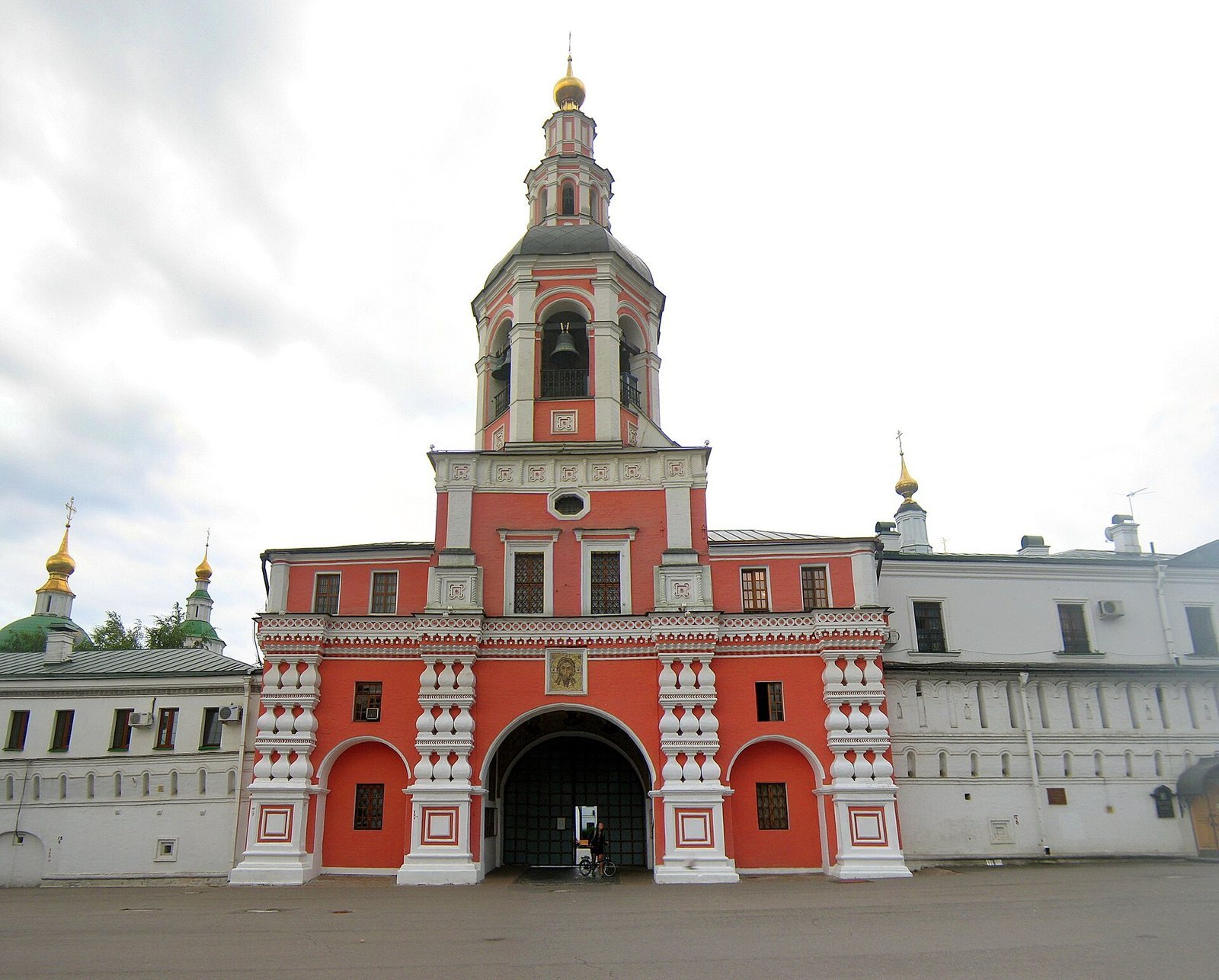
Built above the Holy Gates in 1732 under architect Ivan Michurin, the Gate Church of Simeon the Stylite is Baroque in style, with balusters, short decorative posts, and recessed-panel ornament. A bell tower was installed there in 1736. After the monastery’s closure, the gate served as a checkpoint for the children’s institution. By 1982, the church’s top three tiers and dome had been removed; they were restored in their earlier forms in 1984. Its interior has a three-tier iconostasis designed by Sergey Dobrynin in 1986 and assembled from seventeenth- to twentieth-century icons brought from the Pskov-Caves Monastery.
Trinity Cathedral
Osip Bove designed the neoclassical Trinity Cathedral, built in 1833–38 with funds from the Kumanin and Shustov merchant families. Its central altar is flanked by chapels dedicated to Saint Alexius and the Conception of Righteous Anna. Metropolitan Filaret of Moscow consecrated the central altar. In the 1930s, the children’s institution adapted the cathedral for its use. Following restoration, the central altar was consecrated in 1986 and the chapel of the Nativity of John the Baptist in 1988.
Church of the Resurrection of the Word
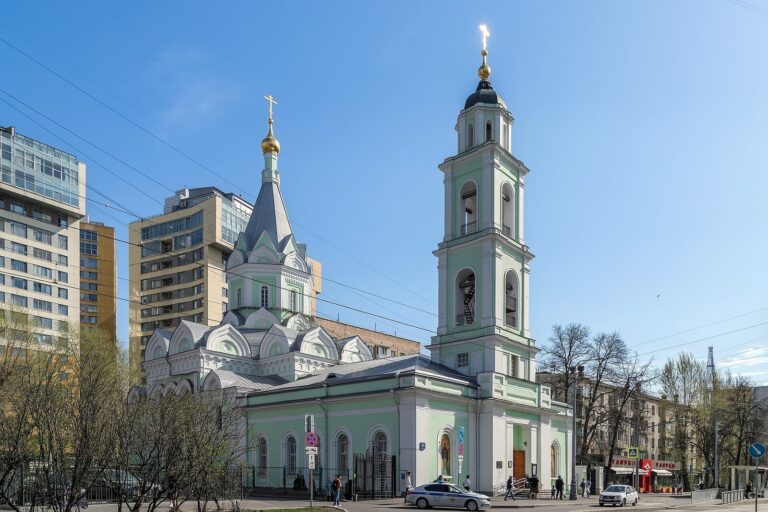
Built in the 1830s by Fyodor Shestakov, this late-classical church stands on the site of an earlier stone church of the same dedication, built around the turn of the seventeenth and eighteenth centuries. It stood near the monastery’s southern wall and served as a parish church after the monastery closed. Its five altars were dedicated to the commemoration of the Church of the Resurrection in Jerusalem, Saints Peter and Paul, the Prophet Elijah, Saint Nicholas, and Saint John Chrysostom.
Church of Saint Seraphim of Sarov
The Church of Saint Seraphim of Sarov dates from 1984. It closed for rebuilding in 1986–87 and was consecrated in 1988. Its contents include prayer beads and a fragment of Seraphim’s mantle.
Churches in the western section and Patriarchal residence
A two-storey building in the monastery’s western section was constructed by a group of architects led by Yuri Rabaev. A house church dedicated to All Saints Who Shone Forth in the Russian Land was installed on its second floor and consecrated in 1988. Also built under Rabaev’s direction that year was the Church of All Saints in the Patriarchal residence.
Memorial and Over-the-Well chapels
Yuri Alonov designed the Memorial Chapel, built in 1988 to commemorate people buried at the monastery. A separate ossuary chapel holds human remains discovered during restoration. Alonov also designed the Over-the-Well Chapel, built in the center of the monastery square in 1988 for commemorative use.
Service buildings, burial ground, and bells
Residential and administrative buildings
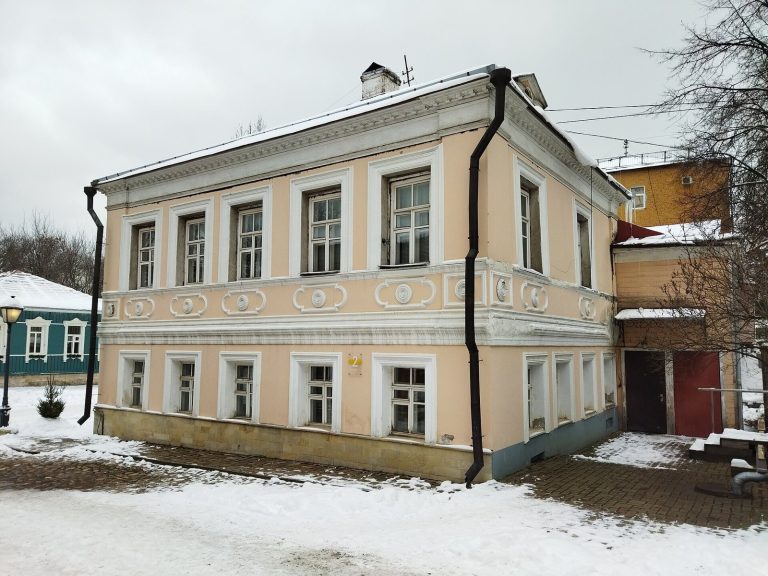
Other structures include the abbot’s residence, dated 1828; a monks’ building from 1869; the former Moscow diocese hospital building, dated 1890; and a building for the Department for External Church Relations.
Cemetery and burials
The cemetery included graves of the Babkin, Zakharov, Kumanin, Ovchinnikov, and Khlebnikov merchant families, as well as an area associated with Slavophiles, nineteenth-century thinkers who emphasized Russian cultural distinctiveness and Orthodox tradition. Those buried there included Slavophiles Alexei Khomyakov, Yuri Samarin, Dmitry Valuev, Alexander Koshelev, Yuri Venelin, and Vladimir Cherkassky, along with writer Nikolai Gogol, poet Nikolai Yazykov, painter Vasily Perov, and musician Nikolai Rubinstein. The cemetery was destroyed after the monastery’s closure in 1929, and some burials were transferred to Novodevichy Cemetery. In April 2007, Archbishop Nicephorus Theotokis’s grave was found beneath the southern gallery of the Church of the Holy Fathers; a white-marble memorial cross was erected nearby.
Bell collection
The collection comprises 18 bells. The largest, called Bolshoi, weighs 13 tonnes and has a 320-kilogram clapper; the smallest weighs 10 kilograms. Tsar Feodor Alexeyevich donated two bells for the new bell tower in 1682, cast by Fyodor Motorin, chief foundryman at Moscow’s Cannon Yard. After Russia’s defeat at Narva, Peter I ordered bells removed from belfries for cannon casting, and a quarter of the Danilov bells’ weight was taken. In 1930, American benefactor Charles Richard Crane acquired the monastery’s bells, preventing their melting, and they were installed at Harvard University. The 2.2-tonne Everyday Bell returned in 2007, and the other 17 bells followed in 2008; exact replicas were cast for Harvard.
An earlier bell made in 1890 weighed 722 poods, a traditional Russian unit of weight, and stood in a wooden belfry on a platform outside the enclosure. A 365-pood bell was made in 1904. It had tiers of vaulted ornamental arches with plant designs, beaded molding, and a Russian-Byzantine frieze. The Gate Church’s bell tower was strengthened in 1906 to carry it.