Cursus Barrows: A Neolithic and Bronze Age Burial-Mound Cemetery
Site at a Glance
- Popularity
- Medium
- Country
- United Kingdom
- Primary era
- Bronze Age
- Eras represented
- Stone Age, Bronze Age
- Civilizations
- Unclassified
- Site type
- Burial
- Remains
- Necropolis
On this page23 sections
History
The Cursus Barrows are a cemetery of Neolithic and Bronze Age burial mounds in the United Kingdom. These are prehistoric periods, and a barrow is a burial mound. The cemetery is included in a UNESCO World Heritage Site designation made in 1986, a status recognizing places of outstanding cultural or natural importance.
Antiquarian investigations
William Stukeley, an English antiquarian who investigated ancient monuments, examined Amesbury 43 and 44 in 1723. His work at Amesbury 43 produced little. In 1803, William Cunnington re-excavated the western mound at Amesbury 44. Richard Colt Hoare investigated many of the barrows in the early nineteenth century, including Amesbury 45–51 and 56 and Winterbourne Stoke 28–30. Amesbury 54 was also excavated during the early nineteenth century.
Damage and later investigation
An eighteenth-century turnpike road damaged the north and east sides of Amesbury 43. During World War I, construction of a military base over Winterbourne Stoke 28 and 29 destroyed both barrows. Amesbury 49, 50 and 51 were considered to be in good condition in 1913, but ploughing severely damaged them in the mid-twentieth century.
Investigations continued at the Fargo Hengiform in 1938, Winterbourne Stoke 30 in 1958, and Amesbury 51 in 1960. In 2010, the Stonehenge Hidden Landscapes project mapped 14 square kilometres of the Stonehenge landscape using radar and magnetic instruments. Its findings led to a new interpretation of Amesbury 50, described below.
Remains
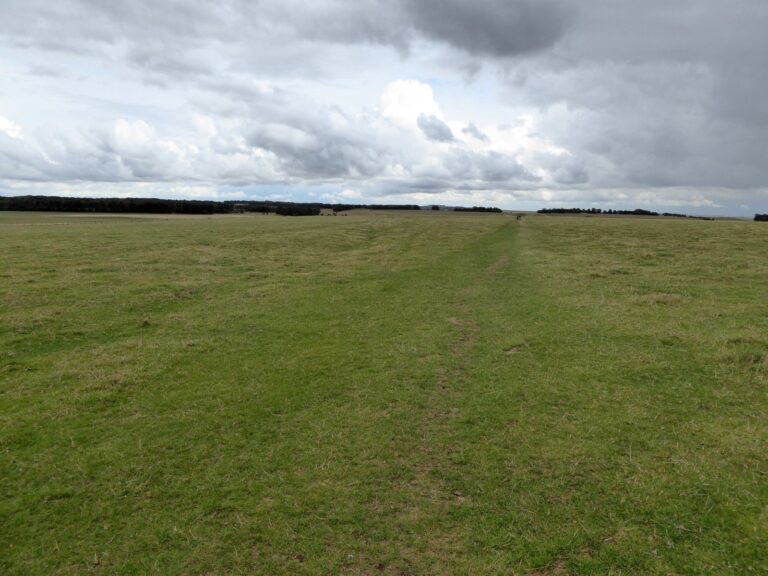
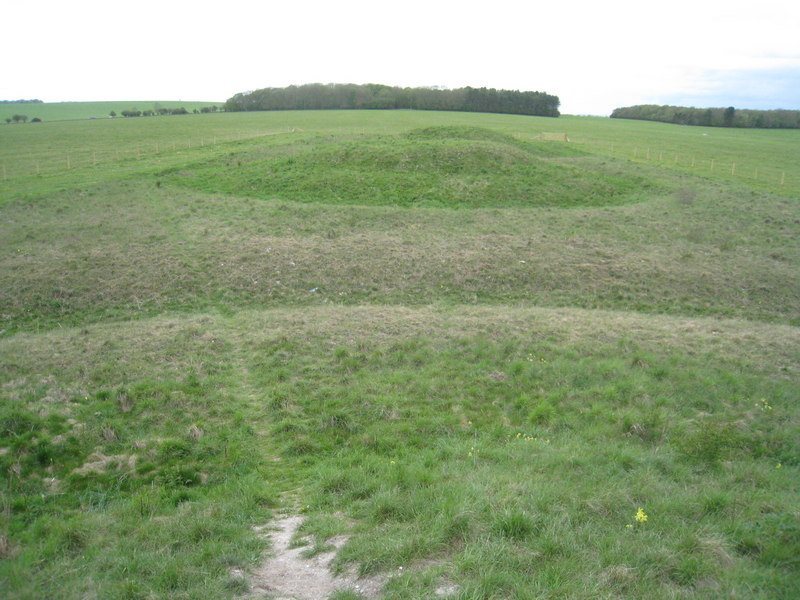
The cemetery follows an east-west ridge for about 1,200 metres and is roughly 250 metres wide. The ridge lies mostly south of the western end of the Stonehenge Cursus, a prehistoric linear earthwork. Around 18 barrows are distributed along it, including Amesbury 43–56, Winterbourne Stoke 28–30, and the Fargo Hengiform. Their forms include bell, bowl and disc barrows, distinct kinds of round burial mound.
Amesbury barrows 43–48
Amesbury 43
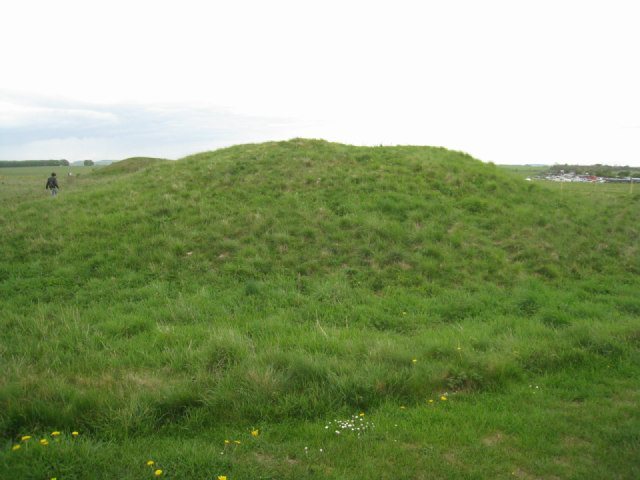
Amesbury 43 is a bell barrow, one form of round burial mound. Its circular central mound stands 3.4 metres high and measures 25 metres across. The mound sits on a raised base and is surrounded by a circular ditch, making the monument about 60 metres across. The eighteenth-century road damage affected the mound’s northern and eastern sides.
Amesbury 44
Amesbury 44 has two mounds within a shared circular ditch, which is 5 metres wide and 1 metre deep. The eastern mound is 1.6 metres high and 15 metres across; the western one reaches 2.3 metres high and 17 metres across. The eastern mound contained a cremation in a pottery urn accompanied by bronze, amber and shale objects. The western mound held a burial and a cremation in a cist, a small grave chamber often made from stone slabs.
Amesbury 45
This large, ditched bell barrow still rises 3.5 metres. Its overall diameter is about 56 metres, and its central mound measures 26 metres across. Excavation uncovered a cremation near a cist containing black ash and a few fragments of burnt bone.
Amesbury 46 and 47
These east-west-aligned bell barrows have overall diameters of 38 and 36 metres. Each central mound is 20 metres across and just under 2 metres high, and their circular ditches join. Amesbury 46 yielded burnt bones and a small spearhead. Amesbury 47 contained a burial of burnt bones.
Amesbury 48
Amesbury 48 is a bowl barrow, another form of round burial mound, surviving as a low earthwork 0.3 metres high. Its outer bank remains as a slight rise 4 metres wide and 0.2 metres high. Excavation uncovered a cremation with beads made of stone, amber and faience, a glazed, glass-like material.
Barrows around Fargo Plantation
Amesbury 49
Amesbury 49 is a round barrow, possibly a bowl barrow, about 26 metres in diameter and surviving as slight earthworks. A flattened feature to its southeast may be a further barrow, Amesbury 114.
Amesbury 50
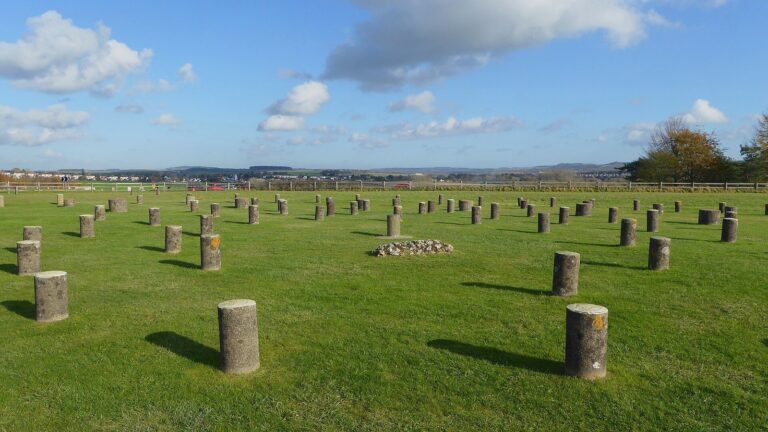
Amesbury 50 survives as slight earthworks. Its central oval mound is about 20 metres across and 0.5 metres high, flanked by uneven side ditches with entrances facing southwest and northeast. The 2010 survey suggested that a large circular ditch had been dug in separate sections. Twenty-four pits, each about 1 metre wide, followed the ditch’s inner edge and may have held a freestanding wooden structure. The opposing entrances suggest an alignment like Stonehenge. Under this interpretation, the burial mound at the centre may have been added later; the feature may instead be an unusual Bronze Age barrow rather than a henge-like monument.
Amesbury 51
Amesbury 51 is a reconstructed bell or bowl barrow about 36 metres across, with a mound now 1.5 metres high. Excavation revealed a primary burial with a beaker, a type of prehistoric pottery vessel, and two later burials of uncremated bodies. Finds from the 1960 excavation included decayed leather, a burial beneath a tapered board, a long-necked beaker and assorted implements. The remains have been interpreted as possibly belonging to a mortuary house, a structure associated with funerary use. The surrounding ditch has gaps or crossings, and fragments of bluestone were found in its silt.
Amesbury 52–54
Amesbury 52, just east of Fargo Plantation, is 0.7 metres high and 25 metres across. Amesbury 53 and 54 lie within the plantation. Amesbury 54 contained a primary burial with a beaker, a flint spearhead and a polished hammerhead.
Amesbury 112
Amesbury 112, on the plantation’s southern edge, may have been a disc barrow, a distinct form of round barrow. It had probably been flattened by the early nineteenth century, and trees were later planted there.
Fargo Hengiform
The Fargo Hengiform, an enclosure with features resembling a henge, lies within Fargo Plantation and survives as an irregular hollow about 8.5 metres across. Excavation revealed a small oval ditch with an outer bank, interrupted by causeways to the north and south. A central grave held a skeleton, a beaker, a food vessel and two cremations; another cremation lay near the ditch’s inner edge.
The Monarch of the Plain, Amesbury 55
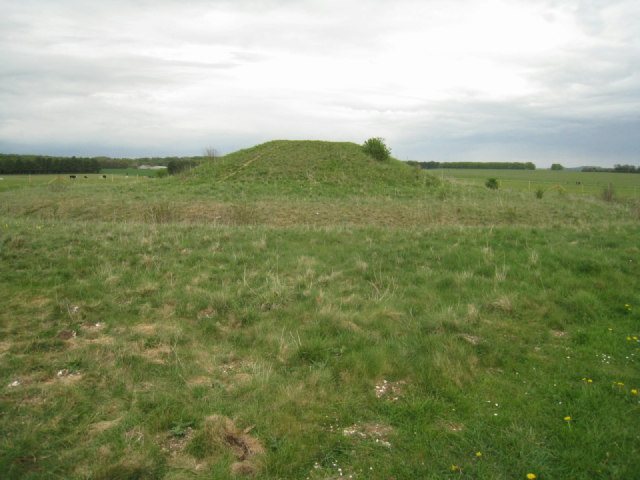
This Bronze Age bell barrow stands at the western edge of Fargo Plantation. It is 2.8 metres high and reaches 58 metres across. Excavation found charred wood.
Barrows at the western end of the Cursus
Amesbury 56
Amesbury 56 lies within the Cursus’s western end. It is a bowl barrow, or possibly a bell barrow, about 1.5 metres high and 25 metres across. Excavation found burials and grave goods, including a bronze dagger.
Winterbourne Stoke 30
Excavation identified Winterbourne Stoke 30 as a bell barrow with a central cremation pit. Two children’s burials were found in its ditch. Colt Hoare’s earlier excavation produced a possible cremation.
Barrows west of Fargo Plantation
Winterbourne Stoke 28 and 29
These were bowl barrows west of Fargo Plantation. Slight earthworks attributed to Winterbourne Stoke 28 remain. Its excavation yielded a handled bronze awl and a collared urn, a type of prehistoric pottery vessel.