Amesbury Priory: A Medieval Fontevraud Benedictine House in England


Site at a Glance
- Rating
- 4.4
- Popularity
- Very Low
- Country
- United Kingdom
- Primary era
- Unclassified
- External website
- Open
- Eras represented
- Unclassified
- Civilizations
- Unclassified
- Site type
- Religious
- Remains
- Monastery
On this page11 sections
History
Amesbury Priory was a Benedictine house of the Order of Fontevraud in Amesbury, England, established by Henry II in 1177 in the medieval period. Formally dedicated to St Mary and St Melor, it became an important English foundation whose female superior ultimately answered to the abbess of Fontevraud. The priory stood on the site of an earlier Saxon Benedictine nunnery founded about 979 by Queen Elfrida.
The Fontevraud refoundation
Henry II’s refoundation followed a papal bull issued by Pope Alexander III on 15 September 1176. An investigation, presented as a measure of monastic reform, led the existing community of about 30 nuns, including Abbess Beatrice, to leave. Beatrice received a pension. A new community of 21 or 24 nuns arrived from Fontevraud, led by a former subprioress, while further members came from Westwood Priory.
The new community was installed on 22 May 1177 in a ceremony led by the Archbishop of Canterbury and attended by Henry II and other bishops. Henry spent about £880 on the buildings, whose completion was celebrated on 30 November 1186 in the presence of the king and the abbess of Fontevraud. The earlier monastery’s endowments passed to the new foundation, including the manor of Winterbourne, which remained among its possessions until the Dissolution.
Fontevraud was a centralized Benedictine reform founded in 1101 by Robert of Arbrissel, a French preacher and religious reformer. Its double monasteries contained separately housed communities of women and men under the ultimate authority of an abbess. At Amesbury, a prioress governed the women’s community, while a prior, and later chaplains and canons, led the associated men. Amesbury was the fourth and last Fontevraud house established in England.
Royal patronage and institutional life
The priory maintained close but intermittent relations with Fontevraud. In 1203 its prioress transmitted an Exchequer payment for a chaplain to pray for Eleanor of Aquitaine, who had earlier given Amesbury 20 marks for prayers for Henry II. Abbess Berthe confirmed an Amesbury gift in 1221. Her successor, Adela of Brittany, who governed Fontevraud from 1228 to 1244, was reportedly brought up at Amesbury. After 1486, contact with Fontevraud is no longer certain.
Royal support expanded the priory’s landholding and privileges. Richard I granted it 78 acres at nearby Barford St Martin in 1197. In 1202 King John cleared the prioress’s debts, and in 1207 he gave her £18. Henry II granted rights to gather firewood in several royal forests. Henry III renewed or enlarged grants of timber, nuts, and firewood, visited Amesbury in 1223, 1231, 1241, and 1256, and inspected and renewed Henry II’s charter in 1270. Edward I granted timber in 1300.
These grants supported enlargement and repair. Timber was supplied for an infirmary chapel in 1226, the cloister and nuns’ stalls in 1231, and the church in 1234 and 1235. Further grants followed in 1241 and 1249, while lead was provided for roofing the canons’ church in 1246.
In January 1256 the community comprised a prioress and 76 nuns, a prior and six other chaplains, a clerk, and 16 lay brothers, some of whom lived at the priory’s granges. Income stood at £100 from rents and £40 from wool, against expenditure of £180, although the house was not in debt. Amesbury held 59 charters and faced a shortage of corn. Richard I had granted £10 for corn in 1189.
Royal women and the priory
Royal connections brought both protection and disruption. Eleanor of Provence, widow of Henry III, retired to Amesbury in June 1286. Her granddaughter Eleanor of Brittany and granddaughter Mary of Woodstock were also associated with the priory. Eleanor of Provence died there on 24 or 25 June 1291 and was entombed before the high altar on 11 September. Her heart was buried at Greyfriars, Newgate, London, while the location of her Amesbury tomb is now lost.
Eleanor of Brittany, later called the Fair Maid of Brittany, entered Amesbury in 1281 at about seven years of age. She received the veil in Edward I’s presence in November 1291, later moved to Fontevraud, and became its abbess by 1304. She had first been buried at St James’ Priory, Bristol, after her death in 1241, but was reburied at Amesbury about a month later. In 1268 Henry III granted Amesbury the manor of Melksham for prayers for Eleanor and her brother Arthur, ordering that they be commemorated with kings and queens.
Mary of Woodstock, daughter of Edward I and Eleanor of Castile, entered Amesbury as a child and received the veil in December 1291. Edward I refused to transfer her to Fontevraud, and she remained at Amesbury. She later acted as the abbess of Fontevraud’s representative in England, issuing documents between 1301 and 1309 and influencing later appointments. Her royal allowance rose to £200 a year, supplemented by 40 oaks annually from royal forests and 20 tuns of wine from Southampton. She administered lands personally, travelled outside the enclosure, kept private quarters, visited court, incurred gambling debts, and borrowed money from the priory. She died on 29 May 1332 and was probably buried at Amesbury.
Mary’s half-sister Eleanor of England died at Amesbury in 1311 but was buried at Beaulieu Abbey. Isabel of Lancaster, prioress from 1343 until shortly before February 1349, had been consecrated a virgin at Amesbury with 35 other nuns in 1327. Her royal connections helped secure three tuns of wine each year and 12 oaks from Chute Forest. Her property, servants, and hunting dogs illustrate the social and financial influence of high-status women within the priory.
Authority, conflict, and changing membership
Edward I advised Joan de Dreux, abbess of Fontevraud from 1265 to 1276, to withdraw to Amesbury with two nieces and another nun. For a period she governed the Fontevraud Order from the English priory. In 1293 a dispute over the election of a new prioress brought royal intervention. Princess Mary of Woodstock and the prior opposed the nuns’ choice, and the king secured the appointment of Joan de Jennes from Fontevraud in 1294.
Royal influence continued during the fourteenth century. Edward III restricted some of the abbess of Fontevraud’s rights in 1341, after which later elections of prioresses required royal licences. Queen Philippa of Hainault requested the appointment of William of Amesbury as prior in 1361, and he later investigated alleged crimes at Nuneaton Priory in 1365. By the fifteenth century, the former close relationship between Amesbury and the royal family had weakened.
The male community grew from a chaplain recorded in 1180 and a prior recorded in 1194 to the larger body listed in 1256. It included 12 chaplains, including the prior, in 1315 and 1316, and 14 chaplains and clerks in 1317 and 1318. Numbers later declined. In 1381 there were eight brethren, only one of them a priest, together with one lay brother. After the destitution of Prior Robert Dawbeney, recorded before 1399, the parallel male community probably gave way to secular priests serving as chaplains.
Amesbury was regarded as the leading Fontevraud house in England, yet it experienced periods of poverty. As the Middle Ages ended, its nuns increasingly came from gentry families rather than exclusively from the aristocracy. In 1398 Margaret Greenfield, a nun, gave birth to a child. That year Prioress Sybil Montagu expelled Prior Robert Dawbeney, leading to investigations and a settlement that granted him a pension. On 14 March 1400 intruders imprisoned Sybil and some nuns for at least two days, and Henry IV ordered their release. Sybil later claimed that she had again been expelled and feared returning. Henry V intervened, and she remained prioress until her death in 1420.
Dissolution and later history
In 1535 the priory’s gross annual income was £558 10s. 2d., while its net income was £482 1s. 10d., making it the fifth wealthiest English nunnery. The Dissolution of the Monasteries was the process by which Henry VIII’s government suppressed England’s monasteries and transferred their property to the Crown during the 1530s. In March 1539 government commissioners initially failed to persuade Prioress Florence Bonnewe to surrender. She resigned at the king’s command in August, and her successor, Joan Darrell, surrendered the priory without resistance on 4 December 1539.
A patent dated 4 February 1540 granted pensions totalling £258 6s. 8d. to Joan Darrell and 33 nuns. Twenty-one nuns were still receiving pensions in 1555 and 1556, and Cecily Eyre remained a beneficiary as late as 1605. Before 22 April 1540, Edward Seymour, 1st Earl of Hertford, acquired the former priory buildings from the Crown. The site was subsequently used for a mansion that retained the name Amesbury Abbey.
Amesbury also entered literary tradition. In Sir Thomas Malory’s Le Morte d’Arthur, first printed by William Caxton in 1485, Guinevere retires to Amesbury for a life of penance. This association reflects the priory’s royal connections rather than recording an event at the historical monastery.
Remains
The monastic complex
Amesbury’s priory complex contained separate communities for women and men. Chapels or churches served the nuns and canons, and the wider group included a cloister, nuns’ stalls, an infirmary chapel, granges, and other monastery buildings. Royal grants of timber and other materials supported successive building campaigns. The infirmary chapel was built with timber supplied in 1226, while work on the cloister and nuns’ stalls followed in 1231. Further work affected the church in 1234 and 1235, and the canons’ church received a lead roof in 1246.
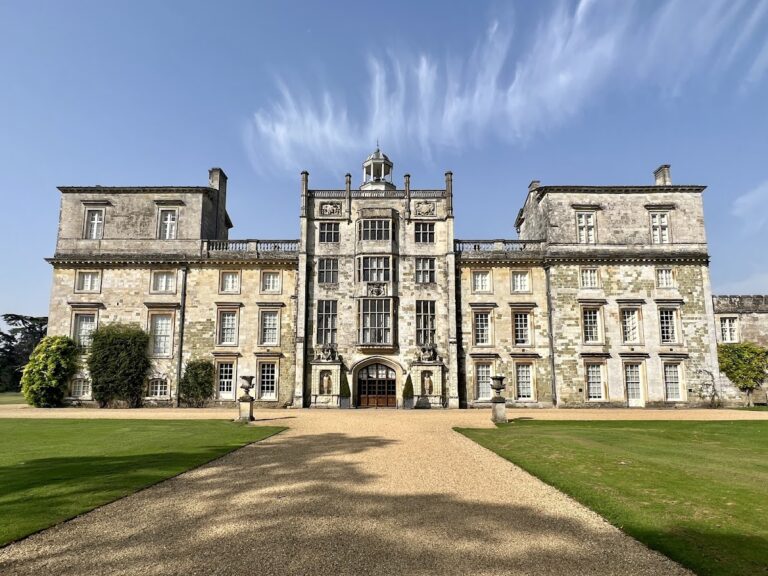
The later mansion called Amesbury Abbey occupies the former priory site and preserves its historical name. The present property therefore represents a later use of the monastic location rather than the medieval institution itself.
Churches and burial places
The present Church of St Mary and St Melor at Amesbury contains a twelfth-century nave. Its relationship to the medieval complex remains debated: it may be the former priory church or the church used by the male community. The church formerly contained Eleanor of Provence’s tomb, although its precise location is now lost. Eleanor of Brittany’s remains were reburied at Amesbury, while her earlier burial at St James’ Priory, Bristol, and the later Amesbury burial do not retain a memorial.
Manuscript and devotional objects
The 1256 inventory provides a glimpse of the priory’s chapel furnishings. It listed four silver-gilt chalices, two silver cups, two silver crosses, and two censers, valuable objects largely confined to the chapels. The same inventory recorded livestock belonging to the estate, including 4,280 sheep, 200 oxen, seven cows, four calves, 23 horses, and 300 swine over one year old.
The Amesbury Psalter is an illuminated English manuscript made about 1250 and now held as All Souls College, Oxford, MS 6. It belongs to a group of five manuscripts produced and illuminated around 1245 to 1255 by an unknown artist. The book contains four full-page miniatures and illuminated initials, and it mentions the feasts of St Melor twice. Its calendar does not otherwise precisely follow that of Amesbury, and it was probably owned by a wealthy laywoman rather than a nun. The manuscript is regarded as the finest of its group and as an outstanding example of mature English early Gothic painting.
Seals and institutional identity
The priory’s seals expressed its religious and institutional character. One seal type showed the Coronation of the Virgin Mary, an unusual subject among medieval English nunneries. Another seal, dated between 1337 and 1345, depicted the standing prioress. Together, these images represented the authority of the female head and the Marian identity of the foundation.