Cunninghamhead Estate: A Historic Scottish Landed Estate
Site at a Glance
- Popularity
- Medium
- Country
- United Kingdom
- Primary era
- Early Modern
- Eras represented
- Early Modern, Modern
- Civilizations
- British
- Site type
- Domestic
- Remains
- Manor House
On this page14 sections
History
Cunninghamhead Estate is a historic landed estate in the United Kingdom whose name replaced Woodhead before 1418. The Cunninghame family acquired it in the early 15th century, and later owners reshaped the estate through rebuilding, agricultural improvement and new uses.
Names and the Cunninghame family
A 1346 charter issued by David II refers to Godfrey de Ross as “of Coyninghamheid.” The area had changed from Woodhead to Cunninghamhead by 1418, and around 1564 another spelling, “Cunnygahamehead,” was in use. At about that time, the estate’s laird, a Scottish landowner, also held Powkellie near Stewarton, while Middleton formed part of the estate.
In the early 15th century, Robert Cunninghame married the Douglas heiress to the estate. The Cunninghame family then held the land for several centuries, and its head was styled Laird of Cunninghamhead. Sir William Cunninghame supported the Protestant reforms of John Knox and attended the Great Parliament of 1560. His brother Sir John was a member of the General Assembly in 1565.
Seizure and religious conflict
In March 1600, Alexander Cuninghame of Towerlands and hired soldiers seized Cunninghamhead House. They refused to leave when ordered by the King, resisted royal commissioners and fired early firearms at them. On 19 December that year, Alexander’s brother William was convicted of helping him. He was sentenced to beheading at Edinburgh’s market cross and deprived of his lands and goods.
The estate lands were valued at £330 in 1640. During the 1640s, Alasdair Mac Colla, sent by the Royalist commander James Graham, Marquess of Montrose, to suppress support for the Covenanters, plundered Ayrshire and demanded penalties. Sir William Cunningham’s penalty for Cunninghamhead was 1,200 merks, a Scottish unit of money. By then, damage worth £10,000 had already been done.
In 1678, the Crown sent a second Highland Host, made up mainly of Catholic Highlanders, into Ayrshire to suppress Presbyterian conventicles, or religious meetings. The troops remained at Cunninghamhead for a month while William Cunninghame occupied the estate. They used up or destroyed grain stores and forced locked places open with fire. One officer threatened to hang a farmer in his barn unless he handed over money. The Host also extorted and attacked people elsewhere; costs in Dreghorn and Pearceton parishes alone reached £1,505 17s 0d.
Rebuilding and agricultural improvement
John Snodgrass Buchanan bought the estate on 23 January 1728 for £23,309 and 2d Scots. In 1747 he demolished the old tower and built a mansion house. Neil Snodgrass later built the stables and extended or rebuilt the mansion. When new, the house was regarded as one of the country’s most elegant; by 1823, alterations had diminished its earlier elegance.
Neil Snodgrass also promoted practical farming with Alexander, Earl of Eglinton, including crop rotation and years when fields were left fallow. William Aiton praised his commitment to agricultural improvement in 1811. Neil had been apprenticed to study law in 1755, but smallpox severely damaged his eyesight, leading him to return to the countryside and pursue rural activities.
Later owners and new uses
The Buchanans of Craigievairn held the estate in 1823, and Mr Snodgrass Buchanan was named as its owner in 1838. The Kerr family followed. William Kerr bought Cunninghamhead and lived there in retirement until his death in 1853; his son Richard succeeded him. The Misses Kerr were listed as owners in 1951.
By the 1960s the estate had fallen into disrepair. After the Kerr sisters died, a developer bought the neglected mansion and was close to completing its renovation when vandals set it on fire in the early part of the decade. The damage was too severe for restoration, and the house was demolished. Repeated vandalism also led to the Gardener’s Cottage being demolished in the mid-1980s.
Work to change the estate’s use began in 1964, first for poultry farming and later as a caravan and camping site. Redevelopment from about 2003 established a residential caravan park intended for retired and semi-retired residents. In the 21st century the estate is mainly a residential caravan park, with two private residences.
Remains
The estate covers 18 acres (7.3 hectares). Its surviving buildings and ruins occupy ground beside the Annick Water, including the low-lying land on the river’s southern bank. A wooded road connects the Cottage Orné with the stables and the former mansion-house site. The remains include masonry buildings, woodland ruins and foundations at Quarry Holm. Gordon’s 1654 map labels the estate “Cuningham Head,” while Moll’s 1745 map names the area “Rungham.”
Buildings and ruins
Cottage Orné
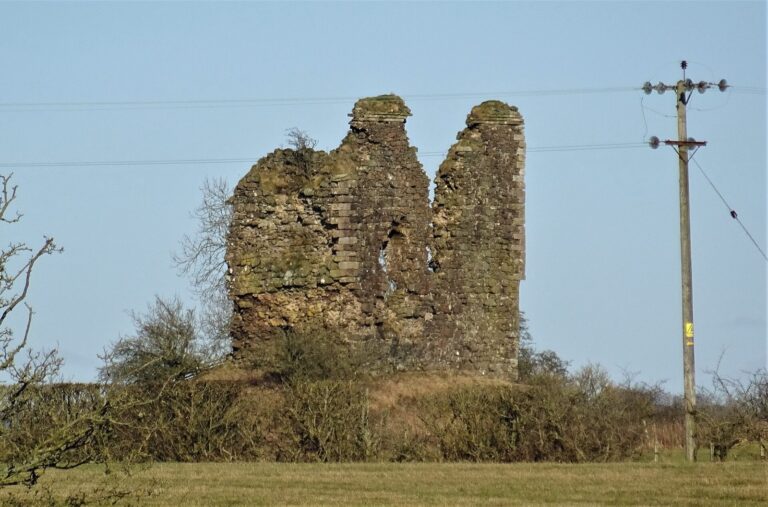
The Cottage Orné, an ornamental cottage, stands in substantial ruin on low ground beside the southern bank of the Annick Water. Its foundations consist of large river boulders, with shaped and carved stone blocks above. A large doorway and window face the low ground. Much of the river-facing wall has collapsed, and it may once have contained two large windows. The doorway has been carefully blocked, while the window facing the low ground may have been adapted as an entrance.
The cottage may date to the estate’s early development around 1747 and may have served as a summer retreat. Aiton’s description of a secluded cottage near gardens on the Eglinton estate, more than half surrounded by a river and used for leisure and observing nature, may have influenced its design. A possible later association is with Lady Jane Hamilton, who built or enlarged a cottage beside the Lugton Water for teaching domestic economy to peasant girls. The Cottage Orné’s last occupant was a Mackay described as a poet or writer. The identity is uncertain: possible associations include Charles Mackay, who edited the Glasgow Argus for four years from 1844 before joining the Illustrated London News in London, or an earlier actor and writer of the same name.
Stables
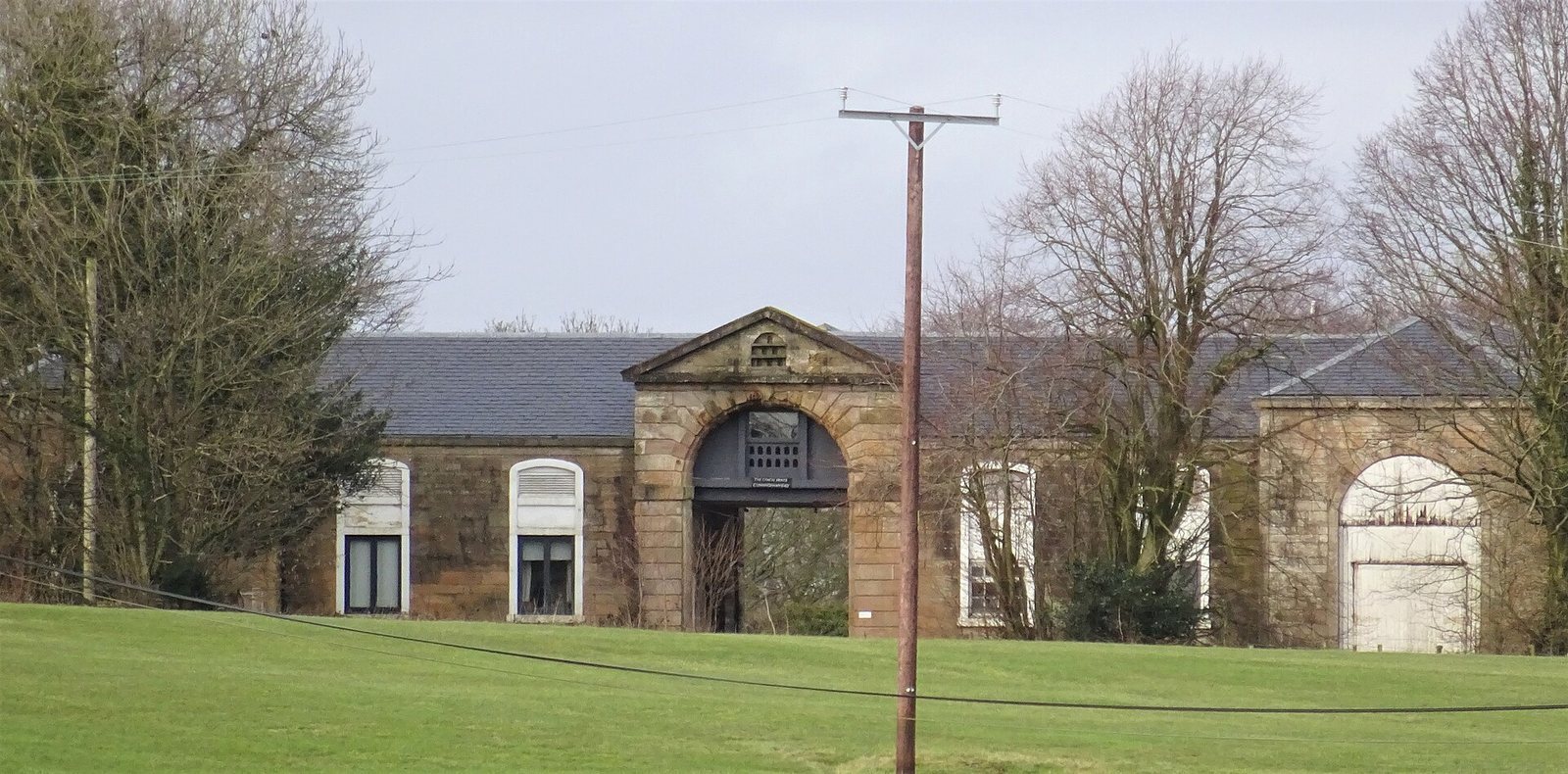
The stables remain in use as a private residence. Their main frontage bears the date 1820, while the remainder may date from the 1740s. The building probably also housed estate offices. Blocked doorways at the lower end of the courtyard suggest small dwellings for workers. Three small columns at the front helped riders mount their horses; a previous owner added them, so they are not original.
Wigwam Bar building
A large building erected in the 1980s for the Wigwam Bar served the caravan site and hosted functions for local young farmers. Around the turn of the millennium it was divided into two holiday-let units.
Woodland building remains
Ruins of other vernacular buildings lie in the woods beside the path down to the Annick Water. The Gardener’s Cottage, once a substantial building that had been extended at least once, stood at the bottom of this road.
Foundations and landscape
Quarry Holm
Quarry Holm lies beside the old railway embankment between Cunninghamhead and Annick Lodge. Foundations there belong to buildings that appear to have had industrial uses and then been put to another use before abandonment. The railway line, built in 1843, separated Quarry Holm from Annick Lodge.
Woodland and riverbank plants
Deciduous woodland north of the Annick Water, near the former mansion site, contains a diverse range of plants associated with long-established woodland rather than recent planting on cleared ground. These include male shield fern, lady fern, tuberous comfrey, tussock grass, bluebells, dog’s mercury, opposite-leaved golden saxifrage, woodrush, sanicle, enchanter’s nightshade and wood sorrel. Agrimony and wild mint grow on the riverbank just upstream of the old railway viaduct.