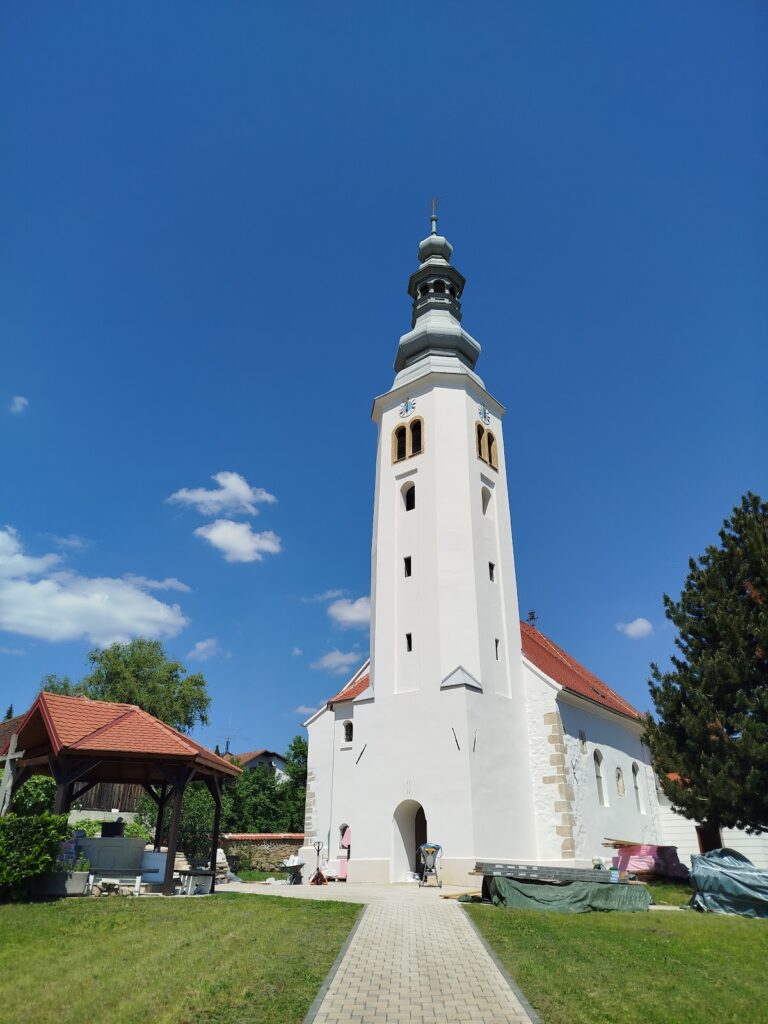
Church of Saint Mary Magdalene in Čazma: A Romanesque Collegiate Church in Croatia


Site at a Glance
- Rating
- 4.8
- Popularity
- Low
- Country
- Croatia
- Primary era
- Medieval
- Eras represented
- Medieval, Early Modern
- Civilizations
- Habsburg, Hungarian
- Site type
- Religious
- Remains
- Church
On this page9 sections
History
The Church of Saint Mary Magdalene in Čazma, Croatia, is a Romanesque church begun in the early thirteenth century and completed in 1232. Romanesque architecture is characterized by massive masonry, rounded arches, and compact forms. Built in the center of Čazma, an important medieval crossroads, it is regarded as the oldest sacred monument in Bjelovar-Bilogora County and as a monument of high value.
The collegiate foundation
In 1232, Zagreb Bishop Stjepan II Babonić founded a collegiate chapter of twelve canons at Čazma. A collegiate chapter was a body of clergy established to serve and administer a church without belonging to a monastic community. The foundation gave Čazma the status of an auxiliary administrative seat of the Zagreb Diocese. A Dominican monastery once stood beside the church, adding a further religious institution to the medieval complex.
The church also became associated with Duke Koloman, who fought the Mongols in 1241. His remains and a tombstone were formerly located inside the church. The nineteenth-century Croatian historian and writer Ivan Kukuljević Sakcinski discovered them and wrote about the find, but the tombstone later disappeared.
Ottoman attacks and later restoration
The church was devastated several times during its later history, particularly during the Ottoman conquests. The Ottoman Empire was the major Islamic imperial power whose campaigns affected southeastern and central Europe. In 1544, the Ottoman pasha and military official Ulama Beg raided Čazma, during a period when such attacks repeatedly disrupted settlements and religious buildings in the region.
Repeated restorations altered both the facade and the interior. The eighteenth-century parish priest Ivan Jambreković played a particularly prominent part in the rebuilding and renewal of the church. These interventions left the building with a later decorative character while preserving its medieval structural identity.
Archaeological investigation and conservation
Research and restoration began around 1995 and continued thereafter. The restoration plan aimed to present the exterior in Romanesque form and the interior in Baroque form. Archaeological investigations carried out in 2003 and 2005 uncovered foundations from earlier construction phases and 136 graves containing numerous early modern objects. These findings added material evidence for the church’s long use and successive alterations.
Remains
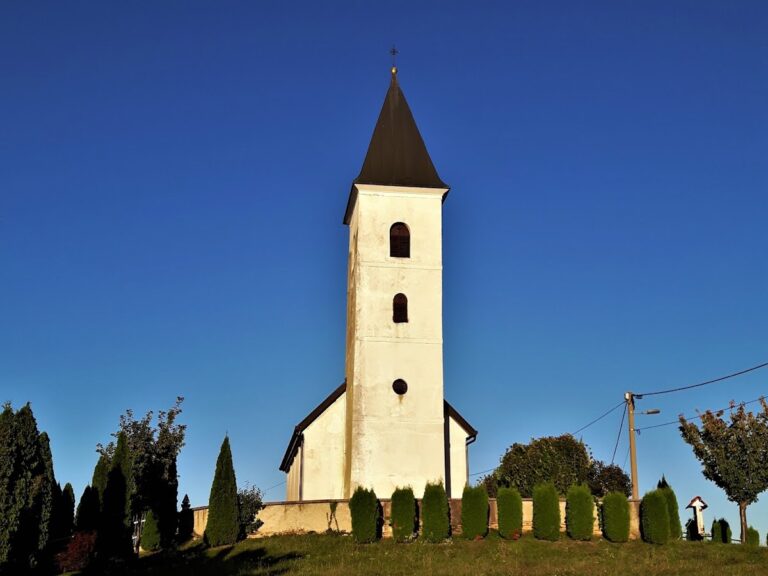
The surviving church is a three-nave building with a cross-shaped plan and two bell towers. Its cruciform design has been described as unique within the Romanesque period in Europe. The building combines a medieval structural form with later layers of decoration and restoration, allowing its changing architectural character to be read across both the exterior and interior.
Plan and exterior
The church’s three naves are organized within a cruciform plan, and two bell towers form part of its composition. The facade formerly featured a prominent portal and a rose window. A rose window is a large circular, usually ornamented window set into a church facade. The restoration approach sought to express the exterior’s Romanesque appearance, a style associated here with the church’s early thirteenth-century origins.
Altars and interior decoration
The original Romanesque interior arrangement has not survived. The existing decoration belongs to the seventeenth and eighteenth centuries and is Baroque, a style known for elaborate ornament. The main altar is dedicated to Saint Mary Magdalene. Other altars honor the Passion of Christ, the Holy Spirit, the Three Kings, Saint Stephen, the Seven Sorrows of the Blessed Virgin Mary, the Assumption of Mary, Saint Roch, and the Holy Cross.
The 1767 organ
A valuable organ built by Johann Hencke in 1767 survives in the church. It was made in Vienna in the Rococo style, a lighter and more intricate decorative style that developed during the eighteenth century. The organ has mechanical action, which transmits the movement of the keys to the pipes through physical linkages, and uses slider chests. Its stated coupling is II-I.
Archaeological remains
Investigations in 2003 and 2005 revealed foundations belonging to earlier phases of construction beneath or within the church complex. They also exposed 136 graves containing numerous early modern objects. Together, these remains provide physical evidence of earlier building phases and burial activity connected with the church.