Old town Đurđevac: A Renaissance Fortress in Croatia


Site at a Glance
- Rating
- 4.6
- Popularity
- Medium
- Country
- Croatia
- Primary era
- Early Modern
- External website
- Open
- Eras represented
- Medieval, Early Modern
- Civilizations
- Habsburg, Hungarian
- Site type
- Military
- Remains
- Fort
On this page11 sections
History
Old town Đurđevac is a fortified site in Croatia, around which the settlement of Đurđevac developed. The present Renaissance fortress was built approximately between 1477 and 1488 on a raised site amid marshland, north of the earlier settlement, in response to the Ottoman threat and conflicts among regional magnates. It later became a royal frontier fortress and a major defensive position in Upper Podravina.
Medieval origins and changing ownership
An earlier fortress existed before 1378 and was commissioned by Stephen Mikcsfi, son of Ban Mikcs of the Ákos kindred. A ban was a high-ranking governor and military-political official in medieval and early-modern Croatia. Mikcsfi supported Ladislaus of Naples during his succession struggle with King Sigismund. After attempting to ambush Sigismund’s army near a crossing of the Drava, he fled to Bosnia while the royal army besieged and captured the fortress.
In 1426, Sigismund returned the fortress to Mikcsfi’s son Nicholas. After Nicholas rebelled, Sigismund’s brother-in-law, Count Hermann of Celje, seized it by force and later sold it to Matko Tallóci, the Croatian ban. Following Matko’s death, John Vitovec, a commander of the Counts of Celje, took the fortress again. John Hunyadi subsequently captured it and transferred it to his nephew, James Székely. The Counts of Celje regained control and held the fortress until 1456, when their family became extinct after Count Ulrich of Celje was murdered at Belgrade.
Ulrich’s widow, Catherine Branković, then sold the fortress to John Vitovec, who was of Bohemian origin. King Matthias Corvinus annulled the transaction and transferred the estate to his treasurer, John Ernuszt. The Ernuszt family was a prominent noble house whose members held important ecclesiastical, financial, and territorial offices in the Kingdom of Hungary-Croatia.
The Renaissance fortress and the Ottoman frontier
The present fortress took shape when Sigismund Ernuszt inherited the wealthy Đurđevac estates. Sigismund, Bishop of Pécs and a major Renaissance patron, was associated with the construction carried out approximately from 1477 to 1488. The fortress was extensively rebuilt and strengthened from 1549 under Captain Luka Székely as Ottoman pressure advanced. The Ottoman Empire was the imperial power against which Habsburg border fortresses in Croatia defended the frontier during the sixteenth and seventeenth centuries. These works created the outer fortress and reinforced Đurđevac’s military role.
After Ulama, the sanjak-bey of Pozega, captured Virovitica in 1552, Đurđevac became the most advanced fortress in the Military Frontier. This Habsburg border-defense zone was organized through permanent military settlements and garrisons to resist Ottoman expansion. The surrounding area was depopulated, while the fortress resisted Ottoman attacks. Between 1575 and 1586, its garrison repelled several assaults. On 30 November 1558, Krsto Ungnad and Vid Halek defeated a larger Ottoman detachment near Đurđevac and freed captives taken during a raid on Koprivnica.
A local tradition explains the inhabitants’ nickname, picoki, meaning “chickens.” When the defenders supposedly ran out of food during an Ottoman siege, they fired their last chickens at the besiegers. The attackers interpreted this as evidence that the fortress still had abundant provisions and withdrew. The story remains central to the Legend of the Picoki and to the annual Picokijada festival, held at the fortress since 1968.
Royal military administration
After the Ernuszt family became extinct in 1540, Croatian Ban Peter Keglevich acquired the property through family connections, but King Ferdinand I did not recognize his claim. In 1546, Nicholas Zrinski arrested Keglevich on the king’s behalf and sent him to Vienna. Đurđevac thereafter became a royal fortress.
The complex was strengthened at royal expense and in 1746 became the headquarters first of the Fifth Military Frontier Infantry Regiment and later of the Sixth Đurđevac Infantry Regiment. It also served as the seat of the Đurđevac captaincy, a military-administrative district commanded by a captain. Together with Koprivnica, it defended Upper Podravina against Ottoman attacks.
Abandonment, reuse, and restoration
The outer fortress was demolished during the nineteenth century. After the Military Frontier was abolished in 1871, the army abandoned the inner fortress. From 1892 to 1909, the buildings housed a girls’ educational institution run by the Sisters of Mercy, followed by approximately two decades of use as a barracks.
During the interwar period, associations and local residents used the fortress for meetings and events, while craftspeople operated workshops there. A primary school occupied it for one year in 1928. After the Second World War, a carpentry and basket-making cooperative operated there from 1967. Later uses included offices, a national university, various associations, and a radio station.
Repairs continued intermittently until 1984. Archaeological and nature-conservation research then preceded a thorough restoration carried out during the 1980s and 1990s. The fortress is protected as a cultural monument under heritage register number Z-2986 and is described as a first-category cultural monument. Its present cultural and public functions include museum, gallery, interpretation, and hospitality uses.
Remains
Fortress layout and defensive works
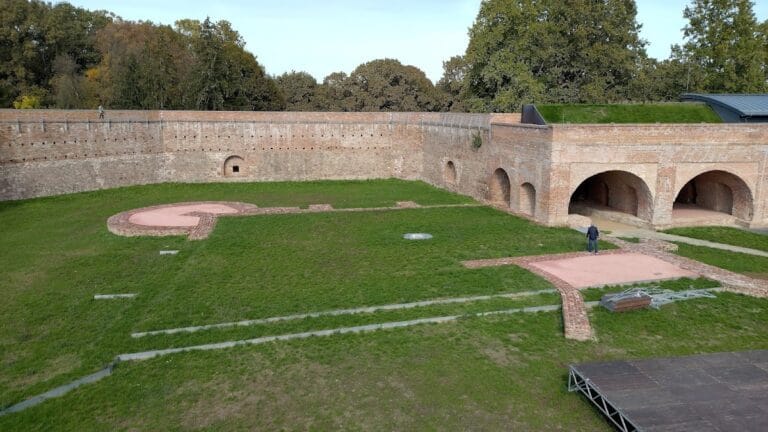
Old town Đurđevac is an approximately octagonal, courtyard-centred fortress on a raised site amid marshland. The surviving inner fortress is the principal restored building. Its walls and structures are built of brick and stone, while the later defensive arrangement was designed to protect the complex on all sides. A square tower was added to the south-western side.
Inner fortress and entrance tower
A square central tower carried the main entrance. Above it was the coat of arms of the Ernuszt family, linking the fortress buildings into a unified composition. The original arms have been conserved, while a replica is displayed in the Renaissance-style inner courtyard. The shield shows a central fortress tower between two six-pointed stars, topped by the mitre of Bishop Sigismund Ernuszt. Ornamental tendrils frame the design, while pears, cherries, walnuts, plums, and leaves form a decorative border. The year 1488 is associated with the coat of arms.
A well once stood in the centre of the inner courtyard. It was later demolished to save space and improve safety. The ground floor now contains a restaurant, pub, and wedding hall, while the upper floor holds museum and gallery spaces as well as a radio station. Gallery space was established in the attic in 1997.
Outer defenses and approach
The entrance was protected by a tower with firing positions. In front of it stood a triangular rampart with two towers, and a water-filled moat protected the fortress. A road from the settlement on an island in the Drava led to the external entrance. These outer works formed part of the later defensive expansion and were demolished during the nineteenth century, leaving the inner fortress as the principal surviving structure.
Museum and gallery interiors
Three large gallery rooms regularly host exhibitions by established painters, while a fourth presents a local collection of works by artists from Podravina. The attic contains the collection associated with Ivan Lacković Croata, a twentieth-century Croatian naive painter and art collector. His donation includes more than 1,000 works by 200 twentieth-century artists. The broader collection contains more than 2,000 exhibits, including paintings, sculptures, posters from around the world, and traditional Croatian clothing.
Interpretation centre
An interpretation centre within the fortress presents archaeological finds, historical material, natural and traditional heritage, and a multimedia interpretation of the Picoki legend. Its displays include interactive installations, representations of figures from the legend, examples of naive art, and filmed scenes of the defenders’ battle with the Ottomans.