Crawford Castle: A Medieval Baronial Stronghold in Scotland


Site at a Glance
- Rating
- 4.4
- Popularity
- Very Low
- Country
- United Kingdom
- Primary era
- Early Modern
- Eras represented
- Medieval, Early Modern
- Civilizations
- Kingdom of Scotland
- Site type
- Military
- Remains
- Castle
On this page11 sections
History
Crawford Castle is a substantially ruined medieval castle in Crawford, United Kingdom, Scotland. Standing near the River Clyde, it existed by 1175 and became the administrative centre of the Barony of Crawford, a territorial lordship described as the largest and most influential barony in southern Scotland. The castle occupied a strategic position beside the Mennock Pass, an important route from England into the upper Clyde Valley.
Origins and the Lindsay lordship
The castle stands close to an earlier Roman fort, occupied between AD 80 and 170 and possibly accommodating a garrison of about 300 soldiers. The later stronghold developed on an earthwork and timber foundation, probably established before 1175 by Sveinn or his son Thor. Sveinn is recorded as an early lord of Crawford, while Thor also held the lordship of Tranent and the office of Sheriff of Edinburghshire.
The Barony of Crawford had been established before 1100. Around 1154, Thor’s younger daughter married William Lindsay, who may instead have inherited the barony after Thor’s death around 1165. The Lindsay family then held Crawford, and William Lindsay, described as Lord of Crawford between 1185 and 1190, probably built the stone castle by 1175. The stronghold is also known as Lindsay Tower, recalling the family’s long association with it.
Crawford lay within Crawford Parish, and the Carmichael family of Meadowflatt served as the castle’s hereditary constables. A hereditary constable was responsible for the custody and administration of a castle, with the office passing within a family. The Carmichaels retained this responsibility under successive owners until 1595.
The earldom and royal possession
In 1398, Robert II granted David Lindsay the title of Earl of Crawford. Lindsay had gained renown through a duel with the English Baron Welles on London Bridge on 23 April 1390. Welles had challenged him at a banquet in Edinburgh, and the encounter became part of Lindsay’s public reputation for bravery.
When James IV became king in 1488, the Barony of Crawford was transferred to Archibald Douglas, 5th Earl of Angus. Douglas had supported the young prince’s rebellion against his father, James III. The Earls of Angus retained the castle until James V forfeited their estates in 1528.
James V subsequently used Crawford Castle as a hunting lodge until his death in 1542. His mistress, Elizabeth Carmichael, was the daughter of the castle’s hereditary constable and the mother of John Stewart, Commendator of Coldingham. In July 1541, James V and his queen, Mary of Guise, visited Crawford and brought tapestry to furnish their lodging. George Carmichael, the castle captain’s son, presented the queen with three ounces of Scottish gold.
Rebuilding and later decline
After James V’s death, the Barony of Crawford returned to the Earls of Angus. In 1633, the 11th Earl of Crawford became Marquess of Douglas, and the castle was probably rebuilt after that date. Much of the surviving fabric belongs to this seventeenth-century rebuilding phase. The property later passed to the Duke of Hamilton and was sold to Sir George Colebrooke in the eighteenth century.
During its final phase of use, the castle served as a farmhouse. It was abandoned at the end of the eighteenth century, after which much of its stone was reused to build the present Crawford Castle Farm. The ruins were included in a list of monuments issued under the Ancient Monuments Consolidation and Amendment Act 1913 and are now a Scheduled Ancient Monument, a legally protected archaeological or historic site of national importance in Scotland. Crawford Castle is also a Category B listed building, a designation for a historic building of considerable regional or more than local importance, dating from 12 January 1971.
Remains
Crawford Castle occupies the north bank of the River Clyde, about 800 metres north of Crawford in South Lanarkshire. The surviving ruins stand on an earlier motte-and-bailey earthwork, a castle form combining a raised mound with a defended enclosure. The motte rises about 5 metres and is surrounded by a ditch, while the bailey extends to the south-west and measures approximately 45 by 33 metres.
Early earthworks
The motte and bailey form the earliest visible arrangement of the castle site. The raised mound provided the foundation for the later stone stronghold, while the bailey created a defended area beside it. Excavations to the north-west identified the position of the earlier Roman fort, placing the medieval earthworks within a landscape that had already held a military installation.
Stone enclosure and seventeenth-century ranges
Curtain wall and corner towers
A curtain wall, meaning a defensive wall enclosing a castle compound, surrounds an area of about 20 by 20 metres on the motte. The enclosure probably dates from the sixteenth or early seventeenth century and may have had round towers at its corners. Its ruined circuit represents the principal stone boundary of the later castle.
South-west range
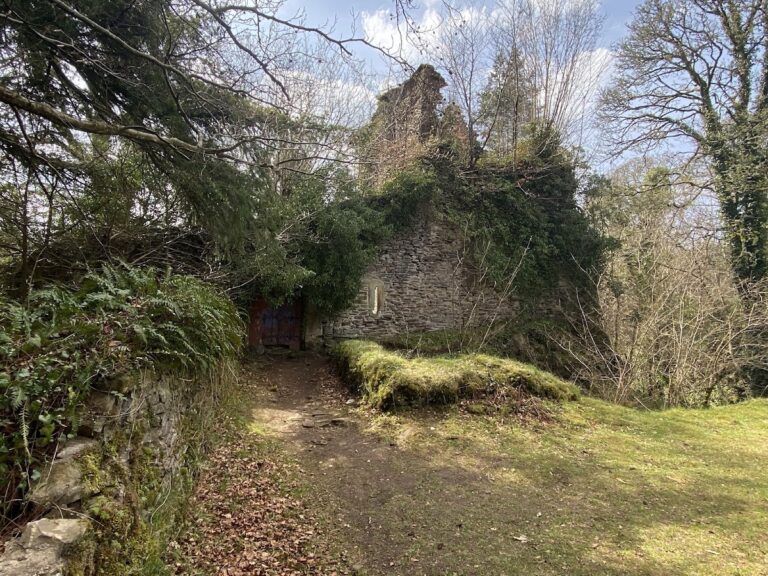
On the south-west side stands a three-storey, tower-like range with an attic, built at approximately the same period as the curtain-wall enclosure. It contained a vaulted basement and had a projecting chimney breast. The surviving structure forms part of the substantial fabric associated with the castle’s later rebuilding.
South-east range
A second range was added to the south-east later in the seventeenth century. It provided more spacious accommodation than the earlier tower-like range and contained larger windows. An arched recess in the east wall indicates that a single-storey building of uncertain type projected from the main structure at that point.
Stone heraldic tablets
Four stone tablets bearing coats of arms are built into the west and south walls of Crawford Castle House. One carries the date 1648. These tablets belong to the physical evidence for the seventeenth-century rebuilding associated with the Marquess of Douglas and remain incorporated into the later structure.