Cowie Castle: A Medieval Coastal Fortress in Scotland
Site at a Glance
- Popularity
- Medium
- Country
- United Kingdom
- Primary era
- Medieval
- Eras represented
- Medieval
- Civilizations
- Kingdom of Scotland
- Site type
- Military
- Remains
- Castle
History
Cowie Castle is a ruined fortress at the northern end of Stonehaven on Scotland’s North Sea coast in the United Kingdom. It is generally considered to have been built in the eleventh century, although its construction is often attributed to Malcolm Canmore, also known as Malcolm III, King of Scots from 1058 to 1093, without confirmation of that attribution by prominent historians.
Medieval origins and use
In the Middle Ages, Cowie formed part of a coastal defense system with Dunnottar Castle to the south. Its position helped control movement along the coast by land and sea to the north and allowed military activity to be monitored.
The Causey Mounth, a strategic trackway in use by at least the eleventh century, linked coastal Stonehaven with a crossing of the River Dee south of Aberdeen and served the defenses at Cowie and Dunnottar. The castle also stands near the southern end of the Elsick Mounth, a route used by Roman forces during their northern invasion and for military movements in later periods. Cowie may have served as a royal hunting lodge and possibly provided lodging for royalty travelling through northeastern Scotland.
Tradition credits St Nathalan, an early Christian saint venerated in northeastern Scotland, with founding the Chapel of St. Mary and St. Nathalan. On 13 June 2001, the site was designated a scheduled monument, a historic or archaeological site protected by law, under the official name Castle of Cowie.
Remains
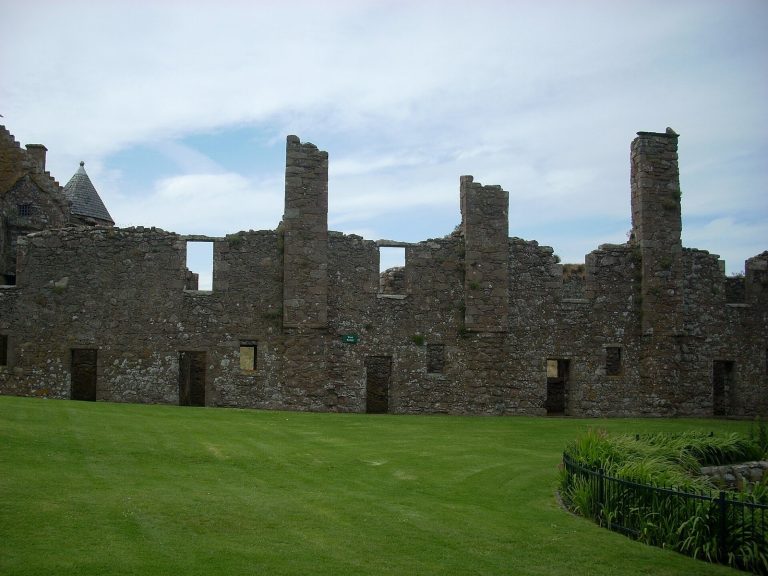
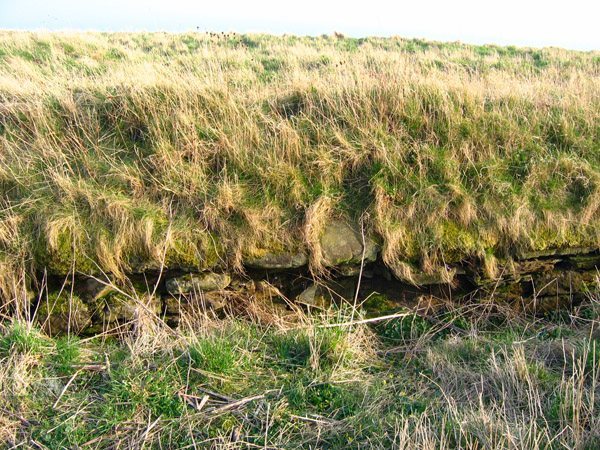
The ruined fortress occupies the northern end of Stonehaven near the North Sea coast. A small section of masonry survives at the site. Cowie Water runs beside it, crossed immediately to the south by Cowie Bridge.
The ruined Chapel of St. Mary and St. Nathalan lies immediately north of the castle site. Iron Age ring cairns, prehistoric circular stone monuments often associated with burial or ritual use, occur in the surrounding area and provide evidence of earlier human activity.