Tatev Monastery: An Armenian Religious and Cultural Center
Site at a Glance
- Popularity
- Very High
- Country
- Armenia
- Primary era
- Medieval
- Eras represented
- Medieval, Early Modern, Modern
- Civilizations
- Armenian, Mongolian, Russian
- Site type
- Religious
- Remains
- Fortified Monastery
On this page21 sections
History
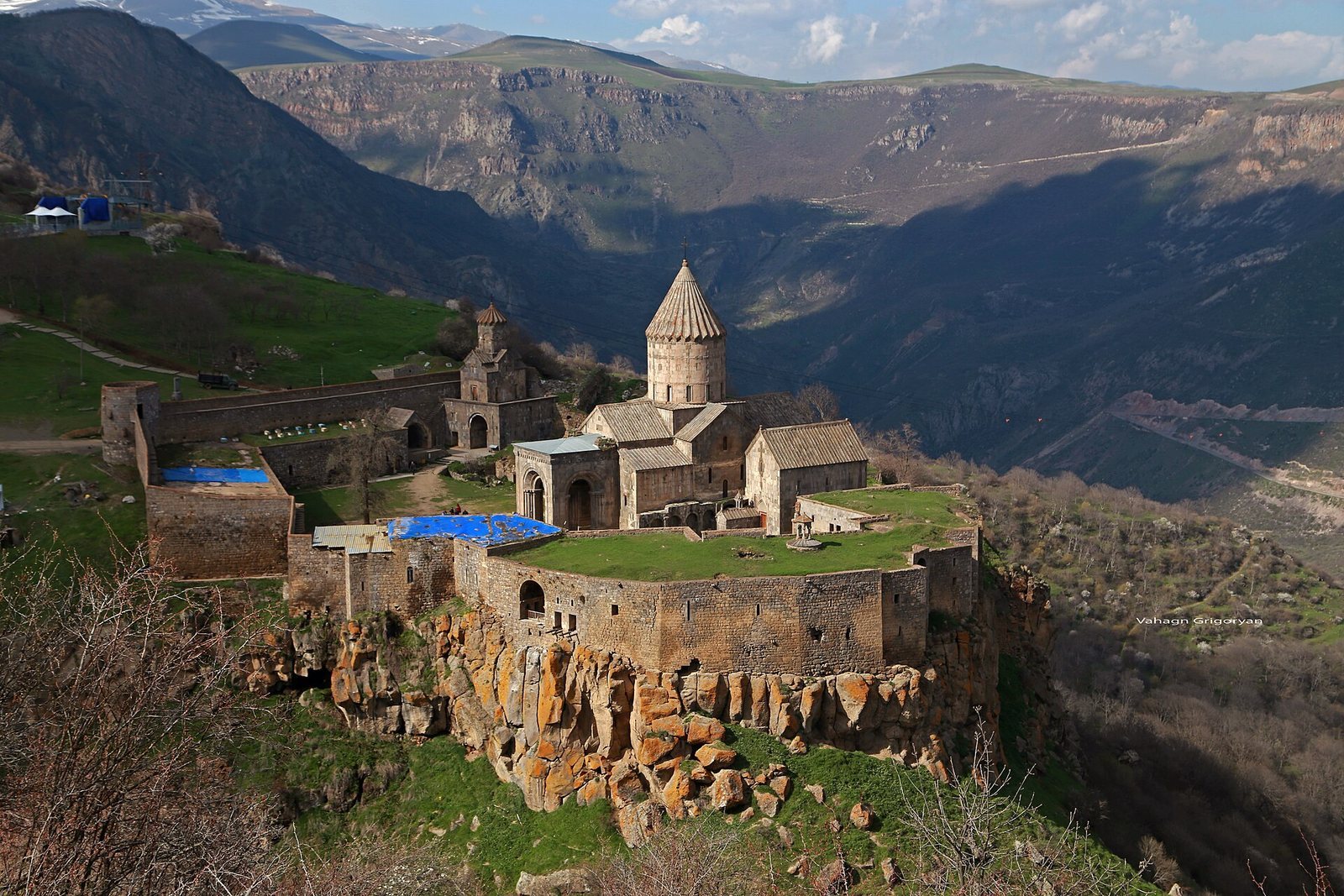
Tatev Monastery is a monastic complex of Armenia’s historic Armenian Apostolic Church in Armenia, on a rocky promontory between the Tatev and Vorotan gorges. Its Christian history reaches back to the fourth century, when a modest church replaced an earlier pagan sanctuary on the Tatev plateau. By the late eighth century, Tatev was the seat of the Syunik bishopric, the territory governed by a bishop, and had become an important religious and cultural center.
Early Christian roots and expansion
Two traditions explain the monastery’s name and early associations. One connects Tatev with Eustateus, a disciple of the apostle Thaddeus said to have been martyred in the area. In this account, Gregory the Illuminator was associated with a fourth-century church at Eustateus’s grave. A separate folk explanation traces the name to a worker’s plea meaning “give me wings” as he fell from a church.
The monastery’s lands and influence grew through grants and purchases. In 839, Bishop David acquired surrounding land from Prince Philip of Syunik, and in 844 he received Tatev village. Prince Hrahat donated another village that year, while Philip commissioned the Church of Saint Gregory the Illuminator in 848. Tatev also gathered sacred objects and relics, including a silver cross containing a piece of the True Cross, made by Vasak, son of Prince Babik. Other holdings were associated with the Virgin Mary, John the Baptist, Stephen the Protomartyr, Gregory the Illuminator, Hripsime, and eleven apostles; the monastery also received the Holy Sign from Byzantium.
At the request of Prince Ashot of Syunik and Princess Shushanik, Bishop Hovhannes began the Church of Saints Paul and Peter in 895. It was completed in 906, and its consecration brought together King Smbat I Bagratuni, Gagik Artsruni, Catholicos John V Draskhanakertsi, Catholicos Simon II of Caucasian Albania, and other religious and noble leaders. A catholicos is the head of an Armenian or related eastern Christian church hierarchy. Tatev received further land and villages on this occasion.
Estate, authority, and unrest
Tatev’s religious role was supported by a large community. In the ninth century it included about 500 people, among them scholars, musicians, painters, and scribes. Its library existed by the tenth century. By the early eleventh century the monastery housed roughly 1,000 monks as well as many artisans, and its estates extended through gifts and acquisitions.
Disputes over monastic authority and land provoked resistance from local peasants. In 915, rebels sacked Tatev and killed some of its monks. Around the turn of the eleventh century, King Vasak of Syunik destroyed Tsouraberd after its inhabitants killed a bishop. These disturbances have also been associated with the Tondrakian movement, an Armenian religious movement condemned as heretical by the Armenian Church.
In the 940s and 950s, Bishop Hakob sought independence from the Armenian Catholicosate. Catholicos Anania I Mokatsi condemned him, while neighboring religious leaders formed separate dioceses and secular rulers took monastic land. Bishop Vahan Syunetsi recovered some of Tatev’s rights and estates after his election in 958. A circular issued in 1006 by Catholicos Sargis I restored the bishopric’s former dioceses.
Attacks and medieval renewal
Forces from neighboring emirates attacked Tatev in 1044, killing monks and plundering the monastery. They burned or damaged Saint Gregory’s Church and nearby buildings. With King Smbat II’s support, Bishop Hovhannes rebuilt the church in 1046 and placed a relic of Gregory the Illuminator in one of its wall supports. An earthquake in the 1130s damaged the dome of Saints Paul and Peter and destroyed Saint Gregory’s Church.
In 1170, Seljuk forces, belonging to a Turkic dynasty that ruled much of West Asia, captured Baghaberd and brought the Syunik kingdom to an end. They looted Tatev’s church treasury and burned about 10,000 manuscripts. The monastery was abandoned, and its leaders relocated to Noravank.
The Orbelian princes began renewing Tatev in 1261. Stepanos Orbelian became metropolitan of Syunik in 1286, a senior bishop overseeing a wider region, and brought several dioceses back under Tatev’s authority. He rebuilt Saint Gregory’s Church in 1295 and completed his history of Syunik at the monastery in 1297. Two large bells were cast for Tatev in 1302 and 1304. Under Mongol rule, the monastery was exempt from taxation and regained economic strength with Orbelian support. Its bishopric held estates and received revenues from villages across 14 districts.
University and later medieval disruption
During the fourteenth century, Tatev became a major center of Armenian culture and established a university with a school of miniature painting. The university flourished in the late fourteenth and early fifteenth centuries under Hovhan Vorotnetsi and Grigor Tatevatsi. Its teaching joined religious study with the humanities, writing and book decoration, and music. Students spent seven to eight years studying subjects that included theology, philosophy, languages, history, mathematics, natural science, astronomy, and architecture. Grigor Tatevatsi revised the curriculum, taught calligraphy, and trained about 60 scribes. The library held more than 10,000 manuscripts.
Tatev’s scholars opposed the Unitores, an Armenian branch of the Dominican order that sought to bring Armenian Christians under Rome. They also supported moving the Armenian Church’s patriarchal seat from Sis to Etchmiadzin, a change made in 1441. Timur’s campaigns in Syunik from 1381 to 1387 brought looting, burning, and the loss of much of Tatev’s land. Shah Rukh’s invasion in 1434 caused further damage. The university and library were plundered in 1434–35 and ceased to function after his invasions. Bishop Shmavon and members of the community moved to Sanahin.
Revival, political change, and restoration
The monastery recovered during the seventeenth and eighteenth centuries. Its bishops regained estates from Persian rulers, including through appeals to Shah Husayn in Isfahan, and undertook extensive repairs. New buildings included a southern gavit, or entrance hall, western monastic cells, a bishop’s residence, living quarters, a refectory, kitchens, a bakery, and an oil mill. The cathedral dome and fortifications were also repaired. An eighteenth-century school continued into the twentieth century.
Tatev and a hermitage in the Vorotan gorge played a strategic part in the Syunik liberation struggle of 1722–30. Persian forces plundered Tatev in 1796 and 1826. After the 1813 Treaty of Gulistan brought much of Syunik under Russian rule, Abbot Bishop Martiros recovered confiscated estates in 1828, renovated the complex, improved the village road, brought water from Kakavasar, and added service buildings.
In the 1830s, Tatev’s metropolitan authority was abolished and Syunik became part of the Diocese of Yerevan. The monastery’s holdings contracted from 70 taxable villages in 1858 to 15 villages and five monks in 1898. Repairs took place in 1862 and 1865. The older entrance hall and bell tower were demolished late in the nineteenth century; a replacement tower was built at the cathedral’s west entrance in the early twentieth century.
During the Zangezur self-defense struggle of 1919–21, led by Garegin Nzhdeh, Tatev hosted Pan-Zangezur congresses in December 1920 and April 1921. They proclaimed Mountainous Armenia and then the Republic of Armenia, in opposition to Soviet Armenia. The 1931 Zangezur earthquake severely damaged the complex, destroying the cathedral dome, bell tower, and several churches. Tatev remained neglected during the Soviet period. From 1974 to 1998, restoration work repaired nearly all the churches, the cathedral dome, residential and service buildings, much of the fortification wall, and the first floor of the bell tower. A revival program established in 2008 led to further work, including restoration of the Church of the Holy Mother of God to its earlier appearance in 2018.
Remains
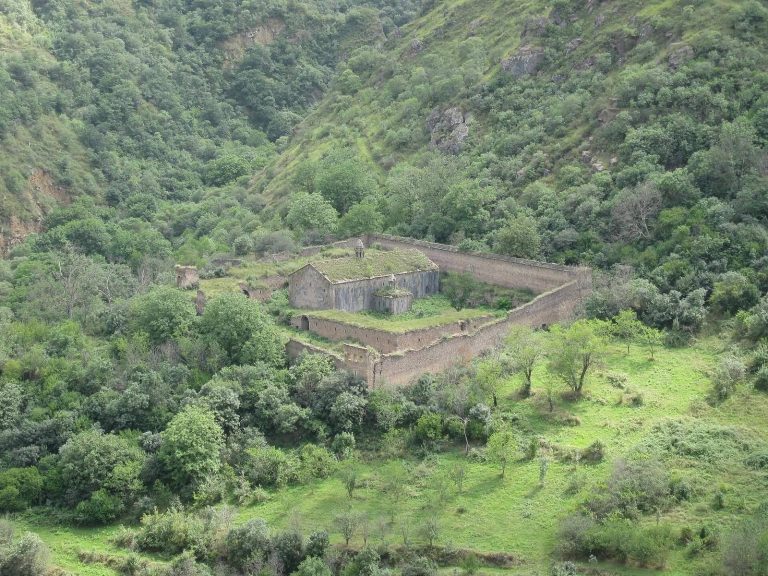
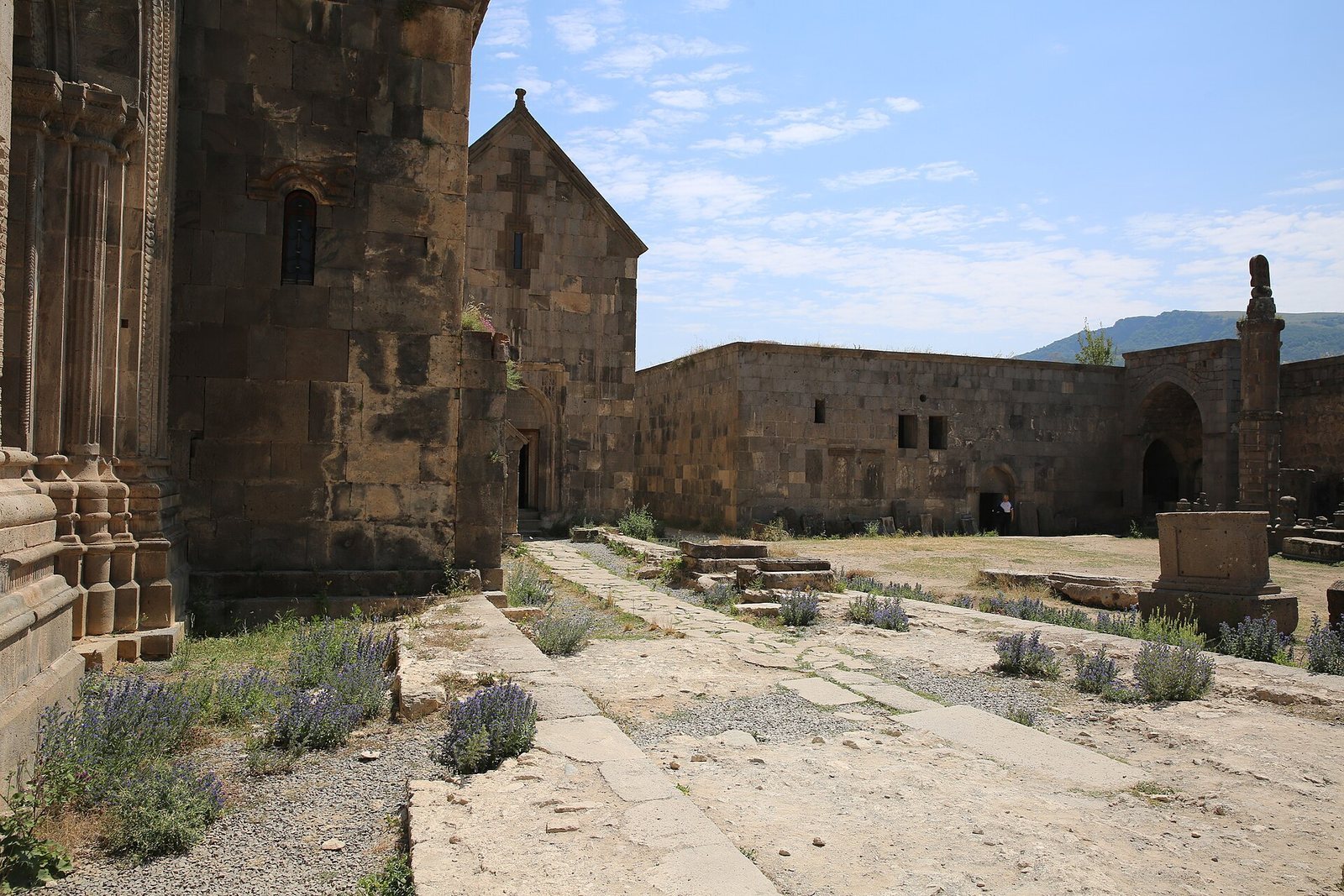
The complex stands on basalt terrain at the edge of a deep ravine, on a roughly triangular promontory between the Tatev and Vorotan gorges. Cliffs around it reach about 700–800 metres. Three churches and a range of monastic buildings occupy the site. Thick defensive walls and towers enclose its other sides, with narrow openings through the fortifications. Retaining walls levelled parts of the steep ground to provide building areas.
Churches
Church of Saints Paul and Peter
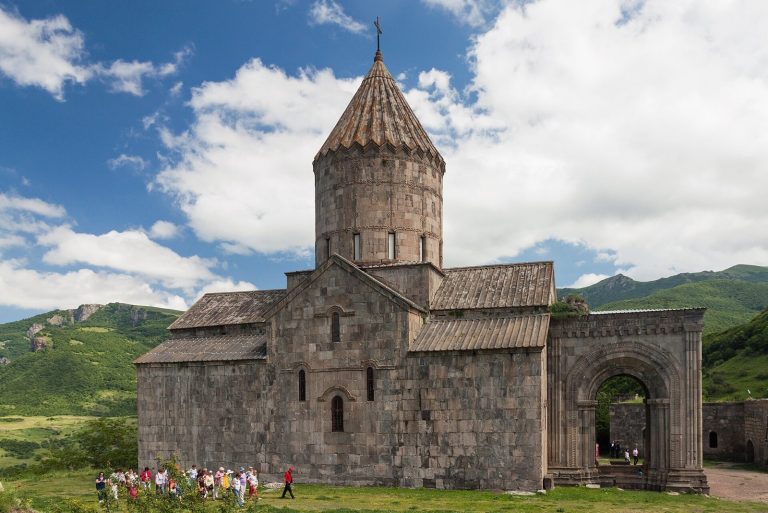
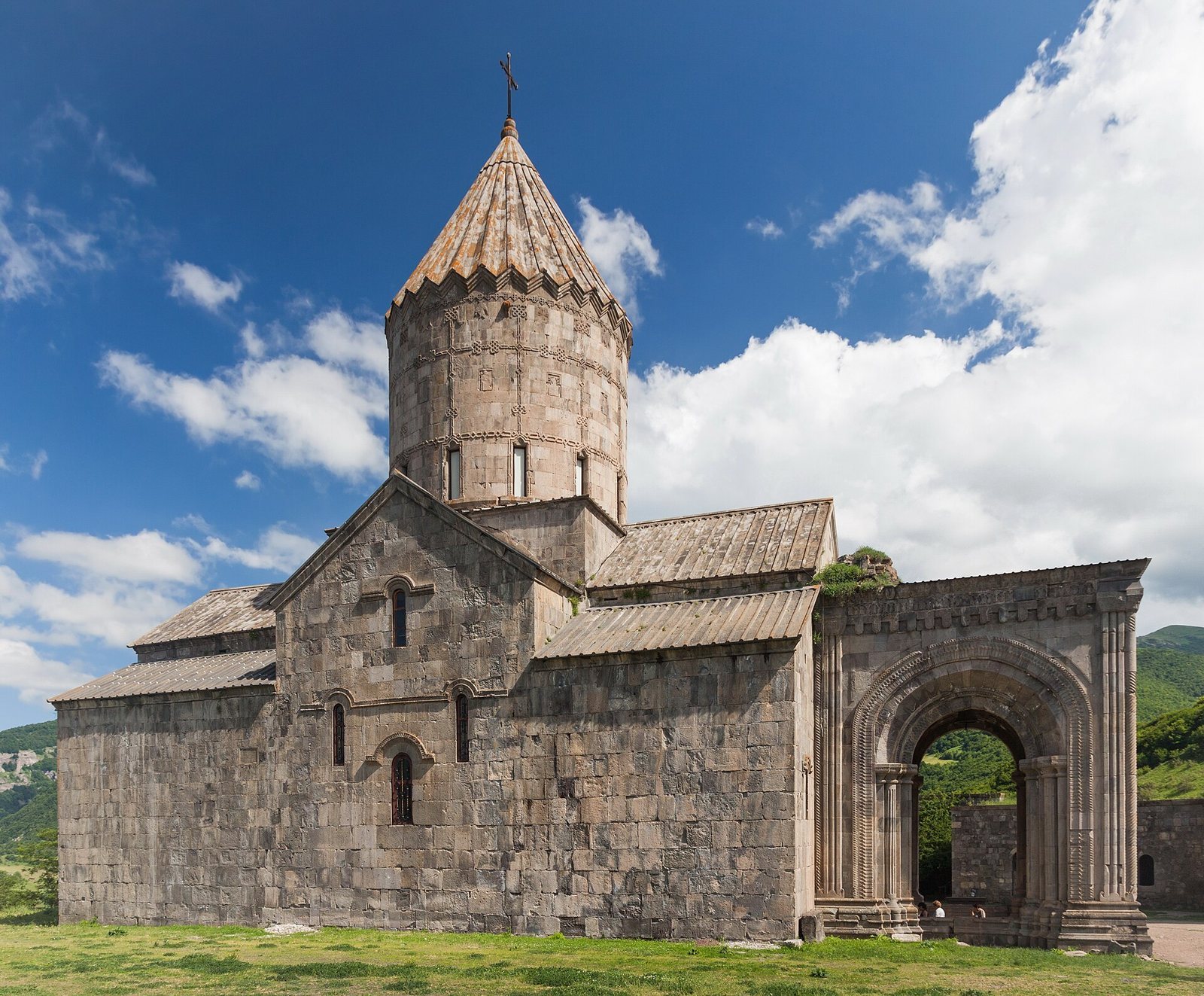
The principal surviving church is a west-to-east rectangular basilica, a long church with a lengthwise plan. Its eastern end forms an apse, the rounded sanctuary end, and two chambers adjoin the main space. Massive masonry piers support the dome, with western annexes providing additional support. The hewn-stone walls and dome have narrow windows, and the roof is arranged in two sloping tiers covered with large tiles.
Deep niches divide the eastern façade. Carved portraits of Prince Ashot and Princess Shushanik sit above them, while serpents and other protective creatures ornament the niche crowns. Bishop Hovhannes’s dedicatory cross-stone remains on the western wall. The church’s frescoes, painted in 930 on a thin plaster coating, used local mineral colors, including lapis lazuli. Artists from Constantinople worked with Armenian painters. Surviving fragments show Christ enthroned with apostles and saints in the apse, and rows of prophets, apostles, and Armenian Church fathers on the curved wall. John the Baptist and the Virgin Mary flank the central window in a Deesis, a composition with Christ at its center. Parts of a Last Judgment and Second Coming scene remain on the west wall, alongside scenes of the infant Jesus’s bathing and the annunciation to shepherds on the north wall.
Church of Saint Gregory the Illuminator
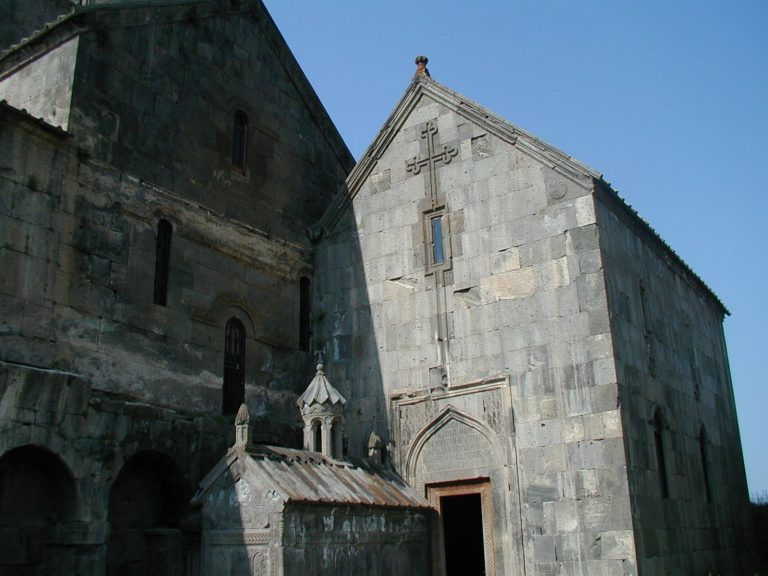
Built between 836 and 848, this church stands beside the south wall of Saints Paul and Peter. Three supports set into each of its north and south walls carry arches beneath a sloping, tiled roof. Geometric carving decorates the entrance. The building was damaged in the eleventh century and reconstructed, and it was destroyed in the earthquake of the 1130s before later rebuilding.
Church of the Holy Mother of God
This small upper-storey church occupies the northern defensive section, above a covered mausoleum near an entrance. A tower rises over its central area, and niches line the interior walls except on the west. The church suffered severe damage in 1931 and was reconstructed in the late twentieth century.
Gavazan column
South of the cathedral stands the Gavazan, an octagonal column of basalt about eight metres tall, topped by a cross-stone. The complete monument reaches roughly nine metres. It dates to 904–06, while the cross-stone placed on top later has no certain date. A jointed base lets the column sway when disturbed and return upright; it has survived repeated earthquakes. Dedicated to the Holy Trinity, it may have served as a warning of earthquakes or approaching armies, though its original purpose remains uncertain. One proposed interpretation is that it began as a pre-Christian cult column and was later adapted to Christian use.
Monastic and service buildings
School building
The former school extended 74.5 metres along the eastern fortification. Its 16 rectangular, vaulted classrooms opened onto a long wooden balcony, and fireplaces heated the rooms. Connected basement chambers had separate doors to the outside. The building was demolished in the early twentieth century, and excavations in 1981–82 exposed its remains. Its layout illustrates the architecture of late-medieval monastic education.
Oil mill and bathhouse
The oil mill lies northeast of the monastery walls and contains four production rooms. One is a domed roasting room with a furnace; another, used for pressing, has a vaulted ceiling. East of the mill, near the gorge slope, a vaulted bathhouse has a changing room, a bathing room, and a heated chamber. The mill was restored in 2010.
Residential and service buildings
The complex also included a library, refectory, mausoleum, bell tower, monastic cells, guesthouse, administrative and residential buildings, kitchens, workshops, and storage rooms. Later additions included a bishop’s residence, more cells and storage space, a refectory, kitchen, bakery, and winery. A vaulted hall once stood before the cathedral’s south entrance. Built in 1043, it was destroyed in the 1931 earthquake. A late-medieval entrance hall on the cathedral’s west side carried a bell tower on its roof. That hall and tower were later demolished; a decorated three-storey tower built at the west entrance in the early twentieth century was also destroyed in 1931.
Memorials and features beyond the main buildings
Eustateus church and Gregory Tatevatsi’s mausoleum
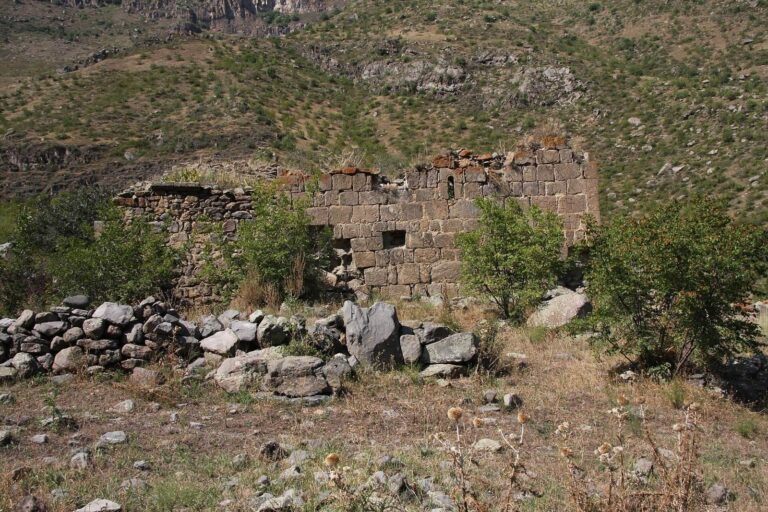
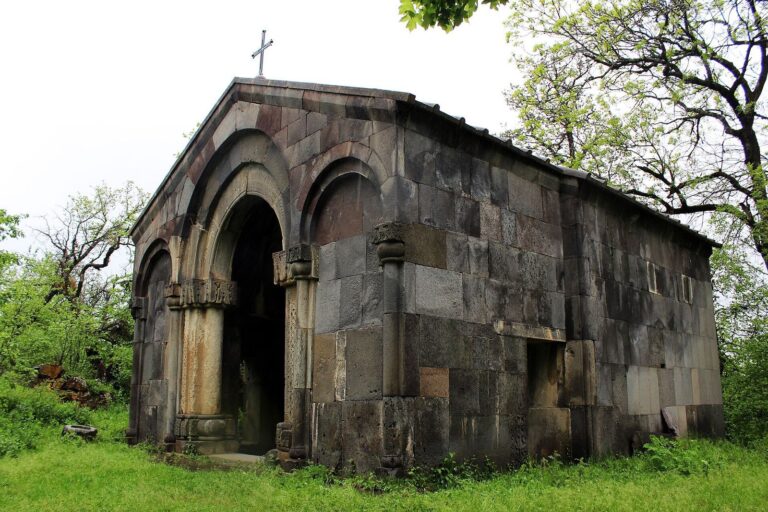
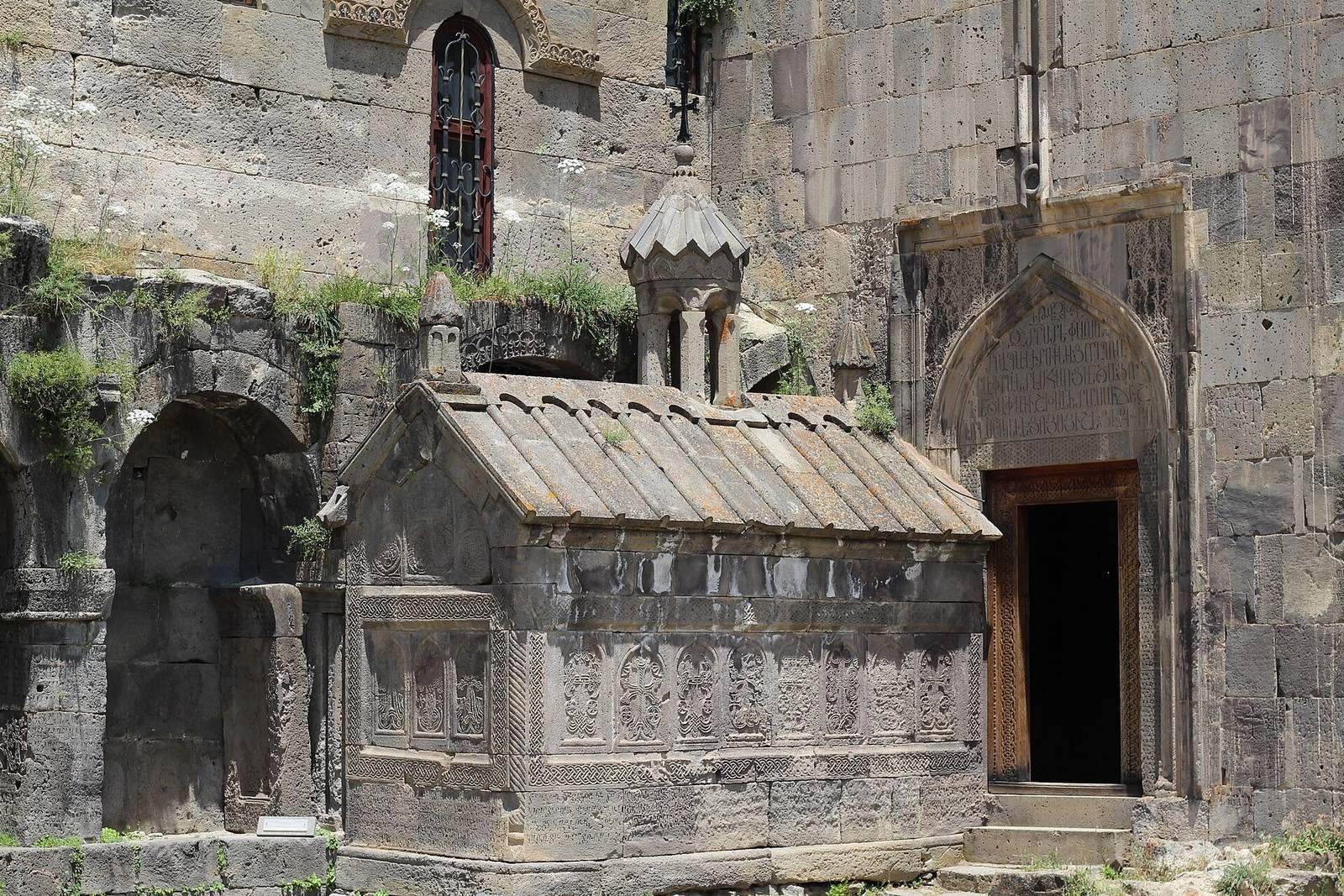
Beyond the fortress walls, not far from the monastery, are the ruins of a church associated with Eustateus’s grave. A mausoleum for Gregory Tatevatsi stands at the cathedral’s south entrance.
Cross-stones
Numerous khachkars, carved Armenian cross-stones, survive in the complex. Some are associated with Abraham, Andreas, Gregory, Lala, Shmavon, and Vasak; another belongs to a winged-cross type.
Hermitage and warning posts
A hermitage in the Vorotan gorge is connected to Tatev by an underground passage. The hermitage was established after Harants Hermitage was destroyed, and the passage was filled with earth and stone after the 1931 earthquake. On the mountain opposite the monastery, the remains of a watchtower are associated with monitoring enemy movements. A warning chain relayed signals from a post at Kornidzor to the bell at Khot and onward to Harsnadzor. Tatev’s bells could be heard as far as 50 kilometres.
Bridge and spring
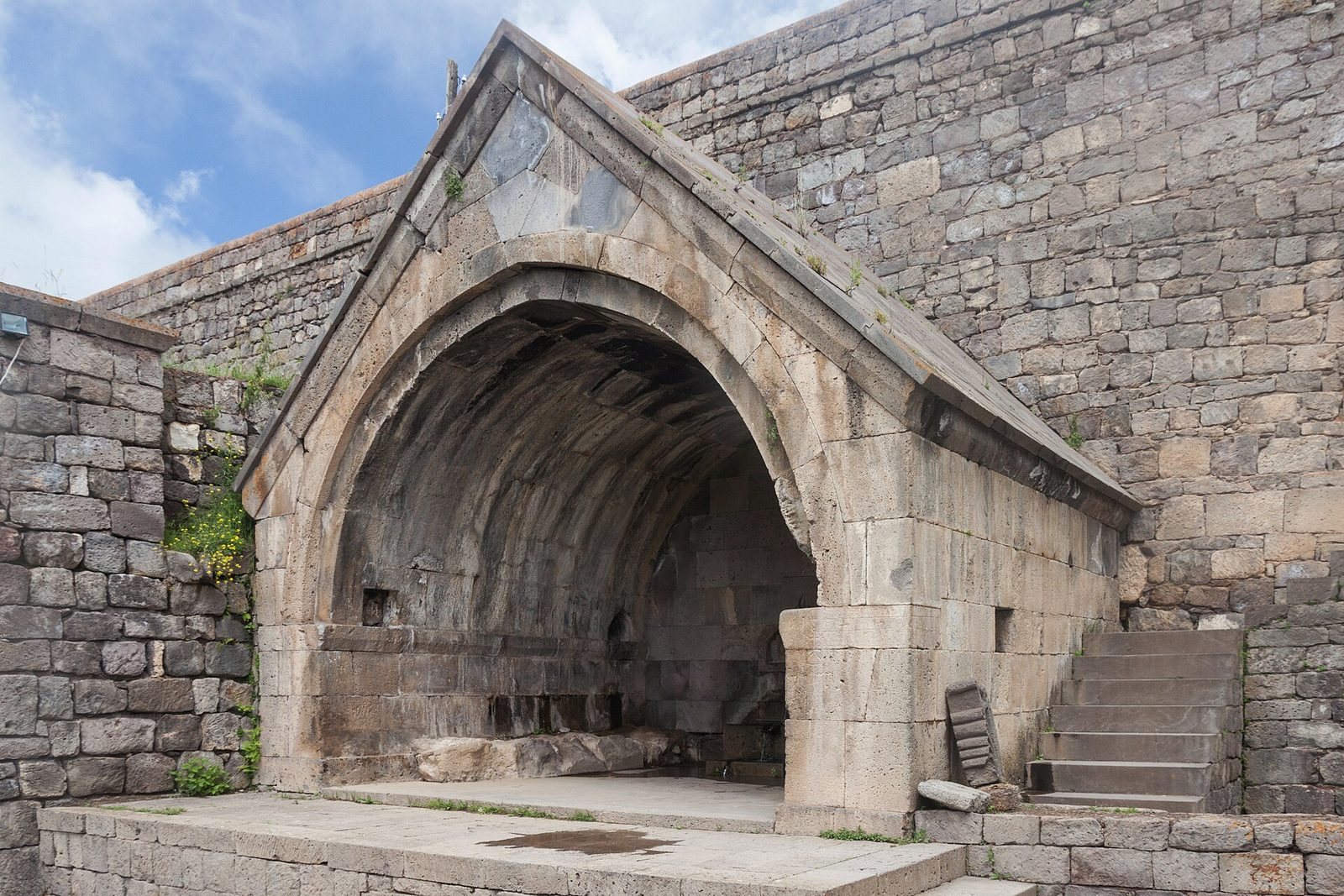
West of the monastery, a single-span bridge crosses a tributary of the Vorotan on the route toward Tandzatap. Its barrel-vaulted span measures 7.2 metres, and an inscription dates the bridge to 1672. A spring building at the southern edge of Tatev village was constructed in 1745. A spring near the monastery’s historic north entrance was returned to its earlier location in 2016.